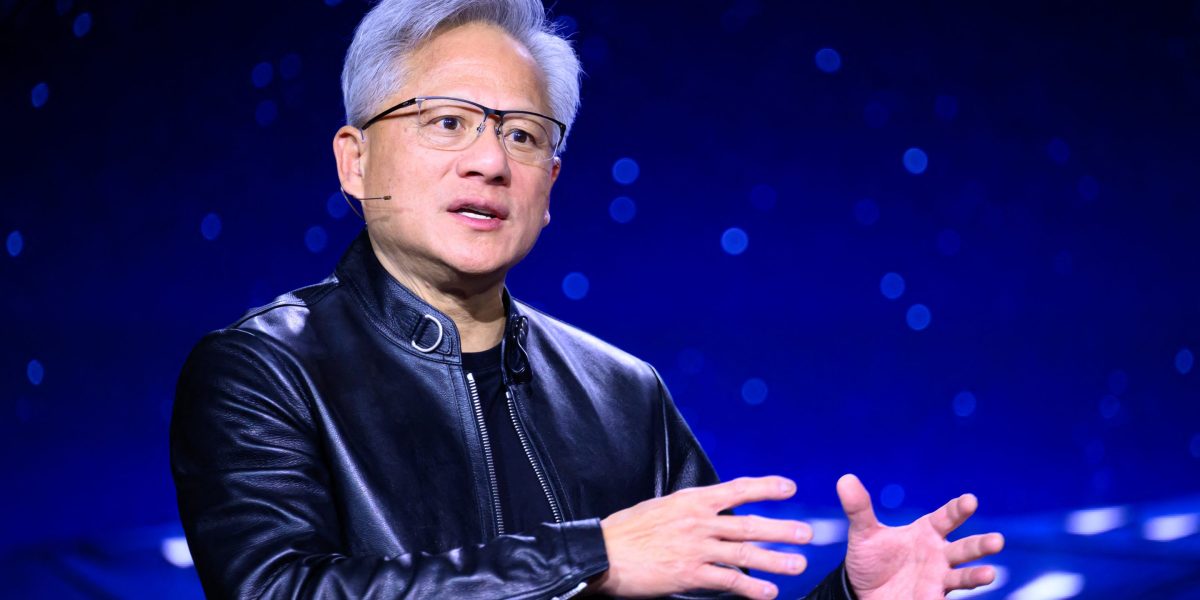
“[What] I want to make sure we all do, is to recognize that people are really worried about their jobs,” Huang recently said on the Lex Fridman Podcast. “I just want to remind them that the purpose of your job, and the tasks and tools that you use to do your job, are related, not the same.”
Workers are understandably stressed over their employers investing billions into AI, as layoffs sweep tech companies, and AI agents are positioned as humans’ new coworkers. Leaders like Google DeepMind’s Demis Hassabis and Uber cofounder Travis Kalanick have even predicted that when artificial general intelligence (AGI) reaches maturity, the tools will be just as capable as people—and Huang said “we’ve already achieved” the feat.
However, Huang’s not convinced that AGI will cause a jobs reckoning, just like previous tech transformations weren’t able to snatch his job.
“I’m the longest-running tech CEO in the world, 34 years,” he continued. “The tools that I’ve used to do my job have changed continuously in the last 34 years, and sometimes quite dramatically.”
The Nvidia CEO’s prime example of AI supercharging jobs: radiologists
Huang explained his reasoning through a job paradox he’s witnessed in the era of AI: the fate of radiologists.
The Nvidia leader said that computer scientists predicted that the first job to be automated by AI would be radiology, since computer vision was going to reach “superhuman levels” thanks to the advanced tech. Around 2020 the tools became that powerful, Huang pointed out, and “every radiology platform and package today is driven by AI”—yet the number of radiologists has grown.
Now, humans can study scans faster, diagnose better, and see more patients, requiring a bigger workforce of people to keep up with soaring demand.
However, that preemptive forecast may have deterred some people from going into radiology, Huang noted, and it’s led to a “shortage” of humans in the field. He highlights it as a prime example of how the narrative went to an extreme—and illuminates the fact that AI is a part of how workers do their jobs, and is not the bottom line.
“The alarmist warning went too far, and it scared people from doing this profession that is so important to society,” Huang said during the podcast. “It did harm.”
The CEOs who say AI will supercharge work, not replace it
Huang has long been outspoken about the ramifications of AI on the workforce, saying that the tools won’t take over jobs in droves. Instead, tech-savvy humans will have the upper-hand on those who resist it.
“Every job will be affected, and immediately. It is unquestionable,” Huang said at the Milken Institute’s Global Conference last year. “You’re not going to lose your job to an AI, but you’re going to lose your job to someone who uses AI.”
And he’s not the only one taking that stance. Airbnb CEO Brian Chesky also predicted that founder-led companies open to change—like the $76.6 billion business he’s helming—will benefit from the AI transformation. Those who snub the technology will be outpaced by those who embrace it.
“From a business standpoint, I think AI is the best thing that ever happened to Airbnb,” Chesky told CNBC in an interview earlier this year, adding that “If you don’t change, you’re going to be disrupted.”
JPMorgan CEO Jamie Dimon has conceded that AI “will eliminate jobs,” but echoing Huang and Chesky, also stressed the importance of humans getting on the AI bandwagon. Just like any other tech transformation, there are sure to be growing pains—but people can better their chances by adding AI to their arsenal.
“I think people should stop sticking their heads in the sand,” Dimon told Fortune last year. “So, use it. Get good at it…Make it part of your tool set and your weapon set.”