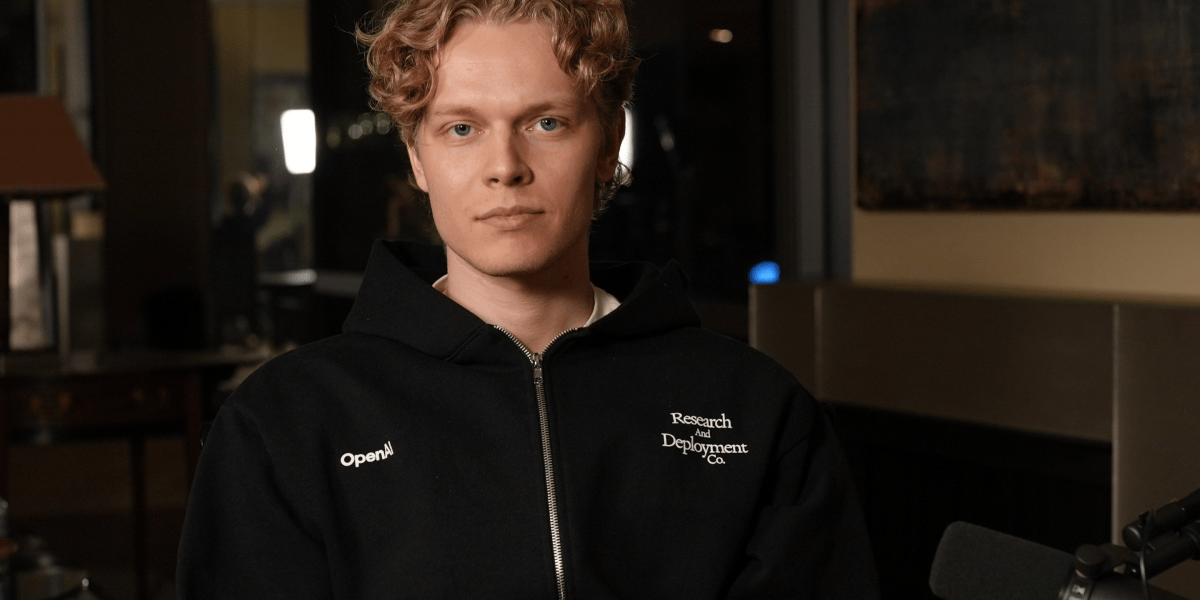
But by high school, growing up in a small Swedish town of about 5,000 people, Petersson found himself less interested in just playing games and more curious in how they worked. That quickly snowballed into a deeper obsession with startups, software, and artificial intelligence—what he saw as the next major technological shift.
Rather than follow a traditional path of finishing high school, studying computer science, and climbing the corporate tech ladder, Petersson opted out entirely. During his senior year, the then 17-year-old dropped out of high school to cofound Depict.ai, an e-commerce data startup, alongside peers who would later go on to roles at companies like Lovable and Lego.
Five years later, that bet has paid off. At 22, Petersson has landed a six-figure salary at ChatGPT parent OpenAI working as a researcher (formally part of the now sun-setting Sora team). And he’s become an unlikely evangelist for a simple idea: the credential gap is closable, if you’re willing to show your work.
How a twentysomething landed a job in Silicon Valley—without a degree to his name
Landing a role at one of Silicon Valley’s most coveted companies without a degree—let alone a high school diploma—requires a different kind of job-seeking strategy. For Petersson, it came down to proving you can do the job before anyone asks for your resume.
After his time at Depict, he joined Y Combinator-backed AI startup Dataland and relocated to New York in 2021. By most measures, things were going well. Then he visited San Francisco.
“I still remember the first week,” Petersson said. “I just couldn’t sleep… you could just go to any place, and people would discuss programming. They would discuss startups. They would talk about all these things that I enjoy talking about…I was just mind blown.”
The trip recalibrated his ambitions entirely. But there was the obvious challenge of how a high school dropout could compete with candidates from Ivy League schools and top engineering programs. His answer was to stop competing on credentials altogether and compete on proof instead.
Rather than submitting applications just through traditional channels, Petersson developed a direct outreach playbook. The format was simple: introduce yourself briefly, express genuine enthusiasm for the company, and—most critically—show them something built for them specifically.
“You can say something like, ‘I was so excited about your company that I’ve been having this side project of building an actual website for what you guys are doing,” he said. “In this way I can prove all these things and not compete with anyone else.”
The strategy helped him land a role at Dataland, and he put it to the test again at Midjourney, an AI research lab based in Silicon Valley. Around that time, he was still striking out through traditional applications, including an early rejection from OpenAI.
So he doubled down on his approach by spending a full week working 16-hour days to build a custom website for Midjourney, then sending over a video demo walking through the code. The effort paid off, and Midjourney hired him as a software engineer in 2023.
“When I make a video demo of a product that I build, I show my understanding, I show that I’m good socially. They can see this person seems reasonable,” Petersson added. “I tick more boxes than I ever could by any proxy.”
The Midjourney role opened the next door. A friend connected him to OpenAI’s research team—the same company that had rejected him a year earlier. This time, he was ready. He landed the role in December 2024. It was a lesson, he said, in the power of trying again for opportunities after you know you can do more.
Gen Z can land their dream job—as long as they have the right mindset, according to Petersson
For Petersson, Midjourney and OpenAI have been more than just jobs—they’ve been confirmation of something he now shares broadly with young people navigating an increasingly credential-obsessed hiring market: elite careers are not reserved for a select few. Even people working at the most powerful companies in the world, he argued, aren’t as unreachable as they seem.
“Anyone can compete if you just put yourself in the right scenarios and the right things,” Petersson said.
Many young professionals fall into the trap of holding themselves back, he added, by staying in roles for too long. Having worked at nearly half a dozen companies before even turning 23, Petersson thinks early careers should be optimized for learning velocity, not stability.
At a moment when many young people are entering the workforce wondering whether AI will simply take the jobs they’re chasing, Petersson is convinced there’s plenty of opportunity for those willing to embrace the technology rather than fear it.
And after working in the tech industry, he pointed out even top minds “don’t have everything figured out.”