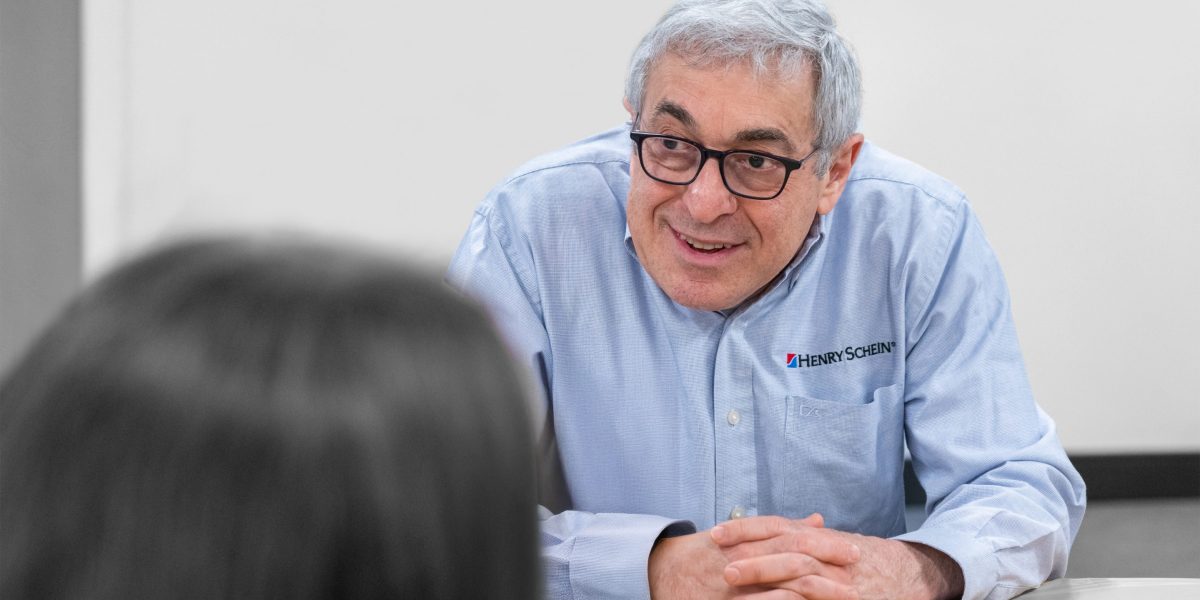
He was 26. He brought with him a philosophy of leadership that would shape his career and his tenure as CEO of Henry Schein, which ended earlier this month after 36 years at the helm. (Fred Lowery became CEO on March 2, with Bergman staying on as chairman.) Bergman took it from a regional dental supplier with $225 million in revenue to a $13.2 billion-a-year global distributor of dental and medical supplies that’s No. 333 on the Fortune 500 list. He credits that growth not only to acquisitions and innovation but also to the values of social impact and philanthropy.
What drew him to to join the Long Island company as CFO in 1980 was seeing how the founders treated their workers.
“They had a belief in aligning business with social values,” he says of the Schein family, who’d started the business in 1932. “It started with Henry. He’d gone to Florida and brought back Smuckers jelly for everyone in the company. There were about 150 people. At Christmas, everybody would get case of wine and at Thanksgiving, they’d get a turkey. His wife Esther did the books. They’d work shoulder-to-shoulder with their people, and they did a lot in philanthropy.”
Henry’s son Jay Schein, who took over as CEO in 1980, built on that ethos in visible and sometimes costly ways. When the HIV/AIDS crisis was taking hold in the 1980s, Jay directed the company to publish an infection control handbook for dentists. They arrived at the 1986 American Dental Association convention with the message to ‘Sterilize as if your life depends on it’ and were asked to leave. “They accused us of hype,” says Bergman. A few years later, dentist David Acer was accused of infecting several patients by disregarding safety protocols as he developed AIDS. Henry Schein was right. And sales went up.
The company Henry Schein joined the Fortune 500 in 2004, debuting at No. 487. It has appeared on Fortune’s World’s Most Admired Companies for 21 consecutive years. As Bergman steps away from the CEO role, Bergman reflected on some lessons:
Choose character qualities over credentials. As a rookie CEO, Bergman got advice from a mentor at Abbott when putting together a team. “He said, ‘Who’s your best people person?’ I said, ‘Jimmy the accountant but he knows nothing about the dental business.’ His response: ‘He’ll learn. He’ll put a team together,’” says Bergman. His deal lawyer became head of strategy, a warehouse manager became head of HR. Bergman hired for values and soft skills, knowing they could build domain knowledge on the job. “It’s all about the teamwork.” In times of rapid change, domain expertise can become outdated in a way that character and an ability to learn does not.
Diversify and delegate. “I always surrounded myself with people who have different opinions. Our CFO is the most conservative person. Our head of strategy is the most liberal person. The success of Henry Schein was to get the two sides to get along,” he said. “The biggest thing is getting the team to work together. I never broke a stalemate. I would encourage this one to talk to that one and resolve the issue and come to me with a plan, saying you never need to get my approval. If you both agree, you can do it.”
Bet on winners and partner to grow. Along with decentralizing distribution centers, Bergman knew he had to go global to grow. He started by simplifying his offering: “There were about 900 dental software systems out there, so we decided to pick one and make that the leader,” he said. Then he expanded through joint ventures, doing dozens of deals with people who knew local markets. “We acquired expertise through joint ventures, kept those entrepreneurs involved, and then built platforms around it.”
Define your business around who you serve. “The only way you can succeed in this environment is not through price, but through value: How do you help a practitioner provide better oral care, and at the same time help them operate a more efficient practice?” said Bergman. The kinds of products they manufacture and services they sell, how that’s delivered, will change as customer needs change. “Henry Schein is not going to be in the business we’re in today.”
Contribute to society. “We have five constituents: the people that give us products, our customers, our team, our investors, and our commitment to society. If you can bring all five together—it’s not easy to get them all aligned all the time—I think it’s a recipe for success,” he says. The last is important for serving the other four. One example: Henry Schein’s ‘Give Kids a Smile’ initiative with the ADA Foundation, started in 2003, brings together 6,500 dentists and 30,000 to provide free oral health screenings to more than 300,000 children annually.
Henry Schein’s sales team sets up the rooms, spend time with dentists, visit dental schools, and build relationships. They partner with more than 100 NGO partners globally around access, policy, innovation, sustainability and empowering Henry Schein’s 25,000+ employees. It helps answer a question Bergman asks his leaders to think about for their teams: “Can they live out their professional dreams in an environment where they feel they’re contributing to society?
Make a clean exit. About 18 months before announcing his retirement, Bergman decided to stop expanding and focus on integrating what existed. “We could have gone on to other legs of the story,” he says. “At one point I said, now let’s stop adding new and let’s take what we’ve got and consolidate it.” He wanted his successor to have the freedom to bring his vision to a business that was operating smoothly instead of integrating acquisitions he might not want or finishing things he didn’t start. And Bergman knew better than to pick a successor himself. “The board conducted an independent process, and we were very fortunate to find Fred, who I’ve referred to as a needle in a haystack,” he said referring to Lowery’s background overseeing Thermo Fisher Scientific’s massive healthcare distribution business. “We’re both in the ice cream business, with different flavors of ice cream.”
And judging from Lowery’s own family foundation and posts over the years, he’s probably aligned when it comes to the philosophy of leadership, too. As Lowery said in a 2020 commencement speech at his alma mater Tennessee Tech University: “Whoever helps the most people wins.”