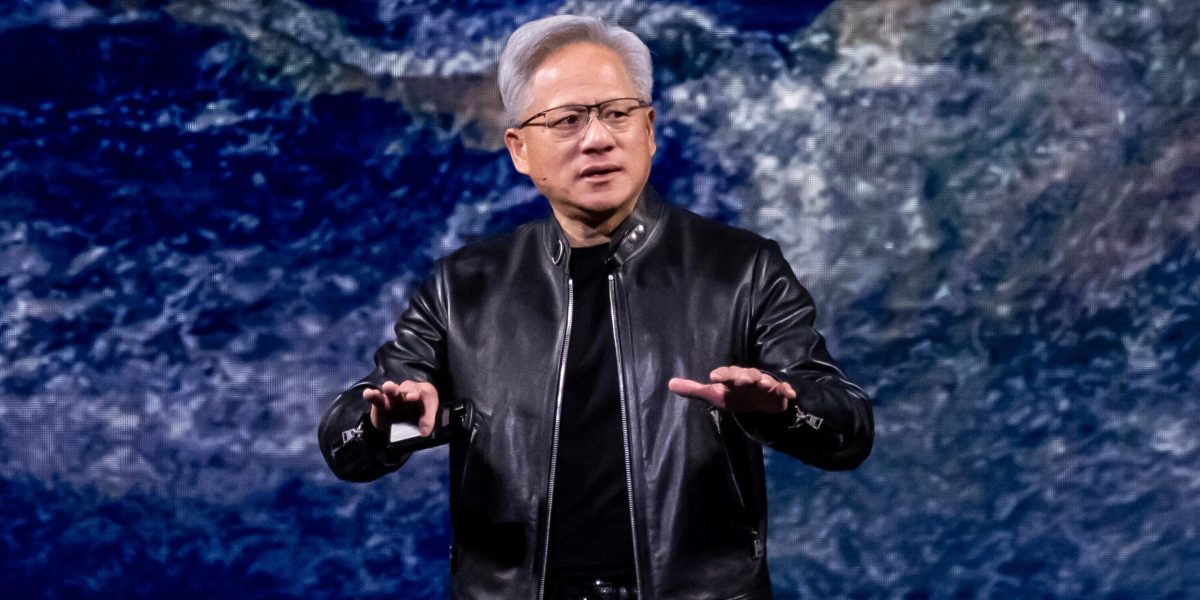
Just a few short years ago, AI was a novel concept generating uncanny, sloppy photos and videos that appeared across your social media feeds. Today, it’s seemingly ubiquitous. New models are popping up almost every month. There’s AI integration in pockets of Hollywood. And even if it’s so far failing to boost your productivity at the office, AI has most likely already appeared in your workplace. That sprawling expansion requires enormous infrastructure investment. And Nvidia CEO Jensen Huang said his company is expecting to deliver those building blocks at a massive scale.
During his keynote address Monday at Nvidia’s GTC conference in San Jose, Huang said the company doubled its demand forecast within the next year. “I see through 2027 at least $1 trillion,” he said. “In fact, we are going to be short. I am certain computing demand will be much higher than that.”
And he’s already preparing for that reality with an unusual incentive to attract top talent and wring more computing power from his workforce: offering engineers AI tokens worth nearly half their salary.
The AI boom is pushing infrastructure investments to new heights. Tech companies are investing a staggering $700 billion into the data center buildout, a sum that rivals the GDP of developed economies like Sweden, and is more than double the total inflation-adjusted cost of the Apollo missions—projects that sent humans to the moon. Nvidia is a critical supplier in that buildout, providing the processors that power AI factories. The $1 trillion demand figure is further proof that the buildout is all gas, no brakes, even as competitors like Advanced Micro Devices (AMD) struggle to close the gap. All of this comes despite looming fears of an AI bubble, as flagged by business leaders like Microsoft CEO Satya Nadella and “Big Short” investor Michael Burry.
Huang made the prediction alongside claims that AI agents could soon run the world, as well as announcements around space-based computing designed to launch AI into orbit, a concept Elon Musk has spotlighted as a potential solution to the energy demands of expanding data centers.
“We are completely resetting and starting the largest buildout of human history,” Huang said. “Most of the world’s industries building AI factories, building chip plants, building computer plants are represented here today.”
The company’s recent earnings reports have added credibility to Huang’s claims. Last month, Nvidia posted $215.9 billion in revenue for fiscal 2026, up 65% from a year ago, the highest annual result ever. Data center revenue alone rose 75% from a year ago, reaching $62.3 billion.
AI tokens: the future of pay?
As business leaders aim to harness AI to boost worker productivity, Huang offered a glimpse at how Nvidia plans to operationalize that ambition: paying engineers in tokens—the currency of AI—to amplify their output.
“I could totally imagine in the future every single engineer in our company will need an annual token budget,” he said. “They’re going to make a few 100,000 a year as their base pay. I’m going to give them probably half of that on top of it as tokens so that they could be amplified 10 times.”
Tokens are the basic units of data or words that AI models use to process language and recognize patterns, making them critical to the future of AI deployment. AI company OpenAI estimates that one token is equal to approximately four characters, with a single one-to-two sentence prompt requiring about 30 tokens. “Fortune Magazine,” for example, may be broken down into five tokens: “For” “tune” “Mag” “az” “ine.”
At the allowance levels Huang described, engineers would have access to billions of tokens annually, unleashing a torrent of compute power. In Huang’s scenario, tokens would be an added employment perk for engineers at his firm, arming them with the power needed to conduct deep research for the company.
The Nvidia CEO said other tech firms will quickly follow suit and use tokens as a recruiting tool to attract top industry talent.
“It is now one of the recruiting tools in Silicon Valley: how many tokens come along with my job,” he said. “The reason for that is very clear because every engineer that has access to tokens will be more productive.”