
Politics
Ken Welch pushes $600M infrastructure bond, vows progress on Gas Plant District during State of the City address
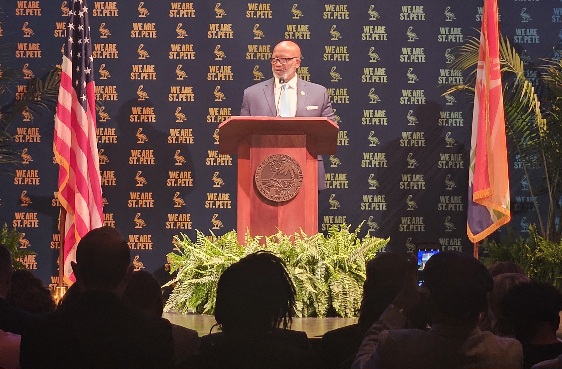
St. Petersburg Mayor Ken Welch outlined an ambitious 2026 agenda centered on a proposed $600 million infrastructure bond and renewed momentum for redevelopment of the Historic Gas Plant District during his State of the City address.
Framing the coming year as a test of resolve in the face of election-year distractions, Welch said the city is preparing to ask voters to approve a general obligation bond to fund approximately $600 million in sewer upgrades, stormwater improvements and neighborhood infrastructure projects.
Welch said the bond would complement projects already accelerated under the city’s St. Pete Agile Resilience Plan (SPAR) and a $160 million federal Community Development Block Grant-Disaster Recovery partnership called “Sunrise St. Pete.”
“The proposed SPAR bond funding will allow us to move forward more rapidly on the infrastructure improvements we need to handle the impacts of sea level rise, extreme weather and flooding that we are experiencing in neighborhoods across the city without relying exclusively on water and sewer rate increases to fund these projects,” Welch said.
Welch also highlighted momentum for Historic Gas Plant District redevelopment plans. He acknowledged the City Council’s recent vote to delay the effort for further consulting, but said “now is not the time to halt the process.”
Welch argued the site has already undergone years of study, citing master planning efforts dating back to 2016 and multiple community engagement processes.
“Planning is, in fact, the only thing we’ve done on that site,” he said.
Welch reiterated what he called the community’s “JHOP” priorities — jobs, housing, economic opportunity and honoring promises made to the historically Black community displaced decades ago.
“Developers are not defining the vision. The people of St. Petersburg already have,” Welch said.
While acknowledging a recent City Council resolution calling for additional planning, Welch said the city will try to incorporate Council concerns without derailing the current proposal review.

The resolution was pushed by City Council member Brandi Gabbard, who has announced intent to run against Welch during the election. Gas Plant District redevelopment has quickly emerged as a point of criticism levied against Welch by Gabbard and other candidates. The election is already drawing a crowded field that could also include Shore Acres Neighborhood Association President Kevin Batdorf and potentially former Gov. Charlie Crist.
“We can address Council concerns … without stopping a process,” he said.
In a press gaggle after the address, Welch elaborated on that approach, saying staff are now meeting with Council members and stakeholders to clarify what additional planning would entail. He added that he hopes a developer selection could occur by Fall, though the timeline is being slowed slightly to account for the Council resolution.
“We want to understand what this additional planning entails and see if we can incorporate that into our review process,” Welch said.
Welch also said the city is in a stronger position now that development rights for the site have returned to St. Petersburg after the termination of prior agreements.
“That land came back to the city of St. Petersburg. We hadn’t held the development rights for 25 years on that land. Now we have the development rights,” he said.
He noted that some of the new proposals include more affordable housing and higher land value than prior concepts, though he declined to discuss specifics while reviews are ongoing.
Beyond the Gas Plant District and infrastructure financing, Welch outlined several other forward-looking priorities that will shape 2026 that include major enterprise projects, technology upgrades and continued housing expansion.
The long-awaited reopening of the Manhattan Casino is anticipated this Summer, marking what Welch described as both a cultural restoration and an economic anchor for the 22nd Street corridor. The city is also advancing redevelopment of the St. Petersburg Municipal Marina, with design-build team interviews underway as part of a long-term modernization plan to strengthen docks, infrastructure and storm resilience.
Welch said the city is also overhauling its internal technology systems through implementation of a new enterprise software suite to replace decades-old platforms that handle everything from utility billing to permitting.
Welch is also pushing in affordable housing efforts. In addition to units already delivered, he said hundreds of workforce and affordable units are currently under construction and expects several projects to come online before the end of the year. Welch also pointed to near-term development parcels within the Gas Plant footprint — including a proposed senior affordable housing site — as opportunities for tangible progress even as broader redevelopment plans move forward.
Welch also recapped past success, framing 2025 as a year of recovery after multiple hurricanes.
He said total crime declined 16% last year and that the city recorded its lowest number of homicides since 1967. The building department processed more than 54,000 permits representing $1.4 billion in construction activity, and the city waived more than $3 million in fees for storm-related permits to speed recovery.
On housing, the city completed 434 multifamily affordable and workforce units, 122 accessory dwelling units and 24 affordable homes in 2025, with hundreds more units currently under construction.
Welch also emphasized investments in public safety alternatives, infrastructure hardening and mental health response systems as examples of how the city is deploying local dollars.
Those spending priorities have drawn recent scrutiny from state officials as lawmakers consider property tax cuts and the Chief Financial Officer has criticized local government budgets.
During the post-speech press conference, Welch said the “least impactful” scenario under current property tax discussions could cost St. Petersburg roughly $20 million.
He also rejected criticism from CFO Blaise Ingoglia over a recent “DOGE” review, arguing it was not a true audit and that funding for increased staffing was misrepresented.
“DOGE was not an audit. It was a way to build a narrative for property tax relief, which is on the agenda of the CFO. But the numbers just don’t add up,” Welch said.
He said most city property tax revenue funds core services like police and fire and that several staffing positions cited by state officials are funded through enterprise fees and utility rates, not property taxes.
Welch defended discretionary programs such as the city’s Community Assistance and Life Liaison (CALL) program, which diverts certain nonviolent calls away from police to mental health professionals.
“Twenty-five thousand calls have gone to CALL without a single incident,” Welch said. “That costs $2 million a year. That’s the kind of discretionary spending that we do, and we stand by all of our spending in the budget.”
He said St. Petersburg’s budget process is among the most transparent in the state and warned that significant reductions in property tax revenue could directly impact police, fire and other essential services.
Throughout both the address and the press conference, Welch returned to a theme of focus despite competing pressures — from hurricanes to state politics to a looming mayoral election.
“It’s not just a redevelopment project,” Welch said of the Gas Plant District. “It is a test of whether we’ll keep our promises, whether we are distracted by election-year politics and political agendas, or … whether we have the political will to do the right thing.”
As 2026 approaches, Welch framed the city’s path as one of discipline and forward motion — not delay.
“The state of our city is strong, our future is bright, because we are St. Pete,” he said.