
Business
Exclusive: Crypto venture firm Dragonfly closes $650 million fund—even as VCs face ‘mass extinction’
When Rob Hadick signed the paperwork to join Dragonfly Capital in April 2022, he rented a house in the Hamptons. A contract with his former employer, the hedge fund GoldenTree, obliged him to refrain from working for six months, so Hadick prepared to lean into forced leisure time in the country. His plans for a relaxed stay soon came undone.
Shortly after his arrival, the crypto market went into a freefall following the implosion of a notorious stablecoin project called Terra Luna. Hadick remembers scrolling through Twitter as the contagion spread. His wife called to ask if he was relaxing. “I don’t think you understand what’s happening to our net worth,” he responded. “I am drinking whiskey in a dark room at 2 p.m. on a Tuesday.”
His exile finally ended in November—right in time for a second crypto calamity in the form of FTX’s collapse. But Hadick never rethought his decision to go all in on crypto. “I was scared about what was happening to the industry,” he recently told Fortune from Dragonfly’s offices near New York City’s Union Square. “But I was excited about the opportunity we had, because we [still] had $500 million to deploy.”
That fund, Dragonfly’s third, ended up catapulting the firm into the upper echelon of the crypto venture world, competing with the likes of Andreessen Horowitz and Paradigm thanks to its prescient bets on now massive startups including Polymarket, Rain, and Ethena. Now, as crypto enters yet another winter, with token prices plummeting and excitement washed out by AI hype, Dragonfly is announcing its fourth fund, a $650 million vehicle.
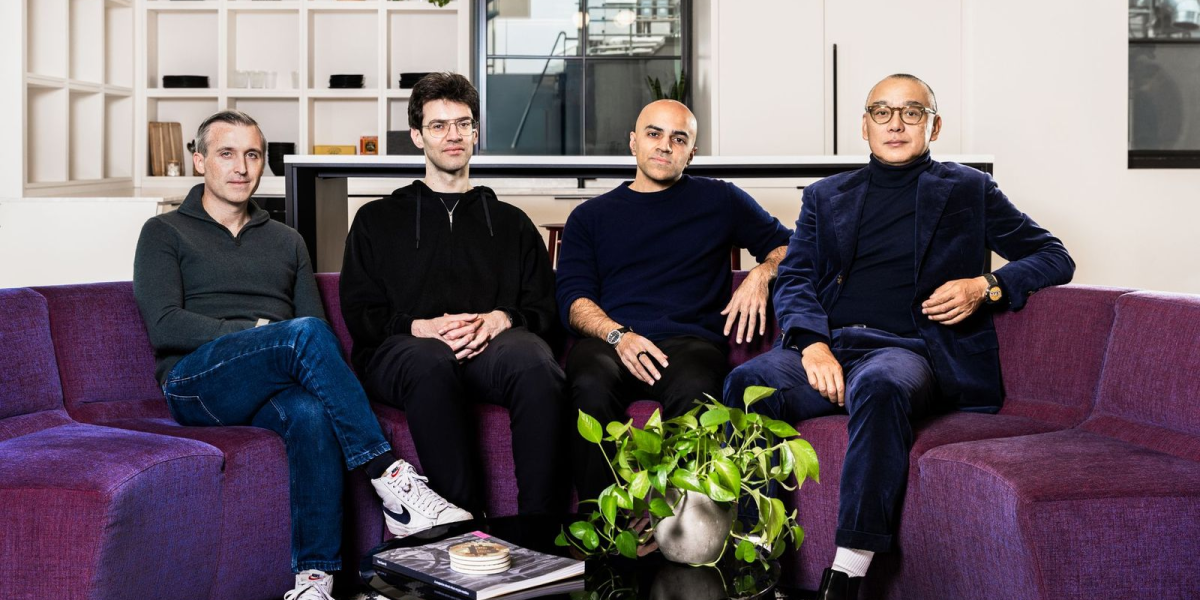
The crypto venture ecosystem is going through a “mass extinction event,” as Hadick put it, but Dragonfly has thrived despite a founder breakup, a regulatory scare from the Department of Justice, and a pivot away from China amid a crypto crackdown. At the core of Dragonfly’s strategy are its four symbiotic leaders: Hadick, the fintech bridge; Haseeb Qureshi, the ambassador; Tom Schmidt, the DeFi whiz; and Bo Feng, the firm’s mysterious founder and an icon of the Chinese tech scene. “It’s bizarre to see us now become one of the incumbents,” said Qureshi. “We’re playing a bigger game than we were playing in the past.”
Origin story
Qureshi started playing poker professionally at 16 years old, mostly sticking to online games because he wasn’t allowed in casinos. By the time he was 21, Qureshi had raked in almost $2 million, but he realized that he didn’t want to make the game his life. He made a bet with a friend that if he ever played another hand of professional poker, Qureshi would have to pay him $100,000. “That was my way of sealing off the decision for myself,” he told Fortune.
Qureshi says that his early years at the digital card table prepared him for a pivot into crypto investing. Just as friends told him he was crazy for becoming a teenage poker shark, his decision to join the crypto industry elicited widespread doubt, not least because Qureshi had made a name for himself as a Silicon Valley software engineer. He left a lucrative job at Airbnb to go start a stablecoin startup in 2017, long before stablecoins were all the rage, eventually finding his way to a (then) $500 million venture fund called MetaStable.
Today, Qureshi is arguably the public face of Dragonfly, thanks to his role on the popular Chopping Block podcast—the crypto version of All-In—and viral posts on Crypto Twitter about the failure of Web3 gaming or the efficacy of blockchain launches. But Qureshi didn’t start at Dragonfly until a few months after it began, joining in 2019 as the crypto industry was stuck in one of its regular prolonged downturns.
That early Dragonfly is unrecognizable from its current form. The firm began as a partnership between Alex Pack, a young VC leading crypto deals at Bain Capital Ventures, and Bo Feng, who had made a name as one of the top investors in China’s burgeoning internet ecosystem. Feng, who declined to be interviewed for this story, is reported to have connections to China’s political elite, forged in part by his marriage to a granddaughter of Deng Xiaoping, who came to power after Mao Zedong’s death.
Through his firm Ceyuan Ventures, Feng had invested in the crypto exchange OKEx (later rebranded to OKX), which in 2018 was the largest exchange in the world. He joined forces with Pack to make bets both in the U.S. and Asia. According to an early article in Bitcoin Magazine, Dragonfly’s first $100 million fund was backed by some of the largest names in Asian tech, including Sequoia China’s Neil Shen. (Beyond Feng’s role as a bridge to the region’s financial powerhouses, Qureshi described him as a “relationship savant,” though he keeps a low public profile.)
Dragonfly built its reputation with investments into crypto companies like the exchange Bybit and the financial services firm Matrixport, as well as investing into other crypto venture firms as a fund of funds. According to Qureshi, when he came onboard, he presented three conditions: He wanted to stop doing fund investments, he wanted to lead more deals, and he wanted to build out a technical team. “Bo basically said yes to all three,” Qureshi said. “In his words, he threw the car keys to me…and that was the birth of modern Dragonfly.” One of Qureshi’s first moves was to bring on Schmidt, then the head of product at a decentralized exchange called 0x, as a junior investor. (Schmidt quickly rose the ranks to general partner.)
The split between Pack, who went on to start his own venture firm Hack VC, and Dragonfly is the stuff of crypto VC lore, though Qureshi downplays the drama. “It ultimately led to us just having totally different visions for what fund two and beyond was supposed to look like for Dragonfly,” he said. Pack told Fortune that his first fund with Feng was a “tremendous success,” but realized they were “very different culturally.”
“I spent a few months helping to hire and train my replacements, and then we parted ways,” he said. Schmidt used more colorful language to describe Pack, attributing the schism to personality.
By 2020, when Pack left the firm, Dragonfly had bigger problems. In large part due to Feng, the firm had its back office team in Beijing. But the Chinese government had begun to crack down on crypto, forcing Dragonfly to pick up its Asia operations and move to Singapore. According to Schmidt, who speaks Chinese and had chosen to intern at a Chinese company during college instead of accepting an early offer from Coinbase, Dragonfly still maintains a strong Asia presence, though its investments in the region have gone down over the years. “You look at the user base of a lot of these chains and [decentralized exchanges], and they’re obviously very Asia-based,” he told Fortune, “But in terms of new investment opportunities, there haven’t been as many as there used to be.”
Still, the firm’s presence in the U.S. crypto scene grew. There were bigger players raising monster funds, including Paradigm and Haun Ventures, which each had vehicles over $1 billion, compared to Dragonfly’s comparatively modest second fund of $225 million closed in late 2020. Still, Dragonfly backed winners such as the layer-1 blockchain Avalanche and the financial services firm Amber Group, as well as an investment into the controversial privacy protocol Tornado Cash, which allows users to anonymize crypto transactions. The latter landed Dragonfly in national headlines in 2025 after prosecutors let slip that Schmidt might face criminal charges for the investment as part of a broader money laundering case. (The Department of Justice quickly backtracked, earning the firm a badge of honor among crypto true believers, though Qureshi said the investment was never ideological.)
Hadick’s arrival amid the existential collapse of FTX, however, catapulted Dragonfly to the next echelon—and solidified the firm’s identity.
The new era
During the crypto boom of 2021, entrepreneurs put forth lofty schemes to remake the internet with decentralized plumbing. Those included building would-be alternatives to the likes of Twitter and Spotify. For crypto investors, these plans revolved around so-called token mechanisms, with venture firms receiving rights to own proprietary cryptocurrencies in lieu of traditional equity stakes.
That Web3 vision of the future never fully played out. Even before the collapse of FTX, crypto was headed in one direction: Wall Street. Bitcoin had started out as a form of electronic cash, and then Ethereum built the next layer by allowing developers to code decentralized financial applications for lending and trading. But investors like Hadick, who came from the world of traditional finance, believed that crypto would soon swallow all of the functions of banks and brokerage firms. “We knew that that was the one place where we needed somebody who was deeper than we were,” Qureshi said. “Rob was just the person that we all intellectually felt had the horsepower, the coverage and the experience to play that role.”
When Hadick joined, Dragonfly began to make investments into the kinds of companies that now define the crypto landscape. One, Ethena, was building a synthetic dollar that generated yield through a complicated hedge fund-like strategy on the back end. Though Ethena has since become one of the most prominent projects in the crowded field of stablecoins, when founder Guy Young pitched the idea to investors, most of them dismissed the idea as “insane,” as he put it. The skeptics cited the Terra Luna debacle, which nearly took down the entire crypto industry after the algorithmic-backed stablecoin failed to maintain a $1 peg. “It’s actually offensive that you’re even saying this after what just happened,” Young remembered investors telling him.
This was still the middle of the bear market of 2023, and Dragonfly jumped at the opportunity. “They were able to look at it from first principles,” Young said. The firm led Ethena’s $6 million seed round. Just over a year ago, Ethena raised a $100 million round, with investors including Franklin Templeton and Fidelity’s venture arm. Today, its flagship stablecoin has a market capitalization of around $6.3 billion.
The next year, Dragonfly backed the Series B funding round for Polymarket, which the firm had almost invested in years before. According to Qureshi, Dragonfly was nearly the first investor into Polymarket’s seed round back in 2020, when Shayne Coplan was striking out with most of the VCs he was pitching. “We really loved him,” Qureshi said, even though prediction markets hadn’t yet proven successful at the time. Polychain ended up offering a better term sheet, which Dragonfly decided not to match. “It was obviously a massive miss on our part, but we had the right idea,” Qureshi said.
The rest of the crypto industry eventually came onboard with the idea that the most successful digital asset companies wouldn’t be blockchain-based mobile games, but relatively boring versions of financial products like credit cards and money market funds. Even Chris Dixon, the a16z partner who championed the Web3 principles of “read write own,” recently wrote a post on X arguing that we are now in the “financial era of blockchains.”
“This is the biggest meta shift I can feel in my entire time in the industry,” Schmidt said, adding that investors are realizing there will be fewer native tokens for different crypto protocols, and more tokens that represent a real world asset like stocks and private credit funds. “A lot of crypto funds are now saying, ‘Hey, we’re fintech funds,’” Hadick said. “Which is what I think we do better than anybody.”
The increasing integration of blockchain and the finance industry raises uncomfortable questions of whether crypto is betraying its founding ideals, which saw Bitcoin as a rebellion against the big bank and government control of the financial system.
“I do always try not to lose sight of the bigger picture, which is we made this digital internet money [go] from zero to a trillion dollars in 10 years,” said Schmidt. “The job is obviously not done, and if anything when I look globally, I think that the need for this stuff is more in demand than ever.”
Nearly four years after Hadick joined, the crypto venture sector is stuck in another identity crisis, with deals falling and funds struggling to convince backers to refill their coffers. But with its fresh war chest, Dragonfly is ready to shape the next blockchain era. “We talk out loud and we say what we think,” said Qureshi. “In a space that is just completely flooded with bullshit and with fakers and self-promoters, I think that has actually been a superpower.”