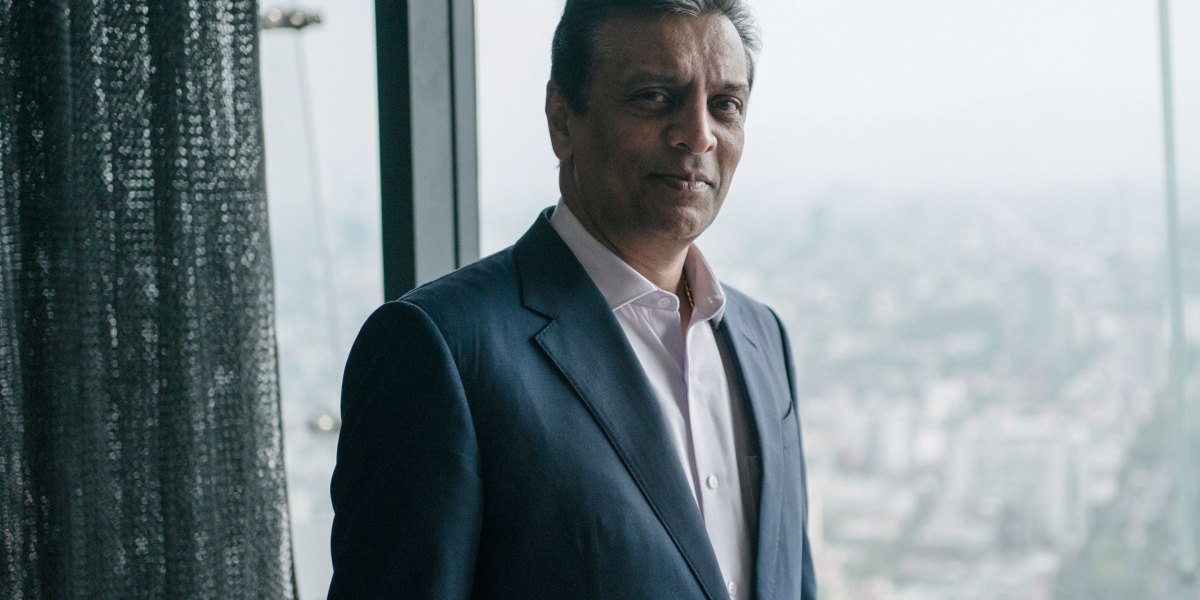
FedEx CEO Raj Subramaniam graduated from Syracuse and the University of Texas at Austin. But he also attended what he calls “CEO school,” taught by Fred Smith, FedEx’s founder and first CEO. Subramaniam is its second; he took over the company in 2022.
Decades of experience informed Smith’s CEO school curriculum. He first conceived of a system for urgent, overnight deliveries in an economics paper at Yale. Smith ran with the idea, launching Federal Express in 1971, and growing it into a global logistics giant with $90.1 billion in revenue in the past 12 months.
In his first three years as CEO, Subramaniam operated with Smith as executive chairman, but Smith died in June at age 80, leaving Subramaniam without his mentor—and FedEx without its founder—for the first time.
Part of Smith’s legacy is FedEx, now a Fortune Global 500 company that moves about $2 trillion worth of commerce every year; handles 17 million packages a day; and operates 400 daily flights from hubs like Memphis, Guangzhou, Singapore, Paris, and Dubai. But it’s also the big lesson he taught Subramaniam, which the CEO drew on last year when the Trump administration’s global tariffs threatened FedEx’s core business of moving goods around the globe. “One thing that Fred taught me…is that change is part of our culture,” Subramaniam recalls. “He always used to say: ‘If you don’t like change, you will hate extinction.’”
The biggest change of Subramaniam’s CEO tenure was the day those tariffs hit, April 2, 2025, or “Liberation Day” as the White House deemed it. Trump imposed a minimum 10% tariff on imported goods and “reciprocal” tariffs of up to 50% on goods from countries that had a large trade surplus with the U.S., like China. FedEx shares plunged 20% in the immediate aftermath. Since then, tariff levels on individual markets have swung wildly as Trump has granted exemptions, slapped further taxes on countries, and signed trade agreements. The average U.S. tariff rate is currently around 17%, up from 10% before April 2025.
“It’s a dynamic environment. We just have to live with that,” Subramaniam told analysts in June. In September, FedEx forecast that tariffs would lead to a $1 billion hit to operating profits for the current fiscal year, which ends May 31.
Shares have recovered from the initial shock, rising more than 50% from April lows, as FedEx adapts to new trading relationships that skirt U.S. levies. (Shares ended 2025 up 3%, behind the broader S&P 500’s 16% growth.)
“There’s an element of re-globalization going on,” Subramaniam says. “The China-U.S. lane is coming down, while Chinese trade to the rest of Asia is going up. You can even see Asia– Latin America trade going up. The mix of trade is evolving as we speak.”
The McKinsey Global Institute estimates that up to one‑third of global trade flows could be reconfigured by 2035, with trade between China and emerging markets, and among emerging economies themselves, remaining relatively resilient even under a scenario where China and advanced economies decouple. New trade corridors linking Asia with other major economies are poised to benefit from the diversion of goods.
Subramaniam says he’s paying close attention to Asian markets like Vietnam, Malaysia, Thailand, and India as bright spots, as exporters serve both U.S. consumers and other emerging markets.
“One thing that [FedEx founder Fred Smith] taught me… is that change is part of our culture. He always used to say: ‘If you don’t like change, you will hate extinction.’”
What Subramaniam learned from his mentor
This year, FedEx launched nonstop cargo flights between Guangzhou and the Malaysian state of Penang, a hub for semiconductor manufacturing. It has also pledged to build a 100,000-squarefoot logistics center, costing about $11 million, at Penang’s airport. Other new or increased routes include those between Guangzhou and Bangkok, Paris and Guangzhou, Seoul and Hanoi, and Seoul and Taipei. It is opening new facilities in Thailand’s Laem Chabang and Indonesia’s Bali, and signed an agreement to help buzzy K-beauty retailer Olive Young with its global expansion.
The U.S. isn’t getting left out. The consumer there “is the largest economic force on this planet,” Subramaniam says, noting FedEx’s new nonstop flight from Singapore to FedEx’s hub in Anchorage, the only such cargo connection from the Southeast Asian country to the continental U.S.
Smith “was an empire builder, and a proponent of making the company bigger and bigger,” says Bruce Chan, a logistics analyst at Stifel. “With investor pressure, and the changing global environment, Raj’s focus has to shift from that quite a bit.” Subramaniam is undertaking a big cost-cutting program, combining FedEx’s ground and air networks, and spinning off FedEx Freight.
Still, the CEO is confident about the demand for FedEx’s bread-and-butter operations. “People want to trade and travel,” he says. “I don’t think there’s any going back.”
Company revenue between March and November—the period surrounding Liberation Day—rose by 3.3% year on year, reaching $67.9 billion. Profits also rose 14% to reach $3.4 billion, beating expectations as the companywide cost-cutting effort seemed to bear fruit.
FedEx’s global expansion is in “early innings,” Chan says. Most of FedEx’s capacity and customers remain in the U.S., unlike, say, Germany’s DHL, whose shares are up 40% in the past year. “It’s going to take a very long time for FedEx to permanently pivot their focus to other geographies,” he says.
Subramaniam, 58, ended up working at FedEx by a stroke of luck that no CEO could easily replicate. The native of Thiruvananthapuram, a coastal city in southern India, elected to head to the U.S. for graduate studies in engineering and business. When his roommate ditched a job interview with FedEx, Subramaniam, needing a green card to remain in the U.S., showed up instead.
“When I walked into the interview, I told them upfront that I didn’t have a green card. I asked if that would be an issue. They said, ‘Son, let’s get through the interview first, then we can discuss a green card,’” he recalled in a 2023 interview with the Horatio Alger Association. Subramaniam got a job as an associate analyst, based in Memphis; FedEx is the only company he’s ever worked for.
In turning to a FedEx lifer as CEO, the logistics firm joins the likes of Costco, Target, Walmart, and Nike, which have all recently chosen chief executives with decades-long company tenures.
Subramaniam says his 30 years at FedEx give him a “natural advantage” as CEO. “A lot of people ask me how difficult it is to manage people in different parts of the world, with different cultures,” he says. “The language of the country may be different, but the language of FedEx is the same.
“It’s very difficult for someone to parachute in from outside and figure it out,” he notes. And that person, of course, would not have learned the ropes from the man who built FedEx into what it is today
This article appears in the February/March 2026: Asia issue of Fortune with the headline “How FedEx CEO Raj Subramaniam is adapting to the era of ‘re-globalization’”