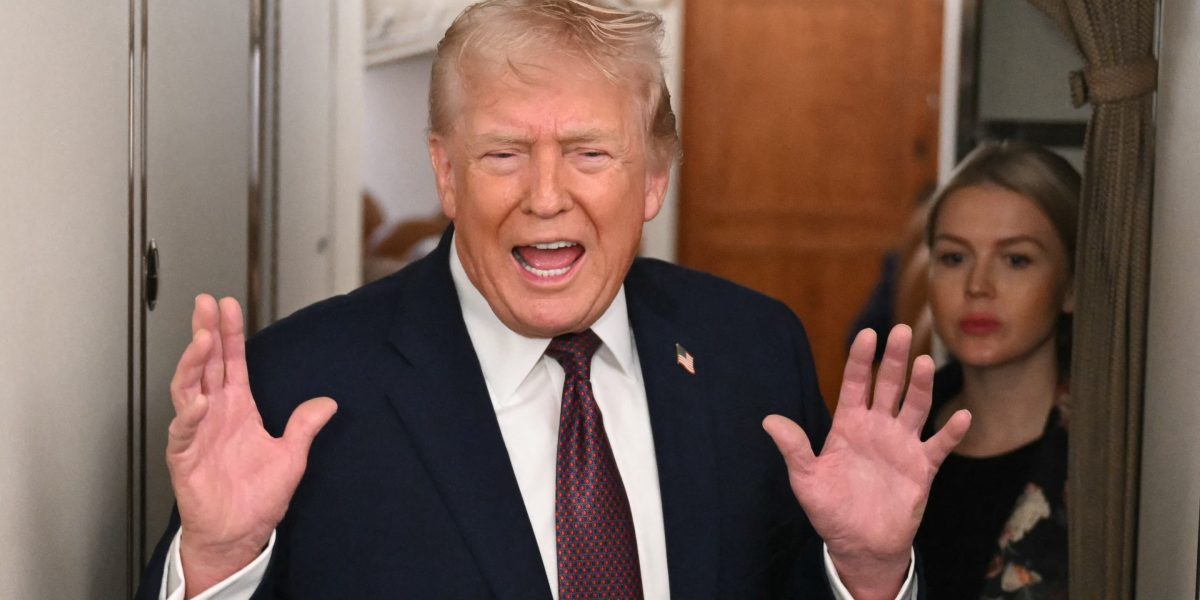
While President Donald Trump starts his new year opening Venezuela to U.S. oil companies and pining over Greenland’s potential oil and critical mineral reserves, American shale producers are increasingly miffed over the commander-in-chief’s focus on international energy as opposed to their declining domestic profits.
Although the U.S. is, in fact, churning out barrels of oil near all-time highs, Trump’s “Drill, baby, drill” ethos is ringing hollow amid weaker oil prices and waning drilling activity. The president’s fixation on lower prices at the pump is working in his favor—largely because of higher OPEC output, as he desired. But cheap fuel comes at the detriment of the U.S. oil producers struggling to turn a profit for their crude.
“I think everyone feels a bit slighted here,” the CEO of one big U.S. oil producer told Fortune, requesting confidentiality to avoid any potential reprisal from the Trump administration.
The U.S. benchmark for crude oil is sitting just under $60 per barrel, the threshold below which American oil producers struggle to profit and justify new activity. And the amount of active oil drilling rigs has plunged about 15% in a year as of Jan. 16. Despite all that, previous drilling activity and oilfield efficiency gains have pushed domestic oil production near world-leading, all-time highs of 13.8 million barrels a day—a stubbornly high level that’s contributing to lower oil prices. U.S. producers are at least pleased that Trump has expedited greenlighting energy projects and rolled back environmental protections.
At the same time, Trump is urging U.S. companies to move into Venezuela and spend more than $100 billion to rebuild its dilapidated infrastructure and pump more heavy Venezuelan crude oil.
“Venezuela is going to make more money in the next six months than they’ve made in the last 20 years. Every major oil company is coming in with us,” Trump said Jan. 21 at the World Economic Forum in Davos, Switzerland.
In the U.S., Trump said, “We’ll soon be averaging less than $2 a gallon.” The U.S. average for a gallon of regular unleaded fuel is $2.76 per gallon this week, down 32 cents in a year.
White House spokesman Taylor Rogers said that “thanks to President Trump’s energy dominance agenda, oil and gas production is at an all-time high. President Trump’s historic energy deal with Venezuela has unlocked a new, unprecedented opportunity for oil companies to invest in the world’s largest oil reserve.”
Marshall Adkins, head of energy for Raymond James, said U.S. shale producers are frustrated by low oil prices and Trump’s eagerness to “press every button” with OPEC and countries around the world, including in Venezuela, to produce more oil.
“Trump has been unequivocal. He wants lower prices,” Adkins said, “and that’s bad for U.S. producers.”
The CEO of a smaller U.S. oil producer in Midland, Texas, said Trump’s oil rhetoric is frustrating and his emphasis on crude oil as a primary reason for forcibly removing Venezuelan leader Nicolás Maduro was “disgraceful.”
“[Trump’s] messaging is annoying, but it’s just noise,” the CEO said, asking for confidentiality, arguing that increasing Venezuelan oil production enough to notably impact pricing would take years. Oil pricing is already at harmful levels, he said.
“It’s miserable,” he said of West Texas’ Permian Basin. “The fundamentals are negative to keep drilling for oil.”
Crude Venezuelan dreams
While there may be some smaller, fast-moving companies going into Venezuela, Adkins said, Trump really needs the Big Oil giants to invest many billions of dollars there to move the needle. And Exxon Mobil CEO Darren Woods “hit the nail on the head” when he recently told Trump that Venezuela is currently “uninvestable.”
So, who will go into Venezuela?
Chevron, for one, because the oil giant is the only U.S. company currently pumping out oil there thanks to its special license. Chevron Vice Chairman Mark Nelson told Trump it could hike its oil flows by 50% in less than two years. But that would equate to raising the country’s overall volumes from almost 1 million barrels of oil daily to more than 1.1 million barrels for a country—with the world’s largest proven oil reserves—that peaked decades ago with an output of nearly 4 million barrels.
And oilfield services drillers also are eager to go back—partly because they’re contractors and not the ones investing many billions of dollars.
Halliburton CEO Jeff Miller said on his Jan. 21 earnings call that he can “scale up very quickly” there as needed.
“My phone is ringing off the hook in terms of interest in Venezuela,” Miller said, calling it a “small market” compared to the industry just a decade ago.
Duane Germenis, president of the Intelligent Water Solutions oilfield services firm, used to work in Venezuela periodically before oil assets were expropriated by the government almost two decades ago, but he won’t go back. He said he’s happy to sell equipment to U.S. oil companies going there, but not to operate there.
“There’s a lot of oil to find, but how safe are you going to be?” Germenis told Fortune. “The country already owes many vendors lots of money that they’ll never see.”
The leaders of some privately held U.S. oil producers, such as Hilcorp and Armstrong Oil & Gas, told Trump they’re eager to invest in Venezuela, but those companies did not respond to repeated requests for comment by Fortune.
Instead of U.S. producers, major European players may prove to be key investors in Venezuela. Shell CEO Wael Sawan said at a White House meeting that the Big Oil giant has a “few billion dollars worth of opportunities to invest.”
Likewise, Spain’s Repsol and Italy’s Eni already operate in Venezuela under a joint venture to produce natural gas for much of the country’s domestic electricity. And they said they’d love to produce more crude oil as well with U.S. permission.
Repsol CEO Josu Jon Imaz said the company could triple its relatively small output of 45,000 barrels of oil daily in three years.
“We are also ready to join with American companies in our assets to develop and go faster with good investors and good know-how from the U.S. companies,” Eni CEO Claudio Descalzi told Trump.