Connect with us

Business

One Trump proposal meant to prevent ‘nation of renters’ may make homeownership harder, experts say

Published

on


President Donald Trump said he is reestablishing the American dream of homeownership, but one of his most recent housing policy proposals may put the dream even more out of reach, experts say.

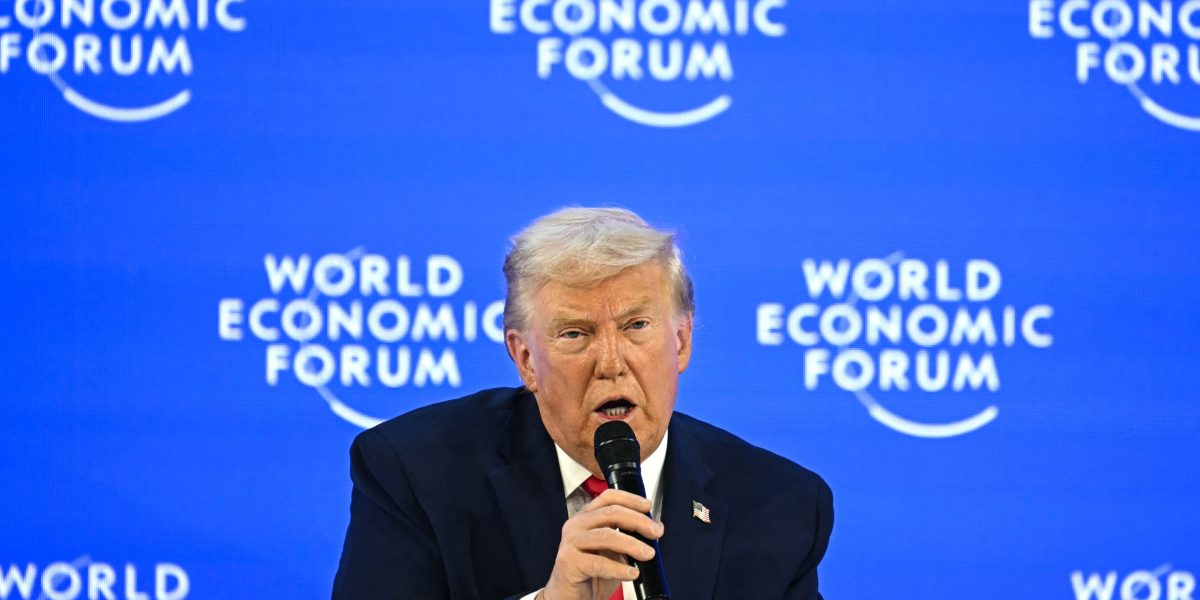
Speaking Wednesday at the World Economic Forum in Davos, Switzerland, Trump touted his barrage of recent housing policy executive orders, including preventing institutional investors from buying single-family homes and attempting to lower mortgage rates by directing government-controlled mortgage finance firms Fannie Mae and Freddie Mac to purchase $200 billion in mortgage-backed securities.

“It’s just not fair to the public [that] they’re not able to buy a house,” Trump said Wednesday of institutional homebuying. “And I’m calling on Congress to pass that ban into permanent law, and I think they will.” Trump has also asked Congress to cap credit-card interest rates at 10%, which he claimed Wednesday “will help millions of Americans save for a home.” 

Trump also spoke directly to Wall Street giants and institutional homebuyers at Davos, saying that “many of you are good friends of mine [and] many of you are supporters,” but “you’ve driven up housing prices by purchasing hundreds of thousands of single family homes.” 

“It’s been a great investment for them, often as much as 10% of houses on the market,” Trump said. “You know, the crazy thing is, a person can’t get depreciation on a house, but when a corporation buys it, they get depreciation.” 

One policy that went unmentioned during Trump’s Wednesday speech in Davos, and one experts say could carry potentially big risks and do little to address the root causes of high housing costs, is his proposal that would allow Americans tap their 401(k) savings for mortgage down payments, which now averages 19% of a home’s price. The current U.S. median home price is about $428,000, according to Redfin, meaning a down payment could amount to a whopping $81,000. Trump hasn’t put a dollar or percentage figure on the cap for the amount Americans could pull from their 401(k)s to use toward a down payment.

Trump’s final plan on allowing Americans to use their retirement savings for down payments would likely require congressional approval because it may involve changing the tax code. The proposal, announced Friday by Kevin Hassett, director of the National Economic Council, is Trump’s latest attempt to address growing concerns about affordability across the U.S. economy, especially in the housing market, and prevent America from becoming “a nation of renters,” as he said in his address at the World Economic Forum Wednesday.

Benefits of using 401(k) funds for a down payment

Trump’s idea has some benefits. The number of first time homebuyers has fallen to half of what it was about a decade ago, according to data from the National Association of Realtors. In addition, 22% of those who are able to buy their first home are already using either borrowed money or a gift from a friend or relative for their downpayment, according to the NAR.

While Americans can already withdraw up to $10,000 to pay for a home from individual retirement accounts (IRAs) without repaying it before age 59 ½ , this rule doesn’t apply to employer-sponsored 401(k)s, the most common retirement account, unless account holders pay a 10% penalty. 

Americans can withdraw money without a penalty from their retirement plans for some exempted purposes such as recovering from a natural disaster and some medical expenses, but still have to pay income taxes on their tax-deferred accounts. These “hardship withdrawals” increased to 4.8% of participants in Vanguard retirement plans in 2024, up from 3.6% in 2023.

Most employer-sponsored 401(k)s also allow Americans to borrow for a limited time from their retirement savings penalty-free before 59 ½, including for a home purchase, as long as they repay the amount borrowed to the account with interest.

Given the limited options for accessing retirement accounts, the president’s proposal could help Americans in need of cash to unlock liquidity for a down payment. This could be especially helpful for those who may struggle to repay an IRA loan, Robert Goldberg, a finance professor at Adelphi University in Garden City, N.Y., told Fortune.

Drawbacks of using 401(k) funds for a down payment

Still, Goldberg warned swapping out the diversified investments of a 401(k) and concentrating a large chunk of their investment into one asset is risky. While some believe home prices always go up, the housing market collapse of 2008 showed this isn’t always the case.

“Imagine home prices drop so much that the home price goes not just down to the mortgage level, but to below the mortgage level, wipes out your equity position,” he said. “You would have lost your equity, your 401(k) equity. Bad outcome.” 

Experts say Trump’s proposal also does little to address the supply side of the housing market, which has been largely frozen as homebuyers who bought in at lower interest rates prior to the pandemic have been hesitant to sell, Goldberg said. Giving more people the means to buy homes without adding more supply may inadvertently increase prices and lock more people out of the housing market, instead of making it more affordable, he argued. 

“Some people will benefit from [Trump’s plan], but overall it will just be more competition for homes,” Goldberg said. 

Yet, Trump’s proposal dealing with retirement savings is especially risky because it makes it easier for Americans to use crucial retirement savings meant for the future for non-retirement uses, said Jake Falcon, a chartered retirement planning counselor and the CEO of Falcon Wealth Advisors.

The median retirement savings for an American between the ages of 45 and 55 was $115,000 as of 2022, according to the Federal Reserve. Yet, this amount may not suffice for everyone, as some experts suggest the average person needs to have saved eight to 10 times their annual salary to retire comfortably.  

“People, generally speaking, are more than likely behind, and this will just make them further behind,” Falcon said.

Given the bleak data on American retirement savings, Falcon said the government should make dipping into a retirement account for other uses harder instead of easier.

“Allowing people to raid their 401(k) doesn’t solve the problem,” he said.


Source link

Continue Reading

Business

The rise of on-demand leadership in the AI economy

Published

on


A quiet but consequential shift is underway in the executive labor market. Companies are rethinking how they access senior judgment in the AI era. 

Rather than defaulting to full-time executive roles that command lofty salaries and long-term overhead, companies are increasingly turning to experienced consultants, strategists, and advisors to provide leadership on a limited and targeted basis.

This is not a dilution of leadership, but a recalibration of where experience delivers the most value.

According to LinkedIn’s latest Jobs on the Rise report, the fastest-growing roles in the U.S. economy sit at the intersection of AI and strategy. AI engineers claimed the top spot, while AI consultants and strategists ranked No. 2 overall. Strategic advisors and consultants also placed in the top 10. Together, the data show that as execution becomes cheaper, human judgment becomes more valuable.

The underlying driver is the implementation gap. After years of AI experimentation, organizations are struggling to convert tools into returns. While they do not lack models or software, many lack orchestration. Companies are increasingly turning to AI consultants and strategists to align technology with business realities, governance, and incentives, work that requires credibility, cross-functional fluency, and the kind of judgment typically associated with senior leadership roles.

The labor market now reflects a clear division of labor. Demand is rising simultaneously for full-time technical AI talent and for senior professionals who can translate those capabilities into business outcomes. As companies scale internal AI teams, they are increasingly relying on external advisors and consultants to provide the judgment required to direct that work at critical moments.

The supply side of this shift is shaped by organizational reality. Executives continue to make daily decisions, but AI has concentrated risk into fewer, more complex, and higher-impact choices around operating models, capital allocation, and governance. Rather than expanding permanent headcount, companies are bringing in experienced external leaders to guide those decisions when the stakes are highest.

The economics reinforce the model. Although senior advisors and consultants often command higher hourly rates, their total annual cost is typically a fraction of a comparable full-time executive role because they are engaged for a limited scope and time. Just as important, this approach allows organizations to draw on multiple forms of expertise rather than binding themselves to a single permanent hire.

The talent profile filling these roles is equally telling. Many of these advisors are former founders, CEOs, and COOs. Experience functions as a filter. LinkedIn’s data shows that many of the fastest-growing strategic roles carry a median of eight or more years of experience. These are not entry-level positions, but mid- or second-act careers for professionals with deep industry context.

The rise of founders and independent consultants on the Jobs on the Rise list also signals that this shift is driven by talent behavior, not just employer demand. Senior professionals are increasingly opting for career paths that offer autonomy, variety, and the opportunity to leverage their skills rather than committing to a single organization in an uncertain environment.

As AI automates and cheapens execution, the market value of human judgment, strategy, and accountability rises. As a result, pricing power shifts from doing the work to deciding what work should be done and how it should scale.

In this environment, experience is the moat. What is often described as “fractional leadership” is better understood as the unbundling of executive judgment from full-time roles. Over time, this model is likely to become not a stopgap but a structural response to the redistribution of value, risk, and expertise in the AI economy.

Join us at the Fortune Workplace Innovation Summit May 19–20, 2026, in Atlanta. The next era of workplace innovation is here—and the old playbook is being rewritten. At this exclusive, high-energy event, the world’s most innovative leaders will convene to explore how AI, humanity, and strategy converge to redefine, again, the future of work. Register now.


Source link

Continue Reading

Business

Trump finds a ‘solution’ to Greenland crisis, backs off on 10% tariff threats

Published

on


President Donald Trump seems to have found a “solution” to the Greenland crisis following talks with NATO leadership on Wednesday. He said he will back away from the threat to impose 10% tariffs on eight European allies — an announcement that had sparked a mass sell-off on Tuesday — that were set to take effect on Feb. 1.

The reversal came only hours after Trump walked back an earlier threat to use force to secure Greenland during his World Economic Forum speech in Davos, Switzerland.

“We have formed the framework of a future deal with respect to Greenland and, in fact, the entire Arctic Region,” Trump wrote on Truth Social, adding that the plan would be “a great one for the United States of America, and all NATO Nations.” He said the tariffs would be shelved “based upon this understanding.”

The announcement followed a meeting with NATO Secretary General Mark Rutte, who has been seeking to defuse growing tensions between Washington and its European allies as Trump escalated rhetoric over Greenland’s strategic importance. Trump also said on Truth Social that additional discussions were underway concerning what he called the “Golden Dome” initiative related to Greenland, without providing details.

Markets reacted sharply to the apparent de-escalation. The S&P 500 rose 1.5% in afternoon trading, while long-term U.S. Treasury yields fell, signaling investor relief after days of volatility. Despite this pullback potentially confirming yet another instance of the “TACO trade,” or “Trump Always Chickens Out,” major questions remain over the substance of the framework. 

Trump has repeatedly said that anything less than controlling all of Greenland is “unacceptable.” It’s unclear, and seems unlikely, that the outline discussed with NATO leadership satisfies that particular condition, given that Denmark reiterated that it would not give up Greenland’s sovereignty after Trump’s speech on Wednesday. 

In his Truth Social post, Trump said Vice President JD Vance, Secretary of State Marco Rubio, and Special Envoy Steve Witkoff would lead negotiations going forward and report directly to him.The announcement also comes after the EU suspended trade negotiations with the U.S. and suspended the trade agreement they have had in place since August. CATO scholar Kyle Handley, in a statement provided to Fortune, wrote that the suspension should have never been seen as a “dramatic breakdown,” because “there was never a real deal to begin with.”

“What’s unraveling now was a fragile, politically convenient set of press releases that papered over fundamental disagreements and was always vulnerable to executive-level tariff threats.”


Source link

Continue Reading

Business

Trump says Europe does one thing right: drug prices

Published

on


President Donald Trump told an audience of thousands of executives and global leaders at the World Economic Forum that European countries have taken a turn for the worse. Trump said his friends who visit the continent tell him they don’t recognize the region—and “not in a positive way.”

“I love Europe, and I want to see Europe go good,” Trump said on Wednesday at the Davos, Switzerland, meeting. “But it’s not heading in the right direction.”

But the president conceded that Europe is doing one thing better: keeping its drug prices low. 

“A pill that costs $10 in London costs $130. Think—it costs $10 in London, costs $130 in New York or in Los Angeles,” he said to murmurs from the crowd. 

Europe may not be recognizable to Trump’s friends, but Trump said he has other friends returning from London, remarking on the affordability of medication there. Indeed, a 2024 Rand study found that across all drugs, U.S. customers paid on average 2.78 times higher prices than in 33 other countries, including France, Germany, and the United Kingdom, in 2022.

The president has adopted a “most favored nation” policy meant to both lower drug costs for Americans while pushing other countries to pay more. Trump made a concerted effort in his second term to address astronomical drug costs, including minting a deal with 17 pharmaceutical companies to slash U.S. prices to match medication costs overseas. The move followed a sweeping executive order issued in May to introduce the most-favored-nation policy. On Wednesday, Trump alluded to an executive order he signed last week, pledging to lower drug prices by up to 90%.

Fallout with France

Trump said pharma companies did not initially believe countries would be willing to change prices. Trump noted in his remarks that he first approached French President Emmanuel Macron about increasing drug prices, but Macron refused.

“I said, ‘Emmanuel, you’re going to have to lift the price of that pill,” Trump said.

Trump said that threatening a 25% tariff on French goods, including wines and champagne, sealed the deal. Macron’s office disputed Trump’s assertion that he pressured the French president into lowering drug prices. 

“It’s being claimed that President @EmmanuelMacron increased the price of medicines. He does not set their prices. They are regulated by the social security system and have, in fact, remained stable,” Macron’s office said in an X post. “Anyone who has set foot in a French pharmacy knows this.”

Included in the post was a gif of Trump with animated “Fake news!” text overlaid on the image.

Health policy experts say drug prices in the U.S. are so high because of a system structured differently from other countries that allow companies to negotiate with individual insurance companies or pharmacy benefit managers, giving them more leverage to raise prices than in other countries’ systems, where there is one regulatory agency negotiating drug prices for a population.

Efficacy of Trump’s efforts to lower drug costs

Industry leaders think Trump’s efforts to lower drug costs could pay off. Vas Narasimhan, CEO of pharmaceutical giant Novartis, told Fortune’s Jeremy Kahn at a USA House session in Davos on Wednesday that Trump identified a valid issue in the high cost of U.S. drugs.

About two-thirds of new drugs on the market over the last decade have come from the U.S., a result of its highly developed research and development (R&D) infrastructure. Some argue that other countries benefit from U.S. innovation without paying their fair share to support the industry’s growth.

“When you look at what underpins R&D in our industry, it’s been primarily in the United States,” Narasimhan said. “The United States is the source of more than half the profits of the industry, and without the United States, you wouldn’t have all of these innovations, all these incredible medicines.”

Narasimham emphasized the need for a “more balanced approach” to funding R&D, implying that other countries should pay more for U.S.-produced pharmaceuticals. He pointed to Trump’s deal with the 17 drug companies as a “reasonable” solution.

Early signs, however, suggest drug prices have not come down. A January report from drug price research firm 46brooklyn found drug companies, including 16 firms with which Trump made deals since September, raised drug prices for at least some of their drugs in the first two weeks of 2026. The median increase of the 872 brand-name drugs with hiked prices was about 4%, the same rate as the year before.

Reuters similarly reported earlier this month, citing data from 3 Axis Advisors, that those 17 drug companies had raised the prices of 350 medications. Public health experts attributed the rise to the behind-the-scenes nature of the deals between drug companies and insurers.

“These deals are being announced as transformative when, in fact, they really just nibble around the margins in terms of what is really driving high prices for prescription drugs in the U.S.,” Dr. Benjamin Rome, a health policy researcher at Brigham and Women’s Hospital in Boston, told the outlet.

The Department of Health and Human Services did not immediately respond to Fortune’s request for comment.


Source link

Continue Reading

Trending

Copyright © Miami Select.