Business
Slipping on ICE: innocent retailers are the latest collateral damage from Trump’s perpetual noise machine
Published
4 hours agoon
By
Jace Porter
In her classic 1961 book The Death and Life of Great American Cities, pioneering urbanologist Jane Jacobs advised that the key to safe cities is “more eyes on the street.” She advocated that the best way to get these was to have neighborhoods filled with stores and restaurants. With local business providing a multitude of reasons for people to be active in city street life, eyes on the street would follow. It was these eyes that were mentioned by Minnesota Gov. Tim Walz in his January 14 primetime media appeal for the public to witness and document the increasingly horrific actions of the agency known as ICE, the once celebrated U.S. Immigration and Customs Enforcement office.
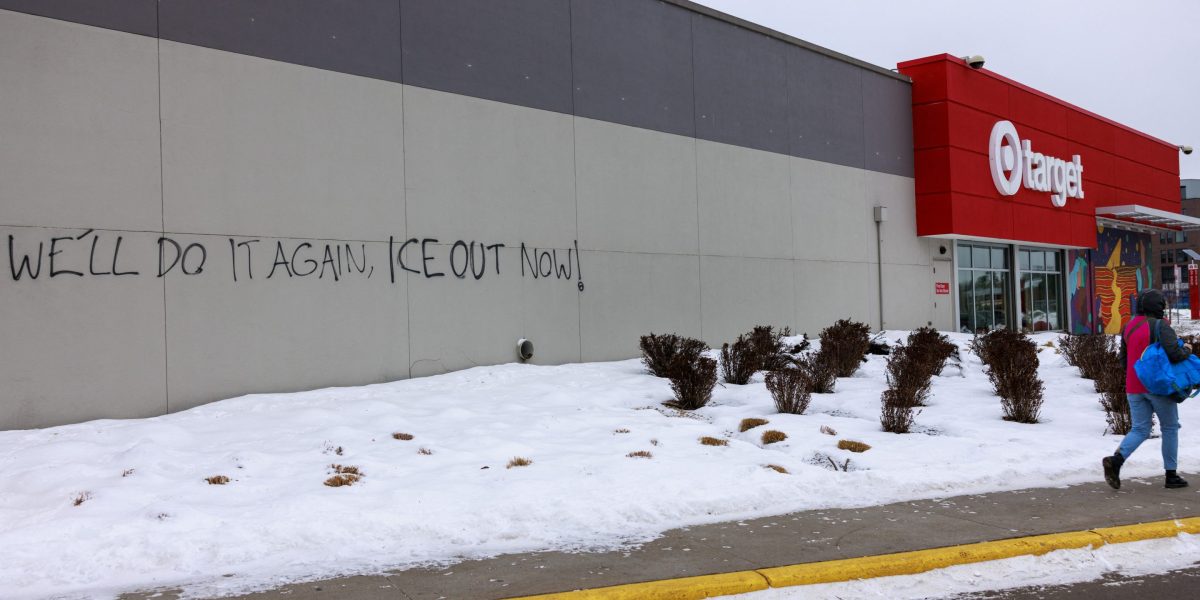
Increasingly known for daily video footage of seemingly arbitrary and brutal force, used by masked ICE agents against shoppers and workers at retail shops and restaurants, Walz urged shoppers to “take out that phone and hit record.” The public has been horrified by the killing of Renee Good, an unarmed 37-year-old mother of three and an American citizen, who was shot multiple times in the face by an ICE agent in her own Minneapolis neighborhood. But the footage of ICE brutality is everywhere, and much of it is occurring in retail establishments.
Consider the vivid hypocrisy of the ICE agents who were seen feasting at the popular El Tapatio Mexican Restaurant in Willmar, Minnesota, and then returning later to arrest the owner and employees of this café that had graciously served them. ICE actions have led several local establishments to close for foot traffic, taking only phone orders, while others reported sales drops of 75%.
As for larger enterprises, with recent raids occurring in Los Angeles, Charlotte, and Phoenix, Fortune 500 giants around the nation including Home Depot, Walmart, Target, Ross, Keurig Dr Pepper, and Constellation Brands have all increasingly warned about the impact of ICE raids on their businesses. Patrons and laborers at one Walmart in Van Nuys, California, faced multiple raids in the same day with people tackled and dragged away from ICE agents. Calls for boycotts of retailers who aid and abet ICE enforcement are understandable but retailers are also victims here. They can and should do more to make their roles more clear.
The eyes on the street
The impact of such ICE invasions into Minnesota is being shared nationally, with profound cost to local commerce and also local communities. Local merchants serve a deeper purpose to society than selling goods that are often available through ecommerce. Retail stores are among the last remaining shared civic spaces—places where people of all backgrounds still cross paths in the course of everyday life. Shopkeepers are community pillars because they build social ties, foster local identity, boost the economy by keeping money local, and act as hubs for connection, often providing personalized service and supporting local events, making neighborhoods more vibrant, resilient, and unique places to live and shop. They transform basic commerce into meaningful relationships and community gathering spots, strengthening the social fabric.
America’s great retailers have long understood this. From Walmart’s Sam Walton to J.C. Penney to The Home Depot co-founders Bernie Marcus and Arthur Blank, retail legends have long described stores not merely as institutions of public trust. Blank has spoken of retail as a civic platform—a space where people from different walks of life come together in ordinary, human ways. Marcus has emphasized that Home Depot was built on dignity: respect for customers, respect for workers, and a belief that welcoming people into shared spaces strengthens communities rather than fragments them.
So, what could possibly disrupt that vision?
Last week, videos ricocheted across social media showing federal immigration agents restraining a man inside a Walmart in Minnesota and detaining individuals at the entrance of a Target. Days later, in Los Angeles, Home Depot parking lots—long informal hiring sites for day laborers—again became flashpoints for enforcement actions and community backlash. These were just a few of many ICE raids playing out across the country, in locales as varied as New York, Georgia, Texas and beyond, where shoppers have reported increased immigration enforcement activity near department stores and shopping centers, triggering protests, boycotts, and a growing sense that retail spaces are being repurposed into stages for public confrontation.
This is surely not the retail experience that Marcus and Blank had in mind when they spoke of dignity and friendly community commons.
President Donald Trump is likely pulling this lever unprovoked to tear apart communities’ harmonious fabric as the kind of diversionary tactic that he often utilizes. Trump’s first year has been soundly rated a failure in all major national polls and in each dimension of national and international priorities. Barely 37% say that Trump places the good of the country above his personal gain, and 32% say that he’s in touch with the problems ordinary Americans face in their daily lives. As we write about in our new book, Trump’s Ten Commandments, the president has long resorted to “perpetual noise machine” distractions when faced with plummeting poll numbers and challenges on the economy and affordability, seeking to divert attention away from his difficulties. This diversion comes at a real cost to retailers and to the American economy.
Multiple major national polls reveal that the ICE mission is failing, with most Americans condemning these raids as making American cities less safe — with 82% of Democrats and Democratic-leaning independents leaning in this direction, but also 67% of Republicans and Republican-leaning independents. Even MAGA-friendly podcaster Joe Rogan launched a harsh takedown of ICE, likening them to the Gestapo secret police of Nazi Germany.
In fact, Minneapolis Police Chief Brian O’Hara, recently showed on Fox TV that, before the ICE invasions, all major categories of crime including violent crimes like murders and carjacks were down last year from 20% to 50%. Former Secretary of Homeland Security Jeh Johnson has shown this weekend that there has been no surge of undocumented immigrants in Minneapolis to justify what is now five times the number of federal law enforcement officers as there are municipal police.
It appears that even Trump is recoiling, offering a surprising criticism of ICE overreach in a New York Times interview this week. Indeed, unless there is some inexplicable policy goal to get Americans to buy ladders, hammers, toilet seats, piles of bricks, washers, dryers, and garage doors online instead of at neighborhood stores, there is no reason why retailers need to become ground zero.
Why would ICE want to hurt businesses that form the backbone of the American economy? After all, we don’t know how good UPS is at delivering garage doors house-to-house, or if FedEx could really handle deliveries of bricks, sinks, and toilets, if they were bought from Amazon instead of from neighborhood stores. While that notion might seem ridiculous, there is nothing funny or ludicrous about the fact that these administration/ICE overreaches risk serious and genuine economic damage if they continue unabated.
The facts about retailers’ lack of complicity
While ICE might be slipping on the ice, the activists who are attacking America’s most beloved retailers as somehow “complicit” with ICE raids in their stores are similarly slipping up. That narrative is wrong, and retailers need to throw rock salt urgently, to avoid flipping over themselves. Here are the facts, which are too often lost in the crossfire, and should be clarified urgently.
First, retailers need to clarify that they have not been complicit and have had no advance knowledge of these raids. Retailers are not accessories with ICE, nor enablers; they are also victims, caught in the crossfire of a political and legal dispute they did not choose.
This clarification is urgent, because critics on all sides misrepresent what retailers can—and cannot—do. One widely circulated myth holds that retailers invite ICE into their stores. In reality, ICE agents, like any law enforcement officers, may enter public spaces open to all customers without needing a warrant.
Another myth suggests that retailers can simply “ban ICE” from their properties if they choose, with some choosing to do so while other stores invite them in with open arms. That, too, misunderstands the law. A retail store is not a private home. As a public-facing space, retailers cannot selectively exclude certain groups—whether law enforcement or anyone else—from areas open to the general public. A store manager cannot “kick out ICE” the way they might remove a shoplifter. Even if a retailer tried to ban ICE, or any other law enforcement agency, from their otherwise public facing spaces, the law enforcement agency could simply ignore it under the law, and the retailer could be subject to a variety of legal claims, including discrimination or obstruction by the affected government entities. Some have suggested that perhaps stores could put whistles by the cash registers or parking lots, but in reality, retailers have no control.
A third myth claims that retailers are facilitating the arrest of their employees or customers. That is false. As Federal law enforcement officers, ICE agents have the authority to make arrests in any public spaces based on probable cause, without the consent—or cooperation—of the venue. While there are allegations that surveillance cameras operated by such retail partners as Flock Safety are being use to assist ICE raids as some activist investors charge, retailers should assert this electronic collaborating is not true—consistent with denials by Flock Safety.
Retailers did not ask to be put into the middle of America’s political and legal fight over immigration. But they are being drafted nonetheless, and need to scream these facts loudly from the mountaintops to deescalate a worsening situation. Fortunately, they are not likely to use needlessly incendiary language the way some overreacting public officials do. Home Depot’s public statements capture the hard edge of their dilemma: the company has said it is neither notified in advance nor coordinating with immigration enforcement, while also acknowledging that it cannot legally interfere with federal agencies.
Now that retailers find themselves in the middle, they deserve something too often missing from this debate: truth, and they need to be screaming this truth loudly from the mountaintops. They are neither covert Quisling collaborators nor law enforcement-subverting antagonists. They are institutions built to welcome the public of all stripes, not to adjudicate federal policy—and they should not be targeted as such by either side.
Some may wonder, why target retailers? If the goal is to trigger unruly public unrest to justify presidential invocation of the insurrection act as some charge, why not visit the spirited crowds at WWE instead. The average Home Depot store has an impressive 2,000 transactions a day but a WWE slapdown such as Raw or Westlemania easily draws five times as many for 10,000 heated fans. If the goal is to capture foreign guests, why not raid the Metropolitan Opera crowds filled with EU national as performers or the American Ballet Theater or the Colorado Ballet known for their high Russian degree of heritage dancers, or the several hundred heavily promoted high kicking Shen Yun performances each year sponsored by the Chinese Falun Gung religious movement.
It is painful to see ICE arrests taking place in the aisles, parking lots, and entry foyers of Minneapolis stores. Who would have thought that even the raucous reputation of the Minnesota Vikings would look refined compared to the hard-edged, ICE enforcement actions? Perhaps they should drop their cowardly masks to hide their identities by donning Viking helmets with horns to more accurately dress for their retail raids. Regardless of the bias in whatever racial or political agenda may be behind this nightmarish remake of Eugene O’Neil’s dark drama of societal miscreants, The Iceman Cometh, the ICE men are making sure their own approval rating melts, while doing damage to both commerce and community safety.
The opinions expressed in Fortune.com commentary pieces are solely the views of their authors and do not necessarily reflect the opinions and beliefs of Fortune.
This story was originally featured on Fortune.com
You may like
Business
Trump tones down escalating Greenland rhetoric in Davos
Published
2 minutes agoon
January 21, 2026By
Jace Porter
President Donald Trump, in his own inimitable way, struck a bellicose and yet conciliatory tone with European leaders in Davos, Switzerland, on Wednesday, somewhat tempering rising trans-Atlantic tensions and stock market jitters over concerns the U.S. is considering a takeover of Greenland.
The nearly 90-minute speech, in which Trump lectured and hectored the tech executives and government officials in the audience, many from Europe, before clarifying that he didn’t want to use force and ultimately wanted peace, could be summed up by Trump ribbing French President Emmanuel Macron, seemingly unaware of his eye injury. “I watched him yesterday with his beautiful sunglasses. I said, ‘What the hell happened?’” Trump later added, “I actually like him. I do.”
And while the president ruled out using military force to acquire the Danish territory of Greenland, he did not back down from antagonistic rhetoric while repeating his contested claim of having stopped eight wars around the world. (Trump’s desire for a Nobel Peace Prize, one measure of his competitiveness with predecessor Barack Obama, has hung on this eight-war figure, which some countries such as India and Pakistan reject.)
Trump used his highly anticipated address at the World Economic Forum as a platform to reaffirm his critique of European nations and of the U.S.’s status as a global superpower, but clarified that he prefers a peaceful resolution to the question over Greenland’s ownership that has threatened to kneecap the 76-year-old NATO alliance.
“I don’t have to use force. I don’t want to use force. I won’t use force,” he said.
Trump’s statement on having resolved multiple conflicts first emerged in a leaked text message the president sent to Norwegian prime minister Jonas Gahr Støre over the weekend in which he said, ominously, that he was no longer obliged to “think purely of Peace.” In that message, Trump linked his Greenland bombast to the Nobel committee deciding not to award him a Peace Prize last October, despite having “stopped 8 wars PLUS.” The committee that awards Nobel Prizes is based in Norway, although the Norwegian government does not have a say in allocating the prizes.
Sigh of relief in the mountains
The statement assuaged the concerns of some European leaders about a possible military confrontation with the U.S. and seemed to reassure markets jittery about the onset of a new trade war, or the end of the western alliance.
Markets responded positively after their big Tuesday sell-off. As of late morning, both the S&P 500 and the Dow Jones Industrial Average had risen over 1%, while the Nasdaq Composite index had advanced 1.3%. The 10-year Treasury yield turned lower, and the U.S. dollar stabilized after big losses Tuesday.
But Trump’s comments were an olive branch in text only, not in tone. Speaking for over an hour, the president reiterated his desire for Greenland, stating “that’s our territory” with regards to the island, while claiming he had “stopped eight wars.” (India has repeatedly rejected Trump’s claim that he stopped a war between the countries, while Pakistan has welcomed his involvement, nominating him for a Nobel.)
And while Trump toned down aggressive rhetoric of an impending military takeover of Greenland, he made clear to foreign leaders that it was a choice, even a favor: “We probably won’t get anything unless I decide to use excessive strength and force, where we would be, frankly, unstoppable, but I won’t do that,” he said.
Trump’s claim has been disputed. While the president did not specify which wars he was referring to, the U.S. has been involved in six ceasefires, although tensions have occasionally flared between Israel and Hamas and India and Pakistan. He may also be referring to agreements brokered during his first term.
Trump’s ruling out of military force on Wednesday soothed some European officials. Rasmus Jarlov, who chairs the defense committee in Denmark’s parliament, told The New York Times he “wasn’t too upset” with the president’s comments.
Lars Lokke Rasmussen, Denmark’s foreign minister, was encouraged as well: “It is positive that it is being said that military force will not be used,” he told local reporters Wednesday. “But that will not make this case go away,” he added.
While Trump reiterated his desire for a peaceful resolution during his speech, he challenged European leaders to remain opposed to him.
“You can say yes and we will be very appreciative, or you can say no and we will remember,” he said.
Business
One Trump proposal meant to prevent ‘nation of renters’ may make homeownership harder, experts say
Published
34 minutes agoon
January 21, 2026By
Jace Porter
President Donald Trump said he is reestablishing the American dream of homeownership, but one of his most recent housing policy proposals may put the dream even more out of reach, experts say.
Speaking Wednesday at the World Economic Forum in Davos, Switzerland, Trump touted his barrage of recent housing policy executive orders, including preventing institutional investors from buying single-family homes and attempting to lower mortgage rates by directing government-controlled mortgage finance firms Fannie Mae and Freddie Mac to purchase $200 billion in mortgage-backed securities.
“It’s just not fair to the public [that] they’re not able to buy a house,” Trump said Wednesday of institutional homebuying. “And I’m calling on Congress to pass that ban into permanent law, and I think they will.” Trump has also asked Congress to cap credit-card interest rates at 10%, which he claimed Wednesday “will help millions of Americans save for a home.”
Trump also spoke directly to Wall Street giants and institutional homebuyers at Davos, saying that “many of you are good friends of mine [and] many of you are supporters,” but “you’ve driven up housing prices by purchasing hundreds of thousands of single family homes.”
“It’s been a great investment for them, often as much as 10% of houses on the market,” Trump said. “You know, the crazy thing is, a person can’t get depreciation on a house, but when a corporation buys it, they get depreciation.”
One policy that went unmentioned during Trump’s Wednesday speech in Davos, and one experts say could carry potentially big risks and do little to address the root causes of high housing costs, is his proposal that would allow Americans tap their 401(k) savings for mortgage down payments, which now averages 19% of a home’s price. The current U.S. median home price is about $428,000, according to Redfin, meaning a down payment could amount to a whopping $81,000. Trump hasn’t put a dollar or percentage figure on the cap for the amount Americans could pull from their 401(k)s to use toward a down payment.
Trump’s final plan on allowing Americans to use their retirement savings for down payments would likely require congressional approval because it may involve changing the tax code. The proposal, announced Friday by Kevin Hassett, director of the National Economic Council, is Trump’s latest attempt to address growing concerns about affordability across the U.S. economy, especially in the housing market, and prevent America from becoming “a nation of renters,” as he said in his address at the World Economic Forum Wednesday.
Benefits of using 401(k) funds for a down payment
Trump’s idea has some benefits. The number of first time homebuyers has fallen to half of what it was about a decade ago, according to data from the National Association of Realtors. In addition, 22% of those who are able to buy their first home are already using either borrowed money or a gift from a friend or relative for their downpayment, according to the NAR.
While Americans can already withdraw up to $10,000 to pay for a home from individual retirement accounts (IRAs) without repaying it before age 59 ½ , this rule doesn’t apply to employer-sponsored 401(k)s, the most common retirement account, unless account holders pay a 10% penalty.
Americans can withdraw money without a penalty from their retirement plans for some exempted purposes such as recovering from a natural disaster and some medical expenses, but still have to pay income taxes on their tax-deferred accounts. These “hardship withdrawals” increased to 4.8% of participants in Vanguard retirement plans in 2024, up from 3.6% in 2023.
Most employer-sponsored 401(k)s also allow Americans to borrow for a limited time from their retirement savings penalty-free before 59 ½, including for a home purchase, as long as they repay the amount borrowed to the account with interest.
Given the limited options for accessing retirement accounts, the president’s proposal could help Americans in need of cash to unlock liquidity for a down payment. This could be especially helpful for those who may struggle to repay an IRA loan, Robert Goldberg, a finance professor at Adelphi University in Garden City, N.Y., told Fortune.
Drawbacks of using 401(k) funds for a down payment
Still, Goldberg warned swapping out the diversified investments of a 401(k) and concentrating a large chunk of their investment into one asset is risky. While some believe home prices always go up, the housing market collapse of 2008 showed this isn’t always the case.
“Imagine home prices drop so much that the home price goes not just down to the mortgage level, but to below the mortgage level, wipes out your equity position,” he said. “You would have lost your equity, your 401(k) equity. Bad outcome.”
Experts say Trump’s proposal also does little to address the supply side of the housing market, which has been largely frozen as homebuyers who bought in at lower interest rates prior to the pandemic have been hesitant to sell, Goldberg said. Giving more people the means to buy homes without adding more supply may inadvertently increase prices and lock more people out of the housing market, instead of making it more affordable, he argued.
“Some people will benefit from [Trump’s plan], but overall it will just be more competition for homes,” Goldberg said.
Yet, Trump’s proposal dealing with retirement savings is especially risky because it makes it easier for Americans to use crucial retirement savings meant for the future for non-retirement uses, said Jake Falcon, a chartered retirement planning counselor and the CEO of Falcon Wealth Advisors.
The median retirement savings for an American between the ages of 45 and 55 was $115,000 as of 2022, according to the Federal Reserve. Yet, this amount may not suffice for everyone, as some experts suggest the average person needs to have saved eight to 10 times their annual salary to retire comfortably.
“People, generally speaking, are more than likely behind, and this will just make them further behind,” Falcon said.
Given the bleak data on American retirement savings, Falcon said the government should make dipping into a retirement account for other uses harder instead of easier.
“Allowing people to raid their 401(k) doesn’t solve the problem,” he said.
Business
‘Let’s not be naive’: Ray Dalio warns the global rule-based order is already ‘gone,’ toppled by America’s debt crisis and raw power
Published
1 hour agoon
January 21, 2026By
Jace Porter
Bridgewater Associates founder Ray Dalio, speaking to Fortune‘s Kamal Ahmed at the World Economic Forum in Davos, Switzerland, issued a stark warning to global leaders and business executives: Stop pretending the old rules still apply. In a candid assessment of the current geopolitical landscape, Dalio argued the fate of the post-World War II global order—much debated amid President Donald Trump’s pursuit of Greenland and unsettling of the NATO alliance—is a moot point.
“Let’s not be naive and say, ‘Oh, we’re breaking the rule-based system,’” Dalio said. “It’s gone.”
The billionaire founder of the largest hedge fund in history added that as a student of financial history, he pays close attention to the economic cycles of the last 500 years and sees cycles repeat themselves over time.
“And what I learned through that exercise is the same thing happens over and over again,” he said. “And it’s like a movie for me. It’s like watching the same movie happen.”
According to Dalio, five specific forces interact to drive the movie plot forward, with the “money-debt cycle” serving as the MacGuffin that kicks things off. The roots of the current instability, Dalio explained, lie in the monetary decisions made during the past several decades. Since 1971, when the U.S. under President Richard Nixon broke the dollar’s link to gold, Dalio notes, governments have consistently chosen to “print money” rather than allow debt crises to naturally play out. This behavior occurs when debt-service payments rise faster than incomes, squeezing spending. After more than half a century of this, he argued, repeating a consistent warning in his public remarks on the subject, the world is now witnessing a “breakdown of the monetary order,” evidenced by central banks altering their reserves and buying gold.
The previous day, Dalio had said in an appearance on CNBC’s “Squawk Box,” from the sidelines of the annual meeting in Davos, fiat currencies and debt as a storehouse of wealth were “not being held by central banks in the same way” anymore. He pointed to a decoupling in which the U.S. markets have underperformed foreign markets in specific metrics, a trend visible in the changing balance sheets of global central banks.
The core of Dalio’s concern lies in the transition from trade disputes to what he terms “capital wars.” He alluded to how U.S. Treasury bonds were the bedrock of global reserves for decades, but now, Dalio said the sheer supply of debt being produced by the U.S. is colliding with a shrinking global appetite to hold it.
“There’s a supply-demand issue,” Dalio noted, adding “you can’t ignore the possibility that … maybe there’s not the same inclination to buy U.S. debt.”
This reluctance is driven by geopolitical friction. According to Dalio, in times of international conflict, “even allies do not want to hold each other’s debt,” preferring instead to move capital into hard currencies. This shift forces the issuer of the debt to monetize it, a phenomenon Dalio summarized bluntly: “We’re increasingly buying our own money. That’s… the lesson of all this.”
As Dalio was speaking on Monday, markets weathered a global selloff as they digested the revelation that President Donald Trump was demanding U.S. possession of Greenland in revenge for not getting the Nobel Peace Prize in 2025. He had texted the Prime Minister of Norway Jonas Gahr Støre in anger about this, according to confirmed reports over the weekend, even though the Nobel Prize committee is separately operated from the government of Norway. But Dalio’s Tuesday remarks came amid calmer markets, as Trump reiterated his request for Greenland but clarified he would not authorize use of force to acquire it.
This economic instability feeds directly into the collapse of political norms, Dalio told Fortune on Wednesday. He argued the multilateral world order established in 1945—characterized by institutions such as the United Nations and the World Trade Organization—was arguably a “naive system” from the start, as it relied on representation without guaranteed enforcement.
“What happens when the leading power doesn’t want to abide by the vote?” Dalio asked. “Do you really expect that there’s going to be a United Nations vote or a World Court that’s going to resolve these things?”
The result, he argued, is a definitive shift from a multilateral system to a unilateral one. Dalio posited the central question of our time has become: “Who makes the rules, who enforces the rules, and how are you going to deal with that?”
Perhaps the most chilling aspect of Dalio’s analysis is the erosion of legal authority in favor of brute force. “Power matters more” than the law, he told Fortune, noting conflicts are increasingly decided by who controls the military, the police, and the National Guard. This trend is visible not only internationally but within nations, where democracy is threatened by populism and a growing belief the system is corrupt.
When asked if this rupture should strike fear into corporate boards and CEOs who have long relied on stable global rules, Dalio responded ignoring the truth is far more dangerous.
“I think what always scares me is the lack of realism,” he said.
Dalio advised leaders to stop relying on a dissolving rule-based system and instead focus on “jurisdiction questions,” seeking out places where people are “like-minded” and mutually supportive. Whether dealing with international boundaries or domestic regulations, Dalio insists businesses must now face the hard reality the era of assured legal protection is ending.
“Will law prevail?” Dalio asked. “Internationally, everybody is having to deal with that question.”
As confidence in institutions, the law itself, and fiat-denominated debt erodes, Dalio highlighted to CNBC the quiet but significant resurgence of gold. He emphasized gold should not be viewed merely as a speculative asset but as “the second-largest reserve currency” in the world. He noted in the previous year, gold was the “biggest market to move,” and it performed far better than tech stocks as central banks diversified their holdings. JPMorgan CEO Jamie Dimon had similar remarks in an interview with Fortune at the Most Powerful Women conference in October, when he said for the first time in his life, it had become “semi-rational” to have gold in your portfolio.
However, Dalio’s outlook was not entirely defensive. He said he sees the current era as a bifurcation between the decaying monetary order and a “wonderful technological revolution,” echoing Trump’s remarks onstage earlier that day about the “economic miracle” taking place. In that regard, at least, might may end up making right.
This story was originally featured on Fortune.com
Trump tones down escalating Greenland rhetoric in Davos
Kim Kardashian Praises Taylor Swift as ‘Super Talented’ Despite Infamous Beef
Parents of trans children urge compassion, not humiliation, in Florida’s schools, doctor’s offices and government halls
Trending
-
Politics8 years agoCongress rolls out ‘Better Deal,’ new economic agenda
-
Entertainment9 years agoNew Season 8 Walking Dead trailer flashes forward in time
-
Politics9 years agoPoll: Virginia governor’s race in dead heat
-
Politics9 years agoIllinois’ financial crisis could bring the state to a halt
-
Entertainment9 years agoThe final 6 ‘Game of Thrones’ episodes might feel like a full season
-
Entertainment9 years agoMeet Superman’s grandfather in new trailer for Krypton
-
Business9 years ago6 Stunning new co-working spaces around the globe
-
Tech8 years agoHulu hires Google marketing veteran Kelly Campbell as CMO
