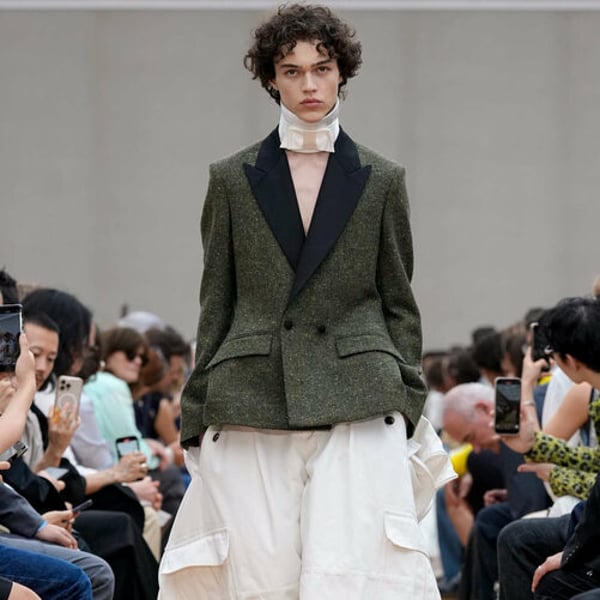
Men’s Fashion Week kicks off in Paris on Tuesday and will feature six days of trend-setting catwalk shows, a farewell at Hermes and tributes to late Italian fashion icon Valentino.
The first day of the Fall/Winter 2026 edition will be dominated by the latest mega-production from Louis Vuitton‘s celebrity menswear designer Pharrell Williams, as well as mourning for one of the industry’s biggest names.
Williams will unveil his collection at the brand’s glitzy gallery space in western Paris under the shadow of the death of Italy’s Valentino Garavani, who passed away Monday at the age of 93.
The giant in the world of haute couture died at his home in Rome, just four months after the death of fellow Italian great Giorgio Armani.
In a sign of industrial renewal, however, French designer Jeanne Friot will take her first steps on the daunting Paris calendar on Monday, with the young stylist telling AFP it was a “quite an unusual joy and stress” to take part.
French designer Veronique Nichanian will meanwhile present her last collection for Hermes on Saturday after 37 years at the helm.
The 71-year-old Parisian — one of the few women designing in menswear — will leave behind a brand in tremendous financial shape with an image of timeless, refined masculinity that she has helped shape.
Her successor, London designer Grace Wales Bonner, who is of English and Jamaican heritage, represents a generational and stylistic shift for the classic family-run French house.
Many fashionistas will be casting an eye on the Christian Louboutin show on day two where Jaden Smith — son of US rapper-actor Will Smith — will present his debut collection.
The model and musician, 27, was unveiled as the creative director of the famed French brand last September by founder Louboutin, who appears to be preparing to hand over the reins to the Gen Z trendsetter.
The choice is seen as a bold bet on relatively inexperienced youth by the veteran maker of red-soled stilettos, whose ready-to-wear menswear and accessories are estimated by analysts to account for about a quarter of his sales.
On Wednesday, much-hyped Dior designer Jonathan Anderson will unveil his second Homme collection, having made his debut in June last year with a widely praised show of unisex styling.
But the 41-year-old’s womenswear collection in September didn’t convince everyone, and some observers expect him to put a more decisive mark on Dior and cement the new identity he’s begun sketching out.
“There’s a lot of anticipation,” Alice Feillard, men’s buying director at Paris department store Galeries Lafayette, told AFP.
The luxury fashion industry has undergone a wave of changes over the last 12 months at a time of weak international growth following the bumper buying frenzy of the post-Covid period.
Slowing demand from China, US tariffs on imports and uncertainty about the global economy have all weighed on sales of European brands.
New faces such as Anderson, Matthieu Blazy at Chanel, Demna at Gucci or Sarah Burton at Givenchy represent the elevation of a new stable of couturiers who look set to dominate the major houses over the next decade.
Elsewhere over the week, Japanese brands from Yohji Yamamoto and Issey Miyake to Mihara Yasuhiro will be out in force.
LVMH-owned Kenzo, will hold a presentation instead of a runway show on Tuesday inside the vast Parisian house of late founder Kenzo Takada in the French capital’s trendy 11th district.
The four-storey modernist building, which features a Japanese garden, will host a day-long gathering of design, food and music curated by chief creative Nigo.
US designer Willy Chavarria, who is one of a handful unafraid to express political views, also returns for his third season in Paris and might have something to say about Donald Trump‘s presidency on Friday.
From its elegantly appointed 1,000-square-metre showroom at 11 Via Uberto Visconti di Modrone in Milan, which showcases the brand’s entire universe, high-end clothing and accessories label Eleventy presented its Autumn-Winter 2026/27 collection, marked by colours new to the house, an expanded assortment—especially in footwear—and the use of new raw materials such as vicuña, as revenue stabilises and new store openings are readied, starting in Chicago.
Eleventy, Autumn-Winter 2026/27
“It’s an important year for us, one in which we wanted to reinvent ourselves, because we believe it’s right to go back to being special,” Marco Baldassari, who continues to lead the brand he owns as CEO, tells FashionNetwork.com. “We had certainly spent many years operating in our comfort zone, with light colours, which by now are no longer distinctive. So we wanted to introduce new, more sophisticated, darker colours and silhouettes that are new to us, to differentiate ourselves once again from what the market offers.”
“The inspiration for the collection,” Eleventy’s CEO continues, “begins with an inner journey of reconnection with nature, which becomes our stage.”
Brown, therefore, assumes a central role in Eleventy’s wardrobe, as do very deep, almost black greys—like the winter sky—alongside forest greens and burgundy.
“This change has been noticed and, I must say, warmly received by buyers, also because I think it’s right to rekindle the desire of a consumer who perhaps had found the market a bit flat, lacking truly new propositions, where everything seems interchangeable,” the entrepreneur notes.
“It’s one of the contributing factors to this global downturn in fashion and luxury sales. More than tariffs, which in my view have somewhat distracted from the real issue—the strengthening of the euro, alongside the weakening of the yen and the dollar—pricing has certainly played a part, and in many cases the end consumer has not found it justified. With a very balanced price-to-quality proposition, Eleventy has not been particularly affected by this phenomenon. I hope this new collection of ours will reignite a great deal of desire, because we have completely reinvented ourselves, including in terms of fit and aesthetic.”
Eleventy, Autumn-Winter 2026/27
Eleventy, which in late 2025 opened its first flagship in Lisbon, will continue its programme of monobrand openings in 2026. The most significant will be in Chicago, in the United States.
“The U.S. is our most important market, thanks also to the mentality of the American consumer, who tends to spend more and is more inclined to purchase than the European customer,” Baldassari observes.
Eleventy currently employs 200 people and has 18 monobrand stores managed directly from headquarters, plus 22 with franchise partners, for a total of 40 monobrand stores. In the multibrand channel, the Milan-based label is carried in around 300 carefully selected doors worldwide.
“To be special, and thereby sell a quality product, you also have to be more selective in distribution, sometimes sacrificing opportunities in favour of a longer-term vision,” the CEO said.
The womenswear collection is growing within Eleventy’s business; today it accounts for 25 per cent of revenue, with turnover rising to 127 million euros from approximately 100 million in 2024 (it was 43 million euros in 2022 and 65 million in 2023, ed.), with 18 per cent generated in Italy and 82 per cent abroad. After the US comes the Middle East, Europe overall, and Asia, where Baldassari highlights South Korea and Japan as growth markets, while China remains to be defined.
Eleventy, Autumn-Winter 2026/27
The agreement between the European Union and Mercosur to further liberalise trade between them “is certainly a new opportunity that we will not fail to evaluate with great attention and interest,” said the founder, in the presence of Gianmarco Tamberi, who has officially become Eleventy’s new brand ambassador.
“The choice of Gianmarco Tamberi is due to two fundamental reasons. First, we are Italian and we want to bring Italy to the world, which an athlete like him represents excellently. Second, the alignment of our respective values: to achieve the results we have, we have made many sacrifices, with hard work, consistency, commitment and discipline. These are all elements that unite our paths,” the founder continued.
Since in recent years fashion has first seen the rise of tennis-inspired style and then that of skiing (preceded about fifteen years earlier by golfwear and polowear), can athleticwear be trendy in the coming years as well?
In other words, will athletics succeed in conveying its values to the general public, as it has almost never managed to do in the past? “Achieving results certainly helps to spur similar developments,” Tamberi replies.
“We were coming out of a period (from around 2000 to 2015) when athletics had a huge void of champions in Italy. Now something has shifted, especially since the Tokyo 2020 Olympics, after the famous five gold medals we managed to bring home. Results can allow the personalities who achieve them to emerge; otherwise it’s difficult to bring a movement to public attention. Today, many young people in athletics are coming through,” explains the high jumper, who in his discipline has won at least once everything there was to win, having been Olympic champion at the Tokyo 2020 Games, world champion in Budapest 2023, world indoor champion in Portland in 2016, and three-time European champion (2016, 2022, 2024), not to mention victories at the European Indoors and two Diamond League finals reached.
Eleventy, Autumn-Winter 2026/27
“The collaboration with Eleventy came about very naturally, as we share similar values,” confirms the Ancona-born athlete. “For a few years I had the honour of being a Giorgio Armani ambassador, whom I take this opportunity to thank and acknowledge. When that partnership ended, several companies came forward to have me as a testimonial, but I couldn’t find any that resonated with me and with what I want to represent and communicate. Then Marco Baldassari got in touch. And everything clicked into place naturally.”
Founded in Milan in 2007 by Marco Baldassari and Paolo Zuntini, joined in 2009 by Andrea Scuderi, and now majority controlled (65 per cent) by the Fashion Cube fund—a holding company composed of the VEI Capital fund and a Gulf financial group that controls all the sales networks of the high-end apparel and accessories company—Eleventy works exclusively with natural Italian materials and 100% made in Italy production. Present in more than 30 countries, it also has directly operated stores in cities such as Milan, New York, Paris, Tokyo, Seoul and Dubai.
This article is an automatic translation. Click here to read the original article.
After a 2025 marked by confirmed trends, Luxurynsight and Heuritech unveil their 2026 trend calendar, revealing a fashion landscape centred on sustainability, textures, volumes and statement pieces.
Last year, several signals stood out: suede, boat shoes and the colour cinnamon far exceeded expectations, as did the Euro summer theme, which propelled buttermilk yellow alongside gingham and oversized polka dots. These latter trends recorded growth of between +17% and +87%, confirming their rapid adoption and long-term potential, while the “city boy” aesthetic—with its vertical stripes, raw denim and cylindrical “duffle” bags—left its mark on urban menswear, signalling an appetite for versatile, functional silhouettes inspired by major global metropolises.
DR
For 2026, the calendar highlights month-by-month trends, each with its own growth forecast. January opened with fur detailing, turning fur into subtle accents on collars, hems and accessories, with visibility forecast to rise by +15% in the first quarter and over the next twelve months.
February spotlighted leather trousers, seen on red carpets and sports grounds, with growth forecast at +8% in the first quarter and +2% over the year, while animal prints and croc-embossed leather complement the masculine aesthetic.
March was dominated by raw denim, appearing in trousers, jackets and monochrome silhouettes, with growth of +11% in the first quarter and +9% over the year. In April, performance football trainers benefited from anticipation of the World Cup, with +12% forecast for the second quarter and +14% over twelve months, while pink trainers emerge as a distinct phenomenon at +19%.
May spotlighted loafers, reinterpreted in suede with playful details such as laces, forecast at +15% in the second quarter and +14% over the year, with suede continuing to gain ground across all categories of footwear. June saw the emergence of shades of green and yellow, “greenfinch” for men and “pickle green” for women, with growth of +15% and +7% respectively—versatile colours suited to sportswear and urban pieces—while tones such as aqua green are set to stand out.
July highlighted draping, celebrating volume, fluidity and sculptural forms across blouses, skirts and trousers, with +5% expected in the third quarter and +7% over the year, while draped tops and dresses reach +15% and +12%. August showcased irregular, tennis-inspired horizontal stripes, forecast at +10% in the third quarter and +5% over twelve months, creating a strong, modern motif.
DR
September introduced structured bags, with +10% visibility in the third quarter and +18% over the year, adopted particularly by consumers seeking a minimalist yet sculptural style. October spotlighted flat-lock stitching details, bringing a technical and graphic finish to silhouettes, forecast at +19% in the fourth quarter and +1% over twelve months.
November confirmed the rise of large polka dots, an oversized and photogenic print, expected to grow by +147% in the fourth quarter and +43% over the year, driven by links with contemporary art and visibility at events such as Art Basel Paris.
Finally, December saw the return of tartan, with +16% for men and +12% for women over the year, incorporating coordinating pieces and varied silhouettes from accessories to over shirts, confirming the relevance of reworked classics in a unisex and sustainable winter wardrobe.
The use of artificial intelligence and machine learning algorithms enabled this study to detect emerging signals and anticipate consumer behaviour. The combination of quantitative precision and qualitative expertise ensures actionable forecasts, offering brands a strategic guide to meeting the expectations of a demanding audience attuned to the stylistic coherence and sustainability of their fashion choices.
This article is an automatic translation. Click here to read the original article.
Bloomingdale’s has appointed Russ Patrick as its new general merchandise manager of home.
Bloomingdale’s names Russ Patrick GMM of home. – Bloomingdale’s
Patrick joins Bloomingdale’s after a 33-year career at Neiman Marcus, where he most recently served as senior vice president, general merchandise manager and head merchant of men’s, gifts, home and children’s. He departed the Dallas-based retailer in 2023, and has since acted as an industry consultant.
“The strength of the team, the clarity of the vision and the opportunity ahead make Bloomingdale’s the destination,” Patrick said. “I’m energized to take on this next chapter as GMM of Home, contributing to the continued evolution of such an iconic company, and to do so in New York — the center of retail energy.”
In his new role, Patrick succeeds Dan Leppo, who transitioned last March to sister company Macy’s as senior vice president and general merchandise manager of men’s and kids’.