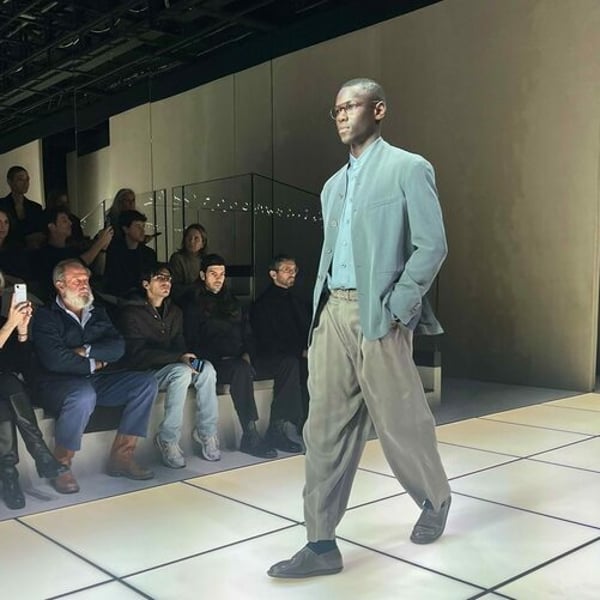
There was a changing of the guard and of gears at Giorgio Armani Monday morning, as Leo Dell’Orco presented a smooth and chic debut collection for the house, the final important show of Milano Uomo Moda.
A velvet suit by Giorgio Armani – FashionNetwork.com
The collection was the first not designed for the house by eponymous designer Giorgio Armani, who passed away in September last year.
Inevitably, Dell’Orco, Giorgio Armani’s right-hand man for the past four decades, sent out a collection that was hyper respectful of the master’s DNA. Yet he still added his own imprint to a signature collection that featured over a dozen women’s looks that practically matched the menswear designs they marched beside.
Leo also upped the pace of the show, which was no bad thing, and concentrated on what the house of Armani does best- impeccable, fluid tailoring. Most notably with some excellent jackets and blazers. Varying between one-button blazers with elongated shawl lapels made in the house’s signature non-colours of mud, cement, or wheat. To five-button Nehru jackets, again riffing on old Giorgio favourites- from zig zag pattern to waffle style. Paired with forgiving tapered pants that nipped at the ankle it all made for a very flattering silhouette.
A woman’s look on the runway – FashionNetwork.com
Leo did break new ground in terms of colours, showing some great olive green or amethyst velvet shirts, pinstripe jackets and coats- for men and women. Along with superb silk mandarin jackets in dashing Colombia blue. While Giorgio’s love of Asian design was remembered in a great series of silk shirts with high smoking collars.
A change of guard also on the board, where recently appointed members John Hooks and Marco Bizzarri sat smiling in the audience.
“It feels emotional to be back after 15 years,” commented Hooks, the house’s managing director for a decade until 2011. While a beaming Bizzarri predicted: “expect an exciting 18 months at the house of Armani.”
As noted, under the terms of Giorgio Armani’s will, the childless late designer left instructions that his heirs sell 15% of the house within 18 months of his death. And then a further 35% to 54.9% to the same buyer.
Muted tones at Giorgio Armani – FashionNetwork.com
However, after watching this show, one got the distinct impression that no one in Armani is in any great hurry to sell.
Clearly enjoying his new role, Dell’Orco took a few risks with his choice of coats, showing dramatic double-face slate grey topcoats with funnel necks, or the sleekest meeting of a chauffeur’s tunic and long coat in putty grey. One could sense the models loved wearing them, too.
In another marked change, the models appeared quicker and marched faster in two morning shows, held in the famed Armani show-space in the basement of Giorgio’s personal palazzo on central Via Borgonuovo.
The collection and show did lose focus towards the finale, with some odd knits and a good deal or repetition. It lacked the ruthless self-editing for which King Giorgio was famous. But overall, this felt like a successful passage into a new era, and a win for the house.
Leo Dell’Orco with his nephew Gianluca Dell’Orco on the runway – FashionNetwork.com
In a generous gesture, Leo took his bow with his nephew Gianluca Dell’Orco, a design director for menswear.
Bowing, smiling, and ebullient- aided by the galactic funk and gentle techno soundtrack, including Evolver by AstroMat. Armani soundtracks traditionally had been one of Leo Dell’Orco’s responsibilities.
And one could not help to chant during the show “Ashes to Ashes,” the traditional refrain at funerals, suggesting there is a future life immortal in heaven.
Valentino Garavani, an icon of Italian fashion, founder of his eponymous maison, and widely regarded as one of the greatest designers of all time, died in Rome on January 19, surrounded by his loved ones.
Born in Voghera, Italy on May 11, 1932, he showed remarkable artistic talent from an early age, which led him to study drawing and fashion in Paris, where he worked with couturiers such as Jean Dessès and Guy Laroche.
Upon returning to Italy, he opened his first atelier on Via Condotti in Rome in 1960, supported by his business partner, Giancarlo Giammetti. International success soon followed: his debut show at Florence’s Palazzo Pitti in 1962 marked his breakthrough, establishing him as an undisputed standard-bearer of Italian fashion worldwide. In 1968, the famous “V” logo was introduced, later becoming the emblem of the maison. Equally iconic is his signature red, inspired by a gown he saw at the opera in his youth, which made this shade a defining hallmark of the house.
Valentino Garavani announced his retirement in 2007, at the age of 75, with a final show celebrating his extraordinary career. His legacy is also chronicled in the 2008 documentary directed by Matt Tyrnauer: “Valentino: The Last Emperor.”
Garavani’s lying in state will be held at PM23, Piazza Mignanelli 23 in Rome, on Wednesday and Thursday, January 21 and 22, 2026, from 11:00 to 18:00. The funeral will take place on Friday, January 23, 2026, at 11:00, at the Basilica of Santa Maria degli Angeli e dei Martiri, Piazza della Repubblica 8, Rome.
This article is an automatic translation. Click here to read the original article.
Maintaining consistency and not over-reacting on pricing is key for retailers as customers seek stability, the CEO of the biggest global IKEA franchisee told Reuters on Monday.
Deputy CEO and CFO of Ingka Group Juvencio Maeztu, visits an IKEA store in London, Britain November 28, 2023 – REUTERS/Maja Smiejkowska/File Photo
After hiking prices during the Covid-19 pandemic due to supply chain disruptions, the world’s biggest furniture retailer has cut prices over the past two years as high inflation and weak housing markets dented consumer demand.
“Companies want to have predictability and stability, but consumers also want to have stability in prices,” Ingka Group CEO Juvencio Maeztu said on the side-lines of the World Economic Forum annual meeting in Davos, Switzerland. “You have to secure stability as much as possible in the low prices,” he told the Reuters Global Markets Forum.
IKEA has been forced to increase prices again on some products in the United States, where it depends more on imports than elsewhere, to offset the impact of tariffs. Importers are braced for a Supreme Court ruling on the legality of President Donald Trump‘s sweeping global tariffs.
Asked about the ruling Maeztu, who became CEO in November last year, said he did not want to speculate. “What we are learning is we need to take things as they come, one by one,” he said.
“We cannot over-react, especially in pricing. We need to keep some kind of consistency,” he said, adding it was more important than ever to “zoom out” from short-term disruptions.
Ingka Group, which owns stores in 32 markets and accounts for 87% of IKEA sales, reported its lowest annual sales since 2021 in October, after cutting prices to attract consumers. Consumer sentiment across markets is now a “mix of being cautious and optimistic, both at the same time,” Maeztu said.
Kiton closes FY2025 with revenue up 3% at €230 million, and announces its arrival on Milan’s Via Montenapoleone in September.
Kiton, FW 2026/27
The Neapolitan men’s luxury brand grew “consistently across all regions, with the United States confirming its position as the leading market,” the company’s CEO, Antonio De Matteis, tells FashionNetwork.com.
For 2026, the company “already has a significant order book and we are quite confident. Right now, quality pays. End customers are looking for companies of great quality,” the CEO continues.
Today Kiton has 67 single-brand boutiques, which it aims to increase to 70 this year, including through a major investment in Milan. “In September we will open our second flagship in Milan, on Via Montenapoleone. It will be a very important step for us. We are not relocating; we are doubling up. We already have a 250 square-metre, two-storey space,” De Matteis reveals.
The focus on the wholesale channel has also been renewed. “I call it the training ground for companies, where they can test themselves against their competitors. Today the big department stores are the ones suffering; we hope this phase will pass. We remain convinced that wholesale will never end, because customers always enjoy shopping where they can see a broader selection of items,” says the entrepreneur.
In terms of product range, Kiton has turbocharged its accessories. “My nephew, who oversees the line, is doing an excellent job. The third generation is bringing us great satisfaction. KNT is also doing very well. It remains our great laboratory where we experiment with fabrics, patterns, proportions, and silhouettes. It is a tremendous help to the company. It shows us how far we can push and how far our end customer is willing to go,” De Matteis continues.
Kiton’s number one then downplays the impact of Trump’s tariffs. “The biggest issue this year has been the effect of exchange rates. Tariffs were not a problem, but we suffered a lot from the dollar’s depreciation. It costs us a few million in revenue and margin. Today the euro is too strong; it penalises us. We sell a year in advance, but ultimately we take in less,” notes the CEO.
In Milan, the brand presented its latest collection inside a “cinema” that shone a light on the behind-the-scenes of the historic tailoring house. “At a time when the supply chain is being called into question, we show how our garments are made. We own 100% of all the companies that make our products. ‘The Truth of Making’ is an expression of our transparency,” says De Matteis, who concludes with an anecdote from the founder, Ciro Paone. “My uncle used to say ‘The customer forgets the price and remembers the quality’.”
This article is an automatic translation. Click here to read the original article.