Connect with us

Business

I lead IBM Consulting, here’s how AI-first companies must redesign work for growth

Published

on


Across every industry, organizations are investing heavily in the potential of artificial intelligence to reshape how they operate and grow. Nearly 80% of executives expect AI to significantly contribute to revenue by 2030, yet only 24% know where that revenue might come from. 

This isn’t an awareness gap. It’s an architecture gap.

The companies already capturing AI’s value aren’t waiting to discover it through pilots and proofs-of-concept. They’re engineering it through deliberate choices about how work gets designed, how human and digital workers come together, and how productivity savings are reinvested. 

From our work with enterprises across every major industry, a clear divide is emerging. 

Some organizations are bolting AI onto legacy workflows and gaining marginal productivity. Others are redesigning how value gets created and building growth trajectories competitors can’t replicate.

By 2030, this won’t be just a short-term positioning advantage. It will determine who remains in business. The difference comes down to three architectural choices that separate AI-first enterprises from everyone else.

Redesign Work Itself, Don’t Just Augment It

Most AI adoption fails because organizations are automating fundamentally broken processes. They’re making inefficient work more efficient—and wondering why transformation doesn’t happen.

AI-first enterprises start with a different question: If we were designing this work today with no legacy constraints, what outcome do we want? And what combination of human judgment and AI capability achieves that outcome best?

Nestlé provides a powerful example of a more than a centry-old global enterprise. The company isn’t just adding AI features to existing systems. They’re building an AI-powered enterprise architecture that understands their entire product ecosystem, supply chain, and consumer relationships in ways generic models never could. The goal isn’t incremental improvement—it’s the capability to deliver superior products faster while creating more personalized experiences for employees and customers.

Riyadh Air represents the opposite end of the business spectrum—a startup with no legacy constraints. But the principle is identical. The airline is building an AI-native operation from day one, with a unified architecture connecting operations, employees, and customers as a single intelligent system.

The insight both share is that the digital backbone isn’t just infrastructure. It’s the intentional architecture that allows humans and AI to work as integrated capabilities, creating adaptability that compounds over time.

Build Proprietary Intelligence, Not Just Access to Models

By 2030, everyone will have access to powerful AI models. The winners will have customized AI that knows their business better than any third-party AI possibly could.

L’Oréal isn’t just using AI to accelerate R&D. They’re building a custom AI foundation model trained on their proprietary formulation data, scientific research, and sustainability requirements.
These models will give their scientists capabilities no competitor could replicate, enabling new scientific possibilities that wouldn’t otherwise exist.

In our recent survey, more than half of executives expect their competitive edge to come from AI model sophistication specifically. Sophistication also comes from proprietary data, custom models tuned to specific challenges, and continuous learning loops. Organizations need multi-model portfolios – some proprietary, some licensed, all integrated into architectures that evolve as quickly as their markets.

The most valuable companies won’t be those with the most data. They’ll be the ones that turn data into AI-driven decisions at scale, with intelligence competitors can’t mimic by simply licensing better models.

Engineer Growth Loops, Not Just Efficiency Gains

Most AI strategies fail because they treat productivity as the destination.

Executives expect AI to boost productivity by 42% by 2030. But if you bank those gains as cost savings, you’ve fundamentally misunderstood the opportunity. AI-first enterprises treat productivity as fuel by reinvesting efficiency gains into new products, services, and markets.

The pattern works like this: AI-driven efficiency frees capital and talent. That freed capacity funds innovation in new markets. New markets generate new data. New data trains better AI. Better AI creates more efficiency. The loop accelerates.

L’Oréal scientists won’t just make formulations faster—this speed will allow them to explore sustainable ingredients that were not economically feasible before. Nestlé isn’t just optimizing supply chains—they’re using those gains to build direct consumer relationships that transform how people interact with their products. Riyadh Air isn’t just building a new airline—they’re stripping out fifty years of legacy in a single stroke that will define the next decade of aviation.

This creates exponential divergence. While laggards optimize margins, leaders accelerate into new markets, building capabilities that compound. By 2030, the gap won’t be measurable in productivity percentages. It will be measurable in entirely different business models.

The Questions That Determine Who Wins

The next era of growth won’t be predicted. It will be engineered. Leaders must answer three uncomfortable questions now:

  1. If we redesigned our operations with AI-first principles, what would we stop doing entirely? Not what would we do faster, rather, what would we eliminate? Most organizations discover that 30-40% of their workflows exist solely to compensate for constraints that AI removes. But elimination requires courage optimization avoids.
  2. What proprietary intelligence could we build that competitors can’t replicate? Not what AI can you license, but what AI could you engineer—built on the human expertise unique to your organization—that is so deeply tuned to your business that competitors would need a decade to catch up?
  3. Are we banking productivity gains or reinvesting them into growth loops?  Cost savings are finite, but growth loops are exponential. Which one is your strategy building?

By 2030, the companies that can answer these questions won’t just be more productive. They’ll be operating in markets competitors didn’t know existed, with capabilities competitors can’t build, and business models competitors can’t afford.

The real risk isn’t moving too fast on AI. It’s engineering too slowly while competitors redesign the game entirely.

The opinions expressed in Fortune.com commentary pieces are solely the views of their authors and do not necessarily reflect the opinions and beliefs of Fortune.



Source link

Continue Reading

Business

Microsoft researchers have revealed the 40 jobs most exposed to AI—and even teachers make the list

Published

on


As companies like Amazon publicly announce AI-driven workforce reductions, workers are scrambling to understand which careers might soon disappear and be outsourced to technology.

A report from Microsoft researchers studying the occupational implications of generative AI offers some clarity.

Translators, historians, and writers are among the roles with the highest AI applicability score, meaning the job’s tasks are most closely aligned with AI’s current abilities, according to the report that ranked professions. Customer service and sales representatives—which make up about 5 million jobs in the U.S.—will also have to compete with AI. 

Overall, the jobs most exposed are ones that involve knowledge work—like people doing computer, math, or administrative work in an office, the researchers wrote. Sales jobs are also high on the list, since they often involve sharing and explaining information.

While Microsoft said high applicability doesn’t automatically mean those jobs will necessarily be replaced by AI, the list of roles quickly went viral—with professionals deeming them “most at risk.” It comes as companies like IBM have been freezing thousands of would-be new roles that it expects AI will take over in the next 5 years, and graduates in the U.K. are facing the worst job market since 2018 as employers pause hiring and use AI to cut costs, said Indeed.

Of course, there are some jobs that are unlikely to be touched by AI: Dredge operators; bridge and lock tenders; and water treatment plant and system operators are among the jobs with virtually no generative AI exposure, thanks in part to their hands-on equipment requirements.

Still, business leaders like Nvidia CEO Jensen Huang have said every job will be touched by AI in some way, and so it’s best to embrace it. 

“Every job will be affected, and immediately. It is unquestionable,” Huang said at the Milken Institute’s Global Conference in 2025. “You’re not going to lose your job to an AI, but you’re going to lose your job to someone who uses AI.”

A degree won’t save you from AI’s jobs revolution

Many of the jobs with high chances of getting upended by AI soon, like political scientists, journalists, and management analysts, are all ones that typically require a four-year degree to land a job. And as the researchers point out, having a degree—which was once considered a surefire path to career advancement—is no longer a safeguard against the changing tides. 

“In terms of education requirements, we find higher AI applicability for occupations requiring a Bachelor’s degree than occupations with lower requirements,” wrote the researchers, who studied 200,000 real-world conversations of Copilot users and cross-compared the AI’s performance with occupational data.

On the flip side, there are some career paths with low AI exposure, that are growing in demand. The health care sector, in particular, is an area that is experiencing this heavily. The home health and personal care aid industry is expected to create among the greatest number of new jobs over the next decade, according to the U.S. Bureau of Labor.

At the same time, the researchers recognized even their findings don’t capture the full scope of the AI revolution—and there could be further automation caused by more than just generative technology: “Our measurement is purely about LLMs: other applications of AI could certainly affect occupations involving operating and monitoring machinery, such as truck driving.”

Kiran Tomlinson, a senior Microsoft researcher, told Fortune the study focused on highlighting where AI might change how work is done, not take away or replace jobs.

“Our research shows that AI supports many tasks, particularly those involving research, writing, and communication, but does not indicate it can fully perform any single occupation. As AI adoption accelerates, it’s important that we continue to study and better understand its societal and economic impact,” Tomlinson said.

Gen Z’s big bet on education might not be all glam

After seeing the rollercoaster of layoffs across the tech industry over the past few years, many Gen Zers have turned to seemingly steadier fields like education.

The sector was the fastest-growing industry among recent U.K. graduates last year, and it was similarly a top career choice for American graduates. And while the profession can provide further work-life balance and decent benefits, the ability for AI to do the work may cause further headache. The report singles out farm and home management educators—as well as postsecondary economics, business, and library science teachers—as roles with relatively high AI applicability.

While it’s unlikely that schools will roll out AI teachers en masse, the report’s findings underscore how quickly the technology could reshape the education profession—and many others.

The top 10 least affected occupations by generative AI:

  1. Dredge Operators
  2. Bridge and Lock Tenders
  3. Water Treatment Plant and System Operators
  4. Foundry Mold and Coremakers
  5. Rail-Track Laying and Maintenance Equipment Operators
  6. Pile Driver Operators
  7. Floor Sanders and Finishers
  8. Orderlies
  9. Motorboat Operators
  10. Logging Equipment Operators

The top 40 most affected occupations by generative AI:

  1. Interpreters and Translators
  2. Historians
  3. Passenger Attendants
  4. Sales Representatives of Services
  5. Writers and Authors
  6. Customer Service Representatives
  7. CNC Tool Programmers
  8. Telephone Operators
  9. Ticket Agents and Travel Clerks
  10. Broadcast Announcers and Radio DJs
  11. Brokerage Clerks
  12. Farm and Home Management Educators
  13. Telemarketers
  14. Concierges
  15. Political Scientists
  16. News Analysts, Reporters, Journalists
  17. Mathematicians
  18. Technical Writers
  19. Proofreaders and Copy Markers
  20. Hosts and Hostesses
  21. Editors
  22. Business Teachers, Postsecondary
  23. Public Relations Specialists
  24. Demonstrators and Product Promoters
  25. Advertising Sales Agents
  26. New Accounts Clerks
  27. Statistical Assistants
  28. Counter and Rental Clerks
  29. Data Scientists
  30. Personal Financial Advisors
  31. Archivists
  32. Economics Teachers, Postsecondary
  33. Web Developers
  34. Management Analysts
  35. Geographers
  36. Models
  37. Market Research Analysts
  38. Public Safety Telecommunicators
  39. Switchboard Operators
  40. Library Science Teachers, Postsecondary

A version of this story originally published on Fortune.com on July 31, 2025.

More on artificial intelligence:

Join us at the Fortune Workplace Innovation Summit May 19–20, 2026, in Atlanta. The next era of workplace innovation is here—and the old playbook is being rewritten. At this exclusive, high-energy event, the world’s most innovative leaders will convene to explore how AI, humanity, and strategy converge to redefine, again, the future of work. Register now.


Source link

Continue Reading

Business

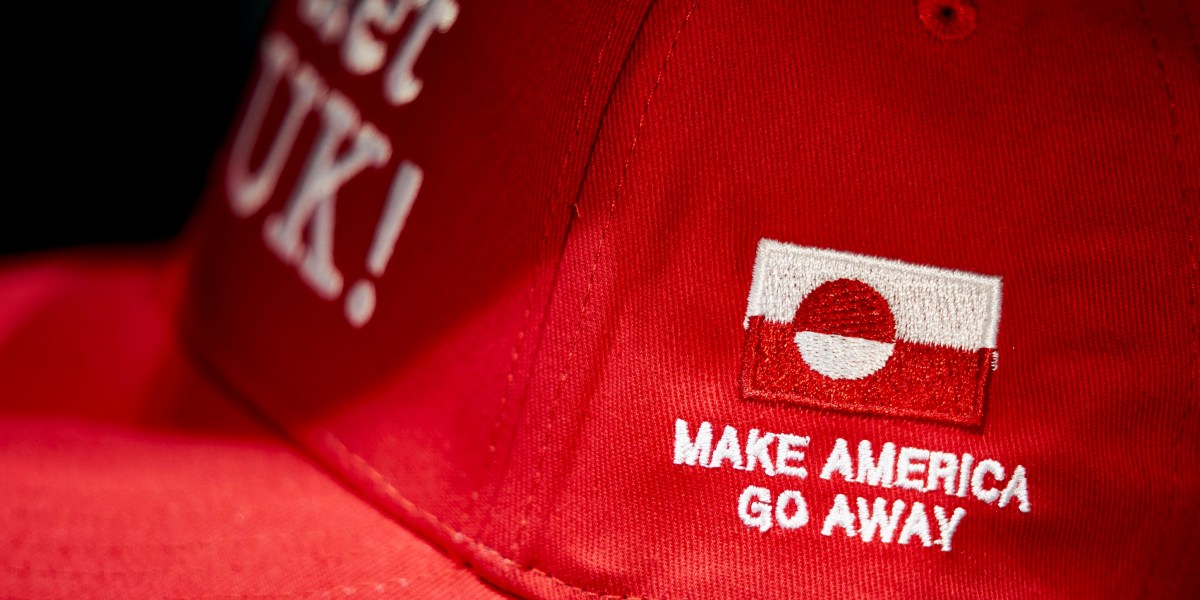
Pro-Greenland protesters mock Trump’s MAGA slogan with ‘Make America Go Away’ caps

Published

on


COPENHAGEN, Denmark (AP) — Red baseball caps spoofing Donald Trump’s iconic MAGA hats have become a symbol of Danish and Greenlandic defiance against the U.S. president’s threat to seize the frozen territory.

The caps reading “Make America Go Away” — parodying Trump’s “Make America Great Again” slogan — have gained popularity along with several variants on social media and at public protests, including a weekend demonstration held in freezing weather in the Danish capital.

European governments are rallying behind Denmark, citing the need to defend Arctic regions and warning that threats against Greenland undermine Western security.

Protesters, however, are less diplomatic.

“I want to show my support to Greenland and also show that I don’t like the president of the United States,” said 76-year-old Copenhagen resident Lars Hermansen, who wore one of the red caps at a protest Saturday.

The mock hats were created by Copenhagen vintage clothing store owner Jesper Rabe Tonnesen. Early batches flopped last year — until the Trump administration recently escalated its rhetoric over Greenland. Now there are popping up everywhere.

“When a delegation from America went up to Greenland, we started to realize this probably wasn’t a joke — it’s not reality TV, it’s actually reality,” said Tonnesen, 58. “So I said, OK, what can I do?” Can I communicate in a funny way with a good message and unite the Danes to show that Danish people support the people of Greenland?”

Demand suddenly surged from a trickle to selling out in the space of one weekend. Tonnesen said he has now ordered “several thousand.”

The original version designed by Tonnesen featured a play on words: “Nu det NUUK!” — a twist on the Danish phrase “Nu det nok,” meaning “Now it’s enough,” substituting Nuuk, Greenland’s tiny capital.

Protesters at Saturday’s rally waved red-and-white Danish and Greenlandic flags and carried handmade signs mocking U.S. claims over the territory, which is slightly larger than Saudi Arabia.

“No Means No,” read one sign. Another declared, “Make America Smart Again.”

Wearing one of the spoof hats, protester Kristian Boye, 49, said the gathering in front of Copenhagen City Hall struck a lighthearted tone while delivering a serious message.

“I’m here to support the Greenlanders, who are going through a very hard time right now,” he said. “They are being threatened with having their country invaded. I think it’s totally unacceptable.”

This story was originally featured on Fortune.com


Source link

Continue Reading

Business

U.S. Supreme Court ruling on tariffs could derail Trump’s plan to take Greenland

Published

on


The U.S. Supreme Court could rule on Tuesday that President Donald Trump’s trade tariffs are illegal—and that would throw up a significant hurdle for his plan to acquire Greenland.

President Trump posted his latest threat to take over Greenland late last night on Truth Social: “Now it is time, and it will be done!!!”

Previously, on Saturday, he threatened to impose tariffs of 10%, rising to 25%, on Denmark, Norway, Sweden, France, Germany, the U.K., the Netherlands, and Finland, rising to 25% on June 1, “until such time as a Deal is reached for the Complete and Total purchase of Greenland.”

But analysts noted this morning that the court is due to issue rulings on Tuesday and Wednesday of this week. The expectation on Wall Street is that the court will rule that the president does not have the power under the International Emergency Economic Powers Act (IEEPA) to impose tariffs on routine international trade. If that happens, Trump’s threats could become meaningless, at least in the short-term.

“Threatened U.S. tariffs … may be overturned by the U.S. Supreme Court,” UBS advised clients in a note this morning.

At ING, Carsten Brzeski and Bert Colijn said, “If the Supreme Court rules against all earlier IEEPA tariffs, Trump’s latest announcement [about Greenland] would be void, and he would have to find other tariffs. Something that would take more time.”

The ruling had been expected earlier this month. The delay has caused some to speculate that the court, which at oral arguments appeared to be skeptical of the White House’s arguments, may now be leaning toward the Trump Administration. The court has a history of taking longer to produce its big, unexpected rulings.

“While the Court is positioned to issue additional opinions this week—sessions are scheduled for Tuesday and Wednesday—our economists’ expectation is that the ruling may not come until later in the year, potentially as late as June,” Jim Reid and his colleagues at Deutsche Bank said in their morning note.

Join us at the Fortune Workplace Innovation Summit May 19–20, 2026, in Atlanta. The next era of workplace innovation is here—and the old playbook is being rewritten. At this exclusive, high-energy event, the world’s most innovative leaders will convene to explore how AI, humanity, and strategy converge to redefine, again, the future of work. Register now.


Source link

Continue Reading

Trending

Copyright © Miami Select.