Connect with us

Business

Down Arrow Button Icon

Published

on


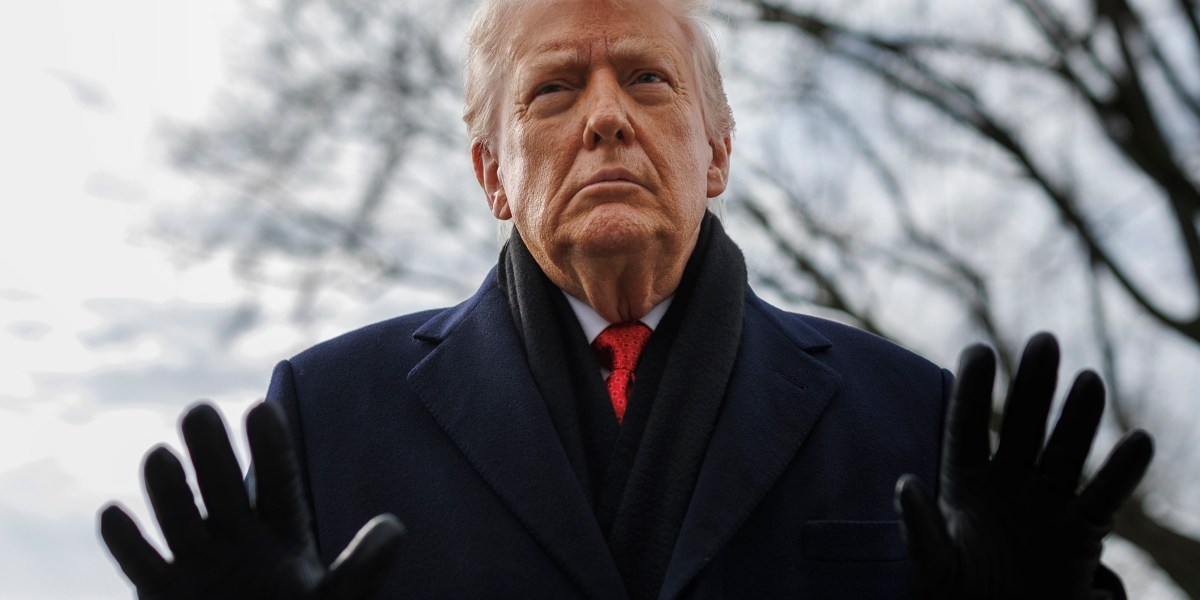
Stock markets went into a global selloff this morning as world leaders at Davos woke up to the news that U.S. President Trump had texted the prime minister of Norway to say that his repeated threats to take over Greenland were based on the fact that he didn’t win the Nobel Peace Prize.

“Considering your Country decided not to give me the Nobel Peace Prize … I no longer feel an obligation to think purely of Peace, although it will always be predominant, but can now think about what is good and proper for the United States of America,” Trump’s message to Jonas Gahr Støre said. “The World is not secure unless we have Complete and Total Control of Greenland.”

The Norwegian government has no control over how the Nobel Committee awards its prizes. Greenland is a territory of Denmark, not Norway.

Late last night Trump posted again on social media, “NATO has been telling Denmark, for 20 years, that ‘you have to get the Russian threat away from Greenland.’ Unfortunately, Denmark has been unable to do anything about it. Now it is time, and it will be done!!!”

Traders, dismayed at the prospect of a renewed trade war between the U.S. and Europe, reacted by driving down equities all over the world.

S&P 500 futures were down 1.12% this morning—an unusually steep drop. The last session closed flat. (Markets in the U.S. are closed for Martin Luther King Jr. Day.) The STOXX Europe 600 fell 1.25% in early trading, the U.K.’s FTSE 100 was down 0.49% before lunch. Japan’s Nikkei 225 was down 0.65%. China’s CSI 300 was flat. India’s NIFTY 50 was down 0.42%. Bitcoin declined to $93K. The only major national index having a good day was South Korea, where the KOSPI rose 1.32%.

Gold, the traditional safe-haven investment, hit a new record high of $4,673.4, on the Comex continuous contract.  

Wall Street’s analysts are broadly agreed that President Trump’s repeated threats to force Denmark to “give back” Greenland and to impose an escalating series of trade tariffs on the U.K. and E.U. if those countries don’t comply are bad for equities globally. They differ only in their assessment of how bad this will get.

ING’s Carsten Brzeski and Bert Colijn told clients, “Overall, we can only repeat our earlier estimates that additional tariffs of 25% would probably shave 0.2 percentage points off European GDP growth. However, this model-based estimate definitely falls short in capturing the full impact of new uncertainty and geopolitical tensions as a result of escalated tensions.”

They also cautioned, “As has been the case before, it is not exactly clear how this will work out as there has been no official communication from the White House, yet, just Trump’s announcement on social media.”

The pair also warned that Trump may be underestimating how resistant Europe is going to be. “While Europe, at least initially, seems to be determined to stand up against the latest tariff threat and the U.S. President’s claims on Greenland, the reality is that Europe is still dependent on the U.S. in many ways, both from an economic and security point of view. This was likely one of the central reasons behind the E.U.’s agreement last summer to agree to a trade deal with the U.S. that did not benefit Europe. Whether the new tariff threat and the situation in Greenland turn out to be the tipping point that finally triggers European unity and Europe’s rise as a geopolitical power remains to be seen. What is clear is that a full-blown trade war between the E.U. and the U.S. would leave only losers.”

At UBS, Paul Donovan’s morning note warned that new tariffs could rebound against American consumers. “Threatened U.S. tariffs appear more serious than those relating to Iran … they imply U.S. consumer prices of goods from the E.U. and UK will increase 4% to 10% (within about six months). This may reinforce the narrative of the U.S. affordability crisis.”

“Policy uncertainty is resurrected for U.S. businesses. This has constrained investment and hiring, but might have faded as firms adapt. Uncertainty on this scale may again put U.S. corporate activity on pause.”

There is also the question of whether Trump has enough domestic political capital to sustain his desire to conquer Greenland. 

“A Reuters/Ipsos poll last week suggested that only 17% of US citizens supported efforts to acquire Greenland, with 47% against. Only 4% approved of using military force with only 8% of Republican voters agreeing,” Jim Reid and his team at Deutsche Bank told clients this morning.

Here’s a snapshot of the markets ahead of the opening bell in New York this morning:

  • S&P 500 futures were down 1.12% this morning. The last session closed flat. Markets in the U.S. are closed for MLK Day.
  • STOXX Europe 600 was down 1.25% in early trading.
  • The U.K.’s FTSE 100 was down 0.49% in early trading. 
  • Japan’s Nikkei 225 was down 0.65%.
  • China’s CSI 300 was flat. 
  • The South Korea KOSPI was up 1.32%. 
  • India’s NIFTY 50 was down 0.42%. 
  • Bitcoin was down to $93K.


Source link

Continue Reading

Business

Pro-Greenland protesters mock Trump’s MAGA slogan with ‘Make America Go Away’ caps

Published

on


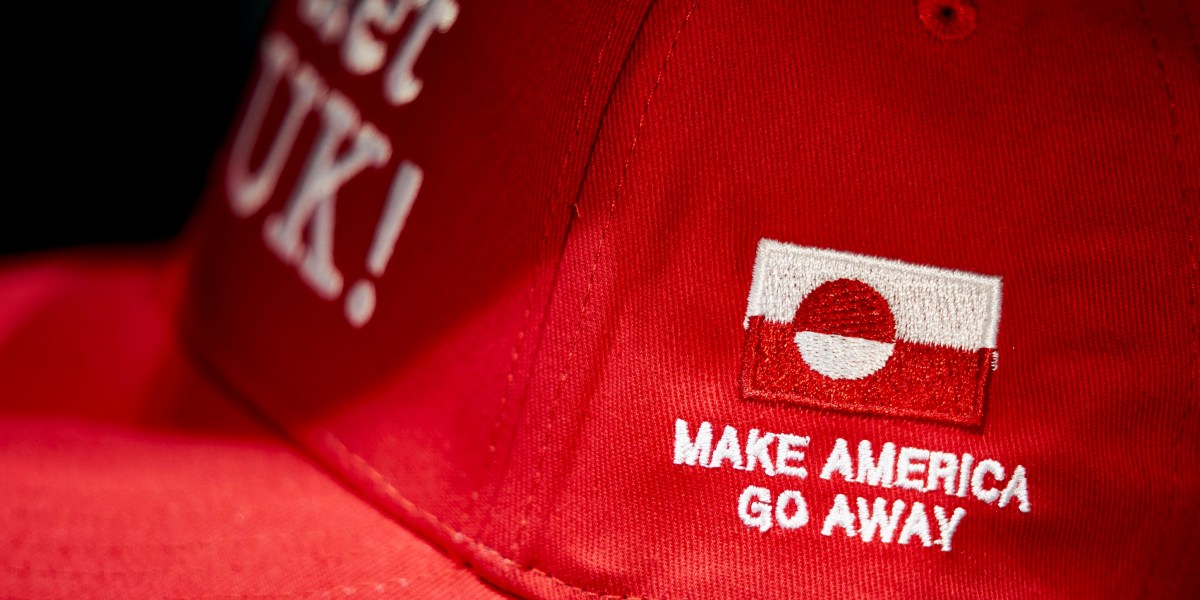
COPENHAGEN, Denmark (AP) — Red baseball caps spoofing Donald Trump’s iconic MAGA hats have become a symbol of Danish and Greenlandic defiance against the U.S. president’s threat to seize the frozen territory.

The caps reading “Make America Go Away” — parodying Trump’s “Make America Great Again” slogan — have gained popularity along with several variants on social media and at public protests, including a weekend demonstration held in freezing weather in the Danish capital.

European governments are rallying behind Denmark, citing the need to defend Arctic regions and warning that threats against Greenland undermine Western security.

Protesters, however, are less diplomatic.

“I want to show my support to Greenland and also show that I don’t like the president of the United States,” said 76-year-old Copenhagen resident Lars Hermansen, who wore one of the red caps at a protest Saturday.

The mock hats were created by Copenhagen vintage clothing store owner Jesper Rabe Tonnesen. Early batches flopped last year — until the Trump administration recently escalated its rhetoric over Greenland. Now there are popping up everywhere.

“When a delegation from America went up to Greenland, we started to realize this probably wasn’t a joke — it’s not reality TV, it’s actually reality,” said Tonnesen, 58. “So I said, OK, what can I do?” Can I communicate in a funny way with a good message and unite the Danes to show that Danish people support the people of Greenland?”

Demand suddenly surged from a trickle to selling out in the space of one weekend. Tonnesen said he has now ordered “several thousand.”

The original version designed by Tonnesen featured a play on words: “Nu det NUUK!” — a twist on the Danish phrase “Nu det nok,” meaning “Now it’s enough,” substituting Nuuk, Greenland’s tiny capital.

Protesters at Saturday’s rally waved red-and-white Danish and Greenlandic flags and carried handmade signs mocking U.S. claims over the territory, which is slightly larger than Saudi Arabia.

“No Means No,” read one sign. Another declared, “Make America Smart Again.”

Wearing one of the spoof hats, protester Kristian Boye, 49, said the gathering in front of Copenhagen City Hall struck a lighthearted tone while delivering a serious message.

“I’m here to support the Greenlanders, who are going through a very hard time right now,” he said. “They are being threatened with having their country invaded. I think it’s totally unacceptable.”

This story was originally featured on Fortune.com


Source link

Continue Reading

Business

U.S. Supreme Court ruling on tariffs could derail Trump’s plan to take Greenland

Published

on


The U.S. Supreme Court could rule on Tuesday that President Donald Trump’s trade tariffs are illegal—and that would throw up a significant hurdle for his plan to acquire Greenland.

President Trump posted his latest threat to take over Greenland late last night on Truth Social: “Now it is time, and it will be done!!!”

Previously, on Saturday, he threatened to impose tariffs of 10%, rising to 25%, on Denmark, Norway, Sweden, France, Germany, the U.K., the Netherlands, and Finland, rising to 25% on June 1, “until such time as a Deal is reached for the Complete and Total purchase of Greenland.”

But analysts noted this morning that the court is due to issue rulings on Tuesday and Wednesday of this week. The expectation on Wall Street is that the court will rule that the president does not have the power under the International Emergency Economic Powers Act (IEEPA) to impose tariffs on routine international trade. If that happens, Trump’s threats could become meaningless, at least in the short-term.

“Threatened U.S. tariffs … may be overturned by the U.S. Supreme Court,” UBS advised clients in a note this morning.

At ING, Carsten Brzeski and Bert Colijn said, “If the Supreme Court rules against all earlier IEEPA tariffs, Trump’s latest announcement [about Greenland] would be void, and he would have to find other tariffs. Something that would take more time.”

The ruling had been expected earlier this month. The delay has caused some to speculate that the court, which at oral arguments appeared to be skeptical of the White House’s arguments, may now be leaning toward the Trump Administration. The court has a history of taking longer to produce its big, unexpected rulings.

“While the Court is positioned to issue additional opinions this week—sessions are scheduled for Tuesday and Wednesday—our economists’ expectation is that the ruling may not come until later in the year, potentially as late as June,” Jim Reid and his colleagues at Deutsche Bank said in their morning note.

Join us at the Fortune Workplace Innovation Summit May 19–20, 2026, in Atlanta. The next era of workplace innovation is here—and the old playbook is being rewritten. At this exclusive, high-energy event, the world’s most innovative leaders will convene to explore how AI, humanity, and strategy converge to redefine, again, the future of work. Register now.


Source link

Continue Reading

Business

Elon Musk: AI, robotics will make work optional and money irrelevant in 10 to 20 years

Published

on


In the future, Elon Musk sees humans as metaphorical vegetable farmers.

The Tesla CEO said at the recent U.S.-Saudi Investment Forum in Washington that in the next 10 to 20 years, work will be optional, likening the decision to have a job to the more laborious upkeep of a vegetable garden.

“My prediction is that work will be optional. It’ll be like playing sports or a video game or something like that,” Musk said. “If you want to work, [it’s] the same way you can go to the store and just buy some vegetables, or you can grow vegetables in your backyard. It’s much harder to grow vegetables in your backyard, and some people still do it because they like growing vegetables.”

The future of optional work will be the result of millions of robots in the workforce able to usher in a wave of enhanced productivity, according to Musk. The tech mogul, worth about $681 billion, has made the recent push to expand Tesla beyond just electric vehicles, working on consolidating his sprawling business interests into his broader vision of an AI-fueled, robotic-powered future. That includes his goal of having 80% of Tesla’s value come from his Optimus robots, despite continuous production delays for the humanoid bots. 

These advancements in automation will have other benefits, too, according to Musk. In an episode of the Moonshots with Peter Diamandis podcast earlier this month, the Tesla CEO predicted his automatons would outnumber human surgeons within the decade. These advancements in medical care would exceed the quality of service the president receives, he said.

In Musk’s imagined future, humans would need that exceptional medical care for longer. He told Diamandis overcoming the problem of a limited lifespan is a programming issue, with access to immortality within human reach thanks to AI.

“You’re pre-programmed to die. And so if you change the program, you will live longer,” Musk said.

Addressing growing pains of an automated future

To many others, the notion of an automated future is less bright, particularly amid concerns about and early evidence of AI displacing entry-level jobs, which may be contributing to Gen Z’s job market woes and flatlining income growth—more of a nightmare than a utopian dream.

But in Musk’s automated, job-voluntary future, money won’t be an issue, he said. Musk takes a page from Iain M. Banks’ Culture series of science fiction novels, in which the self-proclaimed socialist author conjures a post-scarcity world filled with superintelligent AI beings and no traditional jobs.

“In those books, money doesn’t exist. It’s kind of interesting,” Musk said. “And my guess is, if you go out long enough—assuming there’s a continued improvement in AI and robotics, which seems likely—money will stop being relevant.” 

At Viva Technology 2024, Musk suggested “universal high income” would sustain a world without necessary work, though he did not offer details on how this system would function. His reasoning rhymes with that of OpenAI CEO Sam Altman, who has advocated for universal basic income, or regular payments given unconditionally to individuals, usually by the government. 

“There would be no shortage of goods or services,” Musk said at last year’s conference.

Tesla did not immediately respond to Fortune’s request for comment.

Is Musk’s optional-work vision possible?

Creating the world Musk is describing will be a challenge, according to economists. First of all, there’s the question of whether the technology to automate jobs will be accessible and affordable in the next couple of decades. While the cost of AI is decreasing, robotics are stubbornly expensive, making them harder to scale, according to Ioana Marinescu, an economist and associate professor of public policy at the University of Pennsylvania, who alongside colleague Konrad Kording published a working paper at the Brookings Institution last year. (For example, AI expense management platform Ramp noted in April 2025 companies are now paying $2.50 per 1 million tokens—the fundamental unit for powering AI—compared with $10 a year ago.) 

“We’ve been at it making machines forever, since the industrial revolution, at scale,” Marinescu told Fortune. “We know from economics that … you often run—for these kinds of activities—into decreasing returns, as it gets harder in order to make progress in a line of technology that you’ve been at, in this case, for a couple of centuries.”

AI is progressing rapidly, she said. Large language models can be applied to myriad white-collar careers, while physical machines, which she said are necessary in automated labor, are not only more expensive, but highly specialized, contributing to the slowdown in their workplace implementation.

Marinescu agrees with Musk’s vision of full-scale automation as the future of labor, but she is dubious about his timeline—not only because of the limitations of robotics, but also because AI adoption in the workplace is still not as rapid as anticipated, despite recent tech-related layoffs. A Yale Budget Lab report from October 2025 found that since ChatGPT’s November 2022 public release, the “broader labor market has not experienced a discernible disruption” because of AI automation.

Then there’s the matter of what these sweeping changes in labor will mean for the millions—or possibly billions—of people without jobs. Even with an established need for a universal basic income, finding the political willpower to make it happen is a different issue, said Samuel Solomon, an assistant professor of labor economics at Temple University. He told Fortune the political structure supporting the transformed labor force will be just as important as the technological one. 

“AI has already created so much wealth and will continue to,” Solomon said. “But I think one key question is: Is this going to be inclusive? Will it create inclusive prosperity? Will it create inclusive growth? Will everyone benefit?”

The current systems have appeared to widen the gap between the haves and have-nots during this AI industrial revolution, beginning with Musk’s $1 trillion pay package. A ballooning AI bubble has also illuminated class differences, with earnings expectations being revised up for the Magnificent Seven because of the AI boom, while expectations for the rest of the S&P 493 are being revised down, according to Apollo Global Management chief economist Torsten Slok. It suggests that as of today.

“Spending by well-off Americans, driven by their surging stock portfolios, is the single most significant driver of growth,” Slok wrote in a blog post.

Existential changes from AI

Ironing out the complicated logistics of a work-optional world is one thing. Figuring out whether that’s something humans really want is another. 

“If the economic value of labor declines so that labor is just not very useful anymore, we’ll have to rethink how our society is structured,” Anton Korinek, professor and faculty director of the Economics of Transformative AI Initiative at the University of Virginia, told Fortune.

Korinek cited research, such as the landmark 1938 Harvard University study that found humans derive satisfaction from meaningful relationships. Most of those relationships right now come from work, he said. In Musk’s imagined future, the coming generations will have to shift the paradigm of establishing meaningful relationships.

Musk offered his own take on the existential future of humans at Viva Technology in 2024.

“The question will really be one of meaning: If the computer and robots can do everything better than you, does your life have meaning?” he said. “I do think there’s perhaps still a role for humans in this—in that we may give AI meaning.”

A version of this story was published on Fortune.com on November 20, 2025.

More on Elon Musk’s vision for the future:

  • Elon Musk shares 4 bold predictions for the future of work: Robot surgeons in 3 years, immortality, and no need for retirement savings
  • Bad luck, six-figure earners: Elon Musk warns that money will ‘disappear in the future as AI makes work (and salaries) irrelevant
  • Elon Musk says saving for retirement is irrelevant because AI is going to create a world of abundance: ‘It won’t matter’


Source link

Continue Reading

Trending

Copyright © Miami Select.