
Fashion
Source Fashion booms with focus on sustainable production

Published
January 19, 2026
Source Fashion wrapped up last week at London’s Olympia with strong momentum as visitor numbers rose 16% while exhibitor numbers were up 12%. It was busy and buzzing with plenty of special attractions as well as the serious side — meeting buyers and writing orders.
That was both a reflection of the importance of trade shows in Europe generally and of the strength of Source itself that has carved out its place as Europe’s leading sourcing event.
Buying teams visiting the event included the big players such as M&S, Next, New Look, Tesco, N Brown, ASOS, Boohoo, Harrods, and Universal Music, as well as a host of smaller but still important names. Think Lucy & Yak, Joseph, Temperley London, Oliver Bonas, Hawes & Curtis, Agent Provocateur, Rat & Boa, AYBL and more.
UK manufacturing isn’t dead
Bethany Davy-Day, Creative and Operations Director at Fashion Enter said: “It’s been a great show so far. We’ve hosted two upcycling workshops today, and it’s been encouraging to see strong interest from a mix of e-tailers, retailers and start-up brands, all keen to explore UK manufacturing. As a not-for-profit social enterprise specialising in sustainable manufacturing in North London, it’s been valuable to connect with brands at every stage of growth.”

There may be a widely held belief that Britain is no longer a manufacturing hub but the British Pavilion was a big draw at the show as companies focus on more sustainable ways of getting their products to market. The organisers cited exhibitors seeing “high-quality conversations, new commercial leads and a growing appetite from both start-ups and established brands to explore British production”.
Stacey Ohanian at Apparel Tasker, which also featured on the show’s catwalk, said that “we’ve had really positive conversations with start-ups and growing brands who are increasingly interested in working with British manufacturers, and we’ve been able to change perceptions around the cost and value of producing locally. We’ve made a lot of valuable contacts”.
And Colin Spender Halsey, CEO of The Natural Fibre Company, showing for the second time, hailed the “quality of visitors [that] has been even stronger this year. What’s been particularly encouraging is the growing interest in British manufacturing. Many of the visitors we’ve spoken to are actively looking to work with UK manufacturers, with traceability, sustainability and ‘Made in Britain’ increasingly high on the agenda. While we recognise the commercial challenges of producing locally, even small increases in business can make a significant difference to companies like ours”.
Outside of the British Pavilion, the wider show floor was also busy. Katherine O’Driscoll, co-founder of SP & KO, said the company “had a really strong show… the best Source Fashion yet for us. The event has been incredibly busy from start to finish, with fantastic engagement and a steady flow of meaningful conversations. We’ve generated some great leads and already confirmed new contracts, and it’s been particularly encouraging to see so many start-ups and independent designers attending”.
That view was echoed by Ivan Tang and Sandy Chang, respectively MD and business development head at South Enterprises. In their second show, they said they saw “even more traffic” having met “a wide range of new brands, from early-stage start-ups to more established businesses. What’s been particularly positive is seeing how much more focused and informed many brands are, with a growing interest in sourcing more sustainable fibres. There’s a real sense of optimism”.
Sustainability hub
Even director Suzanne Ellingham highlighted the direction the industry is moving in: “What is really encouraging is seeing the direct action that brands and retailers really are looking to bring production closer to home, this is the first time in a few years that we have felt that this is really happening. Alongside responsible sourcing and manufacturing, there is a growing appetite to address what happens at the end of a product’s life.

“Looking ahead, we want Source Fashion to be a place where brands can explore end-of-life materials, deadstock and remanufacturing, supporting circular solutions that create value, jobs and opportunity without relying on volume. That focus on transparency, lifecycle thinking and collaboration will continue to shape how the show evolves into its next edition.”
‘Edutainment’
Apart from the business that was done at the show, there was plenty to both entertain and educate with the content programme a big draw.
There were strong audiences across Source Fashion’s content stages, with supply chain accountability, circular business models, repair and longevity, craft-led production and future sourcing strategies, all on the agenda.

Particularly interesting was a discussion hosted by Simon Platt focusing on supplier collaboration, material innovation and the role of long-term partnerships. Meanwhile, another session challenged brands and buyers to consider how reduced production, alternative value models and craft-led approaches could play a role in building a more resilient fashion industry.
And data-led insight into the commercial outlook for fashion came courtesy of Euromonitor.
That session outlined how “shifting consumer behaviour, commodity pressures and demand for value, quality and sustainability are reshaping the market”. It also highlighted growth opportunities across sportswear- and wellness-driven categories.
A big draw as well was Fashion Deconstructed, which debuted as a hands-on area “designed to shine a light on the skills, processes and people behind fashion production”. That meant live demos, workshops and maker-led sessions, with visitors able to step inside the making process, from repair and upcycling to weaving and circular material innovation.
Copyright © 2026 FashionNetwork.com All rights reserved.
Published
January 19, 2026
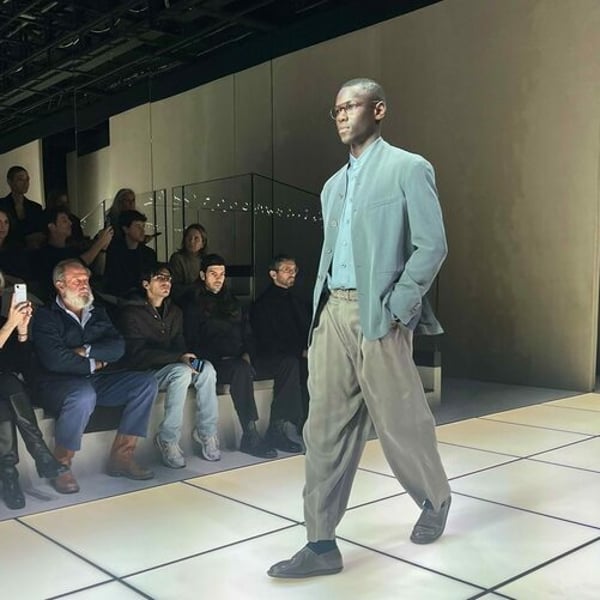
There was a changing of the guard and of gears at Giorgio Armani Monday morning, as Leo Dell’Orco presented a smooth and chic debut collection for the house, the final important show of Milano Uomo Moda.
The collection was the first not designed for the house by eponymous designer Giorgio Armani, who passed away in September last year.
Inevitably, Dell’Orco, Giorgio Armani’s right-hand man for the past four decades, sent out a collection that was hyper respectful of the master’s DNA. Yet he still added his own imprint to a signature collection that featured over a dozen women’s looks that practically matched the menswear designs they marched beside.
Leo also upped the pace of the show, which was no bad thing, and concentrated on what the house of Armani does best- impeccable, fluid tailoring. Most notably with some excellent jackets and blazers. Varying between one-button blazers with elongated shawl lapels made in the house’s signature non-colours of mud, cement, or wheat. To five-button Nehru jackets, again riffing on old Giorgio favourites- from zig zag pattern to waffle style. Paired with forgiving tapered pants that nipped at the ankle it all made for a very flattering silhouette.

Leo did break new ground in terms of colours, showing some great olive green or amethyst velvet shirts, pinstripe jackets and coats- for men and women. Along with superb silk mandarin jackets in dashing Colombia blue. While Giorgio’s love of Asian design was remembered in a great series of silk shirts with high smoking collars.
A change of guard also on the board, where recently appointed members John Hooks and Marco Bizzarri sat smiling in the audience.
“It feels emotional to be back after 15 years,” commented Hooks, the house’s managing director for a decade until 2011. While a beaming Bizzarri predicted: “expect an exciting 18 months at the house of Armani.”
As noted, under the terms of Giorgio Armani’s will, the childless late designer left instructions that his heirs sell 15% of the house within 18 months of his death. And then a further 35% to 54.9% to the same buyer.

However, after watching this show, one got the distinct impression that no one in Armani is in any great hurry to sell.
Clearly enjoying his new role, Dell’Orco took a few risks with his choice of coats, showing dramatic double-face slate grey topcoats with funnel necks, or the sleekest meeting of a chauffeur’s tunic and long coat in putty grey. One could sense the models loved wearing them, too.
In another marked change, the models appeared quicker and marched faster in two morning shows, held in the famed Armani show-space in the basement of Giorgio’s personal palazzo on central Via Borgonuovo.
The collection and show did lose focus towards the finale, with some odd knits and a good deal or repetition. It lacked the ruthless self-editing for which King Giorgio was famous. But overall, this felt like a successful passage into a new era, and a win for the house.

In a generous gesture, Leo took his bow with his nephew Gianluca Dell’Orco, a design director for menswear.
Bowing, smiling, and ebullient- aided by the galactic funk and gentle techno soundtrack, including Evolver by AstroMat. Armani soundtracks traditionally had been one of Leo Dell’Orco’s responsibilities.
And one could not help to chant during the show “Ashes to Ashes,” the traditional refrain at funerals, suggesting there is a future life immortal in heaven.
Copyright © 2026 FashionNetwork.com All rights reserved.
Fashion
Harmont & Blaine to focus on Iberian Peninsula, resorts, sustainability, digital, and wholesale in 2026
Published
January 19, 2026
Harmont & Blaine’s strategic shift continues apace. The ‘Bassotto’ (Dachshund) brand has recently reorganised its executive leadership and embarked on a second three-year governance period focused on a further development and implementation of its industrial plan. From its stunning 1,200 square metre Milan showroom, the label shared with FashionNetwork.com positive figures for 2025 and further growth for 2026, heralded by the new Autumn-Winter 2026/27 collection titled “The Art of Renewal.”
“The line is called ‘The Art of Renewal’ because it represents something of the culmination of an evolutionary journey for our collection and a return to focusing on raw materials, fabrics, savoir-faire, and the desire to embed value in the product we offer our customers,” says Daniele Ondeggia, Harmont & Blaine’s general manager.
Also designed by Tiziano Foglia, Harmont & Blaine underscores its commitment to the ecosystem and, for the second consecutive season, presents the upcycling capsule collection “Re-Loved,” in collaboration with Roberto Lonoce, co-founder and creative director of Re-Jàvu Milano, while also developing the theme of earth dye in denim- namely, the use of natural raw materials in manufacturing and highly sustainable techniques in fabric dyeing. These responsible, alternative treatments are applied not only to cotton but also to jeans overdyed with natural earth pigments, using low-water washes and finishes.
Typically strong in shirts, polos, and trousers, over the past decade Harmont & Blaine has successfully increased its recognition as a total look brand, with an offer that now encompasses footwear, accessories, knitwear, scarves, and bags- the result of substantial work on evolution and brand awareness. “The brand is no longer solely masculine. The women’s collection is now a flagship in its own right and is achieving spectacular growth,” Ondeggia is keen to emphasise. “We have finally found the right coherence between the women’s offer and the menswear style, with a high perceived value- so much so that H&B womenswear sales are growing by 40–50% every year, accounting for around 10% of overall revenue.”

Among the reasons why the Bassotto management believes there can be significant growth for the brand in the near future is the completion of its infrastructure. “A few weeks ago we launched our CRM and marketing automation engine; we have invested in human capital, hiring a specialist in this field with extensive experience and a strong track record in previous roles,” says the general manager.
Harmont & Blaine is headquartered in Naples and is distributed in 46 countries. With around 120 directly operated mono-brand stores and shop-in-shops (about half in Italy) and no fewer than 38 points of sale in Spain, its second-largest market, the brand is focusing strongly on the Iberian Peninsula, where it is finalising the establishment of a subsidiary in Portugal, a country where it did not previously have a presence, specifically in the Algarve.
With its 630 employees, about 480 of whom are in Italy (and as many as 1,000 across the indirect workforce), Harmont & Blaine is pursuing a strategy of brand takeovers in elegant, prestigious locations- such as ski resorts or mountain refuges in winter, and resorts or beach clubs in summer. “We have recently made several investments in this area by sponsoring in Capri- the place from which our collection draws its inspiration- the main bar in the Piazzetta, Bar Tiberio, which we have ‘Bassotto-ised’ with every possible fabric and element,” the executive says. “Of course, we organised several events on site, also because we own a boutique in Capri, on Via Camerelle. The new element is Cortina, where we sponsored Chalet Tofane and opened a corner at the Cortina cooperative, with targeted initiatives for the Olympics.”

Further development prospects in Spain will come thanks to El Corte Inglés, where the Italian brand currently has 34 corners, with some potential openings in this historic department store chain in the pipeline. “So Spain, resort takeovers, eco-sustainability, digital, and wholesale will be our primary focus areas- the channels where we expect to see a huge acceleration in 2026 in terms of sales,” summarises the manager.
Although Harmont & Blaine’s image is always associated with summer, the Mediterranean and colour, the numbers show that the brand now generates 50% of its turnover in autumn-winter. “However, we want to address more forcefully a market segment that knows us less well: the mountain outdoor segment. We have many garments that are perfect for this purpose, and for the Olympics we have developed a high-quality capsule,” says the general manager, who is very pleased with the recently signed EU-Mercosur agreement, which will further liberalise trade between the two areas.
“In Latin America, particularly in Central and South America, we are historically very strong. We are not present in Brazil, but we are distributed in Mexico through a partnership with Palacio de Hierro, where we have our own subsidiary with 14 stores,” Ondeggia explains. “Then the company has partnerships in place with all the countries in that area, from the Caribbean islands to Puerto Rico and Santo Domingo, and in Venezuela, Colombia, Peru, Ecuador, and Panama, precisely because the product meets the appreciation of a local clientele that loves colour and freshness. It will now be an even more important outlet.”

Harmont & Blaine also established a subsidiary in the US last year, opening two stores in Miami, at Aventura Mall and Brickell City Centre. This marked a direct entry after the brand had been present in the US for many years only through a distributor. And the US is the Bassotto brand’s second-largest e-commerce market.
According to the executive, e-commerce has great growth potential for the Neapolitan brand, following an investment in digital transformation that began in 2024 and started to bear fruit in 2025. “The infrastructure is powerful; we believe this technological investment will allow us to see solid double-digit growth in the e-shop’s revenue, which we currently consider insufficient, at around 4%,” reveals Ondeggia. “Womenswear, for example, performs very well in brick-and-mortar, but we have to learn to push it online.”
What about wholesale? On 2025 revenue of €103 million, the wholesale share is about 20%. The brand has around 350 multi-brand clients in Italy and another 200 around the world, and in addition to Portugal the company is advancing a distribution project in India, a country now growing by around 10% a year, where the Bassotto is about to enter via a local distributor.

“For all these reasons, we expect significant growth in 2026,” continues Daniele Ondeggia, “also because we have an ongoing process to streamline our operational engine, ranging from the collection structure to merchandising and buying processes, through to distribution and the revision of the production footprint, to give more space to local workshops- nearshoring in contrast to what has happened in past years, when many relied on the Far East. Therefore,” he continues, “even at the organisational level, we are trying to rationalise, streamline, and recalibrate the business model in a market environment that offers many opportunities but also much uncertainty- not least the numerous luxury brands that have seen significant drops in their share prices.”
For the executive, the shareholder base is confident. It consists of the founding family, the Menniti-Montefusco, who control the brand with a 60% stake, alongside Bassotto 2.0, a club deal that acquired 40% of the company, a stake that had in turn been held by the Clessidra fund for eight years. “I joined the company precisely when the fund came in,” Ondeggia concludes. “In this organisation, the front-runner of the club deal is engineer Riccardo Bruno, the person who at Clessidra invested in Harmont & Blaine. Now, however, he has chosen to invest in the brand independently, with his own money, precisely because he knows the brand’s potential well.”
This article is an automatic translation.
Click here to read the original article.
Copyright © 2026 FashionNetwork.com All rights reserved.


Miami and Indiana in the “Cuban Super Bowl.”

Nicki Minaj Calls Don Lemon a Homophobic Slur After Church Incident in Minnesota

Milan Menswear: a changing of guard and gears at Giorgio Armani
-

 Politics8 years ago
Congress rolls out ‘Better Deal,’ new economic agenda
-
Entertainment8 years ago
New Season 8 Walking Dead trailer flashes forward in time
-
Politics9 years ago
Poll: Virginia governor’s race in dead heat
-
Politics8 years ago
Illinois’ financial crisis could bring the state to a halt
-
Entertainment8 years ago
The final 6 ‘Game of Thrones’ episodes might feel like a full season
-
Entertainment9 years ago
Meet Superman’s grandfather in new trailer for Krypton
-
Business9 years ago
6 Stunning new co-working spaces around the globe
-
Tech8 years ago
Hulu hires Google marketing veteran Kelly Campbell as CMO