Connect with us

Business

Down Arrow Button Icon

Published

on


Rows of businesses stood shuttered inside a sprawling complex of Somali businesses on a recent afternoon.

Karmel Mall in south Minneapolis contains more than a hundred small businesses in suites offering everything from clothing and food to insurance and accounting services. On Thursday, the noisy hallways inside lay quiet, save for occasional chatter between neighboring vendors. The smell of fried food still wafted from the bakeries, the central heating hummed and the sound of Quran recitation flowed quietly from some shops.

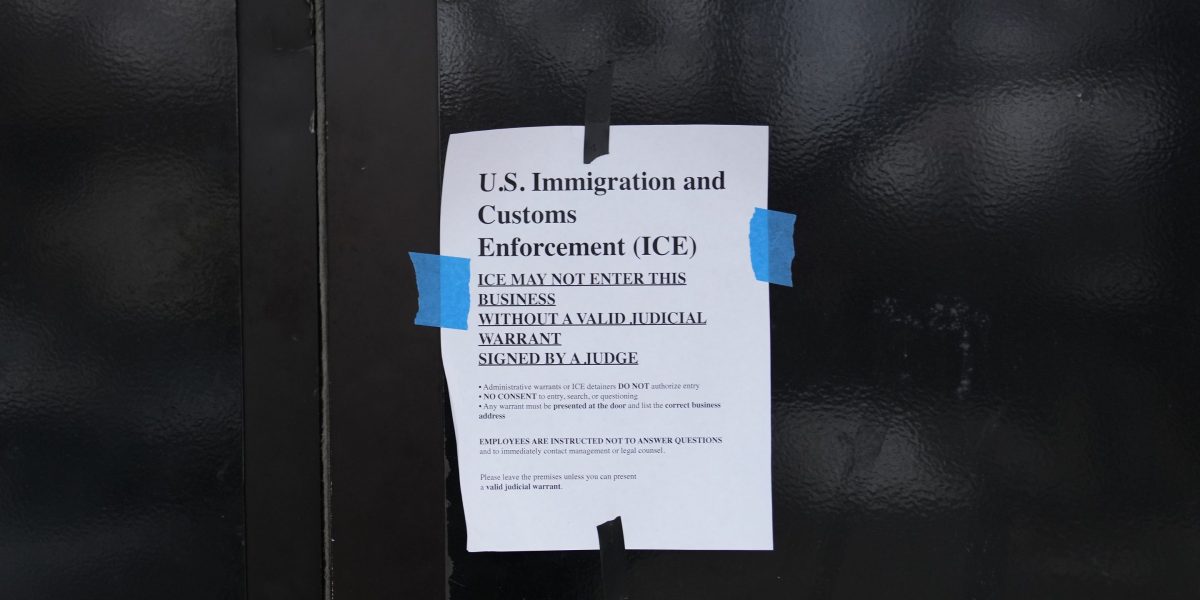
But many sellers sat alone in their clothing stores, waiting for the occasional customer to walk by. Everyone is afraid of federal immigration agents, business owners said. Sellers and customers, citizens and noncitizens. Some don’t bother opening shop because they aren’t expecting any customers.

“It’s been like this for three weeks now,” said Abdi Wahid, who works at his mom’s convenience store in the mall. “Everywhere it’s all been closed up, all the stores.”

Karmel Mall is an economic hub for the area’s Somali population, which is the largest in the U.S. But it also features housing, a mosque and Quran classes, serving as a robust community center for the area.

The economic impact of the Trump administration’s “Operation Metro Surge” stretches beyond the Somali community: many immigrants are on edge, afraid to go to work or leave their homes amid the immigration crackdown.

But President Donald Trump has made the Somali community a special target of his deportation rhetoric after a recent government fraud case in Minnesota included a number of Somali defendants. Since December, Trump has made numerous jabs at the community, calling them “garbage” and saying “they contribute nothing.”

Wahid said early afternoons at the family business once meant 15 to 20 customers. These days, it’s tough to get one.

Wahid is a citizen, but he said the fear extends beyond just immigrants. Citizens are also scared of coming in, especially following the killing of Renee Good and the ICE raid at Roosevelt High School in south Minneapolis.

“I think that caused a lot of people to not even want to come,” he said, because they could be targeted “just because of their race.”

Homeland Security assistant secretary Tricia McLaughlin said in a statement that law enforcement uses “reasonable suspicion” to make arrests under the fourth amendment.

“A person’s immigration status makes them a target for enforcement, not their skin color, race or ethnicity,” she said.

Upstairs, Bashir Garad runs Safari Travel & Accounting Services. Not only has the crackdown in Minneapolis meant he’s lost almost all his customers, but his existing clients are cancelling upcoming trips because they’re worried they won’t be let back into the country.

“They see a lot of unlawful things going on in the city,” he said. “They look at something bad, and then they think some bad things may happen to them.” The majority of his clients are East African, and nearly all are U.S. citizens. They still hesitate to travel.

“The government is not doing the right thing,” he said. “If there’s a criminal, there’s a criminal. Regardless, there are ways to find the criminal, but to marginalize the community’s name, and a whole people, that is unlawful.”

Ibrahim Dahiye, who sells electronics, said winter always used to be slow, “but now it’s totally different. No one comes here. All the stores are closed, few are open.”

Since the crackdown began, Dahiye said his business is down $20,000 monthly, and he’s now pooling funds to make rent.

He said he’s lost most of his customers. His employees are too scared to come to work. He tapped his jacket pocket, saying he keeps his passport on him at all times.

“I don’t know what we can do,” Dahiye said. “We believe in Allah, but we can’t do anything.”


Source link

Continue Reading

Business

EU mulls responding to Trump by reviving €93 billion tariff move

Published

on


European Union member states are discussing several options for how to respond to President Donald Trump’s latest tariff threat, including imposing retaliatory levies on €93 billion ($108 billion) of US goods, according to people familiar with the talks.

EU ambassadors met Sunday evening in Brussels as they tried to devise a joint response to Trump’s announcement that he would put 10% tariffs on eight European countries on Feb. 1 in relation to their actions in Greenland.

Among the other options being discussed is using a powerful tool known as the anti-coercion instrument, added the people, who asked not to be identified discussing sensitive conversations. French President Emmanuel Macron suggested on Sunday the bloc should consider using that new tool, although France backed away from using it in the past after Trump threatened to retaliate.

Last year, the EU had approved retaliatory tariffs on €93 billion of US products but suspended their implementation after the two sides reached a trade pact. European lawmakers suggested over the weekend that they will hold off on approving that trade pact, citing Trump’s latest move. 

The Financial Times reported earlier on the discussions over reviving retaliatory tariffs.

This story was originally featured on Fortune.com


Source link

Continue Reading

Business

BlackRock’s Rick Rieder bid for Fed chair is gaining traction

Published

on


The candidacy of BlackRock’s Rick Rieder to be the next Federal Reserve chair has gained late momentum, people familiar with the matter say, as President Donald Trump weighs congressional blowback in his bid to put a friendlier face at the head of the central bank.

Trump’s interview Thursday with Rieder went well, the people said, speaking on condition of anonymity to discuss the private deliberations.

Key senators such as Republican Banking Committee member Thom Tillis have warned that Trump’s Fed picks will get more scrutiny after the Justice Department subpoenaed the Fed last week over statements by Chair Jerome Powell related to a renovation project at the bank’s headquarters. But Powell, whose term expires in May, contends the criminal probe is a pretext to punish him for not cutting rates quickly enough.

Read More: Fed Served With DOJ Subpoenas; Powell Vows to Stand Firm 

Trump, asked Friday about the selection process, said he had a candidate in mind, while declining to name him. “I think I have it — in my mind, done,” he said.

The search is now a four-man race, some of the people said, among Rieder, National Economic Council Director Kevin Hassett, Fed Governor Christopher Waller and former governor Kevin Warsh, the people said.

Read More: The Turbulent Forces Reshaping The Fed This Year

Hassett was an early frontrunner and continued to be until Trump said this week he may not want to lose Hassett from his current role. It’s not clear if it was a signal of a shifting internal deliberation, or an offhand remark.

“Nobody knows who President Trump will choose for the Fed, except President Trump himself. As the president recently said, he will announce his final decision soon,” White House Press Secretary Karoline Leavitt said in a written statement Saturday.

The decision to subpoena the Fed a week ago sparked a wave of backlash, including a pledge by Tillis — who sits on the committee that would first consider a nominee — to oppose any Fed nomination until the matter is resolved. 

Rieder, BlackRock’s chief investment officer of global fixed income, is viewed as potentially easier to confirm, some of the people said. A spokesperson for BlackRock declined to comment on Rieder’s status.

Hiring data released earlier this month suggested the labor market remained fragile at the end of the year, and the outlook for hiring is guarded. Economists see another year of limited job opportunities and cooling pay gains, likely exacerbating voters’ affordability concerns going into this year’s midterm elections.

Fed officials cut rates three consecutive times at the end of 2025, but have signaled they’re in no rush to lower them again until they see more data on inflation and the labor market. Policymakers are expected to hold rates steady at their next meeting on Jan. 27-28.

Rieder has called the Fed’s independence “critical,” but has also echoed Treasury Secretary Scott Bessent in saying the central bank could be more “innovative” in how it uses its balance sheet.


Source link

Continue Reading

Business

Army readies 1,500 paratroopers specializing in arctic ops for possible Minnesota deployment

Published

on


The Pentagon has ordered about 1,500 active-duty soldiers to be ready in case of a possible deployment to Minnesota, where federal authorities have been conducting a massive immigration enforcement operation, two defense officials said Sunday.

The officials, who spoke on condition of anonymity to discuss sensitive military plans, said two infantry battalions of the Army’s 11th Airborne Division have been given prepare-to-deploy orders. The unit is based in Alaska and specializes in operating in arctic conditions.

One defense official said the troops are standing by to deploy to Minnesota should President Donald Trump invoke the Insurrection Act, a rarely-used 19th century law that would allow him to employ active duty troops as law enforcement.

The move comes just days after Trump threatened to do just that to quell protests against his administration’s immigration crackdown.

In an emailed statement, Pentagon chief spokesman Sean Parnell did not deny the orders were issued and said the military “is always prepared to execute the orders of the Commander-in-Chief if called upon.”

ABC News was the first to report the development.

On Thursday, Trump said in a social media post that he would invoke the 1807 law “if the corrupt politicians of Minnesota don’t obey the law and stop the professional agitators and insurrectionists from attacking the Patriots of I.C.E., who are only trying to do their job.”

He appeared to walk back the threat a day later, telling reporters at the White House that there wasn’t a reason to use it “right now.”

“If I needed it, I’d use it,” Trump said. “It’s very powerful.”

Trump has repeatedly threatened to invoke the Insurrection Act throughout both of his terms. In 2020 he also threatened to use it to quell protests after George Floyd was killed by Minneapolis police, and in recent months he threatened to use it for immigration protests.

The law was most recently invoked by President George H.W. Bush in 1992 to end unrest in Los Angeles after the acquittal of four white police officers in the beating of Rodney King.

Minnesota Governor Tim Walz, a Democrat and frequent target of Trump, has urged the president to refrain from sending in more troops.

“I’m making a direct appeal to the President: Let’s turn the temperature down. Stop this campaign of retribution. This is not who we are,” Walz said last week on social media.

Join us at the Fortune Workplace Innovation Summit May 19–20, 2026, in Atlanta. The next era of workplace innovation is here—and the old playbook is being rewritten. At this exclusive, high-energy event, the world’s most innovative leaders will convene to explore how AI, humanity, and strategy converge to redefine, again, the future of work. Register now.


Source link

Continue Reading

Trending

Copyright © Miami Select.