Connect with us

Business

Electricity as the new eggs: Affordability concerns will swing the midterms just like the 2024 election, Bill McKibben says

Published

on


That sun has provided him cheap power for 25 years, and this month he installed his fourth iteration of solar panels on his Vermont home. In an interview after he set up the new system, he said President Donald Trump’s stance against solar and other cheap green energy will hurt the GOP in this year’s elections as electricity bills rise.

After the Biden and Obama administrations subsidized and championed solar, wind and other green power as answers to fight climate change, Trump has tried to dampen those and turn to older and dirtier fossil fuels. The Trump administration froze five big offshore wind projects last month but judges this week allowed three of the projects to resume. Federal clean energy tax incentives expired on Dec. 31 that include installing home solar panels.

Meanwhile, electricity prices are rising in the United States, and McKibben is counting on that to trigger political change.

“I think you’re starting to see that have a big political impact in the U.S. right now. My prediction would be that electric prices are going to be to the 2026 election what egg prices were to the 2024 election,” said McKibben, an author and founder of multiple environmental and activist groups. Everyday inflation hurt Democrats in the last presidential race, analysts said.

The Trump administration and a bipartisan group of governors on Friday tried to step up pressure on the operator of the nation’s largest electric grid to take urgent steps to boost power supplies in the mid-Atlantic and keep electricity bills from rising even higher.

“Ensuring the American people have reliable and affordable electricity is one of President Trump’s top priorities,” said White House spokesperson Taylor Rogers.

Renewable energy prices drop around the world

Globally, the price of wind and solar power is plummeting to the point that they are cheaper than fossil fuels, the United Nations found. And China leads the world in renewable energy technology, with one of its electric car companies passing Tesla in annual sales.

“We can’t economically compete in a world where China gets a lot of cheap energy and we have to pay for really expensive energy,” McKibben told The Associated Press, just after he installed a new type of solar panels that can hang on balconies with little fuss.

When Trump took office in January 2025, the national average electricity cost was 15.94 cents per kilowatt-hour. By September it was up to 18.07 cents and then down slightly to 17.98 cents in October, according to the U.S. Energy Information Administration.

That’s a 12.8% increase in 10 months. It rose more in 10 months than the previous two years. People in Maryland, New Jersey and Maine have seen electricity prices rise at a rate three times higher than the national average since October 2024.

At 900 kilowatt-hours per month, that means the average monthly electricity bill is about $18 more than in January 2025.

Democrats blame Trump for rising electric bills

This week, Democrats on Capitol Hill blamed rising electric bills on Trump and his dislike of renewable energy.

“From his first day in office, he’s made it his mission to limit American’s access to cheap energy, all in the name of increasing profits for his friends in the fossil fuel industry. As a result, energy bills across the country have skyrocketed,” Illinois Rep. Sean Casten said at a Wednesday news conference.

“Donald Trump is the first president to intentionally raise the price of something that we all need,” Hawaii Sen. Brian Schatz, also a Democrat, said Wednesday on the Senate floor. “Nobody should be enthused about paying more for electricity, and this national solar ban is making everybody pay more. Clean is cheap and cheap is clean.”

Solar panels on McKibben’s Vermont home

McKibben has been sending excess electricity from his solar panels to the Vermont grid for years. Now he’s sending more.

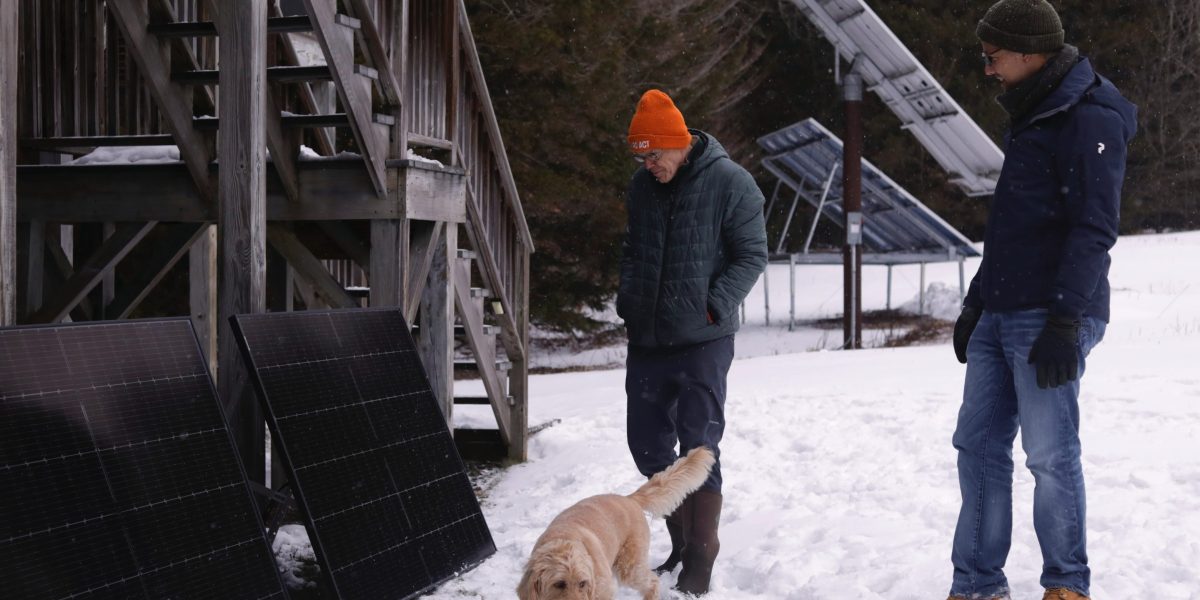
As his dog, Birke, stood watch, McKibben, who refers to his home nestled in the Green Mountains of Vermont as a “museum of solar technology” got his new panels up and running in about 10 minutes. This type of panel from the California-based firm Bright Saver is often referred to as plug-in solar. Though it’s not yet widely available in the U.S., McKibben pointed to the style’s popularity in Europe and Australia.

“Americans spend three or four times as much money as Australians or Europeans to put solar panels on the roof. We have an absurdly overcomplicated permitting system that’s unlike anything else on the rest of the planet,” McKibben said.

McKibben said Australians can obtain three hours of free electricity each day through a government program because the country has built so many solar panels.

“And I’m almost certain that that’s an argument that every single person in America would understand,” he said. “I don’t know anyone who wouldn’t say: ‘I’d like three free hours of electricity.’”

__

Swinhart reported from Vermont. Borenstein reported from Washington. Matthew Daly contributed to this report from Washington.

__

The Associated Press’ climate and environmental coverage receives financial support from multiple private foundations. AP is solely responsible for all content. Find AP’s standards for working with philanthropies, a list of supporters and funded coverage areas at AP.org.


Source link

Continue Reading

Business

BlackRock’s Rick Rieder bid for Fed chair is gaining traction

Published

on


The candidacy of BlackRock’s Rick Rieder to be the next Federal Reserve chair has gained late momentum, people familiar with the matter say, as President Donald Trump weighs congressional blowback in his bid to put a friendlier face at the head of the central bank.

Trump’s interview Thursday with Rieder went well, the people said, speaking on condition of anonymity to discuss the private deliberations.

Key senators such as Republican Banking Committee member Thom Tillis have warned that Trump’s Fed picks will get more scrutiny after the Justice Department subpoenaed the Fed last week over statements by Chair Jerome Powell related to a renovation project at the bank’s headquarters. But Powell, whose term expires in May, contends the criminal probe is a pretext to punish him for not cutting rates quickly enough.

Read More: Fed Served With DOJ Subpoenas; Powell Vows to Stand Firm 

Trump, asked Friday about the selection process, said he had a candidate in mind, while declining to name him. “I think I have it — in my mind, done,” he said.

The search is now a four-man race, some of the people said, among Rieder, National Economic Council Director Kevin Hassett, Fed Governor Christopher Waller and former governor Kevin Warsh, the people said.

Read More: The Turbulent Forces Reshaping The Fed This Year

Hassett was an early frontrunner and continued to be until Trump said this week he may not want to lose Hassett from his current role. It’s not clear if it was a signal of a shifting internal deliberation, or an offhand remark.

“Nobody knows who President Trump will choose for the Fed, except President Trump himself. As the president recently said, he will announce his final decision soon,” White House Press Secretary Karoline Leavitt said in a written statement Saturday.

The decision to subpoena the Fed a week ago sparked a wave of backlash, including a pledge by Tillis — who sits on the committee that would first consider a nominee — to oppose any Fed nomination until the matter is resolved. 

Rieder, BlackRock’s chief investment officer of global fixed income, is viewed as potentially easier to confirm, some of the people said. A spokesperson for BlackRock declined to comment on Rieder’s status.

Hiring data released earlier this month suggested the labor market remained fragile at the end of the year, and the outlook for hiring is guarded. Economists see another year of limited job opportunities and cooling pay gains, likely exacerbating voters’ affordability concerns going into this year’s midterm elections.

Fed officials cut rates three consecutive times at the end of 2025, but have signaled they’re in no rush to lower them again until they see more data on inflation and the labor market. Policymakers are expected to hold rates steady at their next meeting on Jan. 27-28.

Rieder has called the Fed’s independence “critical,” but has also echoed Treasury Secretary Scott Bessent in saying the central bank could be more “innovative” in how it uses its balance sheet.


Source link

Continue Reading

Business

Army readies 1,500 paratroopers specializing in arctic ops for possible Minnesota deployment

Published

on


The Pentagon has ordered about 1,500 active-duty soldiers to be ready in case of a possible deployment to Minnesota, where federal authorities have been conducting a massive immigration enforcement operation, two defense officials said Sunday.

The officials, who spoke on condition of anonymity to discuss sensitive military plans, said two infantry battalions of the Army’s 11th Airborne Division have been given prepare-to-deploy orders. The unit is based in Alaska and specializes in operating in arctic conditions.

One defense official said the troops are standing by to deploy to Minnesota should President Donald Trump invoke the Insurrection Act, a rarely-used 19th century law that would allow him to employ active duty troops as law enforcement.

The move comes just days after Trump threatened to do just that to quell protests against his administration’s immigration crackdown.

In an emailed statement, Pentagon chief spokesman Sean Parnell did not deny the orders were issued and said the military “is always prepared to execute the orders of the Commander-in-Chief if called upon.”

ABC News was the first to report the development.

On Thursday, Trump said in a social media post that he would invoke the 1807 law “if the corrupt politicians of Minnesota don’t obey the law and stop the professional agitators and insurrectionists from attacking the Patriots of I.C.E., who are only trying to do their job.”

He appeared to walk back the threat a day later, telling reporters at the White House that there wasn’t a reason to use it “right now.”

“If I needed it, I’d use it,” Trump said. “It’s very powerful.”

Trump has repeatedly threatened to invoke the Insurrection Act throughout both of his terms. In 2020 he also threatened to use it to quell protests after George Floyd was killed by Minneapolis police, and in recent months he threatened to use it for immigration protests.

The law was most recently invoked by President George H.W. Bush in 1992 to end unrest in Los Angeles after the acquittal of four white police officers in the beating of Rodney King.

Minnesota Governor Tim Walz, a Democrat and frequent target of Trump, has urged the president to refrain from sending in more troops.

“I’m making a direct appeal to the President: Let’s turn the temperature down. Stop this campaign of retribution. This is not who we are,” Walz said last week on social media.

Join us at the Fortune Workplace Innovation Summit May 19–20, 2026, in Atlanta. The next era of workplace innovation is here—and the old playbook is being rewritten. At this exclusive, high-energy event, the world’s most innovative leaders will convene to explore how AI, humanity, and strategy converge to redefine, again, the future of work. Register now.


Source link

Continue Reading

Business

Meet a 28-year-old Canadian woman who turned her pen-pal side hustle into a subscription side hustle with over 1,000 members

Published

on


At a time when productivity means optimizing every second and screens blur the line between work and home, some people are slowing down and disconnecting by looking to communication devices from the past.

Tactile activities ranging from writing letters and typewriter clubs to TikTok communities showcasing calligraphy skills and wax seals are giving retro writing instruments a resurgence. More than quaint throwbacks, the pursuits provide their enthusiasts with opportunities to reduce their technology use, be more intentional with time and build meaningful connections with others.

“I feel as though my pen pals are my friends. I don’t think of them much differently than if I were chatting with a friend on the phone, in a coffee shop or at another person’s house,” said Melissa Bobbitt, 42, a devoted letter-writer who corresponds with about a dozen people from her home in Claremont, California, and has had up to 40 pen pals at one time. “Focusing on one person and really reading what they are saying, and sharing what’s on your heart is almost like a therapy session.”

Ink, paper and other tools that once were the only way to send a message from afar are continuing to bring people together from around the world. Below, some of them explain the appeal of snail mail and give recommendations for getting started.

Writing can be an escape

In a society shaped by constant availability, hands-on hobbies like writing letters and scrapbooking require focus and patience. The act of picking up a pen, sealing an envelope with wax and laying out pages may yield aesthetically pleasing results, but it also creates a space for reflection.

Stephania Kontopanos, a 21-year-old student in Chicago, said it can be hard to put her phone and computer away, especially when it seems all of her friends and peers are on social media and her classes and personal life revolve around being online.

“There are times when I’m with my friends and at dinner, I’ll realize we are all on our phones,” Kontopanos said, adding that she tries to put her phone down at those moments.

Kontopanos also unplugs consciously by sending postcards to her family and friends, scrapbooking, and junk journaling, which involves repurposing everyday materials like tickets and receipts to document memories or ideas. She says going to the post office has become an activity she does with her mother back home in Kansas and includes sharing stories with the postal workers, people she would not have routinely encountered.

Nostalgia can foster community

Writing and sending letters is nostalgic for KiKi Klassen, who lives in Ontario, Canada. The 28-year-old says it helps her feel more connected to her late mother, who was a member of the Canadian Union of Postal Workers, which represents mail carriers and other postal employees.

In October 2024, Klassen launched the Lucky Duck Mail Club, a subscription-based monthly mail service that sends participants a piece of her art, an inspiring quote and message. She says her membership includes more than 1,000 people across, at most, 36 countries.

“When I sit down, I’m forced to reflect and choose my words carefully,” Klassen said. “It also lends itself to vulnerability because it is easier to write down how you are feeling. I’ve had people write me back and I’ve cried hearing so many touching stories. I think for a lot of people paper creates a safe space. You write it down, send it off and don’t really think about it after.”

For Bobbitt, who has corresponded by mail for years, there is a “grand excitement” when she opens her mailbox and finds something that is not a bill or advertisement. “If we all filled each other’s mailboxes with letters, we would all be kinder and, at the very least, won’t dread checking our mailboxes,” she said.

Bobbitt says she first joined a pen pal club in second or third grade and later was connected to more writers through Postcrossing, an online project that partners people around the world to send and receive postcards. She says some of the postcards turned into letters as friendships grew between her and some other regular writers.

It’s a similar feeling of connection that inspired DJ Robert Owoyele, 34, to create CAYA, a monthly “analog gathering” in Dallas. Owoyele launched the event less than a year ago and has since organized evenings with letter writing, coloring, vinyl listening sessions and other activities.

“We live in a digital age that fosters a false sense of connection, but I think true connection happens in person,” he said. “When we are able to touch or see something, we are more connected to it naturally. These analog activities are a representation of that.”

How to get started

While writing letters and engaging in other vintage pursuits might seem accessible, it is not always easy to get involved. For many people, carving out time to slow down can feel like another obligation in a schedule filled with to-dos.

Kontopanos says she decided it was important for her to reprioritize her time. “The older I get, the more I realize how much time had been wasted on my phone,” she said. Creating space to explore allowed her to discover the hobbies she loved doing enough to make them a priority, she said.

There are many hobbies to consider, some of which don’t require expensive tools or hours of free time. Frequenting spaces where communities centered around these hobbies gather can be a way to learn about the different activities. For example, participating in typewriter clubs such as Type Pals, attending events like the Los Angeles Printers Fair hosted by the International Printing Museum in California, and engaging with social media communities like the Wax Seal Guild on Instagram and The Calligraphy Hub on Facebook.

Klassen says that based on posts she’s seeing on her social media feeds, reviving vintage writing instruments and small tactile pleasures might be on the verge of becoming trendy.

“The girls are going analog in 2026,” she said.


Source link

Continue Reading

Trending

Copyright © Miami Select.