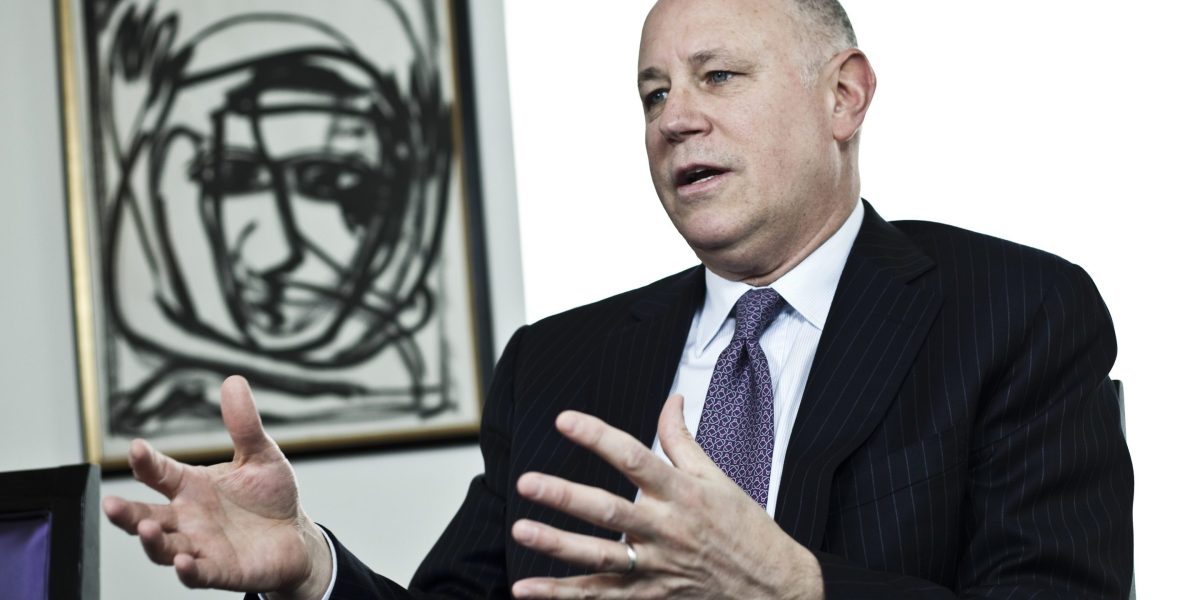
The founder and CEO of Intercontinental Exchange, Jeffrey Sprecher, bought the nearly bankrupt company off Warren Buffett for $1,000 and turned it into a $98 billion giant
A small investment made at the right moment has the power to launch ordinary people to millionaire status. All it took was $1,000 and an out-there idea for Jeffrey Sprecher, the founder and CEO of Intercontinental Exchange, to set his business on a path to becoming a $98 billion behemoth.
“I had this idea that you should be able to trade electric power, buy and sell electric power, on an exchange,” Sprecher recalled recently at the Rotary Club Of Atlanta. But there was a huge caveat: He “had no idea how to do that. I’d never worked on Wall Street, I never traded.”
At the time, Sprecher had heard that Continental Power Exchange—owned by Warren Buffett’s electric utility company, MidAmerican Energy—was about to go bankrupt. Despite Buffett’s business pumping $35 million into it, the company was still struggling. And so Sprecher saw this as an opportune moment to swoop in and pursue his entrepreneurial vision.
“I bought the company for a dollar a share, and there were a thousand shares. So I bought it for $1,000, and I used that as the basis to build Intercontinental Exchange.”
Thanks to his quick thinking and business savvy, Sprecher now boasts a net worth of $1.3 billion. But the journey to the top was not very glamorous.
Living in a 500-ft studio and driving a used car while scaling the business
That measly $1,000 investment made back in 1997 served as the launchpad for Intercontinental Exchange, founded just three years later. A small team of nine employees set off to build the technology in 2000; setting up shop in Atlanta, Georgia, Sprecher and his staffers went all-in on building the business up from its former demise.
It was all hands on deck, and even as the founder and CEO, Sprecher was doing the menial labor to keep everything in order. With money being tight, the entrepreneur lived in a small apartment and drove a used car to the office to keep Intercontinental Energy afloat.
“I bought a 500-foot, one room studio apartment in Midtown…I bought a used car that I kept and I’d go into the office from time to time,” Sprecher explained, adding that he “took the trash out, shut the lights out, answered the phone, bought the staplers and the paper for the photocopier. That was the way the company started.”
Nearly 26 years later, the company boasts a market cap of $98 billion and a team of more than 12,000 employees—and has proudly owned the NYSE for over a decade.
Entrepreneurs who made a key investment at the right moment
Some of the wealthiest entrepreneurs made their billions by spotting the perfect window to invest small and earn big.
Take Kenn Ricci as an example: the serial American aviation businessman and chairman of private jet company Flexjet is a billionaire thanks to his intuition to buy a struggling business four decades ago. After being put on leave from his first pilot job out of the Air Force, he turned a sticky situation into a 10-figure fortune.
“I worked for [airline] Northwest Orient for a brief period of time. I get furloughed. Unemployed, back living with my parents,” Ricci told the Wall Street Journal in a 2025 interview, reminiscing on how he made his first $1 million.
But instead of throwing in the towel, he spotted a golden opportunity. Ricci took a contract pilot job at Professional Flight Crews, and one of the companies he flew for was private aviation company Corporate Wings. The budding businessman was intrigued when its owners put the business up for sale at $27,500 in 1981—and jumped on the opportunity to buy it. By the early 1990s, the business was pulling in $3 million a year.
But people don’t need to buy and scale a company to make a worthwhile investment; millennial investing wiz Martin Mignot became a self-made millionaire thanks to his ability to spot unicorn companies before they make it big. One of his biggest wins was an early investment in Deliveroo—back when the business was just a small, London-based operation.
“They had eight employees. They were in three London boroughs. Overall, they had a few 1000 users to date, so it was very, very early,” Mignot told Fortune last year. “They didn’t have an app. Their first website was pretty terrible and ugly, if I’m frank, but the delivery experience was incredible.”
Lo and behold, Deliveroo grew to become a $3.5 billion company with millions of global customers. And as a partner at Index Ventures, Mignot is part of a team reaping billion-dollar rewards from forward-thinking investments in tech businesses including Figma, Scale AI, and Wiz. Aside from his day job, Mignot has also strategically put money towards iconic European start-ups including Revolut, Trainline and Personio. Before he was even 30, he solidified himself as a notable investor—and advised others that “It’s about owning equity, that is the key.”
Jamie Dimon poached a senior figure from Warren Buffett’s inner circle, and the legendary investor was surprisingly OK with it.
The longtime JPMorgan Chase CEO hired former Geico CEO Todd Combs away from Berkshire Hathaway in December, hand-picking him to lead a $10 billion investment group as part of JPMorgan’s Security and Resiliency Initiative aimed at helping companies accelerate manufacturing.
During a U.S. Chamber of Commerce event Thursday, Dimon said he had called Buffett personally to tell him the unwelcome news. He claimed Buffett accepted the outcome, preferring that his former executive land at JPMorgan than elsewhere.
“It’s a free country, and people make their own decisions,” Dimon said. “I did call Warren. He probably wouldn’t have preferred it, but he said, ‘if he’s going anywhere, at least he’s going to you.’”
Berkshire Hathaway and Warren Buffett did not immediately respond to Fortune‘s request for comment.
In a market saturated with executive moves, Dimon’s Combs hire matters because Berkshire Hathaway is a decentralized empire that draws its strength from the long tenures of its leaders with minimal churn at the top. Its executives are often seen as stewards of a culture, built over Buffett’s own six-decade tenure, that prizes patience and discipline.
Combs, a former hedge fund manager, had been at Berkshire since 2010 and was brought on by Buffett to serve as one of two investment managers tasked with picking stocks for Berkshire. During the succession race to replace Buffett, Combs was positioned as a key leader to assist Greg Abel, who took over as CEO officially this month. Yet, he has also served for nine years on JPMorgan’s board, according to his hiring announcement.
In announcing the hiring, Dimon specifically called out Combs’s investment prowess and his work with Buffett.
“Todd Combs is one of the greatest investors and leaders I’ve known, having successfully managed investments alongside the most respected and successful long-term investor of our time, Warren Buffett,” Dimon said in a statement.
Combs’ hiring may have been directly influenced by his respect for Buffett, claimed University of Maryland finance professor David Kass, who runs a Warren Buffett blog, in an interview with Business Insider.
“Dimon may very well have viewed Combs as a close proxy for Buffett himself,” Kass told BI. “Although Dimon could not hire Buffett, he could hire one of his protégés.”
Dimon has long admired the 95- year- old legendary investor. In May, as Buffett announced he was stepping down from the CEO role, Dimon praised him as a friend and said he had learned from him.
“Warren Buffett represents everything that is good about American capitalism and America itself — investing in the growth of our nation and its businesses with integrity, optimism, and common sense,” Dimon said at the time, according to Reuters.
Though a couple decades younger than Buffett, Dimon, 69, has also faced questions about when he will step aside.
Dimon, who has served as CEO of JPMorgan since 2006, has been reluctant to put a clean end date on his tenure. He spent years responding to retirement questions with a rolling horizon, and only changed his tone in 2024 saying the timeframe had shortened and succession plans were “well on the way.”
On Thursday, Dimon changed his mind again, reverting to his past refrain that his retirement is still “at least” five years away.
Once the world’s most populous nation, China is now among the many Asian countries struggling with anemic fertility rates. In an attempt to double the country’s rate of 1.0 children per woman, Beijing is reaching for a new tool: taxes on condoms, birth control pills and other contraceptives.
As of Jan. 1, such items were subject to a 13% value-added tax. Meanwhile, services such as child care and matchmaking remain duty-free.
The move comes after China last year allocated 90 billion yuan (US$12.7 billion) for a national child care program giving families a one-off payment of around 3,600 yuan (over $500) for every child age three or under.
I have studied China’s demography for almost 40 years and know that past attempts by the country’s communist government to reverse slumping fertility rates through policies encouraging couples to have more children have not worked. I do not expect these new moves to have much, if any, effect on reversing the fertility rate decline to one of the world’s lowest and far below the 2.1 “replacement rate” needed to maintain a stable population.
In many ways, the 13% tax on contraceptives is symbolic. A packet of condoms costs about 50 yuan (about $7), and a month supply of birth control pills averages around 130 yuan ($19). The new tax is not at all a major expense, adding just a few dollars a month.
Compare that to the average cost of raising a child in China – estimated at around 538,000 yuan (over $77,000) to age 18, with the cost in urban areas much higher. One 36-year-old father told the BBC he is not concerned over the price hike. “A box of condoms might cost an extra five yuan, maybe 10, at most 20. Over a year, that’s just a few hundred yuan, completely affordable,” he said.
Pronatalist failings
China is one of many countries to adopt pronatalist policies to address low fertility. But they are rarely effective.
The Singapore government has been concerned about the country’s very low fertility rate for a couple of decades. It tried to devise ways to boost it through programs such as paid maternity leave, child care subsidies, tax relief and one-time cash gifts. Yet, Singapore’s fertility rate – currently at 1.2 – remains one of the lowest in the world.
The government there even started limiting the construction of small, one-bedroom apartments in a bid to encourage more “family-friendly” homes of two bedrooms or more – anyone with children will appreciate the need for more space, right? Yet even that failed to budge the low fertility rate.
The Singaporean government got a helping hand in 2012 from candymaker Mentos. In a viral ad campaign, the brand called on citizens to celebrate “National Night” with some marital boom-boom as they “let their patriotism explode” – with a hoped-for corresponding burst in births in nine months’ time. Even with the assistance from the private sector, it appears, reversing declining fertility rates is a tricky thing.
South Korea, the country with the world’s lowest fertility rate – 0.7 – has been providing financial incentives to couples for at least 20 years to encourage them to have more children.
It boosted the monthly allowance already in place for married couples to become parents. In fact, since 2006 the South Korean government has spent well over $200 billion on programs to increase the Korean birth rate.
But South Korea’s fertility rate has continued to drop from 1.1 in 2006 to 1.0 in 2017, to 0.9 in 2019, to 0.7 in 2024.
Unfavorable headwinds
The plight of China is partly of its own doing. For a couple of decades the country’s one-child policy pushed to get fertility rates down. It worked, going from over 7.0 in the early 1960s to 1.5 in 2015.
That is when the government again stepped in, abandoning the one-child policy and permitting all couples to have two children. In May 2021, the two-child policy was abandoned in favor of a three-child policy.
The hope was that these changes would lead to a baby boom, resulting in sizable increases in the national fertility rate. However, the fertility rate continued to decline – to 1.2 in 2021 and 1.0 in 2024.
While China’s historic programs to push down fertility rates were successful, they were aided by wider societal changes: The policies were in force while China was modernizing and moving toward becoming an industrial and urbanized society.
It’s policies aimed at increasing the birth rate now find unfavorable societal headwinds. Modernization has led to better educational and work opportunities for women – a factor pushing many to put off having children.
In fact, most of China’s fertility reduction, especially since the 1990s, has been voluntary – more a result of modernization than fertility-control policies. Chinese couples are having fewer children due to higher living costs and educational expenses involved in having more than one child.
Plus, China is one of the world’s most expensive countries in which to raise a child, when compared to average income. School fees at all levels are higher than in many other countries.
The ‘low-fertility’ trap
Another factor to take into consideration is what demographers refer to as the “low-fertility trap.” This hypothesis, advanced by demographers in the 2000s, holds that once a country’s fertility rate drops below 1.5 or 1.4 – far higher than China’s now stands – it is very difficult to increase it by 0.3 or more.
The argument goes that fertility declines to these low levels are largely the result of changes in living standards and increasing opportunities for women.
Accordingly, it is most unlikely that China’s three-child policy will have any influence at all on raising the fertility rate. And all my years of studying China’s demographic trends lead me to believe that making contraceptives marginally more expensive will also have very little effect.
New enrollments at American colleges and universities hit their highest level in a decade last fall, but a closer look at the type of institution high schoolers are opting for says a lot about what students’ priorities are nowadays.
Over 16 million students enrolled in an undergraduate degree, a 1.2% increase from the year before, according to a survey released Thursday by the National Student Clearinghouse, an education data provider.
But that growth came down almost entirely to rising interest in community colleges and undergraduate certificates, where enrollment massively outnumbered that at traditional four-year universities. While the number of new students seeking two-year associate’s degrees rose 2.2%, interest in bachelor’s degrees grew less than 1%.
Overall, community colleges added 173,000 undergraduate students last fall, nearly double the number of new students at public four-year colleges. Private nonprofit universities actually suffered a decline in enrollment, losing nearly 60,000 students.
The report, which covers 97% of post-secondary enrollment across the country, illustrates traditional universities’ ongoing identity crisis while students rethink the validity of a four-year degree. As young Americans grow disillusioned by tales of crushing student debt loads, a tight labor market for entry-level jobs, and the threatening possibility that artificial intelligence might usurp some of those roles in the near future anyway, many are looking into other educational pathways.
One factor behind the divergence is cost. Average in-district tuition at public two-year institutions costs a little over $4,000 this year, while public four-year colleges tend to run in-state students around $12,000, according to the College Board. Universities and colleges tout rising tuition costs as investments into students’ futures, but while most data still suggests bachelor’s degree holders will earn more and face less unemployment over the course of their career, fresh grads are now facing a tough job market to navigate. In September, the unemployment rate for new college grads hit 9.5%, its highest since 2021.
The difficult labor market for entry-level roles has pushed more young people to low-cost alternatives, including community colleges and trade schools, which also surged in popularity last year. High-paying jobs that do not require degrees, such as escalator installation and electrical power-line repair, have gone viral among Gen Z audiences, and associate’s degrees and certificates are often functional pipelines for students interested in exploring skilled trades.
While the National Student Clearinghouse report did not say which areas of study community college-goers tend to opt for, other surveys have found that most students who are not planning on transferring directly to a four-year school favor degrees that will grant them quick entry to the workforce. These include nursing, engineering and information technology.
To be sure, earning a bachelor’s degree is still seen as a prerequisite for most knowledge work sectors. In addition to imparting social and creative problem-solving skills, recruiters still rank GPA and degrees highly in their search for new talent, although recent evidence suggests many companies are doubling down on hiring from top colleges. And alternative hiring pathways to white-collar work might have a harder time gaining traction than advocates claim. A Harvard study last year tracked hiring across hundreds of companies, finding that even when employers tout non-degree requirements in their job postings, only one in 700 new hires without a degree actually benefit from these programs.
For traditional colleges, slowing or declining enrollment adds to a list of financial pressures. Falling birth rates in the U.S. have contributed to a so-called enrollment cliff, a shrinking pool of eligible students that could lead to budget cuts and mergers or closures for less secure institutions. Another headache has been the sudden decline in international enrollment as the Trump administration has enforced strict visa requirements for students coming from abroad.
International students are a significant revenue stream for schools, but the National Student Clearinghouse data suggests the U.S. has already become a less attractive destination. Graduate international student enrollment last fall declined nearly 6%, while the number of undergraduates from abroad grew 3.2%, less than half last year’s rate.