
Fashion
Mango maximises burgeoning London sales with new Kensington store

Published
January 16, 2026
Mango has been on a store opening spree in the UK of late and with its sales proving particularly strong in the London area, it has now opened in Kensington.
The new store covers 6,673.6 sq ft, creates 25 new jobs, and is the label’s 24th location in the UK capital. It includes both the Woman and Man collection.
London is a “priority growth market” for the Spanish retail giant and that’s no surprise given that London currently accounts for 40% of the firm’s total UK sales. The retailer reported double-digit sales growth in its London stores last year.
That came after it opened in Paddington, Broadgate and Long Acre, launched a Canary Wharf Man pop-up, and expanded its Man and Teen destinations at White City Westfield during 2025.
As with all of its recent openings, the store has been designed under the banner of Mango’s New Med concept, an interior design inspired by the brand’s Mediterranean heritage and culture, with natural textures, warm tones and sustainable materials.
Globally, under its 2024-26 strategic plan Mango is on track to open 500 new stores. And the UK has been a big part of that as it’s a top 10 market for the brand.

Fiona Cullen, international regional director for the UK & Ireland, said: “London represents one of the most exciting growth opportunities for Mango in the UK. The city’s diverse, fashion-focused customer base has responded extremely positively to our contemporary Mediterranean style, which is reflected in the strong double-digit sales growth we’ve seen across our London stores. Opening new locations like Kensington High Street will ensure we get even closer to our customers and build a network of stores that supports the way Londoners shop today.”
Copyright © 2026 FashionNetwork.com All rights reserved.
Published
January 16, 2026
Bikkembergs returns to Milan Fashion Week and, for the first time, opens the doors of its headquarters on Via Stendhal (Solari). “Pitti is a wonderful platform, but we made a strategic choice to be more consumer-driven,” Dario Predonzan, the brand’s CEO, tells FashionNetwork.com.
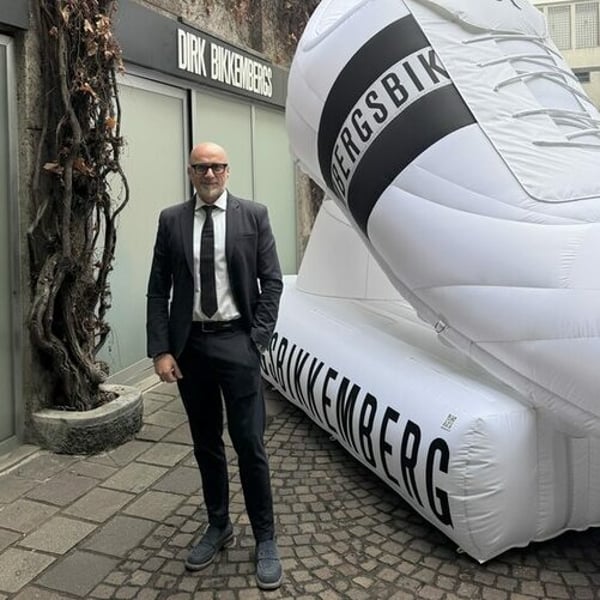
The more than 500-square-metre space, which opened around 10 years ago, brings together the design studio, offices, and B2B sales across two floors, and was set up for the occasion with an oversized inflatable soccer ball positioned at the entrance, the result of a collaboration with a Turin-based creative.
The soccer sneaker is at the heart of the brand’s strategy. Founded by Dirk Bikkembergs, the label is now owned by China’s Modern Avenue. “It is our signature piece, the item consumers associate most strongly with the Bikkembergs name. It’s also on trend right now thanks to its low-profile aesthetic,” Predonzan notes.
Last June’s collaboration with Gosha Rubchinskiy marked a step-change in this direction. “We phased out all the old models across the various markets, a move similar to what Adidas did with the Stan Smith. We will put a strong focus on the brand’s heritage,” says the CEO.
The collaboration with the Russian designer was a limited edition of about 2,000 pairs. “We sold almost all of them. Spring-Summer ’26 was the first season of the sales campaign and we nearly doubled the footwear category’s figures,” Predonzan continues.

The company closed 2025 with turnover of 30 million, in line with last year. “We are satisfied because, despite the difficulties, the company is on a solid financial footing. We have worked hard to streamline processes. It is crucial to be a healthy business in such an uncertain market phase,” the CEO adds.
Driving Bikkembergs’ sales are Germany and Northern Europe, which are once again important markets. The US and Russia account for much of the remainder. “The opening plan through 2027 is proceeding, with two new openings coming in Tbilisi, Georgia, between March 2026 and next autumn-winter. Today we have nine mono-brand stores, but we are always looking for partners for new openings,” says the manager.
In Milan next March, the brand will celebrate its founder with a special event, coinciding with the launch of the first exhibition at MoMu in Antwerp dedicated to the Antwerp Six (which includes designer Dirk Bikkembergs himself). “We want to tie in with this important event to pay homage to our origins,” Predonzan concludes.
This article is an automatic translation.
Click here to read the original article.
Copyright © 2026 FashionNetwork.com All rights reserved.
Published
January 16, 2026
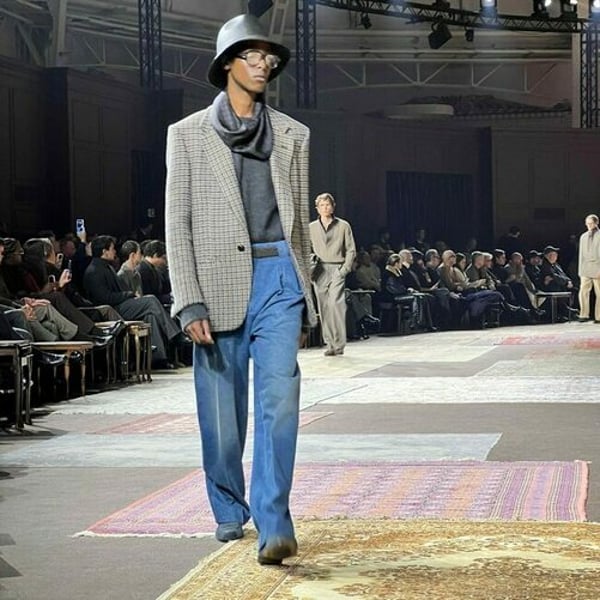
Milan Fashion Week’s menswear season kicked off Friday afternoon with a grand show and ground-breaking collection from a powerhouse brand- Zegna. Presented inside Palazzo del Ghiaccio, a giant, all-white ice-skating rink in east Milan, redesigned like a giant gentleman’s dressing room, where the cast walked out of huge closet doors.
Creative director Alessandro Sartori played with the house’s codes of refined elegance, even as he subverted them- with tailoring innovations and novel materials. Like his brilliant new Horizontal Three jacket, a snug double-breasted blazer, with a hidden third button that can be used to expand the garment into a far looser silhouette.
In terms of fabrics, Alessandro dreamed up a new blend of cashmere and paper- seen in check cardigan jackets. Devoid of interior pockets and with an unexpected hand, they hung perfectly.
The show invitation was a playing card, revealing the collection’s title- Memorie. A riff on the deep history of the brand, which has just named brothers from its fourth generation– Edoardo and Angelo– as new co-CEOs, 115 years after the label was founded in Trivero, Italy. This also referenced Alessandro Sartori’s own memories of his father, who died when he was a young boy.

“One of my strongest emotions was my dad putting on a suit or jacket. When I later found photos of him, I rediscovered my father through his clothes,” explained a wistful Sartori.
The show was also the latest example of smart storytelling by this designer, who presented an early 1930s suit made for founder Ermenegildo Zegna in an Australian wool fabric woven at his own mill. Encased in a museum glass box at the entrance to the show, with a sign that read: Abito 1– or ‘First Suit.’
Staged on a classically cloudy January in Lombardy when a chill humidity seeps down from the nearby Alps, the collection looked ideal for the conditions. Notably, a beautiful series of Donegal tweed style speckled beige and brown suits. Worn with fine wool shirts finished with leather buttons.
No other major Italian tailoring brand has been as courageous as Zegna in pivoting an historically business suits-driven business into the new era of casual luxury. A key reason it could do so is the talent of its creative director Alessandro Sartori.

That said, he produced multiple modernist suits in wide yet subtle stripes, cut with large, notched lapels. And showed multiple great coats with forgivingly softer shoulders. Natty yet always noble and worn on a cast of multiple generations, parading around the carpeted floor.
Backed up by a soundtrack that blended Nick Cave’s Into My Arms with Max Richter’s In The Garden, this was as polished a fashion statement as one could imagine. As Sartori kept stretching the Zegna DNA without ever snapping it.
“I am the custodian of the Zegna family wardrobe,” smiled Alessandro post-show. Before- for his next trick- trying on a Horizontal Three to show how the technique worked to much applause.
Copyright © 2026 FashionNetwork.com All rights reserved.


How Trump became a death knell for the 85-year relationship between farmers and the federal government

Border Patrol Agent Knees Man in Head, Face During Minneapolis Arrest, on Video

West End visitor traffic gets festive boost
-

 Politics8 years ago
Congress rolls out ‘Better Deal,’ new economic agenda
-
Entertainment8 years ago
New Season 8 Walking Dead trailer flashes forward in time
-
Politics9 years ago
Poll: Virginia governor’s race in dead heat
-
Politics8 years ago
Illinois’ financial crisis could bring the state to a halt
-
Entertainment8 years ago
The final 6 ‘Game of Thrones’ episodes might feel like a full season
-
Entertainment9 years ago
Meet Superman’s grandfather in new trailer for Krypton
-
Business8 years ago
6 Stunning new co-working spaces around the globe
-
Tech8 years ago
Hulu hires Google marketing veteran Kelly Campbell as CMO