Connect with us

Business

Jamie Dimon says his success is down to ‘details, no bullsh**ting, or meetings after meetings’

Published

on


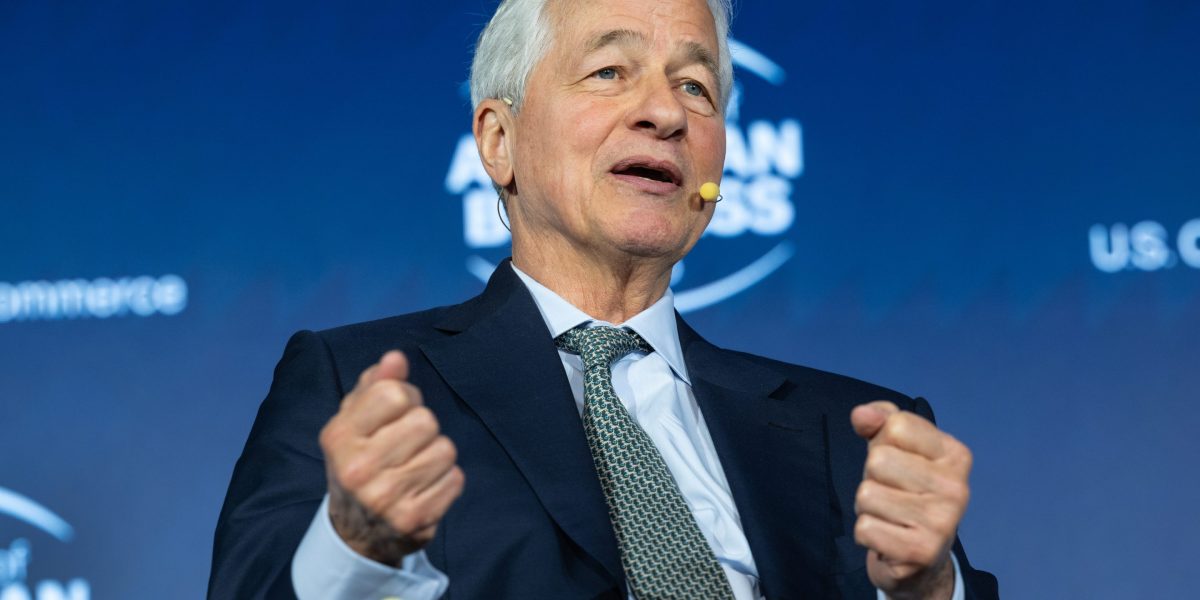
Jamie Dimon’s ethos on running a company is pretty simple: Be relentless, and don’t overlook the details. When organizations get too comfortable and begin ignoring the fine print, he said, is when complacency sets in, and a business begins to decay.

With more than 300,000 employees worldwide, the CEO of America’s largest bank can’t be across every issue in the company—which is why he believes this diligence needs to be instilled at every level.

Speaking at the U.S. Chamber of Commerce yesterday, Dimon was asked how he had made JP better than “every other bank in the world,” a take which its CEO immediately disagreed with: “a lot of people do things better,” he began.

That reflection is “one of the reasons we sometimes do better a little bit,” Dimon added, explaining: “I’m relentless: Details, facts, analysis, no bulllshitting, no meetings after meetings, share all the information—put it on the table, put the dead cats on the table—go through system by system by system, get out on the road, visit other companies, they all do things better than you.”

The overall message is to “learn, learn, learn”, a mantra the Wall Street veteran has advised for everyone from Gen Z’s entering the job market to those in leadership.

“Big companies slow down, they become complacent, they become bureaucratic … arrogant,” Dimon added, all of which eventually leads to “stasis and death.” “Huge, wonderful companies” have failed because of this pitfall, Dimon said, and as such “nothing is too small to care about.”

Watchers of the 69-year-old’s career will not be surprised by his energetic leadership advice. Last April, Dimon wrote in his letter to shareholders that he runs the bank with a military tactic in mind named the ‘OODA loop,’ which stands for observe, orient, decide, act.

JP without Jamie

Under Dimon’s stewardship, JP has scored many wins: Its share price is up 21% over the past year, it is continually leading in AI adoption according to Evident AI’s barometer, and its CEO has the ear of everyone from lawmakers to President Trump.

However, Dimon shocked investors last year when he changed his oft-repeated response to the question of when he may be leaving the top job at JPMorgan Chase. For many years, Dimon would joke that his retirement was five years away. In May last year, that changed. “It’s not five years anymore,” he said.

Speculation has since been rife about which of JPM’s executive team would step in to fill the significant shoes of Dimon. But this week the executive’s tone changed again.

When a “five more years” anecdote was repeated back to Dimon this week, the CEO responded “at least,” suggesting his departure is anything but imminent. “I love what I do, it’s up to the board how long I do it,” he added.

Dimon’s success at JPM, which has included handling politicians and policymakers, led many to question whether one day he might make a move to Capitol Hill. The bank executive completely shut down the notion of a presidential run, as well as the role of Fed chairman (which will be vacated by Jerome Powell this spring).

“Fed chairman, I’d put in the absolutely, positively, no way, no chance, no way, no how for any reason,” Dimon doubled down this week. Since Trump’s return to the White House, the role of Fed chairman has become significantly less attractive, acting as a target for the Oval Office to level criticism and lobbying for the base rate to move one way or another.

But Treasury Secretary Dimon would “consider,” he added: “If a president calls you up asks you to do something, you should consider it. So I would take the call, consider it, and think about why and what they want, but what they want and how they want to operate would be important to me.

“I like my job, I’ve been my own boss for pretty much 25 years, and I like it that way.”


Source link

Continue Reading

Business

In the AI economy, the ‘weirdness premium’ will set you apart. Lean into it, says expert on tech change economics

Published

on


The word “weird” didn’t always mean strange. In Old English, descended from a mix of Germanic and Norse concepts, it meant something closer to “destiny” or “becoming” or even “fate.” Once upon a time, human beings in that culture thought that the way someone’s life would turn out was unseverable from the fundamental weirdness of being alive. 

William Shakespeare’s MacBeth is known for its three witches, who popularized the “double, double, toil and trouble” line, often misquoted from its appearance in a Disney cartoon as “bubble, bubble.” But what’s often forgotten is that Shakespeare named these characters the “Weird Sisters,” connecting them to another mythological group of three old crones: the Norns from Scandinavian mythology, who together weaved a web of destiny called (what else?) the “wyrd,” containing every human’s life story. (J.K. Rowling later named a popular band in her Harry Potter universe “The Weird Sisters,” but that was an all-male lineup.)

The weirdest thing of all in economics, says Brandeis University Economics Professor Benjamin Shiller, is that weirdness is closely tied to fate in the age of artificial intelligence (AI). The weirder you are, he tells Fortune, the better off you’ll be.

In his new book “AI Economics: How Technology Transforms Jobs, Markets, Life, and Our Future,” Shiller, argues that the more bizarre your job, the less likely that AI will take it. A specialist in the economics of technological change—and the son of a famous economist in his own right, Yale’s Robert Shiller, the co-creator of a national home price index still in use today, Shiller tells Fortune that the future of employment is weird. 

“AI models can learn stuff really well but only with a massive amount of training data as humans are much more efficient learners,” Shiller says. “If you have a niche field where there’s not a lot of data out there to train an AI model, then AI probably won’t displace your job.”

Goldman Sachs predicts that 300 million jobs in the U.S. and Europe could be susceptible to some level of change because of AI, predicting that humans could go the way of the workhorse in the modern economy. However, Shiller’s “weirdness premium” suggests a cheat code to gaming AI’s takeover: find a job that’s so complex, not even trillions of tokens of data can replace it. 

AI doesn’t learn as efficiently as humans … yet

Shiller describes what Tesla CEO Elon Musk recently suggested regarding the sheer volume of information required to replace a human skill. The businessman posted in a reply on X (formerly Twitter) “Roughly 10 billion miles of training data is needed to achieve safe unsupervised self-driving.”

“If a typical American drives about 13,500 miles per year, that’s about 750,000 years of a person driving that they need for training data,” Shiller said. In contrast, it takes the average human just a few hundred driving miles and six months of practice to secure their driver’s license. 

Of course, self-driving cars already exist, and can easily get people from point A to point B free of harm. Yet if it takes that much data for an AI to learn a task as simple as driving, then it could take a massive amount of data to automate niche professions, such as that of an aviation accident analyst or an industrial ride engineer. In other words, in fields where data is scarce, humans retain a comparative advantage.

Humans are better equipped at handling kangaroos

Shiller illustrates AI’s limitations with “the kangaroo example,” a cautionary tale of when Waymo tested its self-driving cars in Australia. The vehicles failed to navigate a bizarre and foreign obstacle: jumping marsupials. “They just basically kept on crashing into kangaroos because kangaroos weren’t in their training data and their movements were different [from] other animals’ movements.” 

AI fails to predict the unknown, and that failure is what differentiates humans from even the most advanced machines. “For a human, we’re able to adapt and deal with these edge cases without being specifically trained to handle them,” Shiller said. We’re naturally apt at handling niche scenarios, from the unpredictability of the road to the chaos of a hospital or an investment bank.

Shiller says that modern workers—and young people contemplating a degree—should avoid being caught in a profession that everyone else is doing. “Just taking the standard classes and becoming well-versed in what you’re directly taught in these large majors is a risky strategy,” Shiller said. 

In other words, your fate is certain to be weird.


Source link

Continue Reading

Business

Google Meet exec on the knowledge engine hiding in your calendar: meetings become IP

Published

on


Meetings are the dark energy of business: common, powerful, and largely invisible. The reasoning and judgments that shape a company’s direction happen in meetings, but then disappear. Email turned situational communication into organizational working memory; AI is now doing the same for meetings, making conversations usable beyond the meeting itself. It turns meetings from moments in time to a new kind of organizational asset.

Beyond the Transcript

Meetings contain information that rarely makes it into a formal system: how a leader weighs trade-offs, why a decision went one way instead of another, who deferred to whom, and how objections were resolved. Companies treat strategy documents as critical intellectual property, but the central decision-making process is just as valuable, and harder to capture. Leaders often try to approximate this in writing, but it rarely captures how decisions actually unfold.

The IP of leadership happens in the meeting room. And then it’s gone. 

There is also the simple loss we already feel: decisions made but not recorded. Commitments that fade. Debates rehashed because people forget, not just what was decided, but how. Manual meeting notes are subjective and record only a small portion of this. Even complete transcripts aren’t very useful in capturing meeting meaning; the important information is rarely synthesized, analyzed, or distributed. 

Many people today use AI to summarize meeting recordings and generate (and sometimes share) useful meeting data: who’s on the hook for what, where the disagreements were, who had convincing arguments, and what the agenda should include in the next meeting. This, however, is just the beginning of AI’s application to meetings. All this information can benefit a business on a much larger scale.

Business Value

The information in unrecorded meetings begins melting once the meeting ends.  AI extraction, though, solidifies it into foundational data. Decisions, rationales, and patterns become durable. Their knowledge value stacks like bricks, not ice cubes. For the first time, what gets said in meetings becomes knowledge that an organization can actually build on – just as email made everyday communication archival and durable. 

We can combine this data with the rest of what an organization knows: its documents, CRM, email, and contracts. This joining is where new value surfaces. When meeting intelligence flows into the same corpus as everything else, its signals become amplified.

Some organizations are doing this today. At a large payments and financial services company, leaders aggregate team and customer meeting recordings to analyze patterns across conversations, to surface emerging needs and product ideas that would be difficult or impossible to spot meeting by meeting. Instead of relying on anecdotal recollection, leadership looks across interactions to understand shifting customer signals to inform product development. 

A recurring executive decision-making meeting can become a living archive not just of what decisions are made, but also of how they are made: what kind of arguments and data factor in. It can lead to smoother and more aligned decisions across the company.  As organizations begin systematically capturing meeting intelligence, team dynamics will shift. At first, decision re-litigation decreases, because the capability preserves reasoning. Onboarding accelerates, because new hires can see how the team actually thinks, not just the written policies. 

Individuals adopt AI meeting transcribers because they make their meetings better. But the business value is much larger than better meetings; it is organizational knowledge that we can build on.

What Leaders Should Do Now

Every durable knowledge system eventually reshapes how decisions are made and how work gets done. Consider how email changed the shape of work. AI meeting intelligence will follow the same path, and leaders can accelerate the transition. 

Left to individual adoption, meeting intelligence can stay fragmented. The value, while significant, remains confined to productivity, short of business transformation. The strategic payoff doesn’t materialize. 

To unlock the business value of meeting intelligence, leaders need to treat meeting capture as infrastructure, not as a tool some employees happen to use. When capture, recap, and sharing normalize across the organization, early benefits follow: more transparent accountability, less rework, and better decision follow-through. 

The transformation starts by providing AI meeting tools, explaining their direct benefits to employees, and encouraging their use. At first, the benefits of widespread AI use for capture, recap, and sharing should lead to a growing accountability culture and other employee benefits, such as reduced rework and easier follow-through.

Treating meeting capture as infrastructure means more than using it to improve meeting productivity for individuals and teams. When meeting intelligence is captured consistently, organizations can apply AI analysis to that data to discern business cause-and-effect across decisions, debates, and trade-offs.

This kind of synthesis needs a shared, reliable base of meeting data to draw on. The companies that start capturing meeting data now will be positioned to use advanced analysis as tools mature; those that leave meeting AI tools to individuals and teams won’t have the shared context to build on.

Second, we need to decide how meeting information should be shared and used. We have navigated similar questions with email and documents: as soon as a new form of knowledge becomes durable, norms and governance follow. The same will happen here. 

Meeting data will only become an enterprise asset if people understand how it is being used and can see benefits for themselves. We must be thoughtful about what’s being captured, how it’s retained, and how we manage access. When these choices are clear, meeting intelligence is more likely to strengthen collaboration and analysis, rather than create friction. 

Finally, leaders need to be deliberate about building processes that visibly leverage this new asset. The opportunity is not just capturing conversations, it’s building new rhythms that convert into reusable guidance, behaviors, and institutional memory.

From Ephemeral to Enduring

Managing cumulative meeting intelligence is new territory. There’s no established playbook for how to synthesize it or build on it over time. The organizations that figure this out first will compound their advantage, just as the companies that quickly transitioned to email did. Those that don’t will keep losing the same knowledge they’ve always lost – just with better transcripts. 

This transition won’t happen on its own. It requires leaders who recognize that meetings have crossed from ephemeral to durable, and who are ready to build the systems and culture to capture that value.

The opinions expressed in Fortune.com commentary pieces are solely the views of their authors and do not necessarily reflect the opinions and beliefs of Fortune.


Source link

Continue Reading

Business

‘Star Wars’ gets new chief with Kathleen Kennedy ending lucrative, restless 13 years in rein, Dave Filoni taking over

Published

on


After more than 13 years at the helm of Lucasfilm, Kathleen Kennedy is stepping down from the “Star Wars” factory founded by George Lucas.

The Walt Disney Co. announced Thursday that it will now turn to Dave Filoni to steer “Star Wars,” as president and chief creative officer, into its sixth decade and beyond. Filoni, who served as the chief commercial officer of Lucasfilm, will inherit the mantle of one of the movies marquee franchises, alongside Lynwen Brennan, president and general manager of Lucasfilm’s businesses, who will serve as co-president.

“When George Lucas asked me to take over Lucasfilm upon his retirement, I couldn’t have imagined what lay ahead,” said Kennedy. “It has been a true privilege to spend more than a decade working alongside the extraordinary talent at Lucasfilm.”

Kennedy, Lucas’ handpicked successor, had presided over the ever-expanding science-fiction world of “Star Wars” since Disney acquired it in 2012. In announcing Thursday’s news, Bob Iger, chief executive officer of the Walt Disney Co. called her “a visionary filmmaker.”

Kennedy oversaw a highly lucrative but often contentious period in “Star Wars” history that yielded a blockbuster trilogy and acclaimed streaming spinoffs such as “The Mandalorian” and “Andor,” yet found increasing frustration from longtime fans.

Under Kennedy’s stewardship, Lucasfilm amassed more than $5.6 billion in box office and helped establish Disney+ as a streaming destination — achievements that easily validated the $4.05 billion Disney plunked down for the company. But Kennedy also struggled to deliver the big-screen magic that Lucas captured in the original trilogy from the late 1970s and early 1980s, and her relationship with “Star Wars” loyalists became a saga of its own.

Filoni has established himself almost entirely on the small screen, entering the franchise with the animated series “Star Wars: The Clone Wars” and creating the tepidly received Disney+ series “Ahsoka.” Filoni, who first collaborated with Lucas on “Avatar: The Last Airbender,” has also been an executive producer on “The Mandalorian,” “The Book of Boba Fett” and “Skeleton Crew.”

Both will report to Alan Bergman, Disney Entertainment co-chairman.

“From Rey to Grogu, Kathy has overseen the greatest expansion in Star Wars storytelling on-screen that we have ever seen,” said Filoni. “I am incredibly grateful to Kathy, George, Bob Iger, and Alan Bergman for their trust and the opportunity to lead Lucasfilm in this new role, doing a job I truly love. May the Force be with you.”

Before joining Lucasfilm, Kennedy was one of Hollywood’s most successful producers ever. In 1981, she co-founded Amblin Entertainment with Steven Spielberg and her eventual husband, Frank Marshall. She produced “E.T.,” “Indiana Jones and the Temple of Doom,” “Jurassic Park” and the “Back to the Future” trilogy.

At Lucasfilm, her biggest hit came at the start, with 2015’s “Star Wars: The Force Awakens.” The J.J. Abrams-directed film grossed more than $2 billion worldwide. But the subsequent installment, Rian Johnson’s “The Last Jedi” (2017), was bitterly divisive. The third film, Abrams’ “The Rise of Skywalker” (2019), was widely panned by critics and fans, alike.

After “The Rise of Skywalker,” “Star Wars” went dark on the big screen despite a litany of announced projects. The dry spell is set to be broken in May by Jon Favreau’s “The Mandalorian & Grogu.” The intervening years have been marked by streaming successes in “The Mandalorian” and “Andor,” but the future of “Star Wars” has felt increasingly uncertain.

Struggles over tone and vision have been frequent. The 2018 Han Solo spinoff “Solo: A Star Wars Story” saw its directors, Phil Lord and Christopher Miller, fired during production and replaced by Ron Howard. Most found the mixed-and-matched result blandly disappointing.

More recently, Adam Driver, who played Kylo Ren/Ben Solo in the most recent “Star Wars” trilogy,” divulged to The Associated Press last year that he and Steven Soderbergh had developed a Ben Solo film with Kennedy and Lucasfilm’s support for two years before Disney chief Bob Iger nixed it. Fans were so irate that a plane was flown over Disney’s Burbank studios with a banner reading “Save ‘The Hunt for Ben Solo.’”

Instead, the only “Star Wars” movie of Kennedy’s stewardship to win widespread and prevailing approval from fans was arguably 2016’s “Rogue One.” Gareth Edwards’ spinoff was also a troubled production, leading to Tony Gilroy, eventual creator of “Andor,” overseeing reshoots. Yet despite that, “Rogue One” — taking place within “Star Wars” but outside of the main Jedi storyline — might be the only film of Kennedy’s “Star Wars” reign that managed to both stay true to the space odyssey’s tone and to break new ground.

Kennedy’s fingerprints will be on many of coming “Star Wars” projects for years to come. That includes Shawn Levy’s “Star Wars: Starfighter,” with Ryan Gosling, due out in May 2027, and a fleet of other projects in various stages of development.


Source link

Continue Reading

Trending

Copyright © Miami Select.