
Fashion
Woolrich looks to its past

Published
January 16, 2026
Just two months ago, the Turin-based BasicNet group, owner of the Kappa, Robe di Kappa, K-Way, Superga, Sebago and Briko brands, announced it had reached an agreement to acquire the Europe operations of Woolrich, the historic American brand founded in 1830. Last week also saw the announcement of the suspension of the transfer of the 139 employees currently based at the Bologna headquarters. In short, much has been written in recent months, and the Woolrich name has been at the centre of many conversations in the fashion industry. The Pitti Uomo appearance was highly anticipated.
Lorenzo Boglione, CEO of BasicNet, accompanied by brand director Marco Tamponi, who joined the company in 2017 to oversee Sebago (from both a commercial and creative standpoint), met with the press and outlined the first steps under the new ownership at the Florentine event.
The approach is one of great pride and deep respect for the brand’s DNA: for Boglione, it is “about being custodians of 200 years of history and having the ability and vision to evolve the brand into the contemporary era.”
The first step, then, is study: not only of the garment archive (over 15,000 pieces), but also of the fabrics (over 12,000 samples), which represent a significant part of Woolrich’s heritage. Boglione recalls that the American company was founded in Pennsylvania by John Rich and Daniel McCormick to manufacture fabrics for clothing worn by hunters, lumberjacks and trappers.
“Workwear and outerwear are deeply rooted in American culture, which makes it fascinating to explore their history,” the CEO commented.

The words “time” and “patience” surfaced repeatedly during the press conference. Boglione spoke in measured tones and was keen to emphasise that each step will be taken slowly, in a considered and structured way.
“We bought a brand that had a turnover of 90 million but was in great financial difficulty. Fortunately, we are not chasing immediate results or easy turnover. We all tend to remember Woolrich today for a single jacket style, whereas the brand is much more than a product that was immensely successful 20 years ago. We will not repeat the mistake of lacking a 360-degree vision. We will return to its past and its archive for this very reason: to be able to tell the incredible story of this brand,” he said.
These first weeks have therefore been used to study the current market, define the next steps, and begin work on a collection (both men’s and women’s, a segment that currently accounts for 30 per cent) that will need to be broad and well-structured. The path envisaged by the Boglione-Tamponi duo recalls what was done with Sebago and champions a slow business approach.
“Only on one thing did we work in great haste with a sense of urgency: we had a beautiful space in Turin, our city, and we raced to open a flagship in time for Christmas. For everything else, we don’t have to rush,” they explained with a smile.

“Italy and Germany today are the two main markets (they account for 80 per cent) with high brand awareness. Surely we could start here, but we will not hesitate to look wherever the collection can meet the tastes of new consumers,” Boglione stressed.
On the production side, Woolrich will be able to rely on BasicNet’s highly structured and diversified supply chain, international in scope, with many product categories produced in Italy.
Drawing on his experience with Sebago, Tamponi will lead creative development and commercial strategy together with a team that is taking shape, with every decision carefully considered and made collectively.
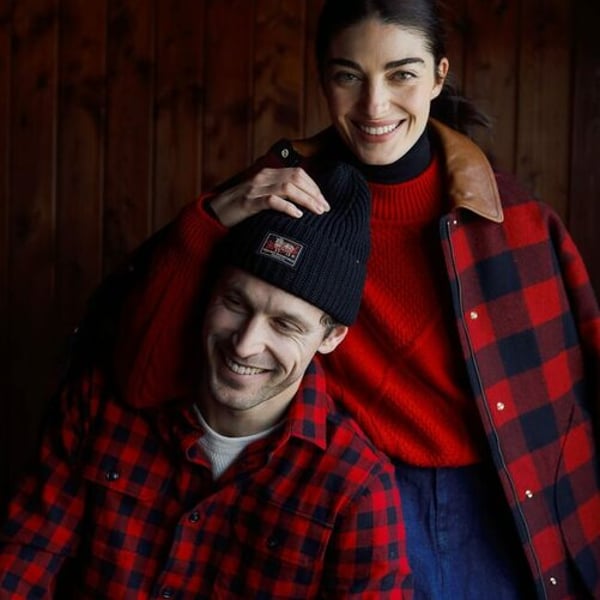
For Pitti, Boglione and Tamponi conceived the Woolrich space as a themed room in which the buffalo check motif covers the surfaces and creates a warm, deeply American atmosphere. Archival catalogues, historical images and tangible evidence of the brand’s long history—original spools of yarn, portraits of founder John Rich and his family—line the walls. Objects that speak of an age-old craft, one that survived the 1903 fire that destroyed part of the archives but not the company’s identity. And it is from that identity that everything is now ready to start again.
This article is an automatic translation.
Click here to read the original article.
Copyright © 2026 FashionNetwork.com All rights reserved.
Published
January 16, 2026
One of the greatest fashion brand pivots of the past few years is Inis Meáin, the Irish marque which has developed into a great supplier of cool casual luxury without losing its earthy roots.
Based in and named after the middle isle of the Aran Islands on the western extremity of Europe, the brand has grown from a label of rustic dense Irish wool sweaters into a purveyor of cashmere and merino while keeping its Celtic charm.
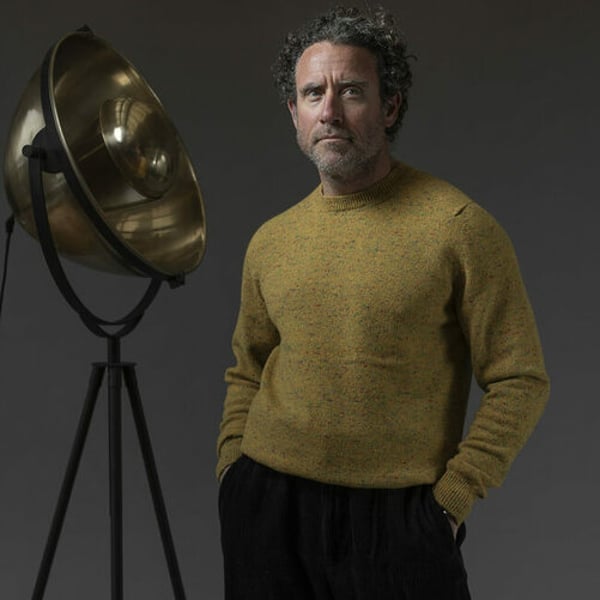
“The company was set up by my dad 50 years ago. And after starting off making heavy woollen sweaters for the tourist market, he decided to branch into a higher-end product,” explained CEO Ruairí de Blacam, son of founder, Tarlach de Blacam.
Investing in new machinery, technology and materials, Tarlach was able to maintain a manufacturing plant on the windswept island. Going around the world 50 years ago growing new markets in Japan, Germany and the U.S. Opening lucrative accounts with the likes of Barneys in New York and Japan; Paul Stewart; Bergdorf Goodman; Saks Fifth Avenue and Bloomingdale’s. In short, the best doors in the world, when American department stores ruled the wholesale roost.
Cineastes will know the islands from Robert Flaherty’s legendary 1934 ethno-fiction documentary “Man of Aran”, shot on sister isle Inishmore in 1934. And the latest collection manages to balance that hardiness with modern hip successfully.
In a second pivot, as the web destroyed the old business model, Inis Meáin smartly evolved into a direct-to-consumer model, a DTC business, which it primarily is today.

One can still find Inis Meáin in destination stores like Liberty in London or Selfridge’s, along with a select few small creative retailers, giving it a global reach of some 150 doors.
“But, to keep the business going, we decided to take it online. And we have grown it from about 12% of the business to 55% in this calendar year gone by,” enthused Ruairí.
Disarmingly direct, he admits he has no plans to open a flagship, even in booming Dublin, the obvious destination.
“There’s a reason why Zegna and Brunello Cuccinelli don’t open a shop in Dublin, you need critical mass. You could think of a lot better ways to spend a couple of hundred grand, you know,” he argues at his stand in Florence at Pitti Uomo, the best fashion salon on the planet.
These days, Inis Meáin sources most of its yarns from close to Pitti, spun in Prato, the true nerve center of Italian fashion.
“The Italians make amazing fabrics. Almost exclusively in winter we work with Filati Biagioli, about 50 miles up the road. They make the most amazing yarns, and we get bespoke colors with an Irish flavor. That Donegal tweed look with neps, those flecks that give it a speckled look,” he explained.
Blending on average 30% cashmere and 70% merino means their sweaters have a beautiful hand and feel great on skin. One Inis Meáin bestseller is its Pub Jacket, a term invented by famed Boston boutique owner Murray Pearlstein. A cardigan jacket that seems built to be photographed in front of a fresh pint of Guinness.

“Murray was really good at marketing, and he even took out an ad in the New York Times for our Pub Jacket. So, it’s been in the collection for 40 years now, an iconic piece. Made in a wool and linen mix,” noted Ruairí, of a jacket that would work everywhere from a bar on the Wild Atlantic Way to cocktail hour in Milan or Paris.
Inis Meáin shuns synthetics, and often adds linen to summer gear, though even here the source is now from Lithuania or Normandy and not Ulster.
That realistic flexibility has guaranteed Inis Meáin’s future and means that its plant on the middle of the island still employs 25 people. Not bad going seeing as the island population is 180 people. That’s another variation on sustainability – sustaining a community.
The brand’s tagline – “Warmth from the Edge” – still rings very real. And it’s DNA resonates, notably in the stand’s center-point – a fantastic giant black-and-white 1912 photo of a gnarly pipe smoking fisherman with six pre-teen kids in knits woven on the rocky island.
It’s price point is very reasonable compared to the likes of Loro Piana or Louis Bompard, ranging from €450 sweaters to €2,000 for jackets, starting with cashmere merino blend beanies at €120.
“Our sweaters are not Sunday Bests. They are often 100% cashmere, so you don’t want to kick them around. But they are made to be worn. You don’t put them in a machine wash. Well, I do… because I run the factory. And if I make a dog’s dinner of it, then that’s okay. I can knit myself another one,” laughed Ruairí , the cashmere king of Connemara.
Copyright © 2026 FashionNetwork.com All rights reserved.
Published
January 16, 2026
For Marco Angeloni, CEO of Caruso, the Italian ultra-high-end menswear manufacturer and part of the Lanvin Group, a few keywords explain Caruso’s success.
“Passion. Quality. Consistency: this is how we have won and retained our customers. Our mantra, ‘playful elegance’, immediately sums up what we do and continue to do. We approach menswear with meticulous attention to detail, yet we also have the ability and courage to experiment with new fibres, colours and shapes, without forgetting our Neapolitan roots, where tailoring is fundamental.”
It is no coincidence that Caruso grew in a complex year like the one that has just ended,”thanks both to the Italian market, which now accounts for almost 30% of sales and has shown extraordinary resilience (with a 70% sell-through before markdowns), and to the Japanese market, whose highly discerning clientele has been won over by our quality, the refinement of our detailing and that inimitable, quintessentially Italian elegance that sets us apart,” Angeloni continued.
At the Caruso booth at Pitti, FashionNetwork.com also spoke with creative director Max Kibardin. The understanding between Kibardin and Angeloni is evident: the manager and the designer complement each other perfectly and share the same vision.
“We are a small team, we move quickly, the decision-making process is streamlined, and our messaging is clear and shared. We understand the importance of research and innovation in fabrics, colours and materials, and we are equally convinced that we must remain faithful to our heritage. We often anticipate trends precisely because of our research and our vision, yet we never stray too far from a reassuring territory in which the customer can feel at ease, as they are investing in wardrobe pieces designed to last,” Kibardin explained.
Angeloni added that, in a complex context like the current one, positioning Caruso within affordable luxury has paid off. “Our core offering sits in the €2,000 bracket, and, with a top-tier wholesale network, we have been recognised as delivering exceptional quality at a distinctly attractive price,” he expressed.

To the keywords cited by Angeloni as defining elements of Caruso’s brand identity, one can confidently add “experimentation”. Proof of this, beyond truly distinctive collection pieces such as the silk coat or the tailored parka, are the collaborations undertaken by the Soragna-based brand.
Following the jewellery collaboration with Villa Milano launched last year, Caruso will introduce during Milan Fashion Week a truly unconventional collaboration with Sanyocoat, a major Japanese player that has devoted more than 80 years to the art of making coats.
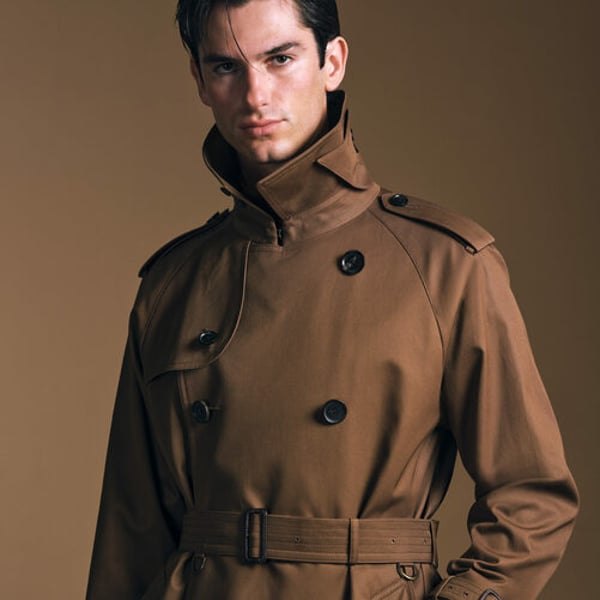
Together with its Japanese partner, Caruso has developed two trench coat models crafted from a special cotton gabardine with a three-dimensional herringbone pattern. The garments, strictly Made in Japan at the Sanyo Sewing Aomori Factory, feature balanced proportions for a soft, relaxed fit. The sleeves are raglan, inspired by the functional language of military uniforms; all finishing is done by hand; horn buttons are used; and details such as the collar and leather buckle express a sense of understated, measured craftsmanship in which every element is essential.
More than a collaboration, this is a dialogue between Italy and Japan that translates into a contemporary interpretation of outerwear, where artisanal know-how and innovation coexist in harmony. On Saturday, the trench coats will be shown during the Milan presentation, but a few months’ patience will be needed before they can be purchased from leading retailers in Europe and Japan.
This article is an automatic translation.
Click here to read the original article.
Copyright © 2026 FashionNetwork.com All rights reserved.


Zimmermann opens another store in Mexico

Democratic candidates stack $216K in Q4 toward Primary race for GOP-controlled HD 106

Singapore tries to give its flagging stock market a kickstart with a link to the NASDAQ, allowing firms to easily list in both places
-

 Politics8 years ago
Congress rolls out ‘Better Deal,’ new economic agenda
-
Entertainment8 years ago
New Season 8 Walking Dead trailer flashes forward in time
-
Politics9 years ago
Poll: Virginia governor’s race in dead heat
-
Politics8 years ago
Illinois’ financial crisis could bring the state to a halt
-
Entertainment8 years ago
The final 6 ‘Game of Thrones’ episodes might feel like a full season
-
Entertainment9 years ago
Meet Superman’s grandfather in new trailer for Krypton
-
Business8 years ago
6 Stunning new co-working spaces around the globe
-
Tech8 years ago
Hulu hires Google marketing veteran Kelly Campbell as CMO