Connect with us

Business

Trump’s ‘Department of War’ rebrand could cost $125 million, says the CBO

Published

on


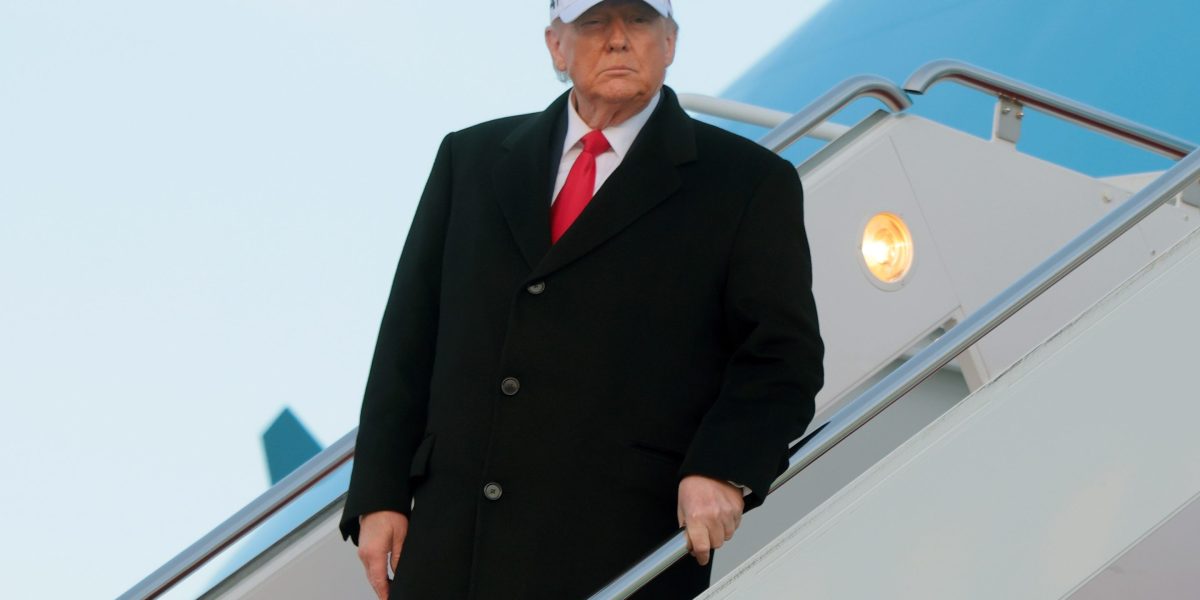
President Trump’s bid to knock four letters off the “Department of Defense” in a rebrand to the “Department of War” could cost upwards of $100 million, the Congressional Budget Office (CBO) has estimated.

On September 5, the president signed an executive order to restore the George Washington-era names of the Department of War and the Office of the Secretary of War as secondary titles for the Department of Defense and the Office of the Secretary of Defense.

Within that order was a stipulation that the Secretary of War would later submit a presidential application to permanently change the name of the department.

However, rebranding the nation’s biggest employer is no small task. The Pentagon oversees 1.32 million people in active duty and 750,000 civilian personnel.

According to the CBO, which responded to a request for information from senators Jeff Merkley and Chuck Schumer, the shift would cost about $10 million for a “modest implementation” of the change, primarily within the department itself. This sum could be absorbed as an opportunity cost, the CBO added, paid out of existing budgets.

But there are two ends to the scale: Minimal implementation might cost a measly few million, the CBO said, but on the extreme end it could cost taxpayers $125 million.

“Broadly, the costs would include staff time spent updating document templates, revising websites, or modifying letterhead, time that could be devoted to the activities that the department had planned to conduct before the executive order was issued,” the CBO wrote. “Similarly, funds used for signage or ceremonial items could reduce resources available for planned items or activities.”

The scale of the costs depends on how “aggressively” the rebrand is rolled out, and how it would be prioritized against remaining activities and “ongoing missions.” A more aggressive rollout, for example, might include “immediately replacing stationery, signage, and nameplates” as opposed to replacing them when existing stock runs out.

“The faster the changes were implemented, the more parts of DoD that the changes applied to, and the more complete the renaming, the costlier it would be,” the CBO added.

“Under President Trump’s leadership, the now aptly-named Department of War is refocused on readiness and lethality—and its title now reflects its status as the most powerful fighting force in the world,” the White House told Fortune. “The White House is working hand-in-glove with the Department of War on implementation of the executive order.”

One of the most expensive endeavours in the proposed change would be renaming the air bases. Even back in March 2023, the Army projected that it would cost at least $39 million to rename nine posts: Forts AP Hill, Benning, Bragg, Gordon, Hood, Lee, Pickett, Polk, and Rucker. That was nearly double an estimate by the Naming Commission a year prior, which put the price at $21 million.

There are also costs incurred for other non-federal entities if the Department of War decides to push its name change through as a blanket approach. For example, the CBO points out that North Carolina spent $400,000 in 2023 to change the name of Fort Bragg to Fort Liberty, just to change it back to Fort Bragg again last summer.


Source link

Continue Reading

Business

US debt: Deficits inflate profits and stocks, so reducing red ink could trigger a financial crisis

Published

on


Massive budget deficits have sent U.S. debt soaring past $38 trillion, but they have also become the primary driver of corporate profits and stock valuations, according to Research Affiliates.

In a recent note, Chris Brightman, who is a partner, senior advisor, and board member at the firm, and Alex Pickard, senior vice president for research, traced the historical trend between the deficit and how earnings are recycled to inflate asset prices.

“In the financialized U.S. economy, each dollar of deficit spending may flow into a dollar of corporate profit,” they wrote.

Annual budget deficits have reached $2 trillion, with debt-servicing costs alone hitting $1 trillion. As federal spending exceeds revenue by wider margins, the Treasury Department must issue greater volumes of bonds.

Much of the money the government raises by selling debt goes into consumers’ pockets, primarily via entitlement payments, which eventually boost profits, according to Research Affiliates.

But for decades, companies largely didn’t invest those profits to expand their capacity. Due to intense global competition, especially from China, returns from U.S domestic production were kept low. And even the money that is invested wound up replacing depreciated capacity rather than expanding it.

As a result, companies returned much of their capital to shareholders in the form of buybacks and dividends, which were plowed back into financial markets, often in price-insensitive passive funds that inflate valuations, the report argued.

“Mandated to remain fully invested, these funds then recycle the inflows to purchase stocks in proportion to their market capitalization indifferent to valuation, thus bidding up prices without any change in fundamentals,” Brightman and Pickard wrote.

They pointed to a real-world experiment that reinforces their thesis. During the late 1990s, the federal government briefly erased its budget deficit and actually boasted a surplus.

That came as the booming economy helped lift revenue while cuts to federal welfare programs limited spending. During this period, corporate profits fell too, they added.

This dependence on federal deficits has left financial markets increasingly fragile, the report warned, as corporate earnings have shifted away from relying on returns from private investment.

“Reversion to a healthier macroeconomic environment of declining deficit spending and greater net investment may cause sharp declines in both corporate profits and valuation multiples and likely trigger a financial crisis with politically toxic consequences,” Brightman and Pickard concluded.

“Ironically, the more palatable option may be to remain on the current path until a financial crisis imposes on us the discipline that we are unwilling to impose on ourselves.”

Changing U.S. debt market

Despite surging revenue from President Donald Trump’s tariffs, debt continues to pile up, drawing alarm bells from Wall Street heavyweights like JPMorgan CEO Jamie Dimon and Bridgewater Associates founder Ray Dalio.

Meanwhile, Trump plans to grow defense spending by 50%, pushing it to $1.5 trillion a year and blowing up the debt even more.

At the same time, the holders of U.S. debt have shifted drastically over the past decade, tilting more toward profit-driven private investors and away from foreign governments that are less sensitive to prices.

That threatens to turn the U.S. financial system more fragile in times of market stress, according to Geng Ngarmboonanant, a managing director at JPMorgan and former deputy chief of staff to Treasury Secretary Janet Yellen.

Foreign governments accounted for more than 40% of Treasury holdings in the early 2010s, up from just over 10% in the mid-1990s, he wrote in a New York Times op-ed last month. This reliable bloc of investors allowed the U.S. to borrow vast sums at artificially low rates. Now, they make up less than 15% of the overall Treasury market.

To be sure, the federal budget deficit isn’t the only driver of growth. The AI boom has set off a massive investment wave, spurring demand for chips, data centers, and construction materials.

But so-called AI hyperscalers are also turning to the bond market to raise capital for annual expenditures of hundreds of billions of dollars. And their debt issuance represents more competition to the Treasury Department, which is looking to ensure investors continue absorbing the fresh supply of debt it must sell.

In a note last week, Apollo Chief Economist Torsten Slok pointed out that Wall Street estimates for the volume of investment grade debt that’s on the way this year reach as high as $2.25 trillion.

“The significant increase in hyperscaler issuance raises questions about who will be the marginal buyer of IG paper,” he said. “Will it come from Treasury purchases and hence put upward pressure on the level of rates? Or might it come from mortgage purchases, putting upward pressure on mortgage spreads?”


Source link

Continue Reading

Business

How calculated career risks led a BNY executive to the C-suite of America’s oldest bank

Published

on


In the high-stakes theater of global financial services, leaving a 26-year run at a blue-chip firm for the uncertainty of a pandemic-era IPO would strike most executives as reckless. For Cathinka Wahlstrom, it was instinct.

Now chief commercial officer at Bank of New York (BNY), Wahlstrom’s leap from Accenture partner to the C-suite of the oldest bank in the United States offers a study in modern leadership that blends vision, systems thinking, and comfort with uncertainty.

Her career is defined by inflection points. She left Accenture at the height of her influence. She moved across continents more than once. She declined a role in Japan when her children were young, then later agreed to take a private-equity-backed company public in the middle of a global crisis. Each decision reflected a consistent trade-off between certainty and growth.

Wahlstrom joined Accenture when it was still a partnership grounded in analysis, expertise, and client service. As the firm evolved into a global public company, her role expanded alongside it. What began as deep technical work in financial services grew into stewardship of major client relationships and leadership roles that required her to think across markets, cultures, and organizational layers. She learned to operate inside complex systems where decisions ripple through clients, teams, and institutions.

Over time, her work shifted from solving siloed problems to understanding interdependence and how choices in one area increasingly shape outcomes in another. She could see her future with unusual clarity, including the shape of the work and the progression ahead.

“I could see my next ten years at Accenture,” Wahlstrom says. “And I just knew I was ready for the next thing—even though I couldn’t quite see what that next thing was yet.” 
​​That clarity signaled mastery, she says. Staying would have meant optimizing what Wahlstrom already knew, whereas leaving would have meant embracing the vulnerability of a new learning curve.

The opportunity arrived during the pandemic in the form of a chief commercial officer role at a Blackstone-backed company preparing to go public. The opportunity arrived during the pandemic, when uncertainty already defined the environment. Wahlstrom became chief commercial officer of a Blackstone-backed company preparing to go public, moving closer to day-to-day operations than at any prior point in her career. The role tested her in a different register: less advisory and more ownership of outcomes.

That experience set the stage for what came next. When BNY approached her, the challenge was fundamentally different. Founded in 1784, the bank’s defining strength is longevity. Wahlstrom was recruited with a mandate to modernize without destabilizing. Her task was to upgrade technology, evolve culture, and expand the bank’s relevance to a younger client base while preserving the foundations that have enabled the institution to endure for nearly 240 years.

Today, Wahlstrom says she works at the seams of the organization where data meets judgment, strategy meets execution, and global plans meet local realities. One example is using AI to better understand the client experience, surface friction points, and identify emerging opportunities. 

Viewed in sequence, Wahlstrom says her career has moved from stability to uncertainty and then to renewal. That arc, she says, reflects what leadership increasingly demands: the ability to live inside paradoxes. Leaders must hold vision and detail at the same time, pair analytical rigor with emotional intelligence, and think globally while acting locally.

“I’m really driven by that journey of setting a vision, coming up with a plan, and then executing,” Wahlstrom says. “I just love the process.”


Source link

Continue Reading

Business

Down Arrow Button Icon

Published

on


DraftKings Inc., Flutter Entertainment PLC and other stocks linked to the sports gambling industry are tumbling on Friday after new data suggested that they may be losing ground to competing products from prediction market startups.

Platforms like Kalshi and Polymarket, which have recently introduced financial contracts tied to the outcome of sports games, reported surging activity last week during the beginning of the NFL playoff season. Meanwhile, during what is typically a boom time for sportsbooks, New York state data showed that revenues from online sports wagering plunged from a year earlier.

DraftKings shares dropped as much as 8.3% in New York trading, the worst intraday plunge since late October. Shares of Flutter, which runs the gambling app FanDuel, were down as much as 5.5%, falling to the lowest intraday level since late November. The broader gambling space also took a dive, with an S&P gauge of the industry’s shares shedding as much as 2.5%.

Online sportsbooks have been under pressure for months since prediction markets rose to prominence with their new sports contracts. The startups have used their status as federally regulated exchanges to offer sports wagers that circumvent the state laws that have governed online gambling.

While several state gaming regulators have called the products illegal and pushed the companies to shut them down, the startups have plowed ahead and sports bets have come to account for around 90% of the trading volumes on Kalshi. The contracts have gotten wide distribution through Kalshi’s partnership with the retail broker Robinhood. 

“We do believe prediction markets are having an impact on the sports betting companies,” Jordan Bender, equity research analyst at Citizens, said. “The PMs are built around large tentpole events like the NFL playoffs.”

According to Piper Sandler & Co. analysts led by Patrick Moley, last week saw the five highest volume games of the season on Kalshi, with NFL-related bets on the platform hitting a record $720 million. The analysts say the weekend also marked a milestone, as the Chicago Bears’ comeback win over the Green Bay Packers was Kalshi’s first game to exceed $100 million in trading.

The shares of Flutter and DraftKings have recovered somewhat over the last two months after both companies said that they were opening their own prediction market offerings in states where sports gambling is illegal. While the companies rolled out those new apps last month, it is not yet clear if they have gained any traction.

“It’s still early days for the products and Kalshi has a lot more functionality than them at this time, so I would be surprised if they were gaining a lot of traction,” Needham analyst Bernie McTernan said. 

There has been debate within the industry about whether prediction markets could offer real competition for the more established offerings from sportsbooks, particularly in profitable areas like multi-leg parlay bets. A recent report from Citizens Bank estimates the new platforms still only account for 5% of the total wagered on sports in the US. 

“We think prediction markets will expand more than cannibalize traditional online sports betting markets,” Dan Wasiolek, a senior equity analyst at Morningstar said. 

Over the past few months, the New York state data has indicated that online gambling companies have generally been growing their revenues from the previous year.

But the new weekly numbers out of New York suggest that the revenues from traditional sportsbooks dropped 40% year-over-year in the week ending Jan. 11, which included the NFL wild card weekend. This comes at a time when prediction markets have seen surging volumes and garnered significant public attention.    

Needham’s McTernan says that while the stock selloff is mostly due to the New York state data, the sportsbooks also face difficult comparisons. “If you look versus two years ago it doesn’t look as bad,” he adds.


Source link

Continue Reading

Trending

Copyright © Miami Select.