India expects talks on a long-sought trade deal with the European Union to conclude this month, Trade Secretary Rajesh Agrawal said on Thursday, in what would be New Delhi’s largest agreement as it seeks new markets amid US tariff pressures.
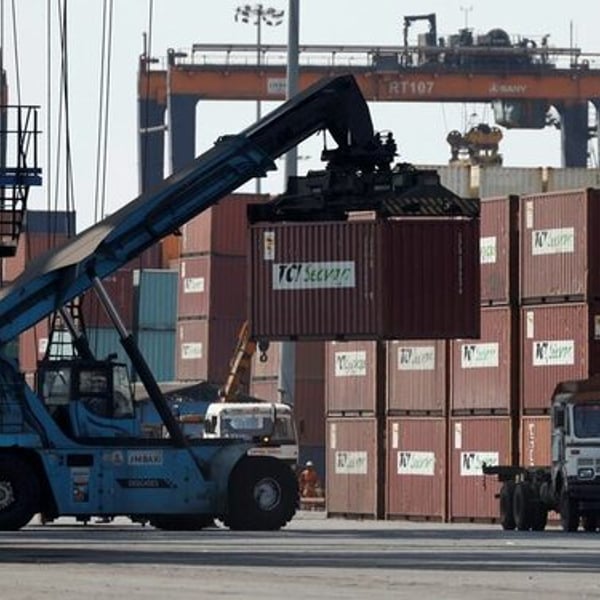
A mobile crane carries a container at Deendayal Port in Kandla, in the western state of Gujarat, India, April 5, 2025 – REUTERS/Amit Dave
The deal, under discussion for years, is seen as a chance for both sides to deepen economic ties and cut reliance on China and Russia. Bilateral trade between India and the EU totalled 120 billion euros ($140 billion) in 2024, making the bloc India’s biggest trading partner. Agrawal said the two sides were “very close” to finalising the pact and were exploring whether it could be wrapped up before leaders meet in New Delhi this month.
He said talks on a US trade pact were continuing and a deal would be reached when both sides were ready. Negotiations collapsed last year after a breakdown in communication between the two governments.
The president of the European Council, Antonio Costa, and European Commission president Ursula von der Leyen will visit India on January 25–27 and co-chair an India–EU summit on January 27, India’s foreign ministry said. If concluded, the deal would open India’s vast and heavily protected consumer market of more than 1.4 billion people to European goods and could reshape global trade flows as protectionism rises and a US-India pact remains stalled.
Both sides have been pushing to close a broad agreement after von der Leyen and Indian Prime Minister Narendra Modi agreed to fast-track negotiations in an effort to close a deal in 2025. Talks, relaunched in 2022, gained momentum after US President Donald Trump imposed tariff hikes on trading partners including India. Brussels has recently signed deals with Mexico and Indonesia and stepped up talks with India, while New Delhi has reached agreements with Britain, Oman and New Zealand.
Some sensitive agricultural items have been excluded from negotiations, an Indian trade ministry official said. India will not open its agriculture or dairy sectors in any trade pact, officials have said, citing the need to protect millions of subsistence farmers.
The EU is pushing for steep tariff cuts on cars, medical devices, wine, spirits, and meat, along with stronger intellectual property rules. India is seeking duty-free access for labour-intensive goods and quicker recognition of its autos and electronics sectors.
Beyond goods, the agreement is expected to expand services trade, investment and cooperation in digital trade, intellectual property, and green technologies, as well as spur European investment in Indian manufacturing, renewable energy ,and infrastructure. Challenges remain over regulatory alignment and the protection of sensitive sectors. The EU’s carbon border levy, which requires importers to account for emissions in steel, cement and other carbon‑intensive products, has started to hit some Indian exports and is a key concern for New Delhi, exporters said.
Tradeinn, a Spanish company specialising in the online sale of sporting goods, increased its revenue by 5.6% in the 2025 financial year to €585 million, up from €554 million in the previous financial year.
David Martín, founder and CEO of Tradeinn – Tradeinn
The Girona-based company frames its 2025 results as part of a “growth trajectory that has been reinforced by its commitment to catalogue specialisation, technological innovation, and adaptation to new consumer habits.”
Over the past year, Tradeinn dispatched a total of 9.2 million parcels to customers in 190 countries. The company notes that 85% of its sales are generated outside the Spanish market, further consolidating its international position. Logistically, the group dispatched more than 8.4 million parcels from its operations centre in Celrà (Girona), while over 700,000 originated from its logistics hub in Germany.
“Our evolution reflects a robust model based on specialisation, direct distribution, and the trust of millions of athletes around the world. Our priority is to continue investing in technology, logistics and artificial intelligence to strengthen our competitive agility and optimise our operational processes. Looking ahead to 2026, we are entering a new phase of international consolidation with an increasingly specialised and differentiated value proposition,” said David Martín, CEO and founder of Tradeinn.
The retailer, launched in 2008 as an e-commerce business but with roots in a diving shop founded in the 1990s, employs more than 530 people. Its catalogue features over 3.5 million products from more than 12,500 brands across 18 categories, and its business model is built on direct distribution and acting as the official distributor for various brands. The company says it drives its competitive agility through AI, “applying artificial intelligence solutions for operational process optimisation, advanced inventory management, demand forecasting and the improvement of the customer experience.”
In 2025, the US private equity fund Apollo acquired a 30% stake in Tradeinn, a holding that had been in the hands of Suma Capital and minority shareholders since 2015. Following this transaction, the founder and CEO retained his 70% stake in the company through Didavid Management, which also includes Dídac Lee, co-founder of Galdana Ventures.
This article is an automatic translation. Click here to read the original article.
Bollywood celebrity Samantha Ruth Prabhu has launched Mile Collective with co-founders Harshita Motaparthi and Pravishta Nadella as a comfort-driven activewear and lifestyle label, designed for Indian bodies.
Mile Collective’s first looks – Mile Collective
“Mile Collective reflects how I choose to live today,” said Mile Collective’s co-founder Samantha Ruth Prabhu in a press release on January 15. “Movement, for me, isn’t just about fitness. It’s about balance, intention, and ease through the day. I found myself reaching for Mile every single day; it became a habit. The pieces look effortlessly fab, feel like a soft cloud yet snug in all the right places, and the colours are just beautiful. It’s comfort you can feel and clothing that makes your day feel better.”
The brand is a new incarnation of Mile Active, which was originally established in 2023 by Harshita Motaparthi with the aim of creating activewear specifically for Indian body types and the county’s climates. Pravishta Nadella later joined as co-founder then Samantha Ruth Prabhu also came on board as a co-founder, drawn in by the brand’s focus on wellness, according to the label.
Now, Mile Active has been reimagined as Mile Collective, with the aim of sparking a new phase of growth and expanding its offering. Mile Collective’s debut collection is titled “OnTheGo” and seeks to take the wearer from workouts to travel and lounging at home with minimalist separates in hues including charcoal and burgundy. Mile Collective’s e-commerce website is scheduled to launch soon to offer its clothing pan-India.
“Mile was never about pushing harder,” said brand co-founder Harshita Motaparthi. “It was about creating pieces that feel good to live in. Mile Collective is an extension of that thinking. Clothes that support your day, without demanding anything from you.”
Munich Fabric Start (MFS) is gearing up for its January 27–29 edition. Designers, product managers, and buyers will be able to explore around 1,000 spring/ summer 2027 collections from international fabric and trim manufacturers at the MOC Munich.
Trade visitors can explore around 1,000 collections over the three days of the trade fair in Munich. – MUNICH FABRIC START
With the lead theme of “Pleasure,” the trade show’s organisers aim to spotlight “attitude, sensuality, and emotional materiality” over the three days of the fair. The lead theme frames fashion as an emotional space, an expression of attitude and cultural reflection. Colours, surfaces and materials become conduits for self-confidence and joie de vivre.
“After seasons of restraint, spring/ summer ’27 marks a deliberate counter-design: optimism, sensuality, and creative freedom take the place of pragmatism and neutrality. Physical presence and individuality are regaining importance- as a response to uncertainty, exhaustion and algorithmic predictability,” according to MFS.
“Efficiency and pragmatism are shaping current market developments. And these are not easy times for us as trade fair organisers either. We are countering this with a clearly structured trade fair and a strong positioning as a key source of inspiration, an interactive business forum, and a platform bringing together textile expertise. In terms of fashion and trends, we are heralding a change of perspective: optimism instead of restraint. Self-confidence instead of uncertainty,” adds managing director Florian Klinder.
With the integrated shows Bluezone, Keyhouse, and The Source, the trade fair brings together all relevant fashion segments: high-quality fabrics and trims, international denim expertise, and forward-looking innovations along the entire textile value chain. International reach, collaboration, and sustainability remain central themes.
Impressions from the summer edition of the trade fair. – MUNICH FABRIC START
The consolidation of the trade fair segments at the MOC has proven successful. The trade fair with its eight areas will once again be held under one roof.
Bluezone and Keyhouse with “Sustainable Innovations” will once again be anchored in the high-footfall area of Hall 2 at the upcoming event- directly connected to the Fabrics and Additionals areas.
The Design Studios in Hall 4 are now positioned even more centrally. And the sustainable sourcing area Resource is also set to have a stronger presence, located directly next to The Source in Hall 1.
To provide buyers and designers with a holistic overview, the Bluezone denim trends will be integrated directly into the trend worlds built around the lead theme in the MOC foyer. This new form of presentation reflects market developments in which denim and classic fashion segments are increasingly merging within collections.
Once again, numerous brands from the mainstream, premium and contemporary segments are expected, including Drykorn, shown here with menswear designer Fred M. Götz. – MUNICH FABRIC START
The exhibitors will once again include well-known names from the fabric and textile industry, including the Albini Group, Kiki Fashion, Calik, Lanificio di Tollegno, Bornemann Etiketten, Manteco, Pontetorto, Riopele, Thermore, Bureaux Bo, Can Tekstil, and Troficolor Denim Makers.
As usual, a supporting programme of keynotes, panel discussions, and trend presentations will round off the trade fair offering. Current industry topics will be discussed and contextualised on the “Stage” with Peclers Paris, David Shah, O/M Collective, Olivia Does Design, and Monsieur-T, among others. The curator of Sustainable Innovations, Simon Angel, will offer in-depth sessions on future-oriented, sustainable material solutions.
This article is an automatic translation. Click here to read the original article.