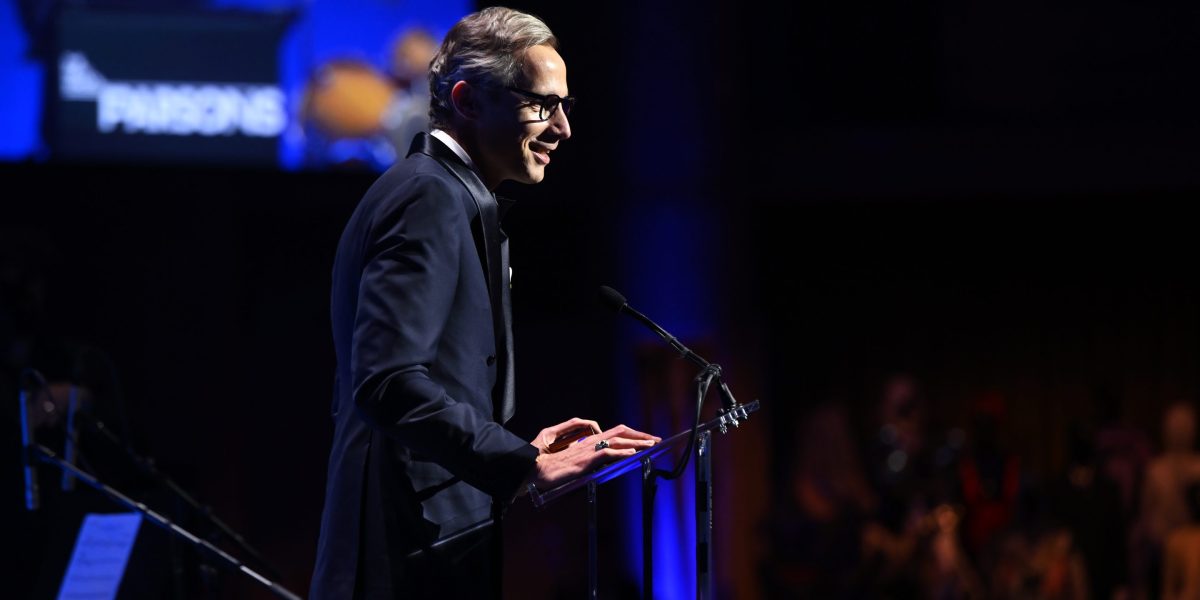
Good morning. The C-suite drama at Saks Global was one of our most popular stories with subscribers last week—and it’s no wonder why. It had risky dealmaking, a failing real estate scion, and luxury chains flailing even though consumers are spending like never before. Now there’s a new twist—Saks Global has filed for Chapter 11 bankruptcy protection and luxury executive Geoffroy van Raemdonck will have the job of turning around the luxury retail group.
It’s an area where van Raemdonck certainly has relevant experience: In 2018, he became CEO of Neiman Marcus Group (which included Bergdorf Goodman), then struggling under the weight of heavy debt from years of private equity ownership. This time around, as CEO of Saks Global, which also piled on debt stemming from the $2.7 billion union in 2024, he’ll have an even tougher job with multiple chains to fix.
During his six years running Neiman Marcus, he succeeded in protecting its market share from the industry headwinds facing luxury department stores andreturned it to profitability. As CEO of Neiman Marcus Group, he often called his management philosophy “leading with love,” a term that often won him snickers at conferences.
What it really meant was making sure luxury was not merely transactional but more about a deeper connection with the consumer, whether inspiring their loyalty from highly personalized service or making them feel like they were at the forefront of fashion. (He famously landed in controversy in 2023 after he told Fortune that his plan was to focus on the well-heeled, much more than on those aspiring to be part of the elite.)
But you can’t woo customers if you have stale or low inventory, so winning AWOL customers, which should be van Raemdonck’s top priority, will certainly have to begin with mending fences with beleaguered vendors. Between sluggish business and its cash crunch, Saks has in the last two years delayed payments to many vendors. Many of the suppliers, particularly smaller ones that could give Neiman and Saks tastemaking cachet, have stopped shipping to its stores. Nordstrom and Bloomingdale’s have wasted no time in swooping in and grabbing some of that market share.
Indeed, one of the reasons van Raemdonck got the job, on top of his experience heading Neiman, was his many years of management experience as a vendor, including years at Ralph Lauren and Louis Vuitton; he speaks their language.
His hands-on experience guiding a company through a bankruptcy reorganization will be a huge help. He knows how to talk to financiers, vendors and employees all at once. That’s a good place to start in the quest to get these historic brands back to health.—Phil Wahba
President Donald Trump said Wednesday that Iran had stopped killing anti-government protestors, which seemed to dial down his earlier threats of a military strike. Trump has vowed to attack Iran if it killed demonstrators. U.S. troops were starting to mobilize from a base in Qatar as human rights groups reported hundreds of such deaths. The president said Wednesday, “we’re going to watch and see what the process is,” when asked whether a strike was now off the table. Oil prices sank on the apparent deescalation.
Dimon’s break with Trump
Jamie Dimon has worked to repair his relationship with President Donald Trump, often expressing support for the administration while watering down criticism of specific policies. But now the JPMorgan CEO’s criticism of the DOJ’s Federal Reserve investigation threatens to derail the relationship again.
The U.S. will pause immigration visa processing for applicants from 75 countries, including Russia, Iran, Brazil, Egypt, and Thailand as it tries to block foreign nationals who may rely on public services. The government will still issue short-term visas.
AI’s risk to London jobs
In an address tonight, London Mayor Sadiq Khan will warn that AI could lead to “a new era of mass unemployment” in the British capital and call on lawmakers to establish guardrails that ensure AI is used for “positive transformation” and not the “destruction of jobs.”
Citigroup CEO issues stern employee memo
Citigroup CEO Jan Fraser stressed to employees that “the bar is raised” in a new internal memo, reported previously by Bloomberg, that emphasized to employees that they are “judged on our results.” The bank plans to cut about 1,000 jobs this week.
Coinbase CEO throws wrench in Senate crypto act debates
Coinbase CEO Brian Armstrong abruptly came out against the Genius Act, a landmark crypto bill that is set for debate by the Senate Banking Committee. Armstrong named a number of specific critiques in his X post, including disagreements over offering rewards on stablecoin holdings and asserted that “we’d rather have no bill than a bad bill.”
The markets
S&P 500 futures were up 0.34% this morning. The last session closed down 0.53%. STOXX Europe 600 was up 0.36% in early trading. The U.K.’s FTSE 100 was up o.52% in early trading. Japan’s Nikkei 225 was down 0.42%. China’s CSI 300 was up o.2%. The South Korea KOSPI was up 1.58%. Indian markets are closed today. Bitcoin was at $97K.
Talks on a landmark free trade deal between the European Union and four South American countries started so long ago that the euro wasn’t even in circulation, China hadn’t yet joined the World Trade Organization and Venezuela was still America’s top oil provider.
This is the first major trade agreement for Mercosur, which includes the region’s two biggest economies, Brazil and Argentina, along with Paraguay and Uruguay. Bolivia, the newest member, was not involved in negotiations but can join the agreement in the coming years.
The trans-Atlantic trade deal — lifting tariffs on products ranging from Argentine steaks and Brazilian copper to German cars and Italian wine — still has to be ratified by the European Parliament.
The significance of creating one of the world’s largest free-trade zones — home to more than 700 million people and accounting for a quarter of global gross domestic product — while President Donald Trump yanks the United States out of the international economy is not lost on the signatories.
For once, it’s not about Trump vs. China
European Commission President Ursula von der Leyen hailed the deal last week as a powerful endorsement of multilateralism “in the face of an increasingly hostile and transactional world.” Brazilian President Luiz Inácio Lula da Silva, 80, called it a rare “victory for dialogue, negotiation and the bet on cooperation.”
“It’s a signal that South American economies are seeking to hedge away from this great power competition between the U.S. and China,” said Lee Schlenker, a research associate with the Global South program at the Quincy Institute for Responsible Statecraft, a Washington think tank.
“It shows that South America can continue to flex its muscles in the international sphere, to diversify its trade partners and exert a certain level of autonomy it’s often denied.”
South American ranchers rejoice
The accord grants South American nations, renowned for their fertile land and skilled farmers, increased access at a preferential tax rate to Europe’s vast market for agricultural goods.
Here in Argentina, exporters reckon they’ll save tens of millions of dollars a year thanks to the deal’s immediate elimination of a 20% tariff on the EU’s long-standing quota scheme for high-quality meat imports.
It’s a breakthrough for Argentina, a nation dominated for decades by left-leaning populist governments that kept the economy closed to the outside world and prioritized the domestic market to the extent of imposing taxes on farm exports to keep food prices down.
“We’re in the midst of a paradigm shift here,” said Carlos Colombo, the president of Cañuelas Cattle Market in Buenos Aires province where over 12,000 cattle are sold daily, many destined for Europe and China. “Argentina has reopened itself to the world.”
At first he derided the notoriously slow-moving Mercosur as irrelevant and threatened to ditch it. But he changed his tune since realizing the bloc’s potential to sweep away tariffs and slash customs red tape.
“He sees this agreement as a way to revitalize and re-signify Mercosur,” said Marcelo Elizondo, an Argentine economic analyst specializing in international trade.
The free-trade fever has also infected Brazil’s long-closed economy. Apex, a Brazilian government investment agency, estimates that EU-bound agricultural exports like instant coffee, poultry and orange juice will rake in $7 billion in coming years.
Europe’s farmer lobby wins concessions
Squeezed by environmental regulations and fearing a flood of cheap food products from across the Atlantic, farmers have blocked highways and descended on the streets of European capitals in an explosion of outrage against the agreement.
The EU has scrambled to soothe their concerns over decades of negotiations, adding environmental and animal welfare safeguards to the accord and imposing strict quotas for South American exports of meat and sugar to ensure homegrown produce stays competitive.
Even so, the angry farmers ultimately persuaded France, Poland and a few other states to oppose the deal in last week’s internal EU vote, depriving the accord’s supporters of what they hoped would be a show of unity. Italy and other agricultural powerhouses only came around after the EU offered farmers generous subsidies to the tune of $52 billion.
“It’s a sizable bribe,” said Jacob Funk Kirkegaard, nonresident senior fellow at the Peterson Institute for International Economics. “EU leaders decided that the deal is so important at this moment, it’s worth it.”
‘Cows for cars’
Some have dubbed the deal “cows for cars,” reflecting the perception that Europe’s auto industry will also win big.
Clobbered by growing competition with China and sky-high U.S. tariffs, vaunted German auto giants like Volkswagen and BMW are glad for the boost, as are producers in Europe’s pharmaceutical, construction and machinery sectors gaining access to hundreds of millions more consumers.
Experts say that the elimination of 35% tariffs on auto parts and cars gives European industrial exporters a rare chance to claw back their South American market share from cheaper Chinese rivals.
“Failing to sign the EU-Mercosur free trade agreement risked pushing Latin American economies closer to Beijing’s orbit,” said Agathe Demarais, a senior policy fellow with the European Council on Foreign Relations.
But many are still are holding their breath, having watched negotiations lumber along for years only to trip up at the last minute.
“There are still several steps that have to be taken … and Europe continues to be very careful,” Colombo said, straining to be heard over the hollers of cowboys prodding hundreds of bellowing cattle into trucks.
“Let’s not forget, this is historic. We’ve never reached an agreement like this before.”
____
Associated Press writer Mauricio Savarese in Sao Paulo contributed to this report.
Good morning. Citi’s fourth-quarter 2025 results marked a profitable close to 2025 and a turning point in its leadership, as longtime CFO Mark Mason prepares to hand the reins to his successor amid solid earnings and an ongoing restructuring.
The bank reported Q4 net income of $2.5 billion, or $1.19 per diluted share, on $19.9 billion of revenue, down from $2.9 billion, or $1.34 per share, on $19.5 billion a year earlier. On a reported basis (including a Russia-related notable item), EPS of $1.19 and revenue of $19.9 billion topped FactSet estimates of $1.02 and $19.6 billion. On an adjusted basis (excluding the notable item), EPS was $1.81 on $21.0 billion of revenue, ahead of consensus EPS of $1.65 and revenue of $20.9 billion.
“We ended the year in a position of strength, having executed against our strategic priorities,” Citi CFO Mark Mason said on Wednesday morning in his final quarterly media call as finance chief. The bank announced in November that he will step down in early March. Mason, who joined Citi in 2001 and became CFO in 2019, takes over as executive vice chairman and senior executive advisor to chairwoman and CEO Jane Fraser, while Gonzalo Luchetti, head of U.S. personal banking, will succeed him as CFO. I previously reported that his long-term ambition is to become a CEO, according to people familiar with the matter.
Mason said Luchetti has driven 13 consecutive quarters of positive operating leverage in U.S. personal banking, including returns of more than 14% in the fourth quarter and more than 13% for the full year. “I think he is well equipped and armed to come in as our newly appointed CFO and continue the momentum,” he said.
Citi said late last year it would move its retail bank into the wealth business, with the two card businesses run together under Pam Habner. Over the balance of 2026, Mason said he will help with Citi’s May 7 investor day and other strategic initiatives.
Citi is working toward a previously discussed reduction of about 20,000 roles. “We’ve made progress on that since 2022 and 2023, landing in the end of 2025 at 226,000 employees,” Mason said, adding he expects headcount to continue to trend down as productivity improves and tools like AI are implemented. It has been reported that Citi is poised to eliminate about 1,000 positions this week, following earlier rounds of layoffs.
On the economy, Mason said the health of the consumer, overall, has remained resilient. Citi’s largely prime (about 85%) card customer base is showing solid financial discipline, with spending up 5% year over year, but lower‑FICO consumers are feeling more pressure from inflation and higher prices, he explained.
As big banks report earnings, President Donald Trump’s proposal to cap credit card interest rates at 10% has surfaced as a key topic. Mason said there is not yet enough detail to speculate, but he called affordability an important issue and said Citi looks forward to working with the administration on a constructive solution.
“I also say that an interest rate cap is not something that we would or could support,” he said, arguing it would restrict access to credit for those who need it most and have “a deleterious impact on the economy.”
Dennis K. Cinelli was appointed CFO of Paramount, a Skydance Corporation (No. 147), effective Jan. 15, and as such has resigned his board of directors seat. Cinelli will succeed Andrew C. Warren, who has served as EVP and interim CFO since June 2025. Most recently, Cinelli served as CFO of Scale AI. He previously held senior finance and operational roles at Uber, including global head of strategic finance, and later running the U.S. and Canada Mobility (Rides) business. Before Uber, Cinelli was with G.E. Ventures as CFO.
Every Friday morning, the weekly Fortune 500 Power Moves column tracks Fortune 500 company C-suite shifts—see the most recent edition.
More notable moves:
Deborah Ricci was appointed EVP and CFO of Acentra Health, a technology and health solutions company. Ricci joins Acentra Health from Guidehouse Inc., where she most recently served as partner and chief financial and administrative officer. Earlier in her career, Ricci held multiple senior finance leadership roles, including CFO positions at Constellis, Centerra Group, and A-T Solutions, and began her career as a certified public accountant with KPMG.
Rohan Ranadive was appointed managing director and CFO of GTCR, a private equity firm. Ranadive succeeds Anna May Trala, who is retiring. Trala will remain affiliated with the firm, serving as a senior advisor going forward. Ranadive brings more than 20 years of experience. He joins GTCR from Vista Equity Partners, where he was a managing director of finance operations. Before that, he was the CFO of Aviditi Advisors and spent 12 years at TPG Capital in various finance and accounting leadership roles.
Big Deal
BCG’s AI Radar 2026 global survey, released this morning, finds that CEOs are recognizing that AI is more than a technology; it can fundamentally change how organizations are run.
For example, 94% of CEOs surveyed said they will continue to invest even if AI does not pay off in 2026. CEOs also said they are increasingly hands-on in AI-driven corporate transformation, with 72% saying they are the main decision maker on AI in their organization. Three CEO archetypes emerge, with “trailblazer CEOs” leading end-to-end AI transformation; 60% of trailblazers’ AI budgets will be spent on agentic AI.
“With AI spending set to ramp up further this year, the focus is shifting from ‘how much do we invest?’ to ‘how do we turn bigger AI budgets into real business impact?’” said Vlad Lukic, global leader for AI at Scale at BCG. “The stakes are rising for leadership, as capital alone is not enough without a clear strategy and disciplined execution.”
The findings are based on a global survey of 2,360 executives, including 640 CEOs, across industries at companies earning between at least $100 million and more than $5 billion in annual revenue.
From the BCG AI Radar 2026 Survey. Courtesy of BCG.
Going deeper
“Can Saks’ new CEO repair the damage done to the luxury retailer by years of being treated as a ‘financial plaything’?” is a Fortune article by Phil Wahba.
Wahba writes: “For the second time in his career, luxury executive Geoffroy van Raemdonck has been tasked with fixing an iconic department store company brought low by financial engineering. In 2018, he was hired to fix Neiman Marcus Group, which was struggling to to keep up with shifting consumer trends and unprofitable under the weight of heavy debt from years of private equity ownership. This time, the job is twice as big. On Tuesday, Van Raemdonck was appointed CEO of Saks Global, the same day as the luxury department store giant, which includes Neiman Marcus Group (and its Bergdorf Goodman division) and Saks Fifth Avenue, filed for Chapter 11 bankruptcy protection.” Read the complete article here.
Overheard
“I’m optimistic that AI won’t hollow out the industrial workforce. In fact, incorporating AI at scale to support a younger workforce may be the only way to sustain it.”
—Kriti Sharma, CEO of IFS Nexus Black, writes in a Fortune opinion piece titled, “AI will infiltrate the industrial workforce in 2026—let’s apply it to training the next generation, not replacing them.”
President Donald Trump is set to meet Thursday at the White House with Venezuelan opposition leader María Corina Machado, whose political party is widely considered to have won 2024 elections rejected by then-President Nicolás Maduro before the United States captured him in an audacious military raid this month.
Less than two weeks after U.S. forces seized Maduro and his wife at a heavily guarded compound in Caracas and brought them to New York to stand trial on drug trafficking charges, Trump will host the Nobel Peace Prize laureate Machado, having already dismissed her credibility to run Venezuela and raised doubts about his stated commitment to backing democratic rule in the country.
“She’s a very nice woman,” Trump told Reuters in an interview about Machado. “I’ve seen her on television. I think we’re just going to talk basics.”
The meeting comes as Trump and his top advisers have signaled their willingness to work with acting President Delcy Rodríguez, who was Maduro’s vice president and along with others in the deposed leader’s inner circle remain in charge of day-to-day governmental operations.
Trump said Wednesday that he had a “great conversation” with Rodríguez, their first since Maduro was ousted.
“We had a call, a long call. We discussed a lot of things,” Trump told reporters. “And I think we’re getting along very well with Venezuela.”
In endorsing Rodríguez, Trump has sidelined Machado, who has long been a face of resistance in Venezuela. She had sought to cultivate relationships with Trump and key advisers like Secretary of State Marco Rubio among the American right wing in a political gamble to ally herself with the U.S. government.
Despite her alliance with Republicans, Trump was quick to snub her following Maduro’s capture. Just hours afterward, Trump said of Machado that “it would be very tough for her to be the leader. She doesn’t have the support within or the respect within the country. She’s a very nice woman, but she doesn’t have the respect.”
Machado’s whereabouts have been largely unknown since she went into hiding early last year after being briefly detained in Caracas. She briefly reappeared in Oslo, Norway, in December after her daughter received the Nobel Peace Prize on her behalf.
The industrial engineer and daughter of a steel magnate began challenging the ruling party in 2004, when the non-governmental organization she co-founded, Súmate, promoted a referendum to recall then-President Hugo Chávez. The initiative failed, and Machado and other Súmate executives were charged with conspiracy.
A year later, she drew the anger of Chávez and his allies again for traveling to Washington to meet President George W. Bush. A photo showing her shaking hands with Bush in the Oval Office lives in the collective memory. Chávez considered Bush an adversary.
Almost two decades later, she marshaled millions of Venezuelans to reject Chávez’s successor, Maduro, for another term in the 2024 election. But ruling party-loyal electoral authorities declared him the winner despite ample credible evidence to the contrary. Ensuing anti-government protests ended in a brutal crackdown by state security forces.
___
Janetsky reported from Mexico City. AP Diplomatic Writer Matthew Lee in Washington contributed to this report.