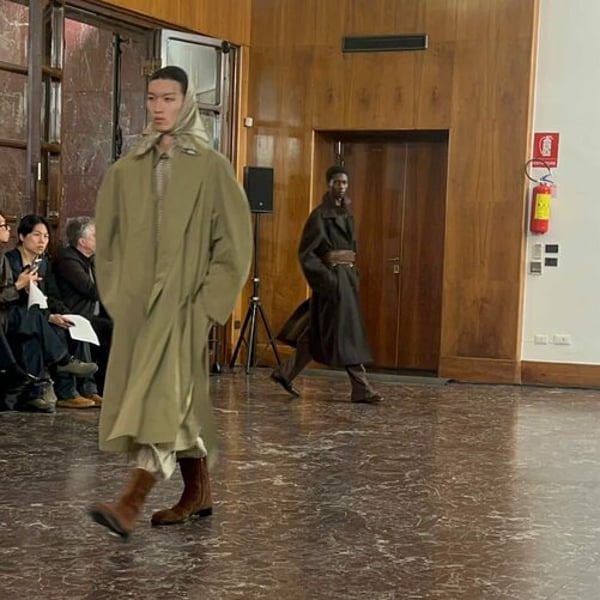
Pitti Uomo 109 staged a double bill of designer runway shows on Wednesday: Hed Mayner with some very fine conceptual and exploratory tailoring, and Shinya Kozuka, with a glove-inspired avant-garde display.
Hed Mayner: Tel Aviv tailoring
Mayner, an Israeli-born designer who for the past couple of years has divided his time between Tel Aviv and Bergamo, presented an impressive collection of enveloping clothes and twisted silhouettes that broke plenty of fresh sartorial ground.
Hed cuts clothes away from the torso and body, so they hang with a certain unexpected authority. Take his nipped-at-the-waist matinee idol coats that are finished with oversize sleeves worthy of a highwayman. Or consider his marvelous jackets, with sleeves that curve away, and shoulders that taper ahead. And you could not help admiring the cloak-meets-houndstooth topcoat combinations; or the superb flowing trench coat that Hed paired with silver sequin sweatpants and shirt.
“I wanted to create a sort of parallel universe, where the clothes work alongside the body, rather than over it,” explained Mayner, in a pre-show briefing.
With his high forehead and vertically ascending mop of hair, it would be easy to mistake Hed Mayner for a physicist. His clothes do reek of experimentation. Though he is certainly no mad scientist – as his experiments generally work, and often with great drama.
Hed showed 10 female looks and 25 looks for guys in this show, and the gals had a brainy, yet tough air about them too. Like the very snazzy pinstripe skirt suit or the brilliantly curvaceous worn. Leather biker jacket, whose shoulders ended halfway down the biceps. All told, this was a master class in bravura tailoring, that still managed to have plenty of commercial credibility.
Ever since his debut show in Paris in 2017, Mayner has been a consistently interesting designer, of considerable talent. And even if the odd look in this show was frankly absurd, like his pleated suede cone-shaped dresses, that only added to the sense of occasion.
All staged inside the Palazzina Reale di Santa Maria della Novella – a distinguished example of 1930s Rationalist architecture, finished with trompe l’oeil frescoes made to look like tapestries recounting Roman and Florentine history.
Making for a memorable fashion statement, by an Israeli designer who fully exploited the opportunity and honor of showing in Pitti, the world’s best organized fashion salon and trade fair, bar none.
Shinya Kozuka: Weird in a warehouse
The opening of Wednesday’s two shows in Pitti was by Shinya Kozuka, marking the Japanese designer’s international catwalk debut.
The invitation was a white cotton glove, and the inspiration was Japanese photographer Koji Ishii’s well-documented habit of taking photos of lost gloves found on the street.
But if the well-spring of the collection was intriguing, the clothes often felt contrived and convoluted.
In his defense, Kozuka is clearly a clever print maker. His assemblages of wild deer, moose, wild crows and campaniles seen in scarves or soft cotton shirts looked great. But a series of ragged, baggy denim shorts; lump snow-pint tops and bulky coats failed to impress.
A collection presented inside the Magazzino, meaning warehouse, of the Fortezza da Basso – the giant medieval fortress that is the nerve center of Pitti – the show-space space was decorated in a fake snowscape.
Kozuka didn’t take any bow at the finale. And the applause was the weakest we have ever heard in over 100 runways shows in Pitti.
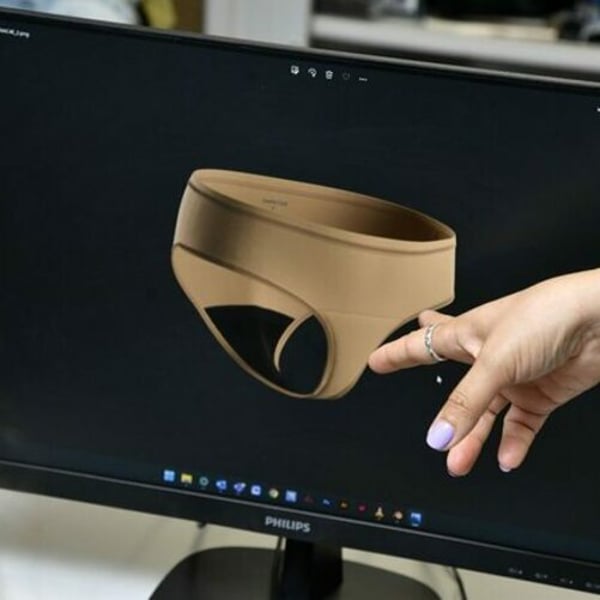
Portuguese group Impetus is working with Straight Lines AI, which specialises in artificial intelligence solutions for the fashion industry, to develop products faster and more efficiently.
Impetus partners with American AI company
As part of this collaboration, Impetus will integrate the Straight Lines AI Creative Design Platform into its creative processes, with the aim of streamlining and accelerating product development, boosting operational efficiency and reducing costs, while also shortening the time-to-market for new underwear collections.
“At Straight Lines AI, we are committed to transforming the fashion industry with our state-of-the-art artificial intelligence solutions,” says Dale Kort, CEO of Straight Lines AI. “We are thrilled to partner with Impetus and to support the company in harnessing the power of AI to enhance its design capabilities, optimise operations, and bring innovative products to market more efficiently,” he adds.
Recognised for the quality of its underwear collections, Impetus views the integration of artificial intelligence as a strategic opportunity to bolster creativity and innovation. Using the Straight Lines AI platform will enable it to automate more labour-intensive tasks, freeing teams to focus on creative development and product design.
“Through this partnership with Straight Lines AI, we will optimise our processes, cut costs and devote more time to what we love most: designing quality products for everyone,” says Nuno Sousa, designer and head of Impetus’s 3D implementation project. “This collaboration will help us increase our efficiency and continue to innovate in this market,” he believes.
Impetus’s commitment to artificial intelligence is not new, as it is already one of the company’s drivers of innovation. On various occasions, including the second episode of the podcast Entre Linhas e Bytes (Between Lines and Bytes), part of the Texp@ct project, which Impetus leads, Nuno Sousa has underlined the central role that 3D technologies currently play at Impetus, highlighting their direct impact on efficiency, collaboration and sustainability in product development. According to the designer, the company already develops between 500 and 600 products per season using 3D and has dispensed with traditional photo shoots, using digital images for presentation and commercialisation.
This article is an automatic translation. Click here to read the original article.
India expects talks on a long-sought trade deal with the European Union to conclude this month, Trade Secretary Rajesh Agrawal said on Thursday, in what would be New Delhi’s largest agreement as it seeks new markets amid US tariff pressures.
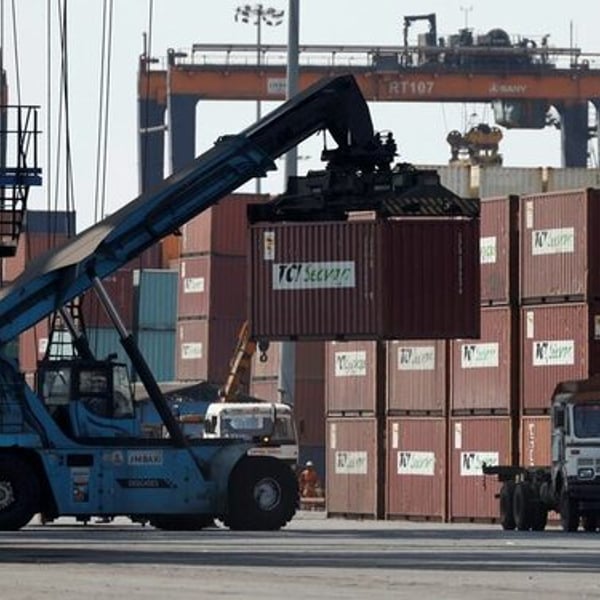
A mobile crane carries a container at Deendayal Port in Kandla, in the western state of Gujarat, India, April 5, 2025 – REUTERS/Amit Dave
The deal, under discussion for years, is seen as a chance for both sides to deepen economic ties and cut reliance on China and Russia. Bilateral trade between India and the EU totalled 120 billion euros ($140 billion) in 2024, making the bloc India’s biggest trading partner. Agrawal said the two sides were “very close” to finalising the pact and were exploring whether it could be wrapped up before leaders meet in New Delhi this month.
He said talks on a US trade pact were continuing and a deal would be reached when both sides were ready. Negotiations collapsed last year after a breakdown in communication between the two governments.
The president of the European Council, Antonio Costa, and European Commission president Ursula von der Leyen will visit India on January 25–27 and co-chair an India–EU summit on January 27, India’s foreign ministry said. If concluded, the deal would open India’s vast and heavily protected consumer market of more than 1.4 billion people to European goods and could reshape global trade flows as protectionism rises and a US-India pact remains stalled.
Both sides have been pushing to close a broad agreement after von der Leyen and Indian Prime Minister Narendra Modi agreed to fast-track negotiations in an effort to close a deal in 2025. Talks, relaunched in 2022, gained momentum after US President Donald Trump imposed tariff hikes on trading partners including India. Brussels has recently signed deals with Mexico and Indonesia and stepped up talks with India, while New Delhi has reached agreements with Britain, Oman and New Zealand.
Some sensitive agricultural items have been excluded from negotiations, an Indian trade ministry official said. India will not open its agriculture or dairy sectors in any trade pact, officials have said, citing the need to protect millions of subsistence farmers.
The EU is pushing for steep tariff cuts on cars, medical devices, wine, spirits, and meat, along with stronger intellectual property rules. India is seeking duty-free access for labour-intensive goods and quicker recognition of its autos and electronics sectors.
Beyond goods, the agreement is expected to expand services trade, investment and cooperation in digital trade, intellectual property, and green technologies, as well as spur European investment in Indian manufacturing, renewable energy ,and infrastructure. Challenges remain over regulatory alignment and the protection of sensitive sectors. The EU’s carbon border levy, which requires importers to account for emissions in steel, cement and other carbon‑intensive products, has started to hit some Indian exports and is a key concern for New Delhi, exporters said.
Cristina Álvarez, who, as of this Thursday, assumes the chair of El Corte Inglés and the Ramón Areces Foundation, has underlined her intention to contribute to the development of the group’s businesses and to its investment programme, which in the 2026-2027 financial year will total €650 million.
Cristina Álvarez, new chair of El Corte Inglés – El Corte Inglés
In a statement, Álvarez explained that this investment will focus on continuing store refurbishments, strengthening the group’s technology and logistics capabilities, and expanding its businesses.
Cristina Álvarez, who replaces her sister Marta, takes the helm of the company and the foundation after both appointments were unanimously approved by all members of the El Corte Inglés board of directors and the board of trustees of the Ramón Areces Foundation.
Cristina Álvarez continues to chair the Appointments and Remuneration Committee. In addition, from Thursday she will also chair the Monitoring Committee and will therefore oversee the strategic plan approved by the board of directors and its implementation by managing directors Santiago Bau and Rafael Díaz Yeregui.
The chairwoman has expressed her “sincere commitment and dedication” to the group, to which she has devoted her professional life for more than 30 years, and has emphasised her “pride in being part of El Corte Inglés.”
In this way, Marta Álvarez steps aside in favour of her sister as chair after six years in the role, a “personal and voluntary decision,” although she will remain a member of the board of directors and of the Monitoring Committee, focusing on the strategic direction of own-brand lines in fashion and home.
Cristina Álvarez, who joined the company in 1992, expressed her thanks, when the handover was announced, for the “magnificent work” carried out by her sister Marta over these years and said she would perform her duties with “humility, always safeguarding the interests of the shareholders, employees and customers of this great company.”
Marta Álvarez’s decision to hand over the chair to her sister came almost a month after the board of directors approved, with immediate effect, the reshuffle of the company’s top management, following the departure of its chief executive officer, Gastón Bottazzini, who took up the post just over a year ago.
This article is an automatic translation. Click here to read the original article.