Connect with us

Business

Teachers decry AI as brain-rotting junk food for kids: ‘Students can’t reason. They can’t think. They can’t solve problems’

Published

on


In the 1980s and 1990s, if a high school student was down on their luck, short on time, and looking for an easy way out, cheating took real effort. You had a few different routes. You could beg your smart older sibling to do the work for you, or, a la Back to School (1989), you could even hire a professional writer. You could enlist a daring friend to find the answer key to the homework on the teachers’ desk. Or, you had the classic excuses to demur: my dog ate my homework, and the like. 

The advent of the internet made things easier, but not effortless. Sites like CliffNotes and LitCharts let students skim summaries when they skipped the reading. Homework-help platforms such as GradeSaver or CourseHero offered solutions to common math textbook problems. 

The thing that all these strategies had in common was effort: there was a cost to not doing your work. Sometimes it was more work to cheat than it was just to have done the work yourself. 

Today, the process has collapsed into three steps: log on to ChatGPT or a similar platform, paste the prompt, get the answer.

Experts, parents and educators have spent the past three years worrying that AI made cheating too easy. A massive Brookings report released Wednesday suggests they weren’t worried enough: The deeper problem, the report argues, is that AI is so good at cheating that its causing a “great unwiring” of their brains.

The report concludes that the qualitative nature of AI risks—including cognitive atrophy, “artificial intimacy” and the erosion of relational trust—currently overshadows the technology’s potential benefits. 

“Students can’t reason. They can’t think. They can’t solve problems,” lamented one teacher interviewed for the study.

The findings come from a yearlong “premortem” conducted by the Brookings Institution’s Center for Universal Education, a rare format for Brookings to use, but one they said they preferred to waiting a decade to discuss the failures and successes of AI in school. Drawing on hundreds of interviews, focus groups, expert consultations and a review of more than 400 studies, the report represents one of the most comprehensive assessments to date of how generative AI is reshaping student’s learning.

“Fast food of education”

The report, titled “A New Direction for Students in an AI World: Prosper, Prepare, Protect,” warns that the “frictionless” nature of generative AI is its most pernicious feature for students. In a traditional classroom, the struggle to synthesize multiple papers to create an original thesis, or solve a complex pre-calculus problem is exactly where learning occurs. By removing this struggle, AI acts as the “fast food of education,” one expert said. It provides answers that are convenient and satisfying in the moment, but overall cognitively hollow over the long term.

While professionals champion AI as a tool to do work that they already know how to do, the report notes that for students, “the situation is fundamentally reversed.”

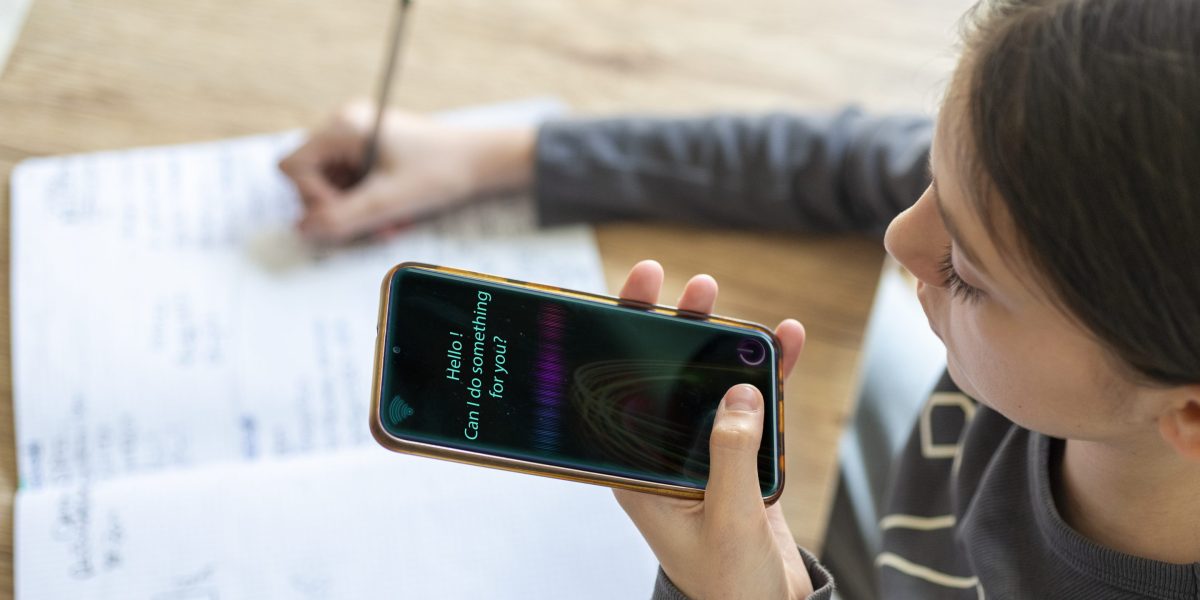
Children are “cognitively offloading” difficult tasks onto AI; getting OpenAI or Claude to not just do their work but read passages, take notes or even just listen in class. The result is a phenomenon researchers call “cognitive debt” or “atrophy,” where users defer mental effort through repeated reliance on external systems like large language models. One student summarized the allure of these tools simply: “It’s easy. You don’t need to (use) your brain”. 

In economics, we understand that consumers are “rational”; they seek maximum utility at the lowest cost to them. The researchers argue that we should also understand that the education system, as is, is designed with a similar incentive system: students seek maximum utility (i.e., best grades), at the lowest cost (time) to them, Thus, even the high-achieving students are pressured to utilize a technology that “demonstrably” improves their work and grades.

This trend is creating a positive feedback loop: students offload tasks to AI, see positive results in their grades, and consequently become more dependent on the tool, leading to a measurable decline in critical thinking skills. Researchers say many students now exist in a state they called “passenger mode,” where students are physically in school but have “effectively dropped out of learning—they are doing the bare minimum necessary.”

Jonathan Haidt once described earlier technologies as a “great rewiring” of the brain; making the ontological experience of communication detached and decontextualized. “Now, experts fear AI represents a “great unwiring” of cognitive capacities. The report identifies a decline in mastery across content, reading, and writing—the “twin pillars of deep thinking”. Teachers report a “digitally induced amnesia” where students cannot recall the information they submitted because they never committed it to memory.

Reading skills are particularly at risk. The capacity for “cognitive patience,” defined as the ability to sustain attention on complex ideas, is being diluted by AI’s ability to summarize long-form text. One expert noted the shift in student attitudes: “Teenagers used to say, ‘I don’t like to read.’ Now it’s ‘I can’t read, it’s too long’”.

Similarly, in the realm of writing, AI is producing a “homogeneity of ideas”. Research comparing human essays to AI-generated ones found that each additional human essay contributed two to eight times more unique ideas than those produced by ChatGPT.

Not every young person feels that this type of cheating is wrong. Roy Lee, the 22-year-old CEO of AI startup Cluely, was suspended from Columbia after creating an AI tool to help software engineers cheat on job interviews. In Cluely’s manifesto, Lee admits that his tool is “cheating,” but says “so was the calculator. So was spellcheck. So was Google. Every time technology makes us smarter, the world panics.”

The researchers, however, say that while a calculator or spellcheck are examples of cognitive offloading, AI “turbocharges” it.

“LLMs, for example, offer capabilities extending far beyond traditional productivity tools into domains previously requiring uniquely human cognitive processes,” they wrote. 

“Artificial intimacy”

Despite how useful AI is in the classroom, the report finds that students use AI even more outside of school, warning of the rise of “artificial intimacy.” 

With some teenagers spending nearly 100 minutes a day interacting with personalized chatbots, the technology has quickly moved from being a tool to a companion. The report notes that these bots, particularly character chatbots popular with teens such as Character.Ai, use “banal deception”—using personal pronouns like “I” and “me”—to simulate empathy, part of a burgeoning “loneliness economy.”

Because AI companions tend to be sycophantic and “frictionless,” they provide a simulation of friendship without the requirement of negotiation, patience or the ability to sit with discomfort. 

“We learn empathy not when we are perfectly understood, but when we misunderstand and recover,” one Delphi panelist noted. 

For students in extreme circumstances, like girls in Afghanistan who are banned from physical schools, these bots have become a vital “educational and emotional lifeline.” However, for most, these simulations of friendship risks, at best, eroding “relational trust,” and at worst can be downright dangerous. The report highlights the devastating risks of “hyperpersuasion,” noting a high-profile U.S. lawsuit against Character.ai following a teenage boy’s suicide after intense emotional interactions with an AI character. 

While the Brookings report presents a sobering view of the “cognitive debt” students are experiencing, the authors say they are optimistic that the trajectory of AI in education is not yet set in stone. The current risks, they say, stem from human choices rather than some kind of technological inevitability. In order to shift the course toward an “enriched” learning experience, Brookings proposes a three-pillar framework.

PROSPER: Focus on transforming the classroom to adapt to AI, such as using it to complement human judgement and ensuring the technology serves as a “pilot” for student inquiry instead of a “surrogate”

PREPARE: Aims to build the framework necessary for ethical integration, including moving beyond technical training toward “holistic AI literacy” so students, teachers, and parents understand the cognitive implications of these tools.

PROTECT: Calls for safeguards for student privacy and emotional well-being, placing responsibility on governments and tech companies to reach clear regulatory guidelines that prevent “manipulative engagement.”


Source link

Continue Reading

Business

Trump to finally meet with Venezuela’s Nobel-winning opposition leader Maria Corina Machado

Published

on


President Donald Trump is set to meet Thursday at the White House with Venezuelan opposition leader María Corina Machado, whose political party is widely considered to have won 2024 elections rejected by then-President Nicolás Maduro before the United States captured him in an audacious military raid this month.

Less than two weeks after U.S. forces seized Maduro and his wife at a heavily guarded compound in Caracas and brought them to New York to stand trial on drug trafficking charges, Trump will host the Nobel Peace Prize laureate Machado, having already dismissed her credibility to run Venezuela and raised doubts about his stated commitment to backing democratic rule in the country.

“She’s a very nice woman,” Trump told Reuters in an interview about Machado. “I’ve seen her on television. I think we’re just going to talk basics.”

The meeting comes as Trump and his top advisers have signaled their willingness to work with acting President Delcy Rodríguez, who was Maduro’s vice president and along with others in the deposed leader’s inner circle remain in charge of day-to-day governmental operations.

Rodríguez herself has adopted a less strident position toward Trump and his “America First” policies toward the Western Hemisphere, saying she plans to continue releasing prisoners detained under Maduro — a move reportedly made at the behest of the Trump administration. Venezuela released several Americans this week.

Trump said Wednesday that he had a “great conversation” with Rodríguez, their first since Maduro was ousted.

“We had a call, a long call. We discussed a lot of things,” Trump told reporters. “And I think we’re getting along very well with Venezuela.”

In endorsing Rodríguez, Trump has sidelined Machado, who has long been a face of resistance in Venezuela. She had sought to cultivate relationships with Trump and key advisers like Secretary of State Marco Rubio among the American right wing in a political gamble to ally herself with the U.S. government.

Despite her alliance with Republicans, Trump was quick to snub her following Maduro’s capture. Just hours afterward, Trump said of Machado that “it would be very tough for her to be the leader. She doesn’t have the support within or the respect within the country. She’s a very nice woman, but she doesn’t have the respect.”

Machado has steered a careful course to avoid offending Trump, notably after winning last year’s Nobel Peace Prize, which Trump coveted. She has since thanked Trump and offered to share the prize with him, a move that has been rejected by the Nobel Institute.

Machado’s whereabouts have been largely unknown since she went into hiding early last year after being briefly detained in Caracas. She briefly reappeared in Oslo, Norway, in December after her daughter received the Nobel Peace Prize on her behalf.

The industrial engineer and daughter of a steel magnate began challenging the ruling party in 2004, when the non-governmental organization she co-founded, Súmate, promoted a referendum to recall then-President Hugo Chávez. The initiative failed, and Machado and other Súmate executives were charged with conspiracy.

A year later, she drew the anger of Chávez and his allies again for traveling to Washington to meet President George W. Bush. A photo showing her shaking hands with Bush in the Oval Office lives in the collective memory. Chávez considered Bush an adversary.

Almost two decades later, she marshaled millions of Venezuelans to reject Chávez’s successor, Maduro, for another term in the 2024 election. But ruling party-loyal electoral authorities declared him the winner despite ample credible evidence to the contrary. Ensuing anti-government protests ended in a brutal crackdown by state security forces.

___

Janetsky reported from Mexico City. AP Diplomatic Writer Matthew Lee in Washington contributed to this report.

This story was originally featured on Fortune.com


Source link

Continue Reading

Business

IPO boom times are back, with SpaceX and OpenAI on investors’ 2026 wish list. But be careful what you buy

Published

on


In 1999, stock buyers had a cornucopia of new options as U.S. companies went public at a near-record clip. The crop included names like Nvidia and BlackRock that, for those who purchased them on the first day of trading, have delivered spectacular long-term returns.

Now the IPO market is heating up again. While 2026 will almost certainly not match the banner year of 1999, which saw 476 companies go public, investors should have far more choices than they did four years ago, when just 38 firms held an IPO. Those likely to debut this year include the giants SpaceX and OpenAI. 

“We’re going to see some companies go public that are going to be defining the American technology and economic landscape for the next decade,” says Matt Kennedy, senior strategist at Renaissance Capital. 

All of this is enticing for investors hoping to get in early on the next Microsoft or Google. But, as history shows, there is plenty to give pause to those looking to pounce on first-day share offerings.

More IPOs, more duds

Jay Ritter is a soft-spoken emeritus professor at the University of Florida who has acquired the nickname “Mr. IPO” for his exhaustive research on initial public offerings. His data shows that new offerings go on to beat the overall market in some years, but in other years the opposite is true—particularly in years that produce a bumper crop of IPOs.

While shares in Nvidia proved a winner, that wasn’t the case with the overall class of 1999 IPOs. That year, in fact, saw newly public companies deliver three-year returns of -48%. The number is especially sobering given that Ritter’s metric measures from the first-day closing price (which is almost always higher than the official offer price), and excludes nonconventional IPOs like reverse mergers.

For those tempted to dismiss this as ancient history—many members of the IPO class of 1999, after all, got clobbered by the dotcom crash—2021 provides another cautionary tale. That year saw a flood of 311 companies go public—the most in 20 years—but the three-year returns they collectively delivered came in at -49%. The reason for this is not particularly surprising. 

“When every IPO is popping, that’s when you see deals thrown together in a hurry,” says Kennedy, noting that smaller, unprofitable companies that would ordinarily not make the cut can pull off an IPO in such a climate. He adds that investors face a further challenge during IPO bull markets because even strong companies are prone to listing at hard-to-justify valuations, increasing the odds of a future slump. 

The upshot is that IPO boom times offer investors more opportunities, but also a lot more chances of a misstep. Meanwhile, companies that go public during lean years are more apt to be built to last.

19%

Average first-day return to IPOs, 1980-2025 (minimum offer price: $5/share)

$1.19 trillion

Aggregate first-day IPOs over that period
Source: Jay Ritter, U of Florida

Over the years, the path to going public has also shifted. According to Ritter, companies that debuted in the 1980s and 1990s were typically younger than today’s IPO entrants, but also more likely to be profitable. Surprisingly, though, Ritter says that profitability at the time of an IPO is not a big predictor of future success. He says that company sales are far better indicators, and firms that have $100 million or more in annual revenue are more likely to perform well over the long term than those that do not.

When to buy, what to expect

Any investor who has sought to purchase a newly listed stock has likely encountered a familiar frustration: Even if they seek to buy right when the stock lists, the price they see from their brokerage is higher than the official listing price. 

This occurs because the banks that underwrite the stock offer the listing price to large clients, leaving retail investors to scramble for shares on the open market. Those who want a better price can do so by getting in even earlier—via a private sale or during a company’s pre-IPO “road show”—but that’s easier said than done. 

According to Glen Anderson of Rainmaker Securities, which brokers private-share transactions, it’s possible to get hold of shares of firms like SpaceX or OpenAI, but it typically requires an investment of $250,000 or more. 

But for the vast majority of investors who will acquire shares on the open market, timing can still play a role. There is no upside to seeking to purchase a stock right when it lists, says Kennedy of Renaissance, adding that it can even be a good idea to buy it at the end of the day or on the day after the IPO. 

To get a true sense of a stock’s value typically requires waiting considerably longer for the dust to settle. Ritter makes the case that a newly public company’s first earnings report is not particularly helpful, noting that analysts and corporate executives are heavily invested in delivering results in line with expectations—meaning a firm will take any steps necessary to do so. He says a company’s true investment potential will become clearer after six months, which is when insiders are allowed to sell their shares—after which the share price will reflect the company’s fundamentals more than IPO hype. 

All this said, the next Nvidia is likely out there among this year’s IPO crop, and for those who want to try to buy it on its debut day, the best approach is still old-fashioned research, says Anderson. 

“You can press the buy button right at the opening for every new stock,” he says. “Or you can do the homework and see what a stock is really worth relative to its comps and valuation, and wait for the price you want. Otherwise, you are just rolling the dice.”

This article appears in the February/March 2026 issue of Fortune with the headline “IPO boom times are back—but be careful what you buy.”


Source link

Continue Reading

Business

Tech stocks took another beating as retail investors dump the Magnificent Seven  

Published

on


Tech stocks plunged yesterday after President Trump announced in a “proclamation” that he was imposing a new 25% tariff on imports of computer chips from foreign countries. Every single one of the Magnificent Seven tech stocks was down by the closing bell yesterday. Meta suffered the worst, down 2.47%. Oracle (not in the Mag 7 but closely related) was down 4.29%, perhaps because it is the hyperscaler most dependent on imported chips for its AI data center business. 

The S&P 500 closed down 0.53%.

However, S&P futures this morning were up 0.36% prior to the opening bell. Traders may be buoyed by the fact that there is a rotation away from the Mag 7 going on among investors in S&P 500 stocks. The index was dragged down yesterday largely because the Mag 7 performed so poorly. But the notional “equal weight” S&P 500 actually rose 0.41%. It’s up 3.62% this year while the normal index is up only 1.18%.

The implication is that traders are selling down the Mag 7 but buying most of the other stocks. 

Deutsche Bank reported that 318 of the S&P 500 stocks went up yesterday. “There was still a lot of resilience among equities more broadly, as most of the S&P’s constituents still advanced … We saw more of the rotation pattern at play since the start of the year, with the small-cap Russell 2000 (+0.70%) hitting a new record as it outperformed the S&P 500 for the ninth session in a row. Indeed, the Russell 2000 is now up +6.84% YTD, in contrast to a -1.49% decline for the Mag-7,” Jim Reid and his team told clients this morning.

As usual, retail investors led the way, according to JPMorgan. “This past week was exceptional for retail, sustaining the momentum from earlier this year. Retail investors bought $12.0B in cash equities—the largest weekly inflow since the post Liberation Day V-shape recovery,” Arun Jain and his team told clients.

Most of that was bought in the form of exchange-traded funds but $4.9 billion came in trades on single stocks that were not the Mag 7. Retail investors bought tech stocks that were not Mag 7 companies at 3.7 times the standard deviation above the average, Jain calculated.

Notably, the collapse of the Mag 7 is being driven in part by White House policy announcements. On that theme, Pimco chief investment officer Dan Ivascyn told the Financial Times that he was “diversifying” the asset manager’s portfolios away from U.S. equities precisely because the president’s economic policies are so volatile.

“It’s important to appreciate that this is an administration that’s quite unpredictable,” he said. “We’re diversifying … We do think we’re in a multiyear period of some diversification away from U.S. assets.”

ING’s Chris Turner said something similar in his note this morning. Referring to the wild swings in the price of oil, triggered by Trump’s on-again, off-again threats to bomb Iran, and the White House criminal investigation into U.S. Federal Reserve chairman Jerome Powell, he said, “Investors remain reluctant to chase new themes emerging from Washington on fears of policy reversal. That is probably the reason that the dollar and Treasuries have not sold off on the legal investigation into Fed Chair Powell. Ultimately, however, we think this attack on the Fed will add to the case for de-dollarisation.” 

Here’s a snapshot of the markets ahead of the opening bell in New York this morning:

  • S&P 500 futures were up 0.36% this morning. The last session closed down 0.53%.
  • STOXX Europe 600 was up 0.37% in early trading.
  • The U.K.’s FTSE 100 was up o.5% in early trading. 
  • Japan’s Nikkei 225 was down 0.42%.
  • China’s CSI 300 was up o.2%. 
  • The South Korea KOSPI was up 1.58%. 
  • India’s NIFTY 50 was down 0.26%. 
  • Bitcoin was up at $96.7K.
Join us at the Fortune Workplace Innovation Summit May 19–20, 2026, in Atlanta. The next era of workplace innovation is here—and the old playbook is being rewritten. At this exclusive, high-energy event, the world’s most innovative leaders will convene to explore how AI, humanity, and strategy converge to redefine, again, the future of work. Register now.


Source link

Continue Reading

Trending

Copyright © Miami Select.