News that family-owned premium footwear retailer Russell & Bromley could be sold with its stores likely to close hasn’t only dismayed the industry at large. Apparently, some members of the founding family are also concerned about the potential plan.
Billie Piper for Russell & Bromley
The Times reported that some family members favour a sale to Next and its partner in the deal Retail Realisation that would see the former owning the brand and the latter selling off the stock and other assets.
But others are believed to be “pushing for a deal with a private equity company that has pledged to preserve the retailer’s stores and jobs”.
Some Bromley family members want the business to be sold to Auralis, a new group that says it will preserve most of the firm’s 450 jobs, 37 stores across the UK, as well as its HQ and distribution centre.
Next, meanwhile, wouldn’t need the stores as it has its own physical locations in which the brand could operate and its own major online operation. That would leave stock clearance specialist Retail Realisation to deal with the wider shutdown of the business.
So what is Auralis? It was set up in 2025 by the investment firm that also owns Weird Fish, Total Capital partners.
Led by Weird Fish CEO David Butler, The Times quoted him saying it’s looking for retailers that are “limited in their abilities to invest in their own businesses”, rather than pursuing distressed acquisitions as some serial acquirers are doing.
The newspaper also said that disagreements within the Bromley family aren’t new with some members not being confident in CEO Andrew Bromley’s turnaround strategy and favouring a sale. The CEO is believed to have preferred the business to stay independent.
Last year the company appointed Interpath Advisory to look at funding options but with no fresh capital forthcoming, a full sale is now being pursued.
The report said no deal has been struck and other private equity bidders are also still looking at the business. Nobody involved has commented.
It may not feel like tennis weather in the Northern hemisphere but with Australia’s summer in full flow, the Australian Open is making global headlines and also showing the material tech that will have a big impact in Europe and the Americas later this year.
Boss
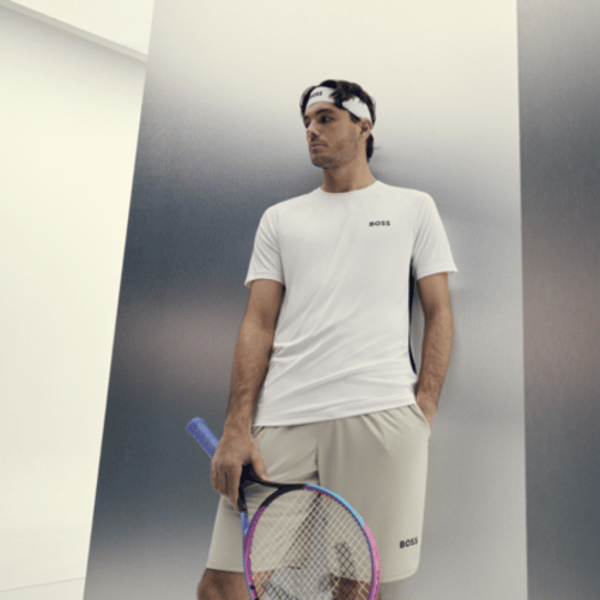
This month, at the year’s first major international tennis tournament, Boss is debuting NovaPoly yarn: a recycled alternative to virgin polyester “with the potential to inspire industry progress in textile innovation and advanced performance”.
Developed in collaboration with Jiaren Chemical Recycling and NBC LLC, it’s claimed to be “more than just a yarn” and is “an example of Boss’s commitment to shaping the future of fashion”.
It features a special additive that speeds up degradability in comparison to conventional polyester fibres, making it biodegradable in an anaerobic active microbial environment.
The Boss brand’s ambassadors will showcase the yarn in its tennis styles during play in Melbourne this month with Taylor Fritz and Matteo Berrettini set to wear key yarn pieces on the court, including jerseys, shorts, and caps.
Hugo Boss said “this marks an important moment” in the brand’s journey as it “reinforces its position as a forward-thinking brand, complementing the company’s ongoing efforts to develop alternatives to conventional polyester and polyamide fibres and aligning with its commitment to driving progress through innovation and advanced materials”.
The fibre is made from recycled textile waste sourced from both pre- and post-consumer phases and modified with an additive.
Boss will “highlight the craftsmanship and forward-thinking approach of NovaPoly yarn through authentic storytelling, athlete endorsements, and dynamic visuals in the collection’s campaign”.
Designs using the fibre will also be available online, in its stores, and through select wholesale retail partners globally from this month.
Last spring, the financial indicators were favourable and Barbara Bui returned to profit in its 2024 financial year. This marked an important milestone, given that in July 2024 the French brand had placed itself under the protection of the Paris Commercial Court (now the Economic Affairs Court) by filing for receivership. Founded in 1987 by the eponymous designer and its CEO, William Halimi, the company remains 65% owned by its founders and their families, with the free float accounting for 35% of the capital of the Euronext Paris-listed company.
Barbara Bui silhouette – Barbara Bui
In 2024, the company recorded growth but struggled to finance it owing to the absence of a banking partner, according to management.
“We had entered the Covid period with a healthy business, because we had made organisational efforts beforehand. As with many companies, the pandemic had a significant impact on our sales. Fortunately, the state‑guaranteed loan (PGE) was a very effective mechanism that enabled us to cope,” recalls William Halimi. “But the issue was that the scheme didn’t anticipate that the economic consequences would persist for more than two years. And repaying the loans over five years, when business was still sluggish, was very onerous. We should have been able to spread these repayments over the longer term.” The executive then found that, with the PGE and a textile sector deemed risky by banks, the company was unable to secure banking support.
“In our line of work, bank credit lines are essential to finance growth. But all too often, bankers lump all brands into the same ‘textile’ category. We are positioned in luxury, with distinctive creations and an international growth focus. It’s not the same risk profile as a mid-market brand with a heavy domestic retail network limited to France.”
After more than two years of financing growth, management resigned themselves to filing for receivership. “It was a difficult decision for us. This brand is our baby. In a way, it cast a shadow over the company and our work,” recalls the co-founder. “And in reality, it was a wonderful experience. Right from the start of the procedure, our case was very well received, with strong engagement from the court and the administrators. As a listed company, we’re used to setting a clear course and keeping our commitments. And I really got the feeling that they were all there to save Barbara Bui.”
For the CEO, receivership allowed the company to continue operating. The brand then worked by focusing on its fundamentals, reducing the number of SKUs, prioritising its directly managed operations, and seeking savings in order to move closer to break-even.
In 2024, sales rose by 3% to 12.4 million euros. Above all, it generated a net profit of 242,000 euros, while reducing its operating loss. Its gross margin improved significantly. A trend that continued in 2025. These advances enabled the company to emerge from receivership on a high note, with the court approving its continuation plan on January 9.
As part of this plan, the company restructured a declared debt of 10.3 million euros, of which 5.3 million euros were officially recognised after analysis of the declarations by the administrators. This restructuring strategy rests on three main levers: securing 600,000 euros in debt waivers agreed with partners; bullet repayment at maturity of 1.1 million euros in shareholder current accounts provided by the co-founders; and spreading the remaining balance of 3.2 million euros over a period of nine years.
Barbara Bui can rely on its three Paris boutiques, located on avenue Montaigne, rue de Grenelle, and rue des Saints-Pères, whose sales are rising steadily.
According to the company, which will publish its sales figures for 2025 in the first quarter of 2026 and its annual results at the end of April, last year saw double-digit growth in its direct sales channels, with a 14% increase in the Paris boutiques and a 65% increase on its e-commerce site.
The brand, which plays with revisited tailoring and references to rock and new wave, all with high-quality materials, is also distributed through around 100 multi-brand retailers worldwide, compared with 140 before the receivership was announced.
“Our entire team of around sixty people was fully involved during the receivership, and this resulted in superb performances in our boutiques,” explains William Halimi. “But receivership often paralyses retailers. Now that we’re out of the procedure, we’ll be able to win back some of our former partners, who will be reassured.”
The brand, which continues to self-finance its development, is preparing new propositions to appeal to export markets, which already account for a quarter of its business, in the coming seasons. And it is embracing a modest but profitable growth strategy to assert its uniqueness in the market.
This article is an automatic translation. Click here to read the original article.
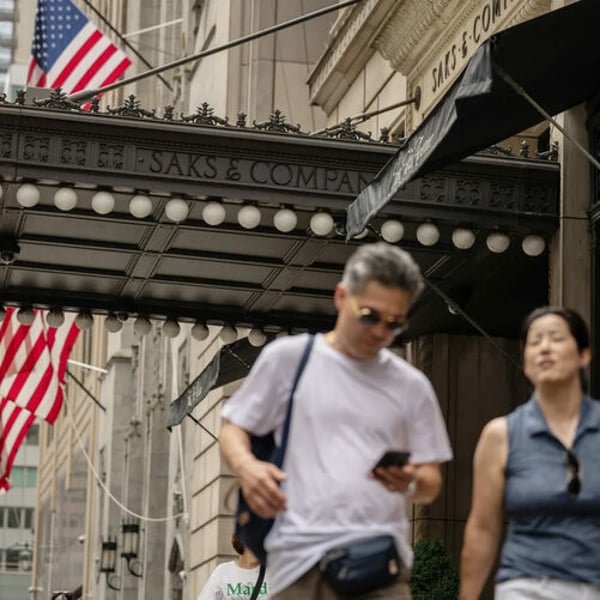
A US bankruptcy judge on Wednesday granted initial approval of Saks Global’s bankruptcy financing, allowing the company to draw on $400 million in new cash despite an objection from Saks’ estranged business partner Amazon.
Saks filed for bankruptcy late Tuesday – Bloomberg
US Bankruptcy Judge Alfredo Perez approved the financing at a court hearing in Houston, saying the money would give Saks a chance to stabilise its business and restructure its debt. Saks’ chief restructuring officer Mark Weinstein said during the hearing that the company would be “dead in the water” without the new money, which would be used to pay vendors and the company’s 17,000 employees.
The luxury retail company filed for bankruptcy late Tuesday with $3.4 billion in debt, after its ill-fated merger with Neiman Marcus caused cash shortfalls that prevented Saks from reliably replenishing inventory at its stores. Saks Global’s attorney, Debra Sinclair, said all the stores remain “open for business,” and that Saks has no concern about weakening customer demand.
“The customers are there, and we know this because when we do have goods available in our stores, we are able to sell them,” Sinclair said. “The problem that you’ll hear a lot about today and over the course of this week has been that we have not been able to buy enough inventory to meet our demand.”
The $400 million infusion approved by Perez is the first tranche of a total financing package that Saks values at $1.75 billion.
Before approving the bankruptcy loan, Perez overruled an objection by online retail giant Amazon, which said its $475 million equity investment in Saks would become “worthless” if the bankruptcy proceeds with the current financing arrangement.
Amazon has “little to no confidence” that Saks can successfully emerge from bankruptcy, Amazon’s attorney Caroline Reckler said at the hearing. Amazon’s attorneys argued that the new loan improperly claimed Saks Fifth Avenue‘s flagship Manhattan store as collateral, when that property’s value had already been used to guarantee up to $900 million in payments owed to Amazon for its collaboration on a “Saks on Amazon” online sales platform.
In addition to approving the bankruptcy financing, Perez also approved several routine requests to help Saks avoid business disruptions during its bankruptcy, such as allowing the company to catch up on late payments to vendors who provided goods and services to Saks before it filed for Chapter 11 protection. Saks said it owes over $337 million to critical suppliers, including French luxury brand Chanel, which is owed $136 million, and Gucci owner Kering, owed $26 million.
Long loved by the rich and famous, Saks never fully recovered from the Covid pandemic, as competition from online outlets rose, and brands started selling more items through their own stores. The company’s vendors began withholding inventory last year after Saks fell behind on payments.







 Politics8 years ago