Connect with us

Business

‘Jamie Dimon probably wants higher rates. Maybe he makes more money that way’: Trump continues Fed attacks in Detroit visit

Published

on


Speaking to the Detroit Economic Club, the president essentially accused the Fed of stealing his joy by not being bullish about lowering interest rates.

It comes as the Trump administration’s criminal investigation of Federal Reserve Chair Jerome Powell has sparked an outcry, with defenders of the U.S. central bank pushing back against Trump’s efforts to exert more control over it. Federal data from December showed inflation declined a bit last month as prices for gas and used cars fell — a sign that cost pressures are slowly easing.

After last year’s election losses for the GOP, the White House said Trump would put a greater emphasis on talking directly to the public about his economic policies after doing relatively few events around the country earlier in his term.

Trump says Renee Good may have in ‘normal circumstances’ been a ‘solid’ person

But, the president said in his interview, “her actions were pretty tough.”

He said that video of the moment when an immigration agent fatally shot her in Minneapolis, “can be viewed two ways, I guess,” but said “there are a couple of versions of that tape that are very, very bad.”

It wasn’t completely clear what he meant by that.

Trump offers little defense when questioned on whether Powell investigation appears to be retribution

The president was asked in an interview that aired Tuesday night on the “CBS Evening News” about the Justice Department’s investigation of Federal Reserve Chair Jerome Powell.

Trump was asked if the probe appeared to be political retribution for Powell having resisted Trump’s repeated hectoring to lower interest rates.

Trump said Powell is “either corrupt or incompetent.” When asked again about the appearance of retribution, he said, “I can’t help what it looks like.”

White House responds to Trump flipping off heckler at Ford plant

While Trump was in Michigan, someone at the auto plant yelled something at the president that included the words “pedophile protector.”

Trump, in a video published by TMZ, appeared to respond by mouthing the F-bomb at the person and raising his middle finger.

White House spokesman Steven Cheung said, “A lunatic was wildly screaming expletives in a complete fit of rage, and the President gave an appropriate and unambiguous response.”

It’s not the first time Trump has dropped an expletive with cameras rolling.

‘No basis’ for civil rights probe in Minnesota ICE shooting, Justice Department official says

Deputy Attorney General Todd Blanche said in a statement that “there is currently no basis for a criminal civil rights investigation.” The statement, first reported by CNN, did not elaborate on how the department had reached a conclusion that no investigation was warranted.

The decision to keep the Justice Department’s Civil Rights Division out of the investigation into the fatal shooting of Renee Good marks a sharp departure from past administrations, which have moved quickly to probe shootings of civilians by law enforcement officials for potential civil rights offenses.

Federal officials have said that the officer acted in self-defense and that Good was engaging in “an act of domestic terrorism” when she pulled forward toward him.

Trump says JPMorgan Chase CEO is wrong in criticizing his moves against Powell

Trump said he thinks JPMorgan Chase CEO Jamie Dimon is wrong in saying it’s not a great idea to chip away at the Federal Reserve’s independence by going after Chair Jerome Powell.

“Yeah, I think it’s fine what I’m doing,” Trump said Tuesday in response to a reporter’s question at Joint Base Andrews after returning from a day trip to Michigan. He called Powell “a bad Fed person” who has “done a bad job.”

“We should have lower rates. Jamie Dimon probably wants higher rates. Maybe he makes more money that way,” Trump said.

Trump: US is awaiting ‘accurate’ numbers of protesters killed in Iran before acting

Trump told reporters Tuesday afternoon that he is expecting a report on the number of protesters who have been killed in Iran since protests began last month as the internet blackout has complicated the death toll.

“The killing looks like it’s significant, but we don’t know yet for sure,” he said. “I’ll know within 20 minutes. We will act accordingly.”

In the last week, the Republican president has escalated threats of U.S. intervention in Iran, saying as recently as this morning that the Islamic Republic will “pay the price” for the hundreds of Iranians that have been killed. But Trump appeared to use more careful rhetoric when pushed by reporters late Tuesday about what kind of action he will take.

“It would seem to me that they have been badly misbehaving, but that is not confirmed,” he said.

RFK Jr. shares the supplements he takes, but cautions he shouldn’t be seen as a role model

The health secretary was open about his dietary supplement routine on The Katie Miller Podcast — but he warned that he shouldn’t be seen as a pinnacle for what others should take.

In response to Miller asking, Kennedy said he takes Vitamin D, quercetin, zinc, magnesium, Vitamin C and “a bunch of other stuff.”

How does he choose which supplements to take? In a relatable way — and one that’s not necessarily medically advised.

“My method is I read an article about something, you know, and I get convinced that, oh, I gotta have this stuff,” he said. “And then I get it and then six months later I’m still taking it. I don’t remember what the article said. So, I end up with a big crate of vitamins that I’m taking, and I don’t even know why.”

RFK Jr. on Trump’s diet: ‘I don’t know how he’s alive, but he is’

Health Secretary Robert F. Kennedy Jr. on a podcast posted online Tuesday said the president eats healthily at Mar-a-Lago and at the White House — but not when he’s traveling.

In the interview with Katie Miller, who is married to top Trump adviser Stephen Miller, Kennedy said people who travel with the president get the idea that he’s “pumping himself full of poison all day long.” He said that while on the road, the president tries not to get sick by eating food he trusts from McDonald’s and other “big corporations.”

“He has the constitution of a deity,” Kennedy said of Trump. “I don’t know how he’s alive, but he is.”

Still, Kennedy praised Trump’s overall health and said he eats well “usually.”

Trump is “the most energetic person” that “any of us have met,” Kennedy added.

Plane used in boat strike off Venezuela was painted to look like a civilian aircraft, AP sources say

The plane used by the U.S. military to strike a boat accused of smuggling drugs off the coast of Venezuela last fall also was carrying munitions in the fuselage, rather than beneath the aircraft.

That raises questions about the extent to which the operation was disguised in ways that run contrary to military protocol.

Details of the plane’s appearance, first reported Monday by The New York Times, were confirmed by two people familiar with the situation who spoke on condition of anonymity to discuss the sensitive matter.

Pentagon press secretary Kingsley Wilson says “the U.S. military utilizes a wide array of standard and nonstandard aircraft depending on mission requirements.”

U.S. military guidelines on the laws of war prohibit troops from pretending to be civilians while engaging in combat. The practice is legally known as “perfidy.”

The Defense Department manual specifically notes that “feigning civilian status and then attacking” is an example of the practice.

Trump criticizes 5 Republican senators who voted to limit his ability to attack Venezuela again

Trump questioned why they would be against what he says was the most successful U.S. military attack in 100 years, the operation that captured Nicolas Maduro and brought him to New York to face drug charges.

Congress has the authority to declare war but the president didn’t give any lawmakers advance warning of the operation.

“It’s one thing if the attack failed,” Trump said. “But here we have one of the most successful attacks ever and they find a way to be against it. It’s pretty amazing. And it’s a shame.”

Sens. Rand Paul of Kentucky, Susan Collins of Maine, Lisa Murkowski of Alaska, Josh Hawley of Missouri and Todd Young of Indiana last week voted with Democrats to send a message of disapproval about Trump’s actions against the South American nation.

The measure still must clear the Republican-controlled House and be signed into law by the Republican president — steps that appear unlikely.

Trump says he plans to announce health care plan this week

The president didn’t specify when he will announce his plan but he and Republicans have been under increasing pressure to address Americans’ health care costs, especially as subsidies for those who get coverage under the Affordable Care Act expired at the end of last year.

Trump reiterated his wish to have money be sent directly to consumers to buy health insurance rather than sending money to insurers.

He also promoted his agreements with various drug manufacturers to lower the costs of their prescription drugs in the U.S. and said his party should win midterm elections this year based on that alone.

“We should win the midterms in a landslide,” he said.

Trump lashes out at Federal Reserve in Detroit speech

The president essentially accused the Fed of stealing his joy by not being bullish about lowering interest rates.

“If you announce great numbers, they raise interest rates,” Trump said in the speech. “When the market goes up, they should lower rates.”

Trump has disagreed sharply with the interest rate strategy of the independent Fed, chaired by Jerome Powell, and has pressed for lower rates, faster. He maintains that a rising stock market should cause the Fed to cut its benchmark interest rates in order to further boost economic growth.

But the Fed has the legal responsibility of keeping prices stable and maximizing employment. Slashing rates as Trump has suggested could push more money into the U.S. economy and worsen inflation.

Trump starts address to Detroit Economic Club

The president opened with introductions and a few jokes, then immediately shifted to talking about his elections and voter ID laws, instead of the economy.

He then resumed recognizing some of the more notable people in the audience in Detroit.

Trump dismissive of Canada and Mexico free-trade agreement

The president stopped to speak to reporters while touring the auto factory and was indifferent to the idea of renegotiating the United States-Mexico-Canada trade pact, or USMCA, which is up for review this year.

“I think they want it,” he said of the other nations. “I don’t really care.”

Trump said the U.S. doesn’t need cars made in Canada or Mexico, but he wants to see them made in the U.S.

Beijing opposes Trump’s threatening 25% tariff on Iran’s trading partners

Beijing on Tuesday criticized President Donald Trump’s plan to impose an additional 25% tariff on Iran’s trading partners, which includes China, Iran’s largest trading partner.

“Tariff wars have no winners,” said Mao Ning, a spokesperson for the Chinese foreign ministry. “China will firmly protect its legitimate and lawful rights and interests.”

It’s not immediately clear if the tariff on Chinese goods will go up, because the two governments have agreed to a yearlong truce in their trade war following a summit between Trump and Chinese President Xi Jinping in October in South Korea.

On Tuesday, the Chinese commerce ministry extended anti-dumping tariffs on U.S. solar polysilicon imports. The rates are 53.3% to 57%.

Republican senator warns against US military action in Iran

Sen. Rand Paul, a Republican who has been outspoken against the Trump administration’s overseas military pursuits, said an attack on Iran would likely harm U.S. interests and could backfire.

“I hope they are able to rise up in sufficient force to actually topple the regime,” he said about the Iranian people protesting.

“But once we start dropping bombs on their government, I mean, it can create the opposite of the intended effect, because when people — no matter who they are, whether they’re pro or against the regime — tend to be unhappy when foreign bombs are dropping on them.”

Trump administration ending protected immigration status for small group of Somali immigrants

“Temporary means temporary,” Homeland Security Secretary Kristi Noem said in a statement to The Associated Press.

DHS told Fox News separately that Somalis with Temporary Protected Status must leave the U.S. by March 17, when existing protections expire. The TPS move comes amid Trump’s immigration crackdown in Minneapolis, where many Somalis have U.S. citizenship. Trump has targeted Somali immigrants with racist rhetoric and accused them of defrauding federal programs.

A congressional report last year estimated the Somali TPS population at 705 people. Noem insisted that circumstances in Somalia “have improved to the point that it no longer meets the law’s requirement for Temporary Protected Status.”

Located in the horn of Africa, Somalia is one of the world’s poorest nations and has for decades been beset by chronic strife and insecurity exacerbated by multiple natural disasters, including severe droughts.

Following Minnesota ICE killing, Democrats renew aim at qualified immunity for law enforcement

A bill introduced by Sen. Ed Markey and Rep. Ayanna Pressley of Massachusetts would allow people to sue federal law enforcement officers for civil rights violations and remove their qualified immunity protections in such cases.

“When masked ICE agents are allowed to kill and harm people with impunity, we have crossed a dangerous threshold in our nation,” Markey said in a statement.

The bill “sends a powerful message to everyone in America — citizen or not — that when ICE agents break the law, they should and will be held accountable” Pressley said.

The bill stands little chance of passage in the GOP-controlled Congress.

Qualified immunity protects government agents from lawsuits unless they violate “clearly established” constitutional or statutory protections. Debates over the scope of the legal doctrine have held up bipartisan negotiations over policing reforms.

Trump sends a message to the citizens of Iran

Trump said Tuesday he’s canceled talks with Iranian officials amid their protest crackdown and promised help to protesters in the country after human rights monitors said Tuesday that the death toll spiked to 2,000.

Trump did not offer any details about what the help would entail, but it comes after Trump said Iran wants to negotiate with Washington after his threat to strike the Islamic Republic. Trump’s latest message on social media appeared to make an abrupt shift about his willingness to engage with the Iranian government.

“Iranian Patriots, KEEP PROTESTING – TAKE OVER YOUR INSTITUTIONS!!!” Trump wrote in morning post on Truth Socia. “Save the names of the killers and abusers. They will pay a big price. I have cancelled all meetings with Iranian Officials until the senseless killing of protesters STOPS. HELP IS ON ITS WAY.”

Trump warns Minnesota that day of ‘retribution’ is coming

In a social media post, Trump defended the aggressive immigration enforcement actions being carried out across Minneapolis as part of his deportation agenda.

Throngs of people have taken to the streets of Minneapolis to protest the presence of Immigration and Customs Enforcement officers after a woman was shot and killed during an operation last Wednesday.

The president asserted in the post that the anti-ICE activity is also shifting the spotlight away from alleged fraud in the state and said, “FEAR NOT, GREAT PEOPLE OF MINNESOTA, THE DAY OF RECKONING & RETRIBUTION IS COMING!”

Trump blames what he calls “professional agitators” for the protests. He has not provided evidence to support his claims.

Michigan Democratic party chair pans the president’s trip

“Michiganders are feeling the effects of Trump’s economy every day,” Michigan Democratic Party chair Curtis Hertel said in a statement, singling out Republican opposition to extending health care subsidies.

“After spending months claiming that affordability was a ‘hoax’ and creating a health care crisis for Michiganders, Donald Trump is now coming to Detroit — a city he hates — to tout his billionaire-first agenda while working families suffer,” Hertel said.

Microsoft pushes Big Tech to ‘pay our way’ for AI data centers amid rising opposition

It won’t be easy for Big Tech companies to win the hearts and minds of Americans who are angry about massive artificial intelligence data centers sprouting up in their neighborhoods, straining electricity grids and drawing on local reservoirs.

Microsoft is trying anyway. The software giant’s president, Brad Smith, is meeting with federal lawmakers Tuesday, pushing for the industry, not taxpayers, to pay the full costs of the vast network of computing warehouses needed to power AI chatbots like ChatGPT, Google’s Gemini and Microsoft’s own Copilot. Trump gave the effort a nod with a Truth Social post saying he doesn’t want Americans to “pick up the tab” for data centers and pay higher utility costs.

“Local communities naturally want to see new jobs but not at the expense of higher electricity prices or the diversion of their water,” Smith said in an interview with The Associated Press.

Central bankers back US Fed Chair Jerome Powell in clash with Trump

Central bankers from around the world said Tuesday they “stand in full solidarity” with U.S. Federal Reserve Chair Jerome Powell, after Trump dramatically escalated his confrontation with the Fed with the Justice Department investigating and threatening criminal charges.

Powell “has served with integrity, focused on his mandate and an unwavering commitment to the public interest,” read the statement signed by nine national central bank heads including European Central Bank President Christine Lagarde and Bank of England Governor Andrew Bailey.

They added that “the independence of central banks is a cornerstone of price, financial and economic stability in the interest of the citizens that we serve. It is therefore critical to preserve that independence, with full respect for the rule of law and democratic accountability.”


Source link

Continue Reading

Business

How Expedia’s CTO is using AI to transform work for 17,000 employees—and travel for millions

Published

on


Ramana Thumu, the chief technology officer at Expedia Group, says there’s no “AI Center of Excellence” at the online travel agency that sits in an ivory tower and mandates how everyone should be using artificial intelligence.

“We are democratizing AI across the entire company,” says Thumu. “Every employee, every team, and every workflow.”

Some examples of how this plays out include the creation of Expedia’s “AI playground,” which gives employees access to more than 60 different large language models—including from OpenAI, Google’s Gemini, Meta’s Llama, and Anthropic’s Claude—to build their own AI agents. Since January 2025, employees have built more than 1,500 different AI agents and around 6,000 monthly sessions occur within the secure AI agent builder environment on a monthly basis. 

Around two-thirds of Thumu’s software developer workforce have embraced AI coding assistant tools including Copilot, Claude Code, and Cursor, often resulting in an estimated 20% productivity lift. Thumu says he wants to bring more “joy” to coding by giving them a broad set of AI tools to infuse in their workflows. He vows that more efficiency won’t necessarily mean fewer jobs. “That’s not how I see it,” Thumu adds. “It’s an improvement which means you can get more work done, much faster, and higher quality work.” 

And last year, Expedia began to embed AI “squads,” teams of around four to six AI engineers that work with various business divisions ranging from legal, procurement, human resources, and marketing, collaboratively working alongside AI “champions” for each of those segments to figure out where AI can possibly be implemented to handle some manual tasks. 

Every one of these AI investments are being measured, ranging from velocity and cycle time for the AI coding assistant tools, and within customer service, tracking how AI is speeding up the time it takes to resolve a customer query. For the broader employee population, Expedia is measuring usage and the impact on workflows. If the company doesn’t see the right adoption or outcomes for these tools, Thumu says Expedia is quick to reassess and adjust its approach.

“We are absolutely testing a lot of experiences and placing a lot of bets to make sure which ones stick and where we scale, and when the test is not wildly successful, fail fast and take those learnings to do something different,” says Thumu.

He joined Expedia, which ranks No. 312 on the Fortune 500, in late 2024 after a decade in technology leadership roles at sports-merchandising company Fanatics. As Expedia’s CTO, Thumu says his core AI priorities include testing and deploying internal productivity use cases, customer-facing external applications that will lean more heavily on multi-step agentic AI, and a focus on data as well as partner support from large language model providers.

“The same transformation that is happening inside the company is going to show up to hundreds of millions of travelers,” says Thumu.

External applications of AI include Expedia Trip Matching, which debuted in June and allows travelers to share any publicly available travel reel that caught their attention on Instagram and then share that reel directly with Expedia. The travel company will then use AI to produce a customized itinerary and travel tips that are based on the content that was originally created by an influencer.

In October, Expedia also served as a pilot partner—along with Booking.com, Zillow, and Spotify—for what’s known as “Apps in ChatGPT,” a feature that aims to further integrate the chatbot with external brands. As an example, a ChatGPT user can type in: “Expedia, find me a hotel in Paris for under $600 per night in March” and it will pull up a list with prices and links that go to Expedia’s site.

The company also developed an AI customer service agent that’s built on Amazon Web Services, which can help travelers with simple tasks including cancelling a hotel booking, getting a refund status, or changing their books so they don’t need to call a human agent. Expedia says this AI agent handles 143 million conversations a year and resolves over 50% of traveler queries.

As Expedia moves forward with embracing more agentic AI capabilities, Thumu stresses that the company will prioritize stitching together the technology in a manner so one AI companion can help customers effortlessly through all touchpoints. He doesn’t want to build one AI companion that helps book hotels, another to handle discovery for excursions, and yet another to address customer service questions. 

“We are trying to bring those together,” says Thumu. “To make sure that from a customer standpoint, it’s one agentic experience. There is a lot of work to be done, but we are in the initial stages.”

John Kell

Send thoughts or suggestions to CIO Intelligence here.

NEWS PACKETS

AI’s health care embrace continues to accelerate. Anthropic debuted a new offering within its Claude chatbot that can access medical information, an offering that’s intended for both large organizations and consumers. As Fortune reports, health-related questions are a leading consumer for AI chatbots and while Anthropic has historically been more focused on serving enterprises, this latest offering is an indication that Anthropic would like to make real inroads with consumers. Separately, OpenAI launched ChatGPT Health, which allows users to connect their medical records and wellness apps to the chatbot. But AI companies pushing into heath care need to be careful to closely guard consumer data and avoid inaccurate outputs. An investigation by the Guardian uncovered that some of Google’s AI Overviews provided false or inaccurate information when asked about blood tests.

Apple taps Google’s Gemini for AI-enabled Siri. The iPhone maker has inked a multiyear pact with Google to lean on the latter company’s Gemini to power its AI features, including a big upgrade for Siri that’s expected later in 2026. While the companies didn’t share details about the financials behind the deal, Bloomberg has previously reported that Apple was planning to pay about $1 billion a year to utilize Google AI. The deal is the latest sign that Google is continuing to make serious gains in the AI race against top rival OpenAI.

Nvidia to invest $1 billion in a new AI lab with Eli Lilly. The AI chip maker and pharmaceutical giant behind blockbuster drugs including Type 2 diabetes treatment Mounjaro and antidepressant Prozac are joining forces to build a facility in Silicon Valley that will aim to speed up the use of AI in drug discovery, a costly and time-intensive process. On top of that, the companies say that they see opportunities to apply AI across clinical development, manufacturing, and commercial operations, leveraging multimodal models, agentic AI, robotics, and digital twins.

Moody’s says data centers will need $3 trillion through 2030. The credit ratings company forecasts that at least $3 trillion of data-center investments will be needed to support building facilities, computer equipment, and new capacity to support the rising demand in AI and cloud computing. A big chunk of that spending will come directly from some of the world’s most valuable companies, as Moody’s says six players—Microsoft, Amazon, Alphabet, Oracle, Meta Platforms, and CoreWeave—are forecasted to spend $500 billion on data center investments in 2026, Bloomberg reports.

Walmart expands drone delivery program. Walmart and drone operator Wing, a unit of Google parent Alphabet, have announced that they plan to make package deliveries by sky available to tens of millions of shoppers by expanding the service to more than 270 Walmart locations by the end of 2027. The Wall Street Journal reports that Wing estimates that more than 40 million Walmart shoppers would have access to the service, up sharply from roughly 2 million mostly limited to the Dallas-Fort Worth and Atlanta regions today. Drone deliveries have been an enticing technology application intended to make it even easier to deliver online orders, but most actual applications have been restricted to just a few markets.

ADOPTION CURVE

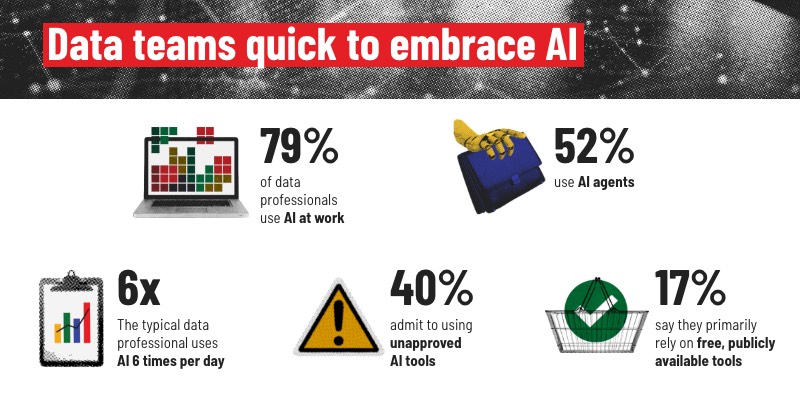
Data professionals are using unauthorized AI tools way more than they should be. Four out of every ten data professionals admitted that they use unauthorized AI at work, and 17% say they are primarily relying on free, publicly available AI tools, according to a recent survey conducted by tech training provider General Assembly. Devanshu Mehrotra, lead instructor of data science and data analytics at General Assembly, tells Fortune that these figures represent an expectation gap between employers and their workforce.

“Employees are expected to be more productive,” says Mehrotra. But, “they are not being given enough instructions and training to understand how to do it properly, or they are not given the tools that are required, and so they end up going the shadow AI route.”

He added that enterprises should more clearly communicate when and where AI should be used and also delineate the difference between a high risk use case that could expose sensitive data externally and lower-risk activities, like asking a chatbot general queries. AI policies, Mehrotra adds, “needs to be more focused on how you can use AI, what education you need to use or have before you can use AI, and what are approved versus unapproved use cases of AI.”

Courtesy of General Assembly

JOBS RADAR

Hiring:

Fortrea is seeking a chief data officer, based in Durham, North Carolina. Posted salary range: $200K-$250K/year.

Redesign Health is seeking a VP of technology, AI ventures, based in New York City. Posted salary: $198K/year.

Armada is seeking a head of engineering for the federal program, based in Seattle. Posted salary range: $187.4K-$235K/year.

AppFolio is seeking a SVP of engineering, based in San Diego. Posted salary range: $324K-$405K/year.

Hired:

Airbnb has appointed Ahmad Al-Dahle to the role of CTO, joining the home-sharing technology company from Meta, where he led the Facebook parent company’s generative AI efforts and the team behind the Llama family of open source models. Prior to Meta, Al-Dahle spent over 16 years at Apple, where he was one of the technologists behind the iPhone’s display and multitouch systems and also worked on the first Apple Watch.

Nationwide has promoted Misty Kuamoo to serve as CTO and SVP of Nationwide Financial, following the appointment of Michael Carrel, who was appointed CTO for the overall enterprise in December 2025. Kuamoo will be responsible for all technology solutions that support the insurer’s financial services businesses. She has served as a technology leader within Nationwide for more than five years.

The Timken Company promoted John Szarka to the new position of CTO after he most recently served as a vice president for the manufacturer of engineered bearings and industrial motion products. Szarka has worked at Timken for more than two decades, beginning as a sales engineer and earning steady promotions throughout his career, becoming a division president beginning in 2017.

GitLab has appointed Siva Padisetty as CTO to lead software engineering, operations, and the customer support teams for the software development platform. Padisetty succeeds Sabrina Farmer, who stepped down from her role and will remain in an advisory capacity through January 31. Previously, Padisetty served as CTO at web tracking software company New Relic.

1Password appointed Nancy Wang as CTO, where she will lead the global engineering team and steer the AI strategy for the password-management service provider. Wang previously served as general manager and director of engineering and product for AWS’ data protection business. She was also previously a founding product manager at data security company Rubrik. 

Curated For You appointed Brad Klingenberg as CTO, where he will lead the engineering and data science teams for the e-commerce technology company. Klingenberg previously served as a c-founder for three years at the software startup Naro and worked as chief algorithms officer for smoothie company Daily Harvest and online personal styling service Stitch Fix.

Amerisure has expanded Amjed Al-Zoubi’s role to now serve as chief information and data officer, broadening his scope to lead the commercial property and casualty insurance company’s analytics and AI efforts. Al-Zoubi initially joined Amerisure in 2018 as a VP of applications systems and had served as CIO since 2020. He also previously served as an IT director for USAA and CUNA Mutual Group.

Validity promoted Matt Gore to serve as CTO from SVP of engineering for the software provider. Gore joined Validity through the company’s acquisition of email marketing software company Litmus last year, where he served as chief product and technology officer.

Benchmark Electronics announced the appointment of Josh Hollin as SVP and CTO, succeeding Jan Janick, who will retire on January 16. Most recently, Hollin served as VP of engineering and technical program management at camera company GoPro. Prior to GoPro, Hollin held senior leadership roles at recycling infrastructure startup AMP Robotics and electronics manufacturer Flex.

Darktrace has appointed Terry Doyle as CIO and is also joining the cybersecurity company’s executive committee. As CIO, Doyle will establish and steer a newly consolidated enterprise IT and data team. Most recently, he served as group CIO at internet solutions provider Team Internet Group. He also previously held senior CIO roles at RWS, a provider of translation services.


Source link

Continue Reading

Business

Nvidia CEO Jensen Huang is ‘fairly confident’ that AI will increase productivity and hiring—but there’s a catch

Published

on


2025 was not the year labor economists hoped for. Last year was the worst year of non-recession job growth since 2003. Tariffs, tighter immigration, and economic uncertainty have all played a role—and artificial intelligence has become an easy scapegoat. But Nvidia CEO Jensen Huang doesn’t see AI as the villain behind today’s job market woes. 

Instead, he views the current slowdown as a period of adjustment—growing pains before a more productive and ultimately more prosperous economy takes shape.

“Our job is not to wrangle a spreadsheet or type into a keyboard—our job is generally more meaningful than that,” Huang told TIME. “I’m fairly confident that AI will drive productivity, revenue growth, and therefore more hiring.”

But his optimism comes with a caveat: the transition won’t be seamless. The rise of AI will force a broad reshuffling of roles and responsibilities across the job market, demanding new skills and adaptability from workers.

“This is for certain: everyone’s job will change because of AI. Some jobs will disappear—every industrial revolution some jobs are just gone—but a whole bunch of jobs are created,” the 62-year-old said.

And there’s an even bigger catch. In order to be part of this transformation, AI must be embraced; otherwise, the consequences could be stark.

“Everyone will have to use AI, because if you don’t, you’ll lose your job to someone who does.”

Nvidia declined Fortune’s request for comment.

2026 might not be any better for job seekers—but here’s how to stand out

Huang is not alone seeing long-term opportunity amid short-term turbulence. AMD CEO Lisa Su has also struck an optimistic tone—particularly for students entering the workforce just as AI shapes how work gets done.

“The Class of 2026 will be graduating at an exciting time, as AI transforms our world and expands what is possible,” she said in a statement announcing her as MIT’s 2026 commencement speaker. “And I look forward to celebrating them as they prepare to share their skills and ideas with the world.”

However, after a sluggish 2025, there’s little evidence that 2026 will offer immediate relief for job seekers—especially if tariff policy and other economic headwinds remain unchanged. For soon-to-be graduates, the outlook is particularly grim. 

More than half of employers rate the job market for the Class of 2026 as “poor” or “fair,” according to a survey from the National Association of Colleges and Employers—the most pessimistic outlook since the early days of the pandemic.

This is playing out in real time as young people are battling for a shrinking number of entry-level roles. At Bank of America, for example, just 2,000 recent graduates were hired from a pool of 200,000 applicants—an acceptance rate of about 1%, far more selective than Ivy League schools.

The bank’s CEO, Brian Moynihan, acknowledged that anxiety is widespread among Gen Z job seekers, but urged them not to retreat from it.

“If you ask them if they’re scared, they say they are. And I understand that. But I say, harness it … It’ll be your world ahead of you,” Moynihan told CBS News earlier this year. 

Huang has echoed that message, arguing that resilience—not entitlement—will be the defining trait of workers who succeed in an AI-driven economy.

“People with very high expectations have very low resilience—and unfortunately, resilience matters in success,” Huang said during an interview with the Stanford Graduate School of Business in 2024. “One of my great advantages is that I have very low expectations.”

Overcoming adversity, Huang said, is a rite of passage for successful people.

“I don’t know how to do it [but] for all of you Stanford students, I wish upon you ample doses of pain and suffering,” Huang added. “Greatness comes from character and character isn’t formed out of smart people—it’s formed out of people who suffered.”


Source link

Continue Reading

Business

Forget the K-Shape: We have a barbell economy—and the middle class is buckling under the weight

Published

on


If you look at the aggregate numbers, the U.S. economy in early 2026 appears resilient. GDP is humming and the soft landing engineered by the Federal Reserve seems to have held. But aggregates are often optical illusions. As a gender economist who analyzes disaggregated data, I do not see a resilient system. I see a dangerously brittle one.

We have transitioned from a K-shaped recovery into a Barbell Economy, a system heavily weighted at the extremes of wealth and precarity, connected by a middle class that is rapidly snapping.

By concentrating wealth, assets, and leverage in a specific, homogenous demographic while hollowing out the economic stabilizers traditionally provided by women and people of color, we have engineered a single point of failure. We have built an economy with a massive engine and insufficient braking mechanisms.

Here is the anatomy of that fracture, and why the next recession won’t be caused by a labor collapse, but by a demographic margin call.

The Risk of the Fragile Top

The prevailing wisdom in corporate boardrooms for the last three years has been simple: Pivot to the premium consumer. As inflation eroded the purchasing power of the middle class, companies shifted strategies to chase the resilient top 20%.

This was a strategic error based on a misunderstanding of risk.

The prosperity of this top cohort is not driven by wage growth. While their wages have risen, they have stagnated relative to the explosive returns on capital. Instead, their consumption is driven by the “Wealth Effect.” New analysis shows that 70% of recent economic growth is now driven by just 20% of earners. These consumers aren’t spending wages; they are spending paper gains tethered to a market bubble.

This makes U.S. GDP effectively a leveraged bet on the sentiment of a single cohort. With the CAPE ratio (Cyclical Adjusted Price-to-Earnings) at its highest level since the Dot-Com bubble, the market they rely on is dangerously extended. Furthermore, the engine is tiny: the top 10 companies now comprise 40% of the S&P 500’s value, a historic concentration risk.

When the market corrects, this group doesn’t just taper spending; they freeze it.

We are already seeing the cracks. The aspirational consumer, the wage-earning professional in the 80th to 95th percentile, has retreated. They are the bridge between the middle class and the wealthy. Yet, in 2025, they reduced luxury spending by roughly 35%.

This retreat exposes the structural flaw. It leaves the economy dependent on the 95th to 99th percentile, the asset-rich households. While wealthy, this cohort is not immune; their consumption is psychologically tethered to their portfolio balance. When the S&P 500 drops, they feel significantly poorer and freeze discretionary spending. In a healthy economy, the middle and working classes provide a floor of stable demand that cushions this volatility.

In 2026, there is no one there to catch it.

The Missing Floor: A Failure of Redundancy

In portfolio theory, redundancy is safety. You hedge volatile assets with stable ones. In an economy, women and people of color have historically acted as that hedge, providing the inelastic demand for care, food, and community services that keeps an economy moving when financial markets seize up.

But we have stripped that floor away. While the top 20% spends paper gains, the bottom 80% is currently financing groceries with shadow debt, having fully depleted their pandemic-era savings buffers.

My analysis of 2020–2025 data shows that the handle of the barbell, the shock absorbers of the economy, has been decimated.

This is not a social justice issue; it is a liquidity crisis.

The subprime auto loan market is currently flashing red, with delinquency rates surpassing 2008 levels. But the risk isn’t contained to car lots; it is moving upstream into asset-backed securities (ABS) held by pension funds and insurers. We are learning the hard way that you cannot build a AAA-rated financial system on the back of a subprime workforce.

The Corporate “Premium Trap”

For the Fortune 500, this demographic concentration has created a premium trap.

By chasing the top of the barbell, companies like Starbucks and Target have exposed their earnings to the specific volatility of the affluent consumer. We are seeing a gentrification by basket, where Walmart reports that its primary growth is coming from households earning over $100,000.

This is not a sign of health; it is a sign of distress. Analysis shows that 80% of luxury sector growth since 2019 was driven by price hikes rather than sales volume. Companies are priced for perfection in an economy that is running on fumes.

Diversity is a Hedge

It is time to stop viewing equity as a moral preference or a CSR initiative. In 2026, equity is structural risk management.

An economy that relies on the asset-derived spending of a homogenous top 10% is inherently unstable. It is subject to groupthink, correlated panic, and rapid contraction. This dependency on the wealth effect accounts for 0.3% of annualized consumption growth, growth we cannot afford to lose in a low-margin world.

To stabilize the U.S. economy, we must diversify our shareholder base. We need to capitalize the real economy,  Black and Latina women who are currently the most under-utilized assets in the nation. By clearing the capital bottlenecks for Latina entrepreneurs and closing the wage arbitrage that drains Black and Native households, we unlock $3.1 trillion in economic growth. Closing the wealth gap is not charity; it is the only way to build a floor under the stock market.

We do not diversify our economy to be nice. We diversify so that when the top weight of the barbell slips, the whole system doesn’t collapse.

The opinions expressed in Fortune.com commentary pieces are solely the views of their authors and do not necessarily reflect the opinions and beliefs of Fortune.

This story was originally featured on Fortune.com


Source link

Continue Reading

Trending

Copyright © Miami Select.