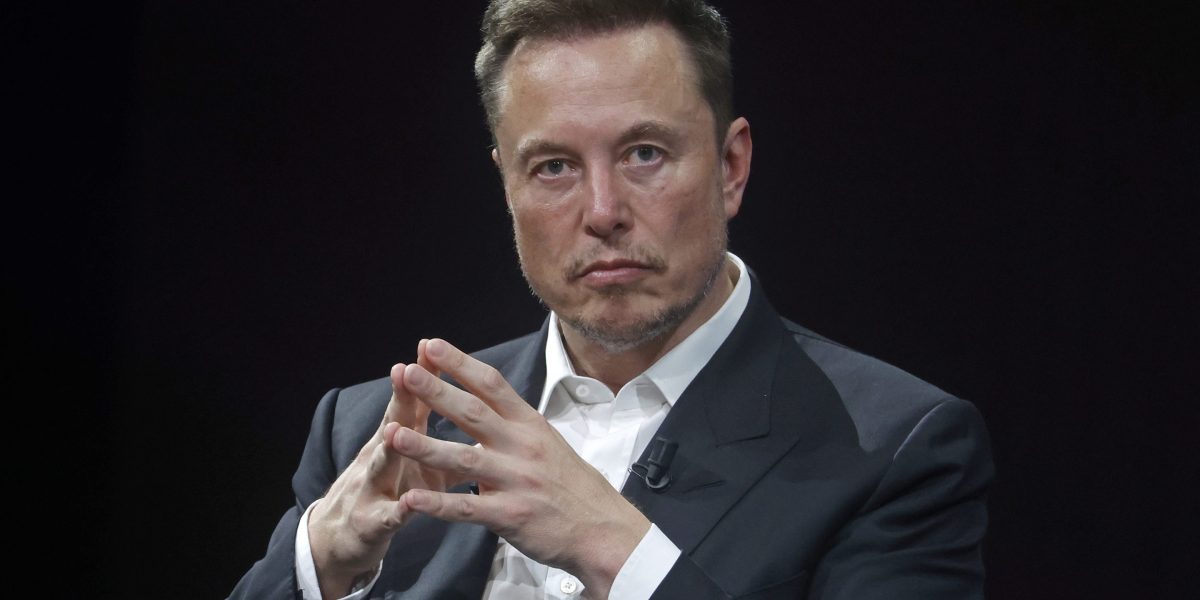
Elon Musk is full of bold predictions, but none may be as controversial as his conclusion that a longer human lifespan is something that can be engineered.
The 54-year-old Tesla boss apparently sees longevity as merely a problem to be overcome—and one with a solution that’s not “particularly hard” at that, he said during an interview on the Moonshots with Peter Diamandispodcast last week.
“You’re pre-programmed to die. And so if you change the program, you will live longer,” he said.
Take, for instance, that every part of the body ages in sync, he argued. Something must be at the root of such synchronization—something that can be identified and potentially altered.
“When you consider the fact that your body is extremely synchronized in its age, the clock must be incredibly obvious,” he said. “Nobody has an old left arm and a young right arm. Why is that? What’s keeping them all in sync?”
In fact, synchronous aging involves a variety of biological factors, including genetics and hormones that help synchronize aging across tissues, according to researchers.
The future of medicine
Musk’s commentary comes at a moment when AI and robotics are set to blur the boundaries between medicine and tech. As part of this revolution, humanoid robots may replace human surgeons, and, in the process, elevate medical care within five years to a much better state than what’s currently available, Musk claimed.
Automation and robotics have already changed healthcare, Musk added, citing LASIK, a procedure that uses a computer-controlled laser to reshape a person’s eyes and improve vision.
“I wouldn’t want the best ophthalmologist with the steadiest hand out there with a hand laser on my eyeball. It’s going to be like that,” Musk said.
While human surgeons take years to gain the experience and skills necessary to operate, humanoid robots like Tesla’s Optimus could potentially do a better job—without the risk of human error.
“Everyone will have access to medical care that is better than what the president receives right now,” he said.
To be sure, Musk’s confidence about increasing longevity runs contrary to his longtime discomfort with the social consequences of an extended lifespan. Unlike some of his billionaire peers who have poured millions into longevity-focused startups, Musk has previously said he’d “prefer to be dead” than live to 100 with dementia or as a burden to society.
“If we live for too long, I think it ossifies society—there’s no changing of the leadership because leadership never dies,” he said.
As I was collecting Crystal Ball predictions for 2026 from readers, I found myself thinking a lot about the future of work.
In part, of course, that’s because you all were thinking about it—combing through email after email, I found waves of predictions about how AI will change our workplaces and our jobs. And I sensed two things: An undercurrent of anxiety, and a resounding sense that AI is our now and future coworker.
The anxiety may have been yours, readers, but it was perhaps mostly mine: I think it’s possible we’re moving towards a future where the most mundane tasks we humans have to do right now are taken over by agentic armies in a way that’s fundamentally good. Much as the Internet created new ways of working that have improved people’s lives, I’m hopeful that AI can too. But then, there’s part of me that says: No, we’re about to move into a world of relentless job contraction and depersonalized professional interactions, made more depressing by the fact they spring from craven laziness above all else.
All of this to say, I’m conflicted. And my ambivalence isn’t helped by the fact that Term Sheet readers—many of whom are investing in the technologies and startups that will shape tomorrow’s workplace—have divergent perspectives. Here’s a sampling of how readers are thinking about an issue that will only become more consequential going forward:
We will start hiring digital employees. We will start treating AI agents like junior staff with job titles, budgets, and spending limits. Once an agent can issue a refund or buy inventory, it stops being a tool and becomes a worker. —Cathy Gao, partner, Sapphire Ventures
You can now build digital autonomous workers that handle large portions of front-office work. We’re heading toward models and agents that can complete a full day’s worth of work with minimal or no human intervention, and we may already be there in some domains. —George Mathew, managing director, Insight Partners
In 2026, companies who rushed to make layoffs hoping AI would fill a significant gap will realize they need to re-hire to fill some of those roles. We saw this starting this year with companies like Klarna, re-hiring to fill customer service roles that chatbots failed at. Next year, we’ll see more of this. —Mahe Bayireddi, CEO and cofounder, Phenom
2025 made it clear that AI would shrink teams by carrying more of the workload. In 2026, the bigger shift will be who gets hired. Companies are increasingly pairing a small number of senior technical leaders with AI-fluent operators, often without traditional CS backgrounds. For VCs, this shift will redefine what a ‘strong early team’ looks like and how capital efficiency is priced. —Jiaona Zhang, CPO at Laurel
New grad hiring will continue to slow and niche talent, either for AI or specific backend infra, will be paid top dollar. As AI makes boilerplate programming table stakes, only great talent will be rewarded. Fewer people will want to major in Computer Science. —Deedy Das, partner, Menlo Ventures
The tensions around returning to the office in any form of mandated pattern are going to continue. While employers might argue it’s a hirer’s job market, if we have an exodus of talent it’s really hard to replace those skillsets. —Livia Bernardini, CEO, Future Platforms
The first real shockwave from AI won’t hit junior analysts; it’ll hit outsourcing. Anything that was being subcontracted to offshore hubs is up first, as AI takes over the repetitive, process-heavy work that used to justify those models. —Raj Bakhru, general manager and cofounder, Blueflame AI
Human judgment will stay at the heart of HR. While AI will streamline recruiting, compensation analysis, and enhance employee experience, humans will remain essential for interpreting nuance, intent and values. HR functions will evolve toward augmented intelligence. —Niki Armstrong, chief administrative and legal officer, Pure Storage
In 2026, agentic AI moves from copilots to autonomous operators. Agentic systems will handle entire workflows, turning automation into a competitive weapon. —Diane Yu, cofounder, Tidalwave
We will see companies and consumers ‘hire’ AI agents to act on their behalf. 2026 will be the year society adjusts to the new realities of AI agents and focuses on what guardrails we expect from the companies behind them. —Don Butler, managing director, Thomvest Ventures
The Term Sheet Podcast is back!… Our first episode of 2026 just dropped. My guest: Jenny Xiao, founder of Leonis Capital and former OpenAI researcher. She talks about why AI companies should be valued closer to (or even below) SaaS, the role academia plays in AI progress, the possibility of another “DeepSeek” moment, and more. Listen and watch here.
Joey Abrams curated the deals section of today’s newsletter.Subscribe here.
VENTURE CAPITAL
– Onebrief, a Honolulu, Hawaii-based operating system for the military, raised $200 million in Series D funding. BatteryVentures and Sapphire Ventures led the round and were joined by SalesforceVentures and others.
– JetZero, the Long Beach, Calif.-based designer of the world’s first all-wing airplane, raised $175 million in Series B funding. BCapital led the round and was joined by UnitedAirlinesVentures, Northrop Grumman, and others.
– Proxima, a New York City-based AI-powered drug discovery platform for proximity therapeutics, raised $80 million in seed funding. DCVC led the round and was joined by NVentures, Braidwell, Roivant, AIXVentures, and others.
– WasabiTechnologies, a Boston, Mass.-based cloud storage company, raised $70 million in funding. L2 Point Management led the round and was joined by PureStorage and existing investors.
– WitnessAI, a Mountain View, Calif.-based AI security platform, raised $58 million in funding. SoundVentures led the round and was joined by FinCapital, QualcommVentures, SamsungVentures, and ForgepointCapitalPartners.
– WithCoverage, a New York City-based AI-powered risk management platform designed to replace insurance brokers for businesses, raised $42 million in Series B funding. SequoiaCapital and KhoslaVentures led the round and were joined by 8VC and CrystalVenturePartners.
– Flip, a New York City-based developer of an AI program that automates customer service calls, raised $20 million in Series A funding. NextCoast Ventures and RidgeVentures led the round and were joined by DataPointCapital and others.
– Tive, a Boston, Mass.-based developer of supply chain and logistics visibility technology, raised $20 million in funding. LightsmithGroup led the round and was joined by SageviewCapital, WorldInnovationLab, AVP, and SupplyChainVentures.
– Klearly, an Amsterdam, The Netherlands-based payment acceptance platform for small and medium-sized businesses, raised €12 million ($14 million) in Series A funding. PayPalVentures led the round and was joined by ItalianFoundersFund and existing investors.
– RISALabs, a Palo Alto, Calif.-based developer of an AI operating system designed for oncology, raised $11.1 million in Series A funding. CencoraVentures and OptumVentures led the round and were joined by others.
– OurPetPolicy, a Boise, Idaho-based pet and emotional support animal platform for rental properties, raised $8 million in Series A funding. RETVentures led the round and was joined by StageDotO and CapitalEleven.
– GrowthPal, a New York City-based developer of an AI copilot designed for M&A, raised $2.6 million in funding. IdeaspringCapital led the round and was joined by angel investors.
PRIVATE EQUITY
– ArlingtonCapitalPartners acquired Pond & Company, an Atlanta, Ga.-based consulting firm for engineering, architecture, planning, and construction management. Financial terms were not disclosed.
– PlatinumEquity acquired a majority stake in NortonPackaging, a Hayward, Calif.-based plastic pails and packaging company. Financial terms were not disclosed.
– WindRose Health Investors acquired a majority stake in AvalonHealthcareSolutions, a Tampa, Fla.-based health diagnostics platform. Financial terms were not disclosed.
EXITS
– Aurex, backed by GodspeedCapital, acquired Alpha 2, a Chantilly, Va.-based provider of cryptographic engineering, cybersecurity, and engineering services. Financial terms were not disclosed.
– Investindustrial acquired Proveris, a Hudson, Mass.-based designer and manufacturer of spray and aerosol testing instrumentation, software and laboratory solutions for the pharmaceutical industry. Financial terms were not disclosed.
– MPearlRock acquired The Good Crisp Company, a Boulder, Colo.-based healthy snack company. Financial terms were not disclosed.
– O’Hara’s Son Roofing, a portfolio company of AngelesEquityPartners, acquired CPRankin, a Chalfont, Pa.-based roofing company. Financial terms were not disclosed.
– PrimeSourceBrands, backed by ClearlakeCapitalGroup, acquired AdvantageIndustries, a Deerfield Beach, Fla.-based gate hardware and pool safety solutions manufacturer. Financial terms were not disclosed.
– TruArcPartners acquired SchillGroundsManagement, a Westlake, Ohio-based commercial landscaping company, from ArgonneCapitalGroup. Financial terms were not disclosed.
– Turn/River Capital acquired StarLIMS, a Hollywood, Fla.-based informatics platform for laboratories, from FranciscoPartners. Financial terms were not disclosed.
– ValorExteriorPartners, a portfolio company of OsceolaCapital, acquired LandmarkExteriors, a Norwalk, Conn.-based roofing company. Financial terms were not disclosed.
PEOPLE
– BregalInvestments, a London, U.K.-based private equity firm, promoted JensBrenninkmeyer to CEO.
– GarnettStationPartners, a New York City-based private equity firm, promoted RafiHaramati to managing director, BradleyEzratty to principal, MaxHoberman to principal, and TeddySokoloff to vice president.
– M13, a Santa Monica, Calif.-based venture capital firm, promoted MorganBlumberg to partner.
– PeriscopeEquity, a Chicago, Ill.-based private equity firm, promoted LukeElder to principal and HarryWaddoups to vice president.
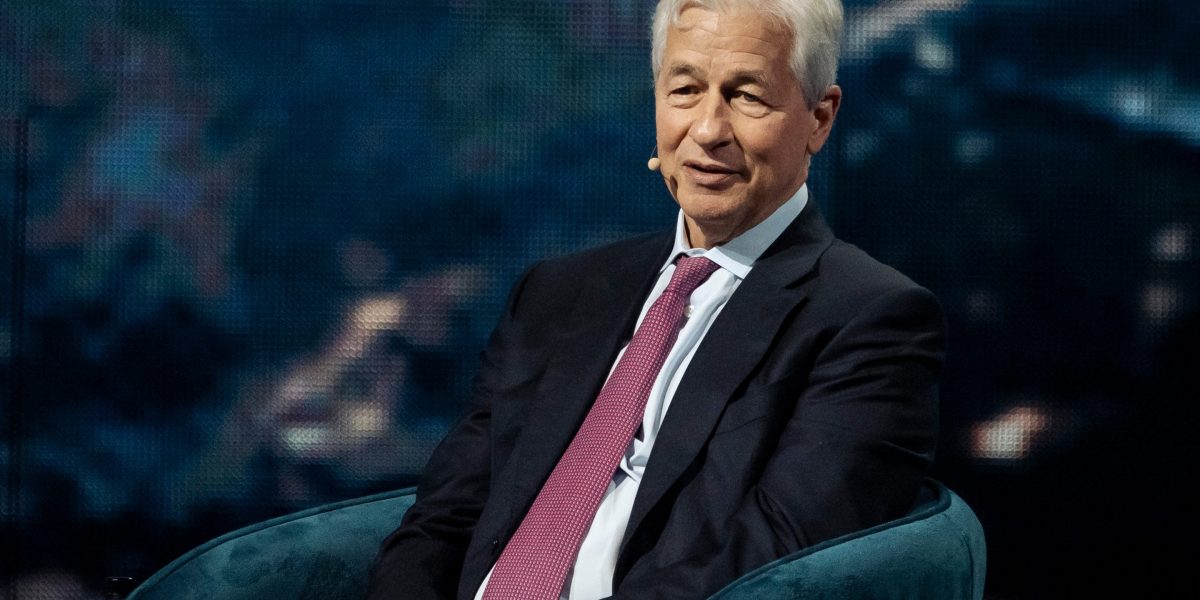
JPMorgan Chase CEO Jamie Dimon had a dose of reality for analysts and investors tuning into his company’s earnings call this week: At some point, governments around the globe are going to have to examine their spending habits.
Shares in America’s largest bank declined following its Q4 2025 earnings call yesterday, which reported revenue of $45.8 billion and assets under management of $4.8 trillion, representing an 18% year-over-year increase.
On the call, Dimon shared a mixed outlook on the economy, saying that “while labor markets have softened, conditions do not appear to be worsening.” He added that consumers remain resilient in their spending and “businesses generally remain healthy.” That’s despite upheaval in markets, which last year had to wrangle with rapidly changing foreign and trade policy from the White House.
While the billionaire banker was bullish on artificial intelligence, he also reiterated his warning that a looming shadow over the macroeconomic outlook is government debt. He has previously cautioned that Washington faces a market “rebellion” over the issue.
When asked about his outlook for 2026, Dimon said the short-term looked good. He explained: “Call it six months and nine months and even a year, it’s pretty positive. Consumers have money. There’s still jobs, even though it’s weakened a little bit. There’s a lot of stimulus coming from the One Big Beautiful Bill. Deregulation is a plus in general, not just for banks, but banks will be able to redeploy capital.”
However, the macro “backdrop” must also be considered, he added, and these work on different timelines: “Geopolitical is an enormous amount of risk … It’s just a big amount of risk that may or may not be determining the fate of the economy.”
He continued: “The deficits in the United States and around the world are quite large. We don’t know when that’s going to bite. It will bite eventually because you can’t just keep on borrowing money endlessly.”
That doesn’t seem to have trickled through to government, which spent $276 billion on interest payments on the national debt in the final three months of 2025 alone. In its most recent budget review released Friday, the Congressional Budget Office reported that the deficit totaled $601 billion in the first quarter of the fiscal year 2026 (October to December), $110 billion less than the deficit recorded the same period last year.
Following the release, Maya MacGuineas, president of the Committee for a Responsible Federal Budget, said the U.S. government is already on track for a $2 trillion deficit in 2026. “Meanwhile, despite being more than a quarter into [fiscal 2026], our government is still not fully funded for the rest of the fiscal year, with another funding deadline around the corner in just over two weeks,” she added. “Lawmakers should come to an agreement on appropriations that avoids increasing our debt even more, restores the caps on discretionary spending, and maintains flat funding from the last fiscal year.”
White House officials have argued that tariff revenue will offset some of the government’s borrowing (despite the president also promising it for other uses), but Dimon remained realistic. “We have to deal with the world we got, not the world we want,” he said, adding his focus is not to guess economic outcomes but serving clients.
Who owns America’s debt?
One of the paths out of a potential debt crunch is that a central bank could simply print more money. By increasing the supply of money, the value of a currency is pushed down, making the interest payments on borrowed money relatively cheaper. However, this comes with inflationary, or hyperinflationary, side-effects.
Moreover, buyers of debt may realise the returns they are getting are decreasing in value, and so demand higher interest payments in the future.
This would be less of a concern for some buyers than others. For example, according to Treasury data analysis by the Peter G Peterson Foundation, which focuses on maintaining a stable fiscal future, the Federal Reserve System is the largest single holder of U.S. debt, owning $4.5 trillion as of March 2025. State and local governments own $1.7 trillion, and mutual funds own $4.4 trillion.
A problem may come from further afield, particularly if geopolitical tensions continue to rise, tempting foreign governments to order their central banks to ditch U.S. debt in protest. That would hurt the value of the dollar, generate inflation, and force the interest yield on U.S. debt upward—all scenarios that would make life more expensive for the federal government.
Investors in Japan, China, and the U.K. are among the highest buyers of U.S. debt, owning $1.1 trillion, $779 billion, and $765 billion, respectively. “While the holdings of U.S. debt by both [Japan and the U.K.] have declined over the past decade, China’s purchases of U.S. Treasury securities have declined more than Japan’s,” the foundation wrote.
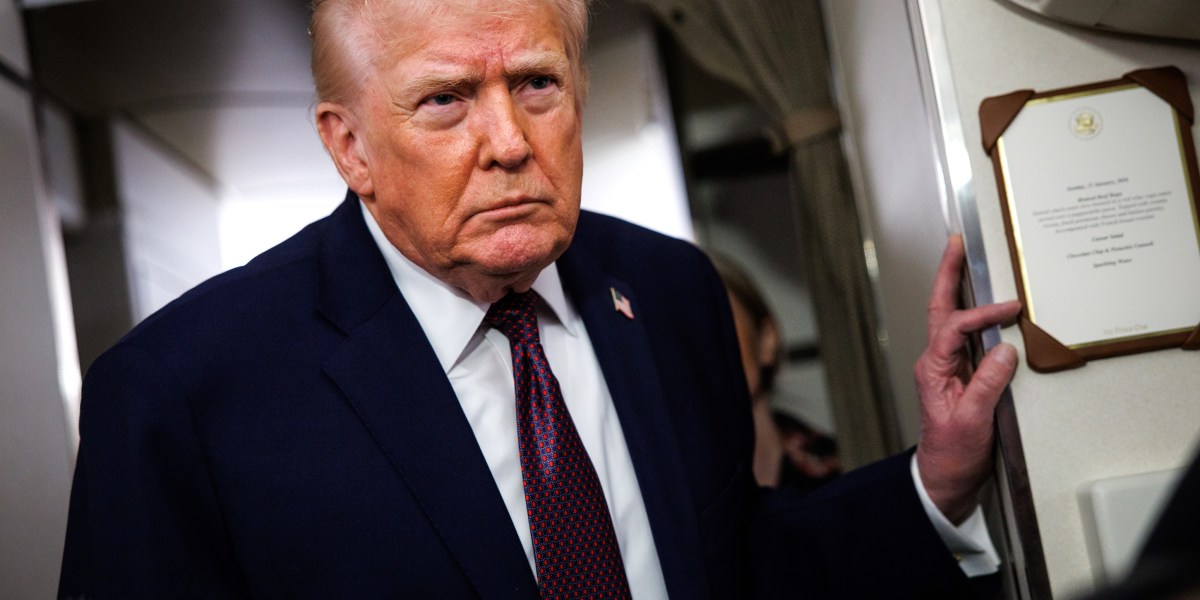
President Donald Trump announced yesterday he would impose a new tariff of 25% on any country trading with Iran. He also predicted disaster if the U.S. Supreme Court were to rule his tariff orders are illegal. The president estimated that “many Hundreds of Billions of Dollars” or even “Trillions” were at stake if the government was forced to refund anyone who paid them.
“It would be a complete mess, and almost impossible for our Country to pay,” he said on Truth Social. “If the Supreme Court rules against the United States of America on this National Security bonanza, WE’RE SCREWED!”
The court could issue a ruling as soon as Wednesday. It had been expected to rule last week. It is not clear why the court is delaying.
But Wall Street analysts are increasingly sanguine about the ruling. As time goes by, many say, the tariff issue becomes less and less dramatic. And in the bigger macro picture, the tariffs are less significant than predicted.
The longer the delay in the ruling the more likely it is the court is leaning toward Trump, according to JPMorgan.
“Legal experts continue to expect the Supreme Court to rule against the use of emergency powers [under the International Emergency Economic Powers Act] to authorize tariffs, but note that each week the Supreme Court delays its decision increases the likelihood of the Trump administration prevailing,” JPMorgan analysts Amy Ho and Joyce Chang told their clients. “Historically, SCOTUS reserves its most impactful decisions for the end of its term in June, which allows for extended deliberation.” Both Supreme Court cases on the Affordable Care Act were pushed to June, they wrote.
The pair also note that in the underlying case, only $135 billion in potential tariff refunds are at stake.
Although Trump has touted the tariffs as a method of paying off the $38 trillion national debt, the reality is that collections so far have been too small to have much of an affect, according to James Knightley, ING’s chief international economist in the U.S. “Since April, tariff revenues are up $206 billion in those eight months relative to [fiscal] 2024, but not all are the IEEPA tariffs—they are estimated to perhaps be $130 billion. Sounds a lot, but the U.S. is a $30 trillion–plus economy,” he told Fortune in an email.
“Many companies will be wary of drawing the ire of the president by claiming a refund, and the hoops to jump through to reclaim through the courts could be quite onerous and deter others. Hence the actual amount that is reclaimed may be quite a lot less than $130 billion.”
Besides, he said, even if Trump loses the Supreme Court case he will likely reimpose the tariffs via some other regulation. “Given tariffs are a signature policy and the Republican polling isn’t looking very strong right now ahead of the midterms, the administration will move swiftly to reinstate tariffs through other legally recognized routes. The promise of a $2,000 tariff dividend needs to be paid for somehow. This is merely shuffling money around seeing as Americans paid the tariffs in the first place only to get money returned, so it is difficult to argue this will be a major stimulus for the economy,” he said.
Tariff revenue is being generated at a current rate of $30.4 billion per month, for an annualized rate of $364.5 billion, according to data from Bloomberg provided to Fortune via Pantheon Macroeconomics. However, those revenues are already in decline as companies find workarounds and as Trump himself cuts deals, compromises, or delays the imposition of harsher measures.
Convera analyst Antonio Ruggiero is also unruffled by the upcoming ruling. If the tariffs are ruled illegal, “we expect the immediate [foreign currency exchange] reaction to be limited, as the broader consensus is that alternative mechanisms will be found to keep tariff revenues intact.
“That said, in the medium term, we cannot exclude the possibility of mild bearish pressure on the dollar tied to expectations of further uncertainty and erratic trade maneuvers should the administration be forced to remove such tariffs, particularly at a time when USD sentiment is increasingly fragile amid concerns over Federal Reserve independence,” he advised clients in an email seen by Fortune.
Here’s a snapshot of the markets ahead of the opening bell in New York this morning:
S&P 500 futures were down 0.15% this morning. The last session closed up 0.16%.






 Politics8 years ago