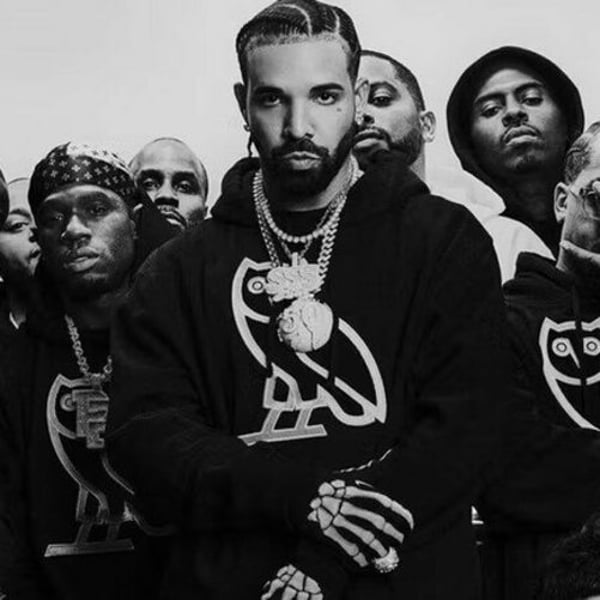
October’s Very Own (OVO) on Tuesday announced it has received capital investment from firm Applied Real Intelligence (A.R.I.), as the Canadian streetwear brand looks to increase its reach globally.
OVO
The U.S.-based investment firm highlighted the “demand for culturally authentic brands right now” adding that the “timing couldn’t be better for OVO,” a lifestyle brand founded by Aubrey “Drake” Graham, Oliver El-Khatib, and Noah “40” Shebib, in Toronto, in 2008.
“Recently, Human Made, the streetwear brand partially owned by Pharrell Williams, went public at nearly $500 million and was reportedly 60 times oversubscribed,” said Dr. Zack Ellison, A.R.I.’s founder and managing general partner.
“It’s a clear signal that investors see tremendous value in brands that blend creativity, community, and cultural credibility. OVO is uniquely positioned within that movement, combining global influence across fashion, music, sports, and a cultural and lifestyle presence that sets it apart.”
Since its inception nearly 20 years ago, OVO has evolved from a music collective into a fully-fledged lifestyle company with retail stores across Toronto, Mississauga, Ottawa, Calgary, and British Columbia, along with international locations in Los Angeles, New York, Las Vegas, and London.
Under the leadership of CEO Derek “Drex” Jancar, OVO will continue to scale its global e-commerce business, expand partnerships, and grow its physical retail footprint, with the help of the new A.R.I. funds, according to a press release.
“OVO represents the next generation of Canadian entrepreneurship,” said Dr. Ellison. “Drake, Oliver, and 40 created something culturally unparalleled, and Drex is now scaling that vision with remarkable discipline and strategic clarity. It’s a rare combination, and one that A.R.I. is proud to support.”
Financial terms of the investment were not disclosed.
With a brand that’s as loved as Mulberry has been for years in the UK, it’s been painful to watch it going into decline in recent years. Each new trading update can bring disappointment. But recent ones have held out some hope. So what did the latest update on Wednesday tell us? Well, there was not only hope but some tangible good news, showing that the turnaround plan put in place around a year ago is paying off.
Mulberry
The company said it saw a “strong festive trading period” underpinned by its full-price sales mix and newness. And there was “positive customer response” to its “right product, at the right price” strategy. You may remember that in November 2024, its still-new CEO Andrea Baldo said it was aiming to sell most of its luxury handbags for less than £1,095 (that is, less than the price of the star Bayswater) to broaden the brand’s appeal and boost sales.
For Q3 (the 13 weeks to 27 December) that translated into total group sales (that is, physical retail, e-tail and wholesale) rising 5.3% with retail and digital sales rising 11% on a like-for-like basis.
In the UK, those two figures were a positive 3.5% and 6.5%, respectively, while in the US they were an even bigger 12.7% and 12.6%. In Europe excluding the UK, the rises were 14.9% and an impressive 27.2%. In Asia Pacific, the total sales rise was just 0.8% (due to the continued right-sizing of its store estate as part of its simplification strategy) but on a like-for-like basis, sales rose 12.1%.
During the period, the group delivered revenue growth across all markets, with “a successful focus on full-price sales in the lead up to and during the festive period, against a highly promotional wider retail market”. This resulted in the previously mentioned group like-for-like sales rise in digital and e-commerce of 11%, with retail full-price sales up 19%.
The company said that the “strength of this performance reflects the group’s ongoing delivery of its new strategy – focused on simplifying the business, refreshing the brand, and more fully leveraging customer insights”.
Success at home and abroad
Part of its new strategy had been about refocusing on the UK market and customer, and this appeared to have been successful as sales in its home market rose. Full-price was the lynchpin, and it also delivered a larger proportion of the sales mix online than the prior year, “amid a backdrop of more challenging growth in the broader retail market”. This tells it that “the product is resonating positively with the UK consumer”.
As for the rest of the world, those figures for the US, Europe and Asia Pacific show that the strategy is working elsewhere too. The strength of the Apac like-for-like rise was a reflection of strong trading during the Double 11 shopping festival in November 2025.
The company added that it’s seen customers responding enthusiastically to its “differentiated product range, at a time when we have been realigning Mulberry’s identity as a British lifestyle brand, and reinvigorating its cultural relevance. Mulberry has successfully re-engaged their existing customer base as well engaging new shoppers across both retail and digital, reinforcing the core offering and signalling the Back to the Mulberry Spirit strategy is working”.
It’s something that’s also being seen at larger peer Burberry and in the case of both companies is a sign that focusing on Britishness and brand heritage doesn’t have to mean products and campaigns that are traditional, even boring.
In fact, both firms have been adding new products and reworking existing ones, using heritage materials, and promoting them via campaigns where creativity is to the fore.
CEO Andrea Baldo said that “there remains plenty more to be done” but the early results are “encouraging” and the business is also maintaining “disciplined cost control, while at the same time growing full-price sales by having products that resonate at the right price”.
He also said the response to its Christmas campaign “has been in line with expectation, with particularly strong demand for the Roxanne, the Hackney and the continued resurgence of the Bayswater”.
High-end department store conglomerate Saks Global filed for bankruptcy protection late on Tuesday in one of the largest retail collapses since the pandemic.
Saks
Saks Fifth Avenue, an affiliate of Saks Global, listed $1 billion to $10 billion in assets and liabilities, according to court documents filed in U.S. Bankruptcy Court in Houston, Texas.
Saks Global did not respond to a request for a further comment.
The move cast uncertainty over the future of U.S. luxury fashion barely a year after a takeover that brought Saks Fifth Avenue, Bergdorf Goodman and Neiman Marcus under the same roof.
A retailer long loved by the rich and famous, from Gary Cooper to Grace Kelly, Saks fell on hard times after the Covid pandemic, as competition from online outlets rose, and brands started more frequently selling items through their own stores.
Saks Global was close to finalizing a $1.75 billion financing package with creditors that would allow its stores to remain open, two people familiar with the negotiations told Reuters earlier on Tuesday.
The financing would provide an immediate cash infusion of $1 billion through a debtor-in-possession loan from an investor group led by Pentwater Capital Management in Naples, Florida, and Boston-based Bracebridge Capital, the people said.
An additional $250 million in financing would also be available through an asset-backed loan provided by the company’s banks, the people said. The luxury retailer would have access to another $500 million of financing from the investor group once it successfully exits bankruptcy protection, the sources added.
A host of luxury brands were among the unsecured creditors, led by Chanel and Gucci owner Kering at about $136 million and $60 million respectively, the court filing said.
The world’s biggest luxury conglomerate, LVMH, was listed as an unsecured creditor at $26 million. In total, Saks Global estimated there were between 10,001 and 25,000 creditors.
In 2024, parent company Hudson’s Bay had bet on scale by merging it with rival Neiman Marcus, creating the entity now known as Saks Global. The $2.7 billion deal was built on about $2 billion in debt financing and equity contributions from investors including Amazon, Salesforce, and Authentic Brands.
Amazon and Authentic Brands were listed in the court filing as equity investors.
Dice Kayek has announced the donation of several iconic pieces from its archive to major international museums, including the Denver Art Museum, The Museum at FIT in New York, the Palais Galliera, the Musée de la Mode de la Ville de Paris, and the Musée des Arts décoratifs.
Dice Kayek donates iconic designs to major international museums. – Dice Kayek
Curatorial teams from the Denver Art Museum, The Museum at FIT, the Palais Galliera, and the Musée des Arts décoratifs were invited to select works directly from the Dice Kayek archive, with each institution choosing pieces to support upcoming exhibitions and strengthen their permanent collections.
The donations build on Dice Kayek’s longstanding recognition by museum institutions, following previous acquisitions by London’s Victoria and Albert Museum and the Los Angeles County Museum of Art.
Launched by sisters Ece and Ayse Ege, the Dice Kayek brand has forged a reputation over the past two decades for its carefully crafted universe. Characteristic styles and techniques include handmade embroidery, the art of folding to create volume through construction, and a unique approach to contrasting fabrics.
“These are one-of-a-kind pieces, there are no others in the world, there aren’t even any patterns to reproduce them,” said Ece.
“When I create a dress from a dream, you really have to think, calculate and examine to turn the beauty of the impossible into reality. It’s not just textile, clothing, it’s something else, an art of transformation.” It’s very important for us to pass on these gifts,” added Ece.
“It’s our way of bearing witness to the whole creative process, so that future generations can discover these unique pieces.”
Notably, the Denver Art Museum selected four sculptural silhouettes from the acclaimed “Istanbul Contrast” collection that have been exhibited internationally and were notably shown at the Victoria and Albert Museum in 2013.
The Museum at FIT chose a look from the Spring-Summer 2015 collection, while the Palais Galliera selected six handmade silhouettes, including dresses, a coat dress, and a suit with matching shoes, drawn in part from “Istanbul Contrast,”. The Musée des Arts décoratifs also chose six silhouettes, including Turkish Delight I and Istanbul by Night II.