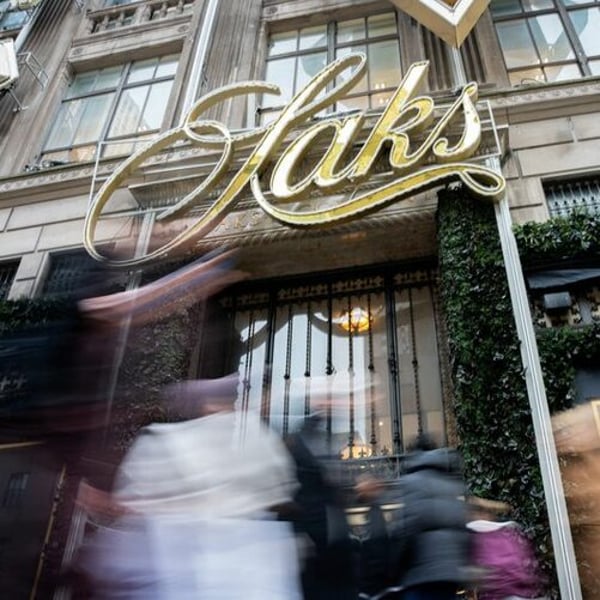
Beleaguered luxury retailer Saks Global is close to finalizing $1.75 billion in financing with creditors that would allow its iconic Saks Fifth Avenue, Bergdorf Goodman and Neiman Marcus stores to remain open, two people familiar with the negotiations said.
The department store conglomerate wants to reorganize its debt and operations in Chapter 11 bankruptcy, which it could file “imminently.” – REUTERS/Angelina Katsanis
The department store conglomerate wants to reorganize its debt and operations in Chapter 11 bankruptcy, which it could file “imminently”, the people said.
The financing would provide an immediate cash infusion of $1 billion through a debtor-in-possession loan from an investor group led by Pentwater Capital Management in Naples, Florida, and Boston-based Bracebridge Capital, the people said.
The company’s banks would also provide an additional $250 million in financing through an asset-backed loan, the people said, asking not to be identified because the discussions are private.
A DIP loan helps companies pay salaries, vendors and other ongoing expenses while a company goes through Chapter 11 bankruptcy, allowing it to continue operating while reorganizing its business. DIP financing gives investors priority repayment if the company isn’t successful and has to liquidate, so a bankruptcy judge will have to sign off on it.
Saks Global, which controls stores and brands that have helped shape America’s taste for high fashion over the last century, would have access to another $500 million of financing from the investor group once it successfully exits bankruptcy protection, the sources added.
The negotiations are still fluid and the exact terms of the lending package could change, they cautioned. The financing plan would also need approval from a bankruptcy judge before it is finalized. The filing could come as soon as Tuesday, the people said.
The DIP finance package would allow Saks Global to repay its vendors and restock depleted inventory, one of the people said, while a Chapter 11 reorganization allows it to continue operating as it restructures its finances and renegotiates lease agreements and other contracts.
The so-called DIP loan could eventually be converted into equity or another type of asset, instead of repaid, if Saks successfully emerges from bankruptcy, one of the people said.
PJT Partners, which is advising Saks on its restructuring, declined to comment. Saks did not immediately return a request for comment.
Driven by the vision of real estate investor Richard Baker, Canada-based conglomerate Hudson’s Bay Co, which had owned Saks since 2013, bought rival Neiman Marcus in 2024 for $2.65 billion and spun off its U.S. luxury assets to create Saks Global.
The plan was to more easily take on competitors like Bloomingdale’s and Nordstrom by bringing together two of America’s best-known department store chains. Big names such as Amazon and Salesforce backed the Saks Global deal by becoming equity investors.
While the marriage gave the newly formed luxury conglomerate more leverage to negotiate discounts with vendors, it also left it saddled with debt. Saks Global took on about $2.2 billion in fresh debt as part of the deal, targeting $600 million in annual cost savings, according to media reports citing the company’s investor call in October.
But demand for luxury goods didn’t rebound as hoped for in 2025 and the servicing costs on that debt significantly ate into its cash flow, making it late in paying vendors and investors, according to interviews with former vendors, investors and analysts.
Saks Global had to tap investors for another $600 million in June and missed a crucial bond payment last month. Some of Saks’ bonds are trading at as little as a penny on the dollar. Its first lien bonds, which have the most protection in bankruptcy, are trading at 25 cents to 30 cents, one bond investor told Reuters.
The new cash injection should give Saks enough breathing room, and liquidity, to eventually recover, one investor said. It wasn’t clear whether the restructuring plan will include additional changes to the company’s management team or its storied real estate holdings, which include its flagship Saks Fifth Avenue store in New York City.
The company abruptly replaced its chief executive – veteran retail executive Marc Metrick – earlier this month, elevating Baker to CEO.
October’s Very Own (OVO) on Tuesday announced it has received capital investment from firm Applied Real Intelligence (A.R.I.), as the Canadian streetwear brand looks to increase its reach globally.
OVO
The U.S.-based investment firm highlighted the “demand for culturally authentic brands right now” adding that the “timing couldn’t be better for OVO,” a lifestyle brand founded by Aubrey “Drake” Graham, Oliver El-Khatib, and Noah “40” Shebib, in Toronto, in 2008.
“Recently, Human Made, the streetwear brand partially owned by Pharrell Williams, went public at nearly $500 million and was reportedly 60 times oversubscribed,” said Dr. Zack Ellison, A.R.I.’s founder and managing general partner.
“It’s a clear signal that investors see tremendous value in brands that blend creativity, community, and cultural credibility. OVO is uniquely positioned within that movement, combining global influence across fashion, music, sports, and a cultural and lifestyle presence that sets it apart.”
Since its inception nearly 20 years ago, OVO has evolved from a music collective into a fully-fledged lifestyle company with retail stores across Toronto, Mississauga, Ottawa, Calgary, and British Columbia, along with international locations in Los Angeles, New York, Las Vegas, and London.
Under the leadership of CEO Derek “Drex” Jancar, OVO will continue to scale its global e-commerce business, expand partnerships, and grow its physical retail footprint, with the help of the new A.R.I. funds, according to a press release.
“OVO represents the next generation of Canadian entrepreneurship,” said Dr. Ellison. “Drake, Oliver, and 40 created something culturally unparalleled, and Drex is now scaling that vision with remarkable discipline and strategic clarity. It’s a rare combination, and one that A.R.I. is proud to support.”
Financial terms of the investment were not disclosed.
Van Cleef & Arpels has unveiled a new boutique at The Mall in Short Hills, New Jersey, expanding the Maison’s retail presence in the United States.
Van Cleef & Arpels opens new boutique in Short Hills, New Jersey. – Van Cleef & Arpels
“We are overjoyed to open our new boutique in Short Hills, offering our cherished clients a new space to discover the magic and artistry of Van Cleef & Arpels,” said Helen King, president and CEO of Van Cleef & Arpels Americas. “This boutique embodies our dedication to exceptional craftsmanship and timeless beauty, providing an immersive journey into our universe.”
Spanning more than 3,000 square feet, the boutique houses the Maison’s High Jewelry, fine jewelry, and watchmaking collections. The interior is anchored by a Veronese two-tier chandelier set beneath a shimmering gold-leaf ceiling, complemented by hand-painted wallpaper, elegant dome fixtures, and a grand central display.
Additional design elements include full-height wallpapers, mirror panels, curated libraries, Veronese sconces, refined lighting, and subtle Van Cleef & Arpels iconography, all set atop rich black hardwood flooring.
Six sales desks are distributed throughout the space, with four positioned at the front and framed by bespoke libraries. Two discreet sales rooms are tucked toward the rear, while a private sitting salon is revealed through a hidden library.
At the back of the boutique, the Poetic Salon provides an intimate setting to encourage discovery and conversation. Lastly, a newly introduced powder room concept adds a contemporary touch, featuring fluted wall tiles and a freestanding Art Deco–inspired vanity.
Meanwhile, the boutique’s exterior is characterized by a distinctive gradient black to gold diamond metal façade, complemented by four showcase windows and decorative metal screens framing the entrance.
Fashion retailer Revolve Group has opened a new store at The Grove in Los Angeles, introducing a new retail concept.
Revolve Group opens permanent store at The Grove in Los Angeles. – Revolve
Spanning 8,450 square feet across two levels, the store showcases a curated assortment from Revolve and its luxury platform Fwrd, including apparel, footwear, accessories, beauty, and home from established and emerging brands, as well as in-house labels such as SRG, Helsa, and Eaves. The architecturally driven space, designed by Montalba Architects, features a sculptural spiral staircase connecting both levels and flexible floor areas that support evolving merchandising needs.
The main level is dedicated to Revolve’s contemporary edit, while the second floor houses Fwrd’s luxury offering in an intimate boutique setting. The store also features Fwrd Renew authenticated pre-owned luxury handbags and a dedicated menswear selection, reflecting the group’s focus on circular fashion and the continued growth of its men’s business.
“As we enter this new era for Revolve Group – marked by our evolved brand identity – expanding our physical footprint is both a strategic and natural progression, allowing us to engage our consumer in a more meaningful, multidimensional way,” said Michael Mente, co-founder and co-CEO, Revolve Group Inc.
“With Los Angeles as our foundation, The Grove was the clear choice for our next store, building on the strong performance of our Aspen location. After years of building our powerful global brand online, we are excited to leverage our brand strength into a physical environment that reflects the discovery, connection, and elevated experience at the core of the Revolve brand.”
In December, Revolve introduced a reimagined brand identity, including a modernized logo, setting the stage for significant expansion plans for 2026.