Connect with us

Business

Investors cry foul over former NYC Mayor Eric Adams’s crypto launch: ‘Such an obvious rug’

Published

on


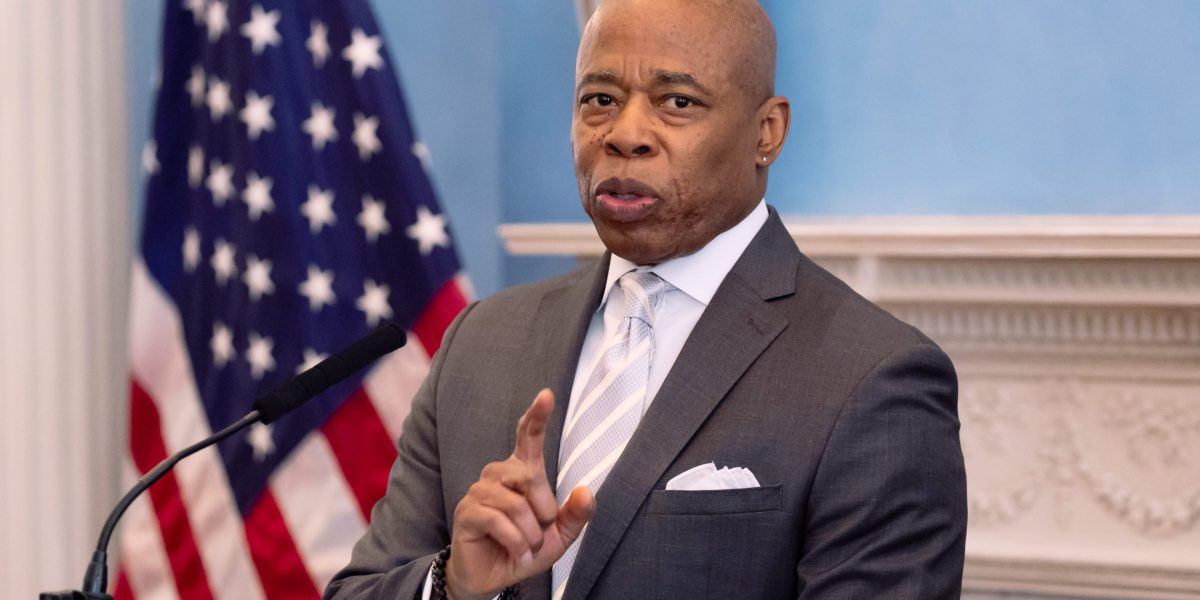
On Monday night, hours after announcing his “NYC Token” at a press conference in Times Square, former New York City Mayor Eric Adams launched his cryptocurrency. The purpose of the token was unclear—beyond a vague promise by Adams that it would combat antisemitism—but investors bought it up anyway, briefly sending its market cap to $600 million. Then it crashed. 

It didn’t take long for crypto observers to declare NYC Token had all the hallmarks of a dreaded rugpull—a common scam where someone launches a cryptocurrency then quickly extracts the value, leaving retail investors with worthless tokens. According to Nicolas Vaiman, the founder of the crypto analytics firm Bubblemaps, as well as blockchain transactions reviewed by Fortune, the developer likely netted around $1 million in proceeds after withdrawing profits from the market. 

Though it remains unclear whether Adams received any of the proceeds, the incident recalled similar debacles of celebrity memecoin launches, including Argentina President Javier Milei’s Libra scandal in early 2025 and Haliey ‘Hawk Tuah girl’ Welch’s failed launch in late 2024. “This is such an obvious rug,” said Vaiman. 

A representative for Adams did not respond to a request for comment. 

$NYC Token

When Adams revealed his “NYC Token” project to a gaggle of reporters in Times Square on Monday morning, he was short on specifics. The former mayor declined to clarify who else was involved with the cryptocurrency, and instead pointed to a website without functioning buttons. He added that the project would teach New York’s children about the virtues of blockchain technology and fund initiatives fighting antisemitism. 

Adams has long been a crypto booster. He started his mayoral term by declaring he would receive his first three paychecks in Bitcoin and palling around with Brock Pierce, the former Mighty Ducks star who earned his fortune on blockchain projects including the stablecoin Tether. 

Eddie Cullen, a former NYC mayoral candidate and founder of the crypto company Crescite, claims that he began sharing ideas with Adams’s inner circle for a NYC token around June 2025. A press release from his political action committee Innovate NY describes plans to support a trademarked initiative called NYC Token that would “channel blockchain technology to drive new city revenue,” and Cullen shared a presentation with Fortune detailing the project that he says he also shared with Adams’s team. 

Cullen says that he had no warning about Monday’s announcement and plans to send Adams a cease-and-desist. “I’m going to hold him accountable,” he told Fortune. “I’m more shocked that he would just go out and do this.” 

It remains unclear who besides Adams was involved with the token’s launch, with a new website listing C18 Digital as an associated entity. Delaware corporation records indicate that a limited liability company called C18 Digital was incorporated on Dec. 30, 2025. 

The muddled history of the token’s origination is just the tip of the iceberg. When a cryptocurrency launches, the developers behind the project will typically fund the new market with other assets such as USDC, a U.S. dollar-backed stablecoin, or the popular cryptocurrency Solana in a so-called “liquidity pool” so that users can both buy and sell the new token. 

But the NYC Token did not follow that approach, instead doing a one-sided liquidity pool that only comprised the token itself. When users began to buy it, injecting the liquidity pool with USDC, a wallet associated with the developer withdrew $2.5 million of those USDC. According to Vaiman, this kind of sell-off is more subtle because it doesn’t look like the wallets are selling the token itself. Hayden Davis— the infamous figure behind the Argentina Libra scandal, which saw investors lose $250 million in a memecoin associated with the country’s president—used a similar approach. 

After reports of a rugpull went viral on X on Monday night, a new account associated with the token announced that it had added new funds to the liquidity pool. Still, according to Vaiman, the developers likely were able to net around $1 million in profit. 

“I truly have no explanation on why they did it,” Vaiman said. “Is this as simple as just pure grift? Maybe I’m overoptimistic and I don’t want to believe that’s the case, but maybe this is what it is.” 


Source link

Continue Reading

Business

Down Arrow Button Icon

Published

on


Delta Air Lines just capped its centennial year with record revenue, record free cash flow, and a fresh jet order, even as its CEO warns that the “bottom end” of the industry is “struggling greatly” and Wall Street remains on edge over tariffs and the fragile economics of budget flying.

America’s most profitable airline used its fourth‑quarter 2025 earnings call on Tuesday to argue that premium-seeking, high‑income travelers—and the loyalty ecosystem built around them—are insulating it from the turbulence battering lower‑cost rivals and jittery investors.​​ CEO Ed Bastian also talked openly about the struggles elsewhere in the industry. “The bottom end of the industry on the commodity side of the business has been struggling greatly,” he told analysts on the earnings call. The economic woes of average Americans don’t seem to be hitting Delta’s profits, though.

Delta said it expects adjusted earnings per share to come in between $6.50 to $7.50 in 2026, versus $5.82 for 2025. Those are impressive numbers, and would be a record for Delta, but the airline guided to $6 per share in October 2025 and guided to more than $7.35 per share for 2025 before tariffs started to bite. Traders sent Delta shares down more than 3% because even another year of high profits aren’t matching the Atlanta flagship carrier’s pre-tariff guidance.

Record year at 30,000 feet

Delta reported record full‑year revenue of $58.3 billion in 2025, up 2.3% year‑over‑year, with a 10% operating margin and $5 billion in pre‑tax income, cementing its status as the U.S. industry’s profit leader. Free cash flow hit $4.6 billion, the highest in Delta’s history, helping the carrier cut leverage by more than half over three years and leaving it with what executives called the strongest balance sheet and credit quality it has ever had.​​

In the December quarter, Delta generated $14.6 billion in revenue—also a record—while delivering a 10% operating margin and earnings of $1.55 per share, modestly above expectations despite a revenue miss and disruption from a government shutdown and FAA‑mandated flight reductions. The company is guiding investors to 20% earnings‑per‑share growth in 2026, with $3 billion–$4 billion of free cash flow and about 3% capacity growth, all concentrated in higher‑margin premium cabins.​

Bastian and his executive team were explicit that the engine behind those results is Delta’s premium customer base and an increasingly sophisticated merchandising model that charges more for better seats and flexibility. President Glen Hauenstein, who is retiring next month after two decades shaping the airline’s commercial strategy, said premium revenue grew 7% in 2025 and that diversified, higher‑margin lines—premium, loyalty, cargo, maintenance, and travel products—now account for 60% of total revenue.​​

Delta’s partnership with American Express remains central to this high‑end tilt, with co‑brand remuneration up 11% to 8.2 billion dollars last year on the back of more than 1 million new card acquisitions and double‑digit spend growth every quarter. Roughly one‑third of active SkyMiles members now carry a Delta Amex card, and the airline expects high‑single‑digit growth in co‑brand remuneration in 2026 as it pushes toward a $10 billion target within a few years.​ Hauenstein said Delta sees “significant runway ahead as member engagement and penetration continues to rise.” (Like Delta, American Express has released a string of blowout earnings, driven by increasing spending from the same cohort of affluent Americans willing to spend.)

‘Bottom end’ of industry under pressure

For all the celebration, Bastian used some of his sharpest language yet about the divide opening up within U.S. aviation between premium‑heavy network carriers and budget airlines that rely on rock‑bottom fares. Citing the collapse or restructuring of several low‑cost players and the stalled growth of ultra‑low‑cost carriers, he noted consolidation in the industry earlier this week, with Allegiant and Sun Country announcing a $1.5 billion merger. He said Delta was “waiting to see what happens with Spirit” as the low-cost carrier navigates bankruptcy.

“That sector has been unable to grow here for the last several years,” he concluded, “and when that sector is not growing, it can’t contain its CASM [cost per available seat mile]. Its CASM goes up significantly every quarter, more than ours. And so that’s become a real challenge for that sector in the industry.” In other words, the only game in town for airline profits is more spending by high earners, and it’s fortunate that Delta is poised to capitalize on this amid what economists widely call a “K-shaped economy,” with the affluent thriving and the poor suffering in opposite directions.

Bastian predicted “further rationalization” among carriers that are not earning their cost of capital, saying it could come via consolidation, liquidation, or internal restructurings as investors lose patience with business models built on cheap seats that no longer cover costs. Hauenstein argued that 2025 showed just how wide the gap has become, saying Delta likely captured a higher share of total U.S. airline profits than ever before as competitors were “very challenged.”​​

To this point, Delta’s own Main Cabin customers—who skew more price‑sensitive—remain a weak spot in an otherwise glossy story. Bastian acknowledged that, while revenue trends have sharply accelerated into early 2026 and booking records were set last week, “we have not really seen Main Cabin move yet,” adding that hitting the top of the company’s guidance range “would definitely be the Main Cabin starting to move.”​

That hesitancy comes amid Trump‑era tariffs that rattled markets and travel demand in 2025. Bastian described a year of volatility that delayed what he still sees as an eventual reset in how the bottom tier of the industry is priced. He cautioned that, even with a strong start to the year and corporate clients signaling more travel, Delta must “have a bit of caution” in its outlook after 2025 was knocked off course by policy shocks and economic jitters.​​

All new seat growth this year will be in premium cabins, and executives touted further gains from “merchandising” tools that slice each product into basic, main, and extra tiers, letting customers pay more for perks like earlier seat assignments or refunds. Hauenstein said those retailing initiatives represent “multibillion‑dollar opportunities” in the coming years, promising more revenue from the same travelers even if Main Cabin demand remains slow to catch up.

For this story, Fortune journalists used generative AI as a research tool. An editor verified the accuracy of the information before publishing.


Source link

Continue Reading

Business

Scott Adams, Dilbert creator who went from cubicle wars to culture wars, posts open letter to time with his death at 68

Published

on


“If you are reading this, things did not go well for me.” That’s how Scott Adams’ X account announced his death on Jan. 13, reaching an enormous global audience in much the way he had for decades throughout a career that spanned both the cartoon pages and front pages of newspapers for the controversial personality.

Adams, creator of the satirical office comic strip “Dilbert” and later a polarizing conservative-leaning online commentator, died in Pleasanton, Calif., at 68 from metastatic prostate cancer. His death came after months of rapidly declining health, including paralysis from the waist down and hospice care in his final days.​

Adams’s first ex-wife, Shelly Miles, told TMZ on Jan. 12 Adams had entered hospice care as his condition worsened, and he died the following day. He had publicly disclosed in May 2025 he was battling aggressive prostate cancer that had already spread and said “the odds of me recovering are essentially zero.” In late 2025, Adams described a tumor near his spine that left him paralyzed from the waist down, telling viewers: “I can’t move any muscles. I do have feeling, I just can’t move any muscles.”​

In his final weeks, Adams continued recording and posting YouTube videos from home while receiving end-of-life care, with family members and a nurse tending to him around the clock. On Jan. 13, his X account posted “a final message from Scott Adams,” which was datemarked Jan. 1, describing his evolution from “Dilbertoonist” to what he described as an author of “useful books.” Framing his later career as oriented around helping people, he wrote, “I had an amazing life. I gave it everything I had.”

Appeal for treatment and political ties

Adams used his social media platforms to detail his treatment, including an appeal in November 2025 for access to Pluvicto, an FDA‑approved drug for metastatic prostate cancer. On X, he claimed Kaiser of Northern California had approved the drug, but “dropped the ball” on scheduling the IV, adding, “I am declining fast. I will ask President Trump if he can get Kaiser of Northern California to respond and schedule it for Monday.” Trump reposted Adams’ plea with the response “On it!” on Truth Social, and Health and Human Services Secretary Robert F. Kennedy Jr. also publicly engaged on the issue, after which Adams said an appointment for Pluvicto had been arranged.​

Adams had long cultivated a reputation as an admirer of Trump’s political style and as a commentator on persuasion and media framing, frequently praising Trump’s communication skills. In later updates, Adams told his audience radiation treatments for the spinal tumor had delayed his Pluvicto regimen and left him uncertain whether he had “missed [his] opportunity” with the drug.​

Critics at the time praised the fact Adams was able to receive the treatment, but bemoaned the fact others don’t have the president’s ear—or the means—to access similar treatment.

“Our health system shouldn’t be one where we need the intervention of the president or the HHS secretary to weigh in on behalf of a high-profile political backer,” Anthony Wright, the executive director of Families USA, told NPR.

From office cubicles to culture wars

Born in 1957, Adams worked in corporate offices before launching “Dilbert” in 1989, a strip that skewered white‑collar life and eventually ran in thousands of newspapers worldwide. The popularity of “Dilbert” led to best‑selling books such as “The Dilbert Principle,” speaking engagements, and a media presence that made him one of the most recognizable cartoonists of the 1990s and early 2000s.​

His reputation shifted dramatically in 2023 after a YouTube livestream in which he reacted to a poll about the phrase “It’s OK to be white” with remarks widely condemned as racist, prompting major newspaper chains to drop “Dilbert.” This was far from the first time Adams made shocking comments that leaned in a conservative direction, though. For instance, he said in 2011 women are treated differently by society in a manner similar to children and the mentally disabled: “It’s just easier this way for everyone.” And he once remarked 2016 GOP presidential candidate Carly Fiorina had an “angry wife face.”

Fans and critics alike are now debating how—and whether—to separate the enduring image of the perpetually frustrated office worker from the man who drew him, whose last public acts included a very modern attempt to shape the story of his own illness and death through social media and carefully prepared final statements.


Source link

Continue Reading

Business

‘Microshifting,’ an extreme form of hybrid work that breaks work into short blocks, is on the rise

Published

on


“Microshifting,” a more radical spin on hybrid work that slices the day into short, non‑continuous blocks of labor, is fast moving from fringe experiment to mainstream talking point in 2026. Advocates say this ultra‑flexible pattern is helping workers reconcile childcare, side hustles, and self‑care with demanding white‑collar roles, while critics warn it could entrench an “always on” culture under a different name.​

Microshifting describes a workday broken into multiple short, flexible “bursts” of focused effort, often around 45 to 90 minutes, separated by stretches of personal time, family duties, or rest. Rather than clocking a continuous 9‑to‑5, a worker might log on at dawn, disappear for school drop‑off or a gym class, and return for another block in the late morning before finishing tasks in the evening.​

The term was popularized by video‑conferencing firm Owl Labs, which defines microshifting as working “in short, non‑linear blocks based on personal energy, responsibilities, or productivity patterns.” Originating during the pandemic, when school closures and lockdowns shattered the traditional schedule, the model has since been embraced by parents, global teams, and gig‑economy workers trying to fit paid work into complex lives.​

Gustas Germanavicius, a Lithuanian ironman competitor and the CEO of InRento, described his approach to microshifting to Fortune in November 2025, likening it both to his physical fitness training and the time he spent studying with the Shaolin monks in China.

“Basically I work in marathons and sprints,” he said. “Two months I work, 24-7, seven days a week, then two weeks off. This two weeks off doesn’t mean that I’m fully offline, but I try to relax and put a lower gear.”

Day One Ventures founder Masha Bucher, an early backer of 12 unicorns and more than 30 exits, told Fortune people close to her absolutely “work seven days a week, from 6:00 or 7:00 am, with a break for sports until like midnight or 1:00 or 2:00 am.” Work to her Silicon Valley circuit is “flexible … I don’t remember when I was on vacation and what vacation is. I think when you do something you love, you don’t feel like you need vacation.”

From hybrid to ‘extreme’ flexibility

The rise of microshifting marks an escalation from earlier forms of hybrid work, which largely focused on where people worked rather than when. In many companies, employees are still required to appear in the office several days a week, but now increasingly negotiate the right to distribute those hours across an elongated day or even late evenings.​ Jones Lang LaSalle conducted a worldwide survey of its commercial real estate business and found a certain “non-complier” with traditional work is “empowered,” because of their special value to the business.

Employer data suggests appetite for this extreme flexibility is strong: Owl Labs’ survey found around 65% of workers are interested in microshifting, with interest especially high among managers, caregivers, and staff with side jobs. Younger workers, particularly Gen Z, are leaning into such non‑linear schedules to accommodate additional gig work, with more than a quarter reporting a second job or side hustle.​

Why workers are embracing it

Supporters argue the model aligns work with natural peaks of concentration and energy, rather than forcing productivity through afternoon slumps. Short, intense blocks are seen as a way to harness “deep work” while leaving time for exercise, school runs, or caring responsibilities that rarely fit neatly into a rigid office day—maybe even ironman training.

Mental health is another selling point: HR consultants say that when done intentionally, microshifting can reduce burnout and decision fatigue, giving workers permission to unplug between bursts. In output‑driven organizations, managers report performance has not dipped when staff are allowed to plan their own microshifts, provided they remain available for key meetings and high‑stakes in‑person commitments.​

Germanavicius, the ironman, stressed to Fortune he encourages people to take vacation and “don’t experience the burnout, because it’s very hard to recover,” including for himself. Referencing the valuable lesson he learned from the Shaolin monks that “practice makes tired,” he said he really works himself hard, and expects everyone else on his team to do so, but there’s a limit.

“The company must not be dependent on me,” he said. “If it’s dependent on me, then it means I’m doing a craftsmanship, not a business. The business needs to work for you, you shouldn’t work for the business.”

Labor experts warn schedule autonomy can morph into expectation, with employees quietly stretching their work across 14 or 16 waking hours to stay responsive in different time zones. Some large employers, especially in finance and government, remain wary, pushing a return to presence‑heavy office cultures and expressing concerns about coordination, accountability and surveillance in such dispersed patterns.​

Jones Lang LaSalle was clear in its survey around workforce trends: The next battlefield between workers and employers has already shifted from where to when. Work-life balance has overtaken salary as the leading priority for office workers globally (65%, up from 59% in 2022.), with employees especially looking for “management of time over place.”


Source link

Continue Reading

Trending

Copyright © Miami Select.