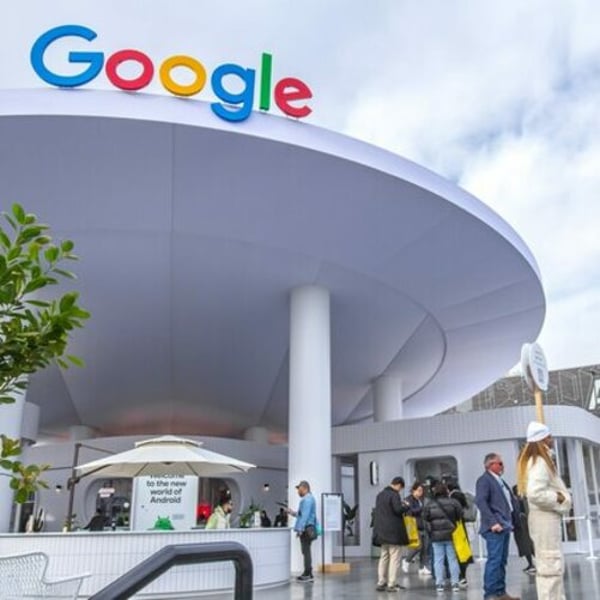
At the NRF trade show in New York, Google unveiled its Universal Commerce Protocol (UCP), an open standard designed to streamline interactions between AI and merchants. Backed by a coalition of industry players spanning Shopify to Zalando, the protocol aims to shape the era of ‘agentic commerce’, in which virtual assistants steer the buying journey from search through to payment.
Shutterstock
Google’s aim is to establish a common language for the sector and, in the process, preserve its strategic position in e-commerce. The UCP is designed to serve as a universal infrastructure, enabling AI-powered ‘agents’ (personal assistants) to carry out complex tasks- from product sourcing to after-sales service- without running up against platform-specific technical barriers.
This standardisation is designed to ensure compatibility with existing protocols (A2A, AP2…) and promises ‘total interoperability’- a pledge of instant compatibility intended to guarantee a ‘frictionless’ dialogue between AI and retailers.
To avoid the pitfalls of a closed solution, Google has opted for an industry alliance. The protocol has been co-developed with leading players such as Shopify, Etsy, Walmart and Wayfair. The coalition also includes major payment providers (Stripe, Visa, Adyen) and international retailers including Best Buy and Zalando, helping to secure initial adoption of the standard across the entire value chain.
Conversion-focused agents
For brands, this framework unlocks new levers for transactional performance. Its flagship feature is the ‘Business Agent,’ a virtual salesperson capable of conversing with consumers directly in search results, adopting the brand’s tone of voice to advise or answer questions. Google is also introducing ‘Direct Offers,’ enabling brands to surface exclusive, real-time discounts within Google’s interface to convert hesitant buyers.
For customers, it is now possible to complete an order directly from the Gemini app (Google’s consumer AI) or within Google’s interface itself, without being redirected to a third-party site. Payment relies on secure data from Google Wallet (and soon PayPal), while the retailer handles fulfilment. This level of fluidity now requires sellers to significantly enrich their data in Merchant Center to remain visible to these new algorithmic intermediaries.
This deployment comes three months after OpenAI, ChatGPT’s parent company, launched its Instant Check-Out feature. This enables Internet users to purchase products on third-party sites without ever leaving ChatGPT. At a time when consumers are increasingly turning to AI for their product searches, Google could find in the UCP a key to defending the position of ‘arbiter of commerce’ conferred on it by its mastery of SEO.
This article is an automatic translation. Click here to read the original article.
UK shoppers continue to warm to artificial intelligence (AI) in their decision-making, according to new research. AI’s increasingly shaping how consumers plan and buy goods as they look for savvier ways to manage spending in 2026, says American Express.
American Express
Its latest Spending Spotlight research shows 29% of UK adults either plan to, or will consider using, AI assistants and tools when they shop this year, rising to 37% for consumers aged 18-34.
Indeed, those younger consumers are using bots to compare prices (31%) and track deals (25%), along with boosting their research confidence by surfacing reviews and key product details (31%) and uncovering new brands and alternatives (27%).
Also, 20% of consumers say AI’s helpful when looking for inspiration for new experiences, from activities and events to travel ideas – “highlighting its growing role in shaping how people plan and spend their downtime”.
More broadly, the Spending Spotlight also shows 46% of Britons are entering 2026 with a New Year’s spending resolution, such as shopping around for deals, tracking their spending more closely and buying from eco-friendly brands.
The research also suggests competition for consumer loyalty is set to intensify among retailers, with savvy shoppers increasingly looking to rewards and incentives when deciding where to spend. Two-thirds (66%) of respondents say they have used loyalty or rewards points to get a better deal in the past year and plan to continue doing so through 2026.
This reward-seeking focus is also influencing where people choose to shop as 61% say they have intentionally chosen to spend with businesses with loyalty programmes and plan to continue spending with them, “reinforcing the importance of rewards to driving repeat custom”, the report said.
Dan Edelman, UK general manager, Merchant Services, American Express, added: “We’re seeing AI progressing at pace into a valuable companion for shoppers to help them plan and feel confident in their spending decisions.
“What’s also clear is that as people continue to look at savvier ways to spend, being rewarded for their loyalty remains highly important to shoppers. For retailers, that means competing not just on price, but on the quality of information, experience and incentives they provide.”
Barcelona-based fashion brand Mango has arrived in Iceland. As part of its ambitious international expansion, Mango has opened its first store in the Nordic nation, located in the Smáralind shopping centre, the largest retail complex in Reykjavik.
Exterior of the Barcelona-based brand’s new store in the Icelandic capital. – Mango
The new store spans 450 square metres and is dedicated exclusively to the brand’s womenswear line. Conceived in line with Mango’s signature New Med concept, inspired by the Mediterranean, its design reflects the brand’s identity and places sustainability and architecture at its core, using traditional, artisanal, sustainable and natural materials.
This opening in the Icelandic capital forms part of the 4E 2024–2026 Strategic Plan, which seeks to strengthen the company’s distinctive value proposition, reinforce its commitment to innovation and sustainability, expand its retail network domestically and internationally, and continue to drive growth across all its lines and channels. In this context, Mango is currently pursuing various growth drivers, including the expansion of its Teen category, consolidating its presence in markets such as Italy and the US, and opening stores dedicated to its Home category.
Founded by Isak Andic in 1984, the Catalan company currently operates in more than 120 markets through a network of over 2,900 points of sale. According to the latest available data, Mango posted revenue of €1.728 billion in the first half of the 2025 financial year, up 12% on the same period a year earlier, and expects to end 2026 with sales of €4 billion and 500 additional stores.
This article is an automatic translation. Click here to read the original article.
Adidas is to launch a footwear collaboration with British celebrity fashion/beauty influencer Molly-Mae Hague.
Image: Molly-Mae Hauge/Adidas
The collab has seen Hague work with Adidas on a limited footwear collection, with the sportswear brand confirming the partnering on an upcoming SS26 campaign and product launch. Further details have yet to be announced.
Posing by an Adidas-themed vehicle surrounded by the brand’s distinctive shoe boxes, Hague has just shared the news with her 8.5 million Instagram followers: “Three stripes. One vision. Curated by Molly-Mae. Coming soon…”, adding: “ADI X MM… what started as a dream years ago is now becoming reality. My own footwear collection with Adidas.”
Hague has her own fashion label, Maebe, launched in late 2024, positioned as ‘accessible luxury’, featured minimalist wardrobe staples including denim, tailored outerwear, shirts and vests, in a neutral colour palette.
She was also formerly a creative director for Prettylittlething brand in 2022 and retains her position as a brand ambassador for the label after first finding fame as a contestant on TV show Love Island in 2019.