Connect with us

Business

Is Powell’s Fed head independence dead? Trump outfoxes himself this time

Published

on


The only surprising quality regarding President Trump unleashing federal investigators to prepare potential prosecution criminal charges against the highly respected Federal Reserve Chairman Jay Powell — a Trump appointee himself — is that anyone is surprised by this news.

Financial markets initially dropped before rebounding as investors blew off Trump’s Justice Department move as the flailing bluster of a lame duck and a fissure opened in the GOP, with open concern about the sacred independence of the DOJ as well as of the Federal Reserve.

For example, prominent Republican Sen. Thom Tillis, of the Senate Banking Committee, asserted that “It is now the independence and credibility of the Department of Justice that are in question.”

Similarly, Republican Rep. French Hill, chairman of the House Financial Services committee, called this investigation “an unnecessary distraction that could undermine this Administration and sound monetary decisions.”

Even Trump’s own Treasury Secretary, Scott Bessent, challenged Trump on his “revenge probe” of Powell.

The sequential, dramatic waves of prosecutions against such officials as Trump’s former National Security Advisor John Bolton, former FBI chiefs James Comey and Christopher Wray, New York Attorney General Letitia James, former CIA chief John Brennan, Federal Reserve Governor Lisa Cook,  former Homeland Security official Miles Taylor, Sen. Adam Schiff, cybersecurity chief Christoper Krebs, and former special counsel Jack Smith, among others, is alarming. As Trump’s Truth Social messaging shows, he has personally directed such prosecutions, showing a weaponization of the judiciary against perceived political enemies. Some critics see this as the impulsive emotional fits of the crazed Queen of Hearts from Alice in Wonderland, screaming “off with their heads” regarding any who displease her. However, what is missed is that these moves are far more deliberate actions, part of a larger tactical pattern.

The charges against Powell — that he lied to Congress due to building renovation costs overruns — is ludicrous and such charges will surely be dismissed in court. The alleged 40% cost overruns may be true but they are not criminal. let alone reckless. The actual Fed renovations are costing $2.5 billion, which is 40% overbudget due to cost inflation, but Trump admitted last month that his own East Wing demolition and construction of a new White House ballroom has ballooned to 200% over budget. This is truly stunning as this project was only six months ago and Trump should know how to estimate construction accurately as a builder himself. 

These costs are not out of line, given that this is the first comprehensive renovation in the 90 years since the Marriner Eccles building was built in 1937.  By contrast, the nearby Hart, Russell, and Dirksen Senate Office buildings and the Cannon House Office building have continuously undergone massive renovations over the decades. 

Plus, regardless of the nature of these common cost overruns, not a penny of this is from U.S. taxpayer funds. The Fed is funding these renovations out of its own budget as the Fed is entirely operationally self-sufficient, funded primarily by its own investment income on the U.S. Treasury bonds it owns. 

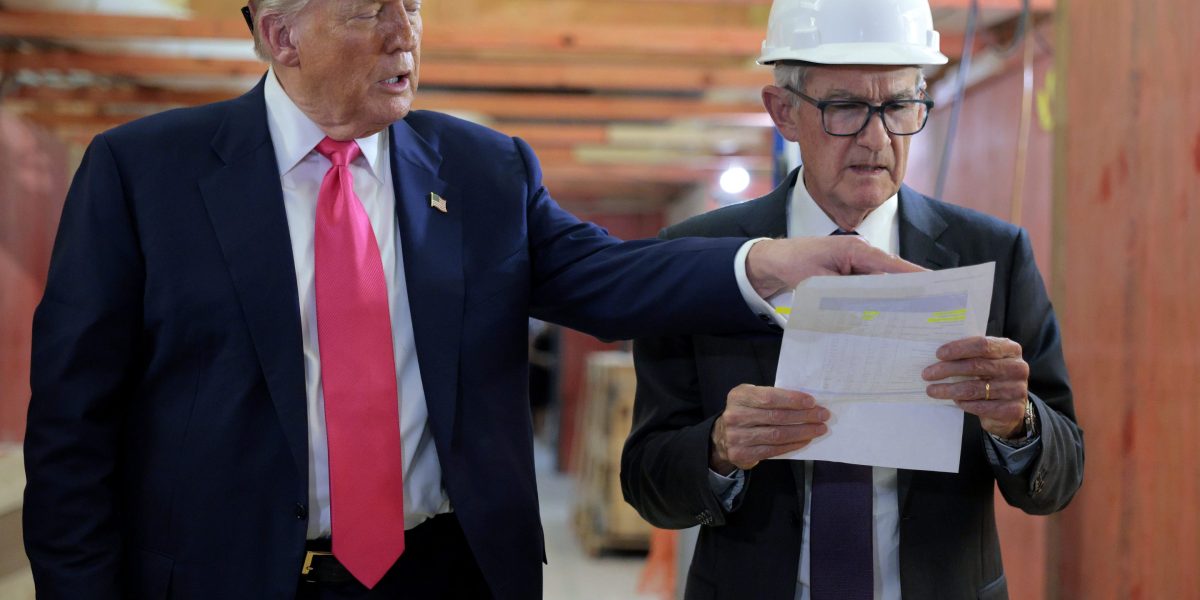
Trump’s attempted ambush of Powell on national TV this summer, during a tour of the construction site, backfired, with Powell correcting and embarrassing him. Trump’s false statement that the renovations had ballooned to $3.1 billion was shown to incorrectly include a separate, already-completed renovation of a different building.

On the surface, Trump is angry that the Federal Reserve is not cutting rates faster and further and that is how chairman Powell explains why he is being targeted as he complained: “This new threat is not about my testimony last June or about the renovation of the Federal Reserve buildings. … Those are pretexts. The threat of criminal charges is a consequence of the Federal Reserve setting interest rates based on our best assessment of what will serve the public, rather than following the preferences of the President.”

Fully 71% of the 200 CEOs at my recent Yale CEO Summit complained that Trump had already eroded the independence of the Federal Reserve via actions from his administration, and 81% stated that they prefer Governor Chris Waller as Powell’s prospective successor when the chairman’s term ends this spring, presuming he will fortify Fed independence. 

So, if this lawfare attack is not an impulsive tantrum, what is the strategic rationale? Like Trump’s false assertion this month that the attack on Venezuela was driven by the advance interest of U.S. oil producers, which they soundly denied, claiming Venezuela was “uninvestable,” this was more of Trump’s diversionary maneuvering. In my new book, Trump’s Ten Commandments (Simon & Schuster), I label this his “Wall of Sound” tactic to change the public narrative from his faltering polling with Gallup’s end of year national survey reporting only 36% of the nation approving and the Economist/YouGov  finding that 57% disapprove. Even over half of MAGA/Trump voters don’t support Trump on his handling of the Epstein files and affordability and healthcare. His ICE/immigration tactics have plummeted 30% in recent polling. 

But Trump has succeeded in his mission of getting every media outlet to drop their 24/7 hammering on his weaknesses on salient domestic policies. Plus, he is pulling three other levers in this Fed/Powell diversionary maneuver — he invokes his “hub & spoke” leadership model where there are no independent agencies of control, his crushing of adversaries with selective retribution, and his deft manipulation of the classic mass communication propaganda tool “sleeper effect” where a false message is repeated in an unrelenting determined way and eventually gets traction. 

These are four of the 10 tools in Trump’s tool kit that I label his “Ten Commandments.” He selects them deliberately and not truly impulsively despite his bravado. Trump is far from tone deaf or foolish. He is dumb as a fox, but even foxes, generally symbol of intelligence and slyness, become victims of their own presumed cleverness. 

The opinions expressed in Fortune.com commentary pieces are solely the views of their authors and do not necessarily reflect the opinions and beliefs of Fortune.

This story was originally featured on Fortune.com


Source link

Continue Reading

Business

MrBeast has a $2.6 billion net worth, but even he’s in the red and having to borrow cash right now: ‘That’s how little money I have’

Published

on


Some successful entrepreneurs sitting atop billion-dollar businesses say they may look rich on paper, but take a peek into their bank accounts, and they’re actually cash poor. Social media mogul Jimmy Donaldson, known to his 460 million YouTube followers as MrBeast, claims he’s just as broke as everyone else despite running a $5 billion entertainment empire. 

“I’m borrowing money. That’s how little money I have,” Donaldson told the Wall Street Journal earlier this month. “Technically, everyone watching this video has more money than me and their bank account if you subtract the equity value of my company, which doesn’t buy me McDonald’s in the morning.”

The 27-year-old entrepreneur has said that he keeps less than $1 million for himself, despite being a billionaire and owning more than half of his $5 billion company Beast Industries. Aside from his nine-figure Amazon deal and popular YouTube channel with 107 billion lifetime views, Donaldson hit the ultra-rich club—at least on paper—from a slew of successful businesses. He’s launched ventures including multimillion-dollar chocolate brand Feastables; Lunchly, a Lunchables-esque packaged food product; MrBeast Burger, a virtual restaurant that only allows for pickup and drop-off; and production company MrBeast LLC, which helps manufacture his viral videos.

Through his assets, Donaldson is projected to be worth at least $2.6 billion—although he emphasized it’s not a fat wad of cash burning a hole in his pocket. Forbes has also estimated that his annual earnings reached $85 million between April 2024 and April 2025, a far cry from the typical American salary of $62,088 a year. However, that doesn’t mean he’s splurging on luxuries and only flying private. Donaldson claimed he’s actually in the red.

“It’s funny talking about my personal finances, because no one ever believes anything I say,” Donaldson explained. “They’re like, ‘You’re a billionaire!’ I’m like, ‘That’s net worth.’ I have negative money right now.”

“I wake up, I just work…I’m just so busy working I don’t really think about my personal bank account,” Donaldson continued. “I’m just laser-focused on making the greatest videos as possible, and building the business as big as possible.”

Why MrBeast says he’s in the red

Donaldson rakes in eight-figure earnings and runs a $5 billion business, yet still claims to be broke. So where is all of his money going? Right back into his business ventures, the YouTube star says. 

“I personally have very little money because I reinvest everything (I think this year we’ll spend around a quarter of a billion on content). Ironically I’m actually borrowing $ from my mom to pay for my upcoming wedding,” Donaldson wrote on X in response to a post heralding him as the only billionaire under 30 who didn’t inherit their wealth. 

“But sure, on paper the businesses I own are worth a lot,” he continued. 

The billionaire entrepreneurs who say they’re broke—or act like it

Other billionaire founders have echoed that they don’t feel as wealthy as their net worth suggests. Ben Francis, the founder and CEO of $1.5 billion sportswear brand Gymshark, insisted that his $1.3 billion net worth is “all on paper,” and that his wealth isn’t a “real” marker of success.

“People assume there is some bank balance with my name on it that has billions in which is just completely untrue,” Francis said on The SuperPower Podcast in 2023. “None of it is real.”

After all, it only takes one negative earnings report or fierce new industry competitor to jolt his net worth. Since Francis owns 70% of the company, his fortune is wrapped up in the success of his assets—which can fluctuate in value at any given moment. 

“It could double, it could [halve],” the Gymshark founder continued. “That’s why I think it’s important that no individual should ever pin their self-worth on things like wealth, net worth, or anything financial.”

Even the billionaires who do have cash to burn are just skirting by, out of choice. Lucy Guo, the cofounder of $29 million company Scale AI, isn’t keen to spend the $1.3 billion stake she has in the business. The youngest self-made billionaire woman in the world doesn’t like to “waste” money, opting to fly commercial, drive an old Honda Civic, wear Shein clothes, and leverage meal deals to get the best price. In fact, she believes flashing wealth and needlessly splurging on life luxuries is a sign of insecurity; Guo doesn’t feel the need to prove she’s successful. 

“Who you see typically wasting money on designer clothes, a nice car, et cetera, they’re technically in the millionaire range,” Guo told Fortune last year. “It’s like, act broke, stay rich.”


Source link

Continue Reading

Business

Investors cry foul over former NYC Mayor Eric Adams’s crypto launch: ‘Such an obvious rug’

Published

on


On Monday night, hours after announcing his “NYC Token” at a press conference in Times Square, former New York City Mayor Eric Adams launched his cryptocurrency. The purpose of the token was unclear—beyond a vague promise by Adams that it would combat antisemitism—but investors bought it up anyway, briefly sending its market cap to $600 million. Then it crashed. 

It didn’t take long for crypto observers to declare NYC Token had all the hallmarks of a dreaded rugpull—a common scam where someone launches a cryptocurrency then quickly extracts the value, leaving retail investors with worthless tokens. According to Nicolas Vaiman, the founder of the crypto analytics firm Bubblemaps, as well as blockchain transactions reviewed by Fortune, the developer likely netted around $1 million in proceeds after withdrawing profits from the market. 

Though it remains unclear whether Adams received any of the proceeds, the incident recalled similar debacles of celebrity memecoin launches, including Argentina President Javier Milei’s Libra scandal in early 2025 and Haliey ‘Hawk Tuah girl’ Welch’s failed launch in late 2024. “This is such an obvious rug,” said Vaiman. 

A representative for Adams did not respond to a request for comment. 

$NYC Token

When Adams revealed his “NYC Token” project to a gaggle of reporters in Times Square on Monday morning, he was short on specifics. The former mayor declined to clarify who else was involved with the cryptocurrency, and instead pointed to a website without functioning buttons. He added that the project would teach New York’s children about the virtues of blockchain technology and fund initiatives fighting antisemitism. 

Adams has long been a crypto booster. He started his mayoral term by declaring he would receive his first three paychecks in Bitcoin and palling around with Brock Pierce, the former Mighty Ducks star who earned his fortune on blockchain projects including the stablecoin Tether. 

Eddie Cullen, a former NYC mayoral candidate and founder of the crypto company Crescite, claims that he began sharing ideas with Adams’s inner circle for a NYC token around June 2025. A press release from his political action committee Innovate NY describes plans to support a trademarked initiative called NYC Token that would “channel blockchain technology to drive new city revenue,” and Cullen shared a presentation with Fortune detailing the project that he says he also shared with Adams’s team. 

Cullen says that he had no warning about Monday’s announcement and plans to send Adams a cease-and-desist. “I’m going to hold him accountable,” he told Fortune. “I’m more shocked that he would just go out and do this.” 

It remains unclear who besides Adams was involved with the token’s launch, with a new website listing C18 Digital as an associated entity. Delaware corporation records indicate that a limited liability company called C18 Digital was incorporated on Dec. 30, 2025. 

The muddled history of the token’s origination is just the tip of the iceberg. When a cryptocurrency launches, the developers behind the project will typically fund the new market with other assets such as USDC, a U.S. dollar-backed stablecoin, or the popular cryptocurrency Solana in a so-called “liquidity pool” so that users can both buy and sell the new token. 

But the NYC Token did not follow that approach, instead doing a one-sided liquidity pool that only comprised the token itself. When users began to buy it, injecting the liquidity pool with USDC, a wallet associated with the developer withdrew $2.5 million of those USDC. According to Vaiman, this kind of sell-off is more subtle because it doesn’t look like the wallets are selling the token itself. Hayden Davis— the infamous figure behind the Argentina Libra scandal, which saw investors lose $250 million in a memecoin associated with the country’s president—used a similar approach. 

After reports of a rugpull went viral on X on Monday night, a new account associated with the token announced that it had added new funds to the liquidity pool. Still, according to Vaiman, the developers likely were able to net around $1 million in profit. 

“I truly have no explanation on why they did it,” Vaiman said. “Is this as simple as just pure grift? Maybe I’m overoptimistic and I don’t want to believe that’s the case, but maybe this is what it is.” 


Source link

Continue Reading

Business

Fortune Article | Fortune

Published

on


The Trump administration’s criminal investigation of Federal Reserve Chair Jerome Powell appeared on Monday to be emboldening defenders of the U.S. central bank, who pushed back against President Donald Trump’s efforts to exert more control over the Fed.

The backlash reflected the overarching stakes in determining the balance of power within the federal government and the path of the U.S. economy at a time of uncertainty about inflation and a slowing job market. This has created a sense among some Republican lawmakers and leading economists that the Trump administration had overstepped the Fed’s independence by sending subpoenas.

The criminal investigation — a first for a sitting Fed chair — sparked an unusually robust response from Powell and a full-throated defense from three former Fed chairs, a group of top economic officials and even Republican senators tasked with voting on Trump’s eventual pick to replace Powell as Fed chair when his term expires in May.

White House press secretary Karoline Leavitt told reporters that Trump did not direct his Justice Department to investigate Powell, who has proven to be a foil for Trump by insisting on setting the Fed’s benchmark interest rates based on the data instead of the president’s wishes.

“One thing for sure, the president’s made it quite clear, is Jerome Powell is bad at his job,” Leavitt said. “As for whether or not Jerome Powell is a criminal, that’s an answer the Department of Justice is going to have to find out.”

Critics see Trump as trying to control the Fed

The investigation demonstrates the lengths the Trump administration is willing to go to try to assert control over the Fed, an independent agency that the president believes should follow his claims that inflationary pressures have faded enough for drastic rate cuts to occur. Trump has repeatedly used investigations — which might or might not lead to an actual indictment — to attack his political rivals.

The risks go far beyond Washington infighting to whether people can find work or afford their groceries. If the Fed errs in setting rates, inflation could surge or job losses could mount. Trump maintains that an economic boom is occurring and rates should be cut to pump more money into the economy, while Powell has taken a more cautious approach in the wake of Trump’s tariffs.

Several Republican senators have condemned the Department of Justice’s subpoenas of the Fed, which Powell revealed Sunday and characterized as “pretexts” to pressure him to sharply cut interest rates. Powell also said the Justice Department has threatened criminal indictments over his June testimony to Congress about the cost and design elements of a $2.5 billion building renovation that includes the Fed’s headquarters.

“After speaking with Chair Powell this morning, it’s clear the administration’s investigation is nothing more than an attempt at coercion,” said Sen. Lisa Murkowski, R-Alaska, on Monday.

Jeanine Pirro, U.S. attorney for the District of Columbia, said on social media that the Fed “ignored” her office’s outreach to discuss the renovation cost overruns, “necessitating the use of legal process — which is not a threat.”

“The word ‘indictment’ has come out of Mr. Powell’s mouth, no one else’s,” Pirro posted on X, although the subpoenas and the White House’s own statement about determining Powell’s criminality would suggest the risk of an indictment.

bipartisan group of former Fed chairs and top economists on Monday called the Trump administration’s investigation “an unprecedented attempt to use prosecutorial attacks” to undermine the Fed’s independence, stressing that central banks controlled by political leaders tend to produce higher inflation and lower growth.

“I think this is ham-handed, counter-productive, and going to set back the president’s cause,” said Jason Furman, an economist at Harvard and former top adviser to President Barack Obama. The investigation could also unify the Fed’s interest-rate setting committee in support of Powell, and means “the next Fed chair will be under more pressure to prove their independence.”

The subpoenas apply to Powell’s statements before a congressional committee about the renovation of Fed buildings, including its marble-clad headquarters in Washington. They come at an unusual moment when Trump was teasing the likelihood of announcing his nominee this month to succeed Powell as the Fed chair and could possibly be self-defeating for the nomination process.

While Powell’s term as chair ends in four months, he has a separate term as a Fed governor until January 2028, meaning that he could remain on the board. If Powell stays on the board, Trump could be blocked from appointing an outside candidate of his choice to be the chair.

Some Senate Republicans express doubts

Powell quickly found a growing number of defenders among Republicans in the Senate, who will have the choice of whether to confirm Trump’s planned pick for Fed chair.

Sen. Thom Tillis, a North Carolina Republican and member of the Senate Banking panel, said late Sunday that he would oppose any of the Trump administration’s Fed nominees until the investigation is “resolved.”

“If there were any remaining doubt whether advisers within the Trump Administration are actively pushing to end the independence of the Federal Reserve, there should now be none,” Tillis said.

Sen. Dave McCormick, R-Pa., said the Fed may have wasted public dollars with its renovation, but he said, “I do not think Chairman Powell is guilty of criminal activity.”

Senate Majority Leader John Thune offered a brief but stern response Monday about the tariffs as he arrived at the U.S. Capitol, suggesting that the administration needed “serious” evidence of wrongdoing to take such a significant step.

“I haven’t seen the case or whatever the allegations or charges are, but I would say they better, they better be real and they better be serious,” said Thune, a Republican representing South Dakota.

Powell could stay on the Fed board, possibly thwarting Trump

If Powell stays on the board after his term as chair ends, the Trump administration would be deprived of the chance to fill another seat that would give the administration a majority on the seven-member board. That majority could then enact significant reforms at the Fed and even block the appointment of presidents at the Fed’s 12 regional banks.

“They could do a lot of reorganizing and reforms” without having to pass new legislation, said Mark Spindel, chief investment officer at Potomac River Capital and author of a book on Fed independence. “That seat is very valuable.”

Powell has declined at several press conferences to answer questions about his plans to stay or leave the board.

Scott Alvarez, former general counsel at the Fed, says the investigation is intended to intimidate Powell from staying on the board. The probe is occurring now “to say to Chair Powell, ’We’ll use every mechanism that the administration has to make your life miserable unless you leave the Board in May,’” Alvarez said.

Asked on Monday by reporters if Powell planned to remain a Fed governor, Kevin Hassett, director of the White House National Economic Council and a leading candidate to become Fed chair, said he was unaware of Powell’s plans.

“I’ve not talked to Jay about that,” Hassett said.

A weaker Fed could mean a weaker economy

A bipartisan group of former Fed chairs and top economists said in their Monday letter that the administration’s legal actions and the possible loss of Fed independence could hurt the broader economy.

“This is how monetary policy is made in emerging markets with weak institutions, with highly negative consequences for inflation and the functioning of their economies more broadly,” the statement said.

The statement was signed by former Fed chairs Ben Bernanke, Janet Yellen, and Alan Greenspan, as well as former Treasury Secretaries Henry Paulson and Robert Rubin.

Still, Trump’s pressure campaign had been building for some time, with him relentlessly criticizing and belittling Powell.

He even appeared to preview the shocking news of the subpoenas at a Dec. 29 news conference by saying he would bring a lawsuit against Powell over the renovation costs.

“He’s just a very incompetent man,” Trump said. “But we’re going to probably bring a lawsuit against him.”

__

AP writers Lisa Mascaro and Joey Cappelletti contributed to this report.


Source link

Continue Reading

Trending

Copyright © Miami Select.