Connect with us

Business

Down Arrow Button Icon

Published

on


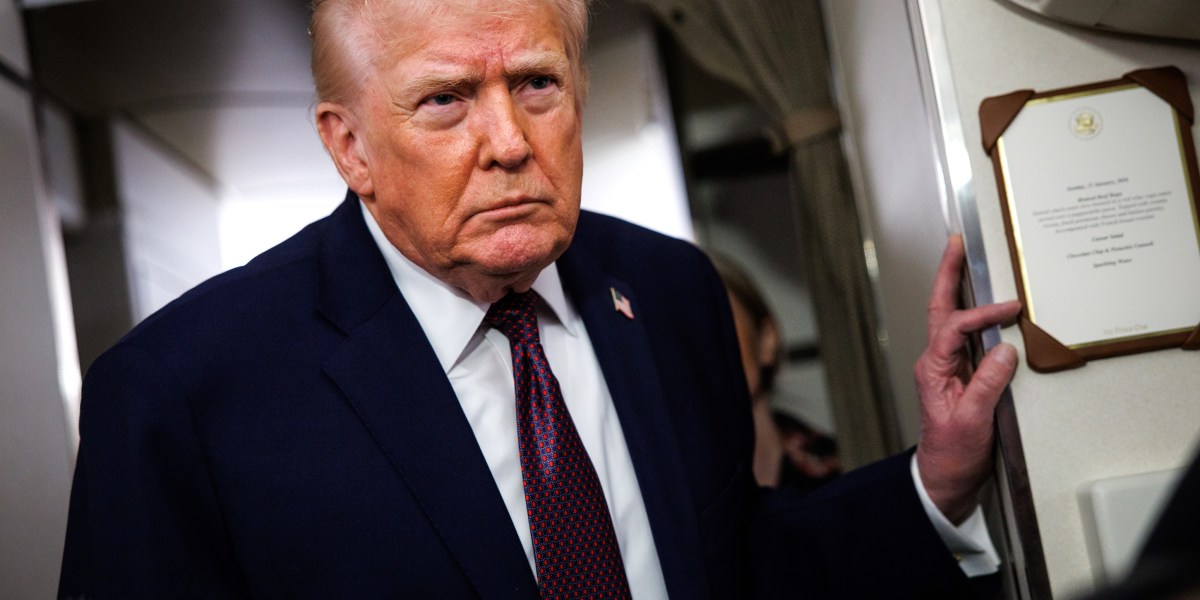
President Trump announced yesterday he would impose a new tariff of 25% on any country trading with Iran. He also predicted disaster if the U.S. Supreme Court were to rule his tariff orders are illegal. The president estimated that “many Hundreds of Billions of Dollars” or even “Trillions” were at stake if the government was forced to refund anyone who paid them.

“It would be a complete mess, and almost impossible for our Country to pay,” he said on Truth Social. “If the Supreme Court rules against the United States of America on this National Security bonanza, WE’RE SCREWED!”

The court could issue a ruling as soon as Wednesday. It had been expected to rule last week. It is not clear why the court is delaying.

But Wall Street analysts are increasingly sanguine about the ruling. As time goes by, many say, the tariff issue becomes less and less dramatic. And in the bigger macro picture, they’re less significant than predicted.

The longer the delay in the ruling the more likely it is because the court is leaning toward Trump, according to JPMorgan.

“Legal experts continue to expect the Supreme Court to rule against the use of emergency powers [under the International Emergency Economic Powers Act] to authorize tariffs, but note that each week the Supreme Court delays its decision increases the likelihood of the Trump administration prevailing,” JPMorgan analysts Amy Ho and Joyce Chang told their clients. “Historically, SCOTUS reserves its most impactful decisions for the end of its term in June, which allows for extended deliberation.” Both Supreme Court cases on the Affordable Care Act were pushed to June, they wrote.

The pair also note that in the underlying case, only $135 billion in potential tariff refunds are at stake. 

Although Trump has touted the tariffs as a method of paying off the $38 trillion national debt, the reality is that collections so far have been too small to have much of an affect, according to James Knightley, ING’s chief international economist in the U.S. “Since April, tariff revenues are up $206 billion in those eight months relative to [fiscal] 2024, but not all are the IEEPA tariffs—they are estimated to perhaps be $130 billion. Sounds a lot, but the US is a $30 trillion-plus economy,” he told Fortune in an email.

“Many companies will be wary of drawing the ire of the president by claiming a refund and the hoops to jump through to reclaim through the courts could be quite onerous and deter others. Hence the actual amount that is reclaimed may be quite a lot less than $130 billion.”

Besides, he said, even if Trump loses the Supreme Court case he will likely reimpose the tariffs via some other regulation. “Given tariffs are a signature policy and the Republican polling isn’t looking very strong right now ahead of the midterms, the Administration will move swiftly to reinstate tariffs through other legally recognized routes. The promise of a $2,000 tariff dividend needs to be paid for somehow. This is merely shuffling money around seeing as Americans paid the tariffs in the first place only to get money returned, so it is difficult to argue this will be a major stimulus for the economy,” he said.

Tariff revenue is being generated at a current rate of $30.4 billion per month, for an annualized rate of $364.5 billion, according to data from Bloomberg provided to Fortune via Pantheon Macroeconomics. However, those revenues are already in decline as companies find workarounds and as Trump himself cuts deals, compromises, or delays the imposition of harsher measures. 

Convera analyst Antonio Ruggiero is also unruffled by the upcoming ruling. If the tariffs are ruled illegal, “we expect the immediate [foreign currency exchange] reaction to be limited, as the broader consensus is that alternative mechanisms will be found to keep tariff revenues intact.”

“That said, in the medium term, we cannot exclude the possibility of mild bearish pressure on the dollar tied to expectations of further uncertainty and erratic trade manoeuvres should the administration be forced to remove such tariffs, particularly at a time when USD sentiment is increasingly fragile amid concerns over Federal Reserve independence,” he advised clients in an email seen by Fortune.

Here’s a snapshot of the markets ahead of the opening bell in New York this morning:

  • S&P 500 futures were down 0.15% this morning. The last session closed up 0.16%. 
  • STOXX Europe 600 was flat in early trading.
  • The U.K.’s FTSE 100 was up o.o5% in early trading. 
  • Japan’s Nikkei 225 was up 3.1%.
  • China’s CSI 300 was down o.6%. 
  • The South Korea KOSPI was up 1.47%. 
  • India’s NIFTY 50 was down 0.25%. 
  • Bitcoin was at $92K.


Source link

Continue Reading

Business

Fortune Article | Fortune

Published

on


The Trump administration’s criminal investigation of Federal Reserve Chair Jerome Powell appeared on Monday to be emboldening defenders of the U.S. central bank, who pushed back against President Donald Trump’s efforts to exert more control over the Fed.

The backlash reflected the overarching stakes in determining the balance of power within the federal government and the path of the U.S. economy at a time of uncertainty about inflation and a slowing job market. This has created a sense among some Republican lawmakers and leading economists that the Trump administration had overstepped the Fed’s independence by sending subpoenas.

The criminal investigation — a first for a sitting Fed chair — sparked an unusually robust response from Powell and a full-throated defense from three former Fed chairs, a group of top economic officials and even Republican senators tasked with voting on Trump’s eventual pick to replace Powell as Fed chair when his term expires in May.

White House press secretary Karoline Leavitt told reporters that Trump did not direct his Justice Department to investigate Powell, who has proven to be a foil for Trump by insisting on setting the Fed’s benchmark interest rates based on the data instead of the president’s wishes.

“One thing for sure, the president’s made it quite clear, is Jerome Powell is bad at his job,” Leavitt said. “As for whether or not Jerome Powell is a criminal, that’s an answer the Department of Justice is going to have to find out.”

Critics see Trump as trying to control the Fed

The investigation demonstrates the lengths the Trump administration is willing to go to try to assert control over the Fed, an independent agency that the president believes should follow his claims that inflationary pressures have faded enough for drastic rate cuts to occur. Trump has repeatedly used investigations — which might or might not lead to an actual indictment — to attack his political rivals.

The risks go far beyond Washington infighting to whether people can find work or afford their groceries. If the Fed errs in setting rates, inflation could surge or job losses could mount. Trump maintains that an economic boom is occurring and rates should be cut to pump more money into the economy, while Powell has taken a more cautious approach in the wake of Trump’s tariffs.

Several Republican senators have condemned the Department of Justice’s subpoenas of the Fed, which Powell revealed Sunday and characterized as “pretexts” to pressure him to sharply cut interest rates. Powell also said the Justice Department has threatened criminal indictments over his June testimony to Congress about the cost and design elements of a $2.5 billion building renovation that includes the Fed’s headquarters.

“After speaking with Chair Powell this morning, it’s clear the administration’s investigation is nothing more than an attempt at coercion,” said Sen. Lisa Murkowski, R-Alaska, on Monday.

Jeanine Pirro, U.S. attorney for the District of Columbia, said on social media that the Fed “ignored” her office’s outreach to discuss the renovation cost overruns, “necessitating the use of legal process — which is not a threat.”

“The word ‘indictment’ has come out of Mr. Powell’s mouth, no one else’s,” Pirro posted on X, although the subpoenas and the White House’s own statement about determining Powell’s criminality would suggest the risk of an indictment.

bipartisan group of former Fed chairs and top economists on Monday called the Trump administration’s investigation “an unprecedented attempt to use prosecutorial attacks” to undermine the Fed’s independence, stressing that central banks controlled by political leaders tend to produce higher inflation and lower growth.

“I think this is ham-handed, counter-productive, and going to set back the president’s cause,” said Jason Furman, an economist at Harvard and former top adviser to President Barack Obama. The investigation could also unify the Fed’s interest-rate setting committee in support of Powell, and means “the next Fed chair will be under more pressure to prove their independence.”

The subpoenas apply to Powell’s statements before a congressional committee about the renovation of Fed buildings, including its marble-clad headquarters in Washington. They come at an unusual moment when Trump was teasing the likelihood of announcing his nominee this month to succeed Powell as the Fed chair and could possibly be self-defeating for the nomination process.

While Powell’s term as chair ends in four months, he has a separate term as a Fed governor until January 2028, meaning that he could remain on the board. If Powell stays on the board, Trump could be blocked from appointing an outside candidate of his choice to be the chair.

Some Senate Republicans express doubts

Powell quickly found a growing number of defenders among Republicans in the Senate, who will have the choice of whether to confirm Trump’s planned pick for Fed chair.

Sen. Thom Tillis, a North Carolina Republican and member of the Senate Banking panel, said late Sunday that he would oppose any of the Trump administration’s Fed nominees until the investigation is “resolved.”

“If there were any remaining doubt whether advisers within the Trump Administration are actively pushing to end the independence of the Federal Reserve, there should now be none,” Tillis said.

Sen. Dave McCormick, R-Pa., said the Fed may have wasted public dollars with its renovation, but he said, “I do not think Chairman Powell is guilty of criminal activity.”

Senate Majority Leader John Thune offered a brief but stern response Monday about the tariffs as he arrived at the U.S. Capitol, suggesting that the administration needed “serious” evidence of wrongdoing to take such a significant step.

“I haven’t seen the case or whatever the allegations or charges are, but I would say they better, they better be real and they better be serious,” said Thune, a Republican representing South Dakota.

Powell could stay on the Fed board, possibly thwarting Trump

If Powell stays on the board after his term as chair ends, the Trump administration would be deprived of the chance to fill another seat that would give the administration a majority on the seven-member board. That majority could then enact significant reforms at the Fed and even block the appointment of presidents at the Fed’s 12 regional banks.

“They could do a lot of reorganizing and reforms” without having to pass new legislation, said Mark Spindel, chief investment officer at Potomac River Capital and author of a book on Fed independence. “That seat is very valuable.”

Powell has declined at several press conferences to answer questions about his plans to stay or leave the board.

Scott Alvarez, former general counsel at the Fed, says the investigation is intended to intimidate Powell from staying on the board. The probe is occurring now “to say to Chair Powell, ’We’ll use every mechanism that the administration has to make your life miserable unless you leave the Board in May,’” Alvarez said.

Asked on Monday by reporters if Powell planned to remain a Fed governor, Kevin Hassett, director of the White House National Economic Council and a leading candidate to become Fed chair, said he was unaware of Powell’s plans.

“I’ve not talked to Jay about that,” Hassett said.

A weaker Fed could mean a weaker economy

A bipartisan group of former Fed chairs and top economists said in their Monday letter that the administration’s legal actions and the possible loss of Fed independence could hurt the broader economy.

“This is how monetary policy is made in emerging markets with weak institutions, with highly negative consequences for inflation and the functioning of their economies more broadly,” the statement said.

The statement was signed by former Fed chairs Ben Bernanke, Janet Yellen, and Alan Greenspan, as well as former Treasury Secretaries Henry Paulson and Robert Rubin.

Still, Trump’s pressure campaign had been building for some time, with him relentlessly criticizing and belittling Powell.

He even appeared to preview the shocking news of the subpoenas at a Dec. 29 news conference by saying he would bring a lawsuit against Powell over the renovation costs.

“He’s just a very incompetent man,” Trump said. “But we’re going to probably bring a lawsuit against him.”

__

AP writers Lisa Mascaro and Joey Cappelletti contributed to this report.


Source link

Continue Reading

Business

Polygon Labs buys two crypto startups for $250 million as it looks to compete with Stripe

Published

on


The blockchain developer Polygon Labs has closed deals to buy the crypto startups Coinme and Sequence. The total purchase price for the two startups was for more than $250 million, but Polygon Labs declined to disclose how much it paid for each, or whether the deals were for cash, equity, or a mix of both. 

The acquisitions are meant to aid the blockchain network’s stablecoin strategy, said Polygon Labs CEO Marc Boiron and Polygon Foundation founder Sandeep Nailwal in an interview. The Seattle-based Coinme, which specializes in converting cash into crypto and is known for its work with crypto ATMs, has a suite of money transmitter licenses in the U.S. Meanwhile, New York-based Sequence builds out blockchain infrastructure, including crypto wallets.

Polygon Labs’ acquisitions of the two startups puts it in competition with the fintech giant Stripe, said Nailwal. Over the past year, the payments giant bought a stablecoin startup, a crypto wallet firm, and backed its own blockchain focused on payments. The Stripe acquisitions signalled an intention to own every layer of the stablecoin stack, from the servers that process payments to the accounts where users hold crypto. 

“It’s a reverse Stripe in a way,” Nailwal said of Polygon’s stablecoin play. Stripe first acquired its stablecoin startups and then built out its own blockchain. In contrast, Polygon already has a longstanding network of blockchains, and it’s bringing on startups to build on top of it. “Polygon Labs is becoming a full-blown fintech company,” said Nailwal.

Stablecoin shift

The push from Polygon Labs into payments comes amid a wave of hype for stablecoins, or cryptocurrencies that are pegged to real-world assets like the U.S. dollar. Especially after President Donald Trump signed into law in July a new bill regulating the tokens, fintechs, tech companies, and even banks have said they’ll launch their own stablecoins, which proponents say are an upgrade over decades-old financial infrastructure.

Polygon Labs, whose blockchain network sits on top of Ethereum, is aiming to ride this wave of enthusiasm. Best known for its prominence during the NFT boom of 2021 and 2022, Polygon has made significant investments in payments over the past year, even poaching Stripe’s head of crypto, John Egan. 

The deal for Coinme, its latest payments play, was for between $100 and $125 million, reported CoinDesk, which implies that the price for  Sequence was somewhere between $125 and $150 million. But Boiron, the CEO of Polygon Labs, pushed back on the reporting. “Almost everything that CoinDesk wrote in that article is wrong,” he said.

He also said he wasn’t worried about Coinme’s legal struggles. In 2025, regulators in California and Washington targeted the crypto company for violations that included a failure to stop customers from taking out more than $1,000 in a day from the firm’s affiliated crypto ATMs. Washington regulators agreed to stay a cease-and-desist order against Coinme a month after going after the startup. 

“I think they go far beyond what is required,” said Boiron, in reference to Coinme’s compliance regime. “On the back end, the way that they handle being able to limit risk to users, I think is state of the art.”


Source link

Continue Reading

Business

Anthropic launches Cowork, a file-managing AI agent that could threaten dozens of startups

Published

on


Anthropic has launched Claude Cowor, a general-purpose AI agent that can manipulate, read, and analyze files on a user’s computer, as well as create new files. The tool is currently available as a “research preview” only to Max subscribers on $100 or $200 per month plans.

The tool, which the company describes as “Claude Code for the rest of your work,” leverages the abilities of Anthropic’s popular Claude Code software development assistant but is designed for non-technical users as opposed to programmers.

Many have pointed out that Claude Code is already more of a general-use agent than a developer-specific tool. It is capable of spinning up apps that perform functions for users across other software. But non-developers have been put off by Claude Code’s name and also the fact that Claude Code needs to be used with a coding-specific interface.

Some of the use cases Anthropic showcased for Claude Cowork include reorganizing downloads, turning receipt screenshots into expense spreadsheets, and producing first drafts from notes across a user’s desktop. Anthropic has described the tool, which can work autonomously, as “less like a back-and-forth and more like leaving messages for a coworker.”

Anthropic reportedly built Cowork in approximately a week and a half, largely using Claude Code itself, according to the head of Claude Code, Boris Cherny.

“This is a general agent that looks well positioned to bring the wildly powerful capabilities of Claude Code to a wider audience,” Simon Willison, a UK-based programmer, wrote of the tool. “I would be very surprised if Gemini and OpenAI don’t follow suit with their own offerings in this category.”

Enterprise AI race

With Cowork, Anthropic is now competing more directly with tools like Microsoft’s Copilot for the enterprise productivity market. The company’s strategy of starting with a developer-focused agent and then making it accessible to everyone else could give it an edge, as Cowork will inherit the already-proven capabilities of Claude Code rather than being built as a consumer assistant from scratch. This approach could make Anthropic—which is already reportedly outpacing rival OpenAI in enterprise adoption—an increasingly attractive option for businesses looking for AI tools that can handle work autonomously.

Like any other AI agent, Claude Cowork comes with security risks, particularly around “prompt injections,” where attackers trick LLMs into changing course by inserting malicious, hidden instructions into webpages, images, links, or any content found on the open web. Anthropic addressed the issue directly in the announcement, warning users about the risks and offering advice such as limiting access to trusted sites when using the Claude in Chrome extension.

The company, however, acknowledged the tool was still vulnerable to these attacks, despite Anthropic’s defenses: “We’ve built sophisticated defenses against prompt injections, but agent safety—that is, the task of securing Claude’s real-world actions—is still an active area of development in the industry…We recommend taking precautions, particularly while you learn how it works.”

The launch has also sparked concern among startup founders about the competitive threat posed by major AI labs bundling agent capabilities into their core products. Cowork’s ability to handle file organization, document generation, and data extraction overlaps with dozens of AI startups that have raised funding to solve these specific problems.

For startups building applications on top of models from major AI companies, the concern about foundational AI labs building a similar functionality as part of their base product is a common one. In response to these concerns, many startups have argued that companies with deep domain expertise or a better user experience for specific workflows may still maintain defensible positions in the market.


Source link

Continue Reading

Trending

Copyright © Miami Select.