Connect with us

Business

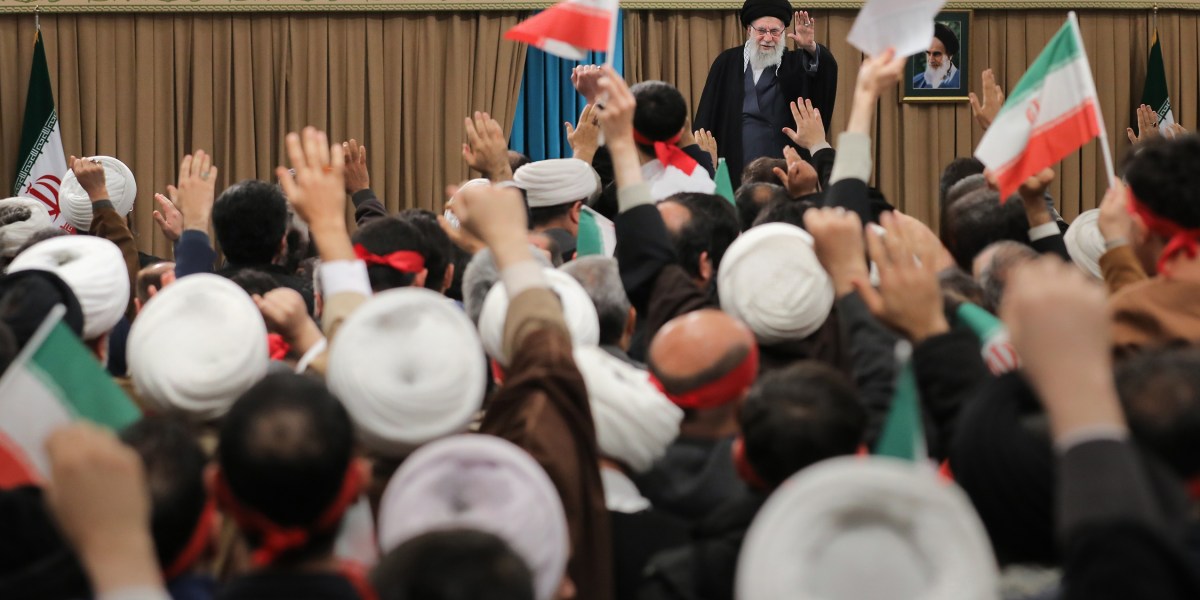
Iran edges closer to a revolution that would reshape the world

Published

on


As protesters pour into the streets of Iran night after night, leaders across the region and around the world are grappling with the possibility that the Islamic Republic could be overthrown — a seminal event that would transform global geopolitics and energy markets.

The regime of Supreme Leader Ayatollah Ali Khamenei has weathered bouts of protests many times, but demonstrations that began two weeks ago are spreading — by some accounts, hundreds of thousands of people defied authorities’ threats and a brutal crackdown to take to the streets over the weekend, from the capital Tehran to dozens of other cities across the nation of 90 million. They are being cheered on by President Donald Trump, fresh off the capture of Venezuela’s Nicolas Maduro, and the US leader has in recent days repeatedly threatened to strike Iran, suggesting that America is back in the regime change business.

World leaders and investors are watching closely. US commanders have briefed Trump on options for military strikes, according to a White House official. Brent crude surged more than 5% on Thursday and Friday to over $63 a barrel as investors priced in the possibility of supply disruptions in OPEC’s fourth-biggest producer.

“This is the biggest moment in Iran since 1979,” said William Usher, a former senior Middle East analyst at the Central Intelligence Agency, referring to the revolution that birthed the Islamic Republic, upended the balance of power in the region and led to decades of rancor between Tehran and the US and its allies. “The regime is in a very tough spot right now and the primary driver is the economy. I think they have a narrowing window to reassert control and a diminished toolset to do it.”

More than 500 protesters have been killed in the past two weeks, according to the AP, citing the US-based Human Rights Activists News Agency, and more than 10,000 have been arrested in demonstrations triggered by a currency crisis and economic collapse, but now also focused on the regime.

Authorities have tried to block the internet and telephone networks since Thursday, as they seek to quell Iranians’ growing outrage over government corruption, economic mismanagement and repression. Foreign airlines have canceled flights to the country.

Trump’s repeated warnings to Iran that the US will strike if it kills peaceful protesters come as the president escalates his assault on the post-World War II global order in a stunning assertion of American power that’s included claiming Venezuela’s oil after seizing Maduro, and threatening to take over Greenland from NATO ally Denmark.

Israel, which battered Iran during a US-assisted 12-day air war in June, is liaising closely with European governments about the situation on the ground, according to a senior European official, who asked not to be named discussing private talks. 

If the regime does fall, it would be a blow to Russian President Vladimir Putin, who would lose another foreign ally after Maduro this month and the overthrow of Syria’s Bashar al-Assad just over a year ago, the official added.

The stakes for oil traders are significant. But it’s unclear if Khuzestan, the main oil-pumping province, has seen unrest and so far there are no signs of reduced crude exports. On Saturday, Reza Pahlavi, the son of the former shah who’s exiled in the US and positioning himself as an opposition leader, urged petroleum workers to strike. Oil strikes in 1978 were one of the death knells of his father’s monarchy because of how they immediately hit the economy.

The market’s “focus has now shifted to Iran,” said Arne Lohmann Rasmussen, chief analyst at A/S Global Risk Management, which helps clients manage volatility in energy markets. “There is also growing concern in the market that the US, with Trump at the helm, could exploit the chaos to attempt to overthrow the regime, as we have seen in Venezuela.”

The White House is on a high after the tactical success of the operation against Maduro, as well as Trump’s decision to bomb Iranian nuclear facilities at the end of the 12-day war. American officials are also increasing pressure on Denmark to cede control of Greenland, signaling the administration has the appetite for more forays abroad.

Read More: Trump’s Ousting of Maduro Shows His New World Order Is Here

Trump may well be tempted, for all the risks, to try to topple a government that’s been an archenemy to the US and Israel for over 45 years. 

“The balance of power would change dramatically,” Mark Mobius, the veteran emerging markets investor, said of the downfall of the Islamic Republic. “The best outcome would be a complete change in the government. The worst outcome would be continued internal conflict and a continuing rule by the current regime.”

Trump at times ran against American adventurism in the region, where the ousting of longtime US enemy Saddam Hussein in Iraq unleashed a generation of chaos and terrorism, costing hundreds of thousands of lives and trillions of dollars.

It’s just that kind of potential power vacuum that’s worrying Arab leaders in the Gulf Cooperation Council, according to regional officials. While the group — which includes Saudi Arabia, the United Arab Emirates and Qatar — has often viewed Iran as an adversary, its members have sought to improve ties in recent years to ensure Tehran doesn’t lash out against any Israeli or US military action by attacking them. The specter of the Arab Spring, where dictators fell across the region only for chaos to follow, looms large.

Iran has warned that if it’s attacked, American assets in the region — where it has deep commercial ties and tens of thousands of troops stationed — and Israel will be “legitimate targets for us.”

Read More: How Sanctions and a Currency Crash Fueled Iran Unrest

The Islamic Republic has been severely weakened in the past two years, thanks to its stagnating economy, rampant inflation and Israel striking both it and its proxies. But it retains a large and sophisticated arsenal of ballistic missiles able to hit targets across the Middle East, from military bases to oil installations, and the regime still has the backing of the country’s myriad security forces, including the all-important Islamic Revolutionary Guard Corps.

For the GCC and the likes of Turkey and Pakistan, the worst outcome would be chaos in Iran, said Ellie Geranmayeh, deputy program director for the Middle East and North Africa at the European Council on Foreign Relations. It’s an eventuality made more possible by the sheer diversity of Iranian protesters, who include everyone from urban, secular elites to religious conservatives and lack a unifying leader.

“With the GCC reconciliation of the past few years with Tehran, there’s a sense of better the devil you know rather than complete chaos or an unknown power structure that is alien to them,” said Geranmayeh.

US and Israeli strikes might even strengthen the government and reduce the appeal of the protest movement. In June, there was a surge in nationalism as the Jewish state and Washington rained down bombs.

The Islamic Republic probably won’t survive in its current form by the end of 2026, according to Dina Esfandiary, a Middle East analyst at Bloomberg Economics. The most likely scenario, she said, is a leadership reshuffle that largely preserves the system or a coup by the IRGC, which could mean greater social freedom — the organization is run by generals rather than clerics — but less political liberty and a more militaristic foreign policy.

The chances of a revolution are still fairly low, she said.

“A collapse appears unlikely for now,” she said. “Iranians are frightened of chaos, having seen it wreak havoc in neighboring Iraq and Syria. More importantly, the government is cracking down hard.”

On Sunday, President Masoud Pezeshkian, a former heart surgeon and a moderate relative to others at the top of the Iranian government, struck a conciliatory note, offering condolences to families affected by the “tragic consequences.”

“Let’s sit down together, hand in hand, and solve the problems,” he said on state TV.

It’s unlikely many protesters will believe him. The supreme leader, a much more powerful figure, as well as members of the security forces, are increasingly bellicose, floating the death penalty and making clear they’re prepared to respond as they always have — with brutal force.

“I don’t think a collapse of the regime would be pretty,” said Usher, the former CIA analyst. “Short-term, I could imagine some fracturing of the country as ethnic minority groups and some provinces pursue autonomy from Tehran. The IRGC will fight vigorously to save the regime so I think there’d be strong possibility for large-scale violence.”


Source link

Continue Reading

Business

Reference to Trump’s impeachments is removed from Smithsonian portrait display

Published

on


President Donald Trump’s photo portrait display at the Smithsonian’s National Portrait Gallery has had references to his two impeachments removed, the latest apparent change at the collection of museums he has accused of bias as he asserts his influence over how official presentations document U.S. history.

The wall text, which summarized Trump’s first presidency and noted his 2024 comeback victory, was part of the museum’s “American Presidents” exhibition. The description had been placed alongside a photograph of Trump taken during his first term. Now, a different photo appears without any accompanying text block, though the text was available online. Trump was the only president whose display in the gallery, as seen Sunday, did not include any extended text.

The White House did not say whether it sought any changes. Nor did a Smithsonian statement in response to Associated Press questions. But Trump ordered in August that Smithsonian officials review all exhibits before the nation celebrates the 250th anniversary of the Declaration of Independence on July 4. The Republican administration said the effort would “ensure alignment with the president’s directive to celebrate American exceptionalism, remove divisive or partisan narratives, and restore confidence in our shared cultural institutions.”

Trump’s original “portrait label,” as the Smithsonian calls it, notes Trump’s Supreme Court nominations and his administration’s development of COVID-19 vaccines. That section concludes: “Impeached twice, on charges of abuse of power and incitement of insurrection after supporters attacked the U.S. Capitol on January 6, 2021, he was acquitted by the Senate in both trials.”

Then the text continues: “After losing to Joe Biden in 2020, Trump mounted a historic comeback in the 2024 election. He is the only president aside from Grover Cleveland (1837– 1908) to have won a nonconsecutive second term.”

Asked about the display, White House spokesman Davis Ingle celebrated the new photograph, which shows Trump, brow furrowed, leaning over his Oval Office desk. Ingle said it ensures Trump’s “unmatched aura … will be felt throughout the halls of the National Portrait Gallery.”

The portrait was taken by White House photographer Daniel Torok, who is credited in the display that includes medallions noting Trump is the 45th and 47th president. Similar numerical medallions appear alongside other presidents’ painted portraits that also include the more extended biographical summaries such as what had been part of Trump’s display.

Sitting presidents are represented by photographs until their official paintings are commissioned and completed.

Ingle did not answer questions about whether Trump or a White House aide, on his behalf, asked for anything related to the portrait label.

The gallery said in a statement that it had previously rotated two photographs of Trump from its collection before putting up Torok’s work.

“The museum is beginning its planned update of the America’s Presidents gallery which will undergo a larger refresh this Spring,” the gallery statement said. “For some new exhibitions and displays, the museum has been exploring quotes or tombstone labels, which provide only general information, such as the artist’s name.”

For now, references to Presidents Andrew Johnson and Bill Clinton being impeached in 1868 and 1998, respectively, remain as part of their portrait labels, as does President Richard Nixon’s 1974 resignation as a result of the Watergate scandal.

And, the gallery statement noted, “The history of Presidential impeachments continues to be represented in our museums, including the National Museum of American History.”

Trump has made clear his intentions to shape how the federal government documents U.S. history and culture. He has offered an especially harsh assessment of how the Smithsonian and other museums have featured chattel slavery as a seminal variable in the nation’s development but also taken steps to reshape how he and his contemporary rivals are depicted.

In the months before his order for a Smithsonian review, he fired the head archivist of the National Archives and said he was firing the National Portrait Gallery’s director, Kim Sajet, as part of his overhaul. Sajet maintained the backing of the Smithsonian’s governing board, but she ultimately resigned.

At the White House, Trump has designed a notably partisan and subjective “Presidential Walk of Fame” featuring gilded photographs of himself and his predecessors — with the exception of Biden, who is represented by an autopen — along with plaques describing their presidencies.

The White House said at the time that Trump himself was a primary author of the plaques. Notably, Trump’s two plaques praise the 45th and 47th president as a historically successful figure while those under Biden’s autopen stand-in describe the 46th executive as “by far, the worst President in American History” who “brought our Nation to the brink of destruction.”


Source link

Continue Reading

Business

Powell says DOJ criminal probe is attack on Fed’s independence to set rates

Published

on


Federal Reserve Chairman Jerome Powell called out the Trump administration for attacking the central bank’s independence, saying a criminal probe is due to the Fed’s refusal to lower rates earlier this year as President Donald Trump demanded.

He said in a statement Sunday that the Justice Department of served the Fed with grand jury subpoenas, threatening a criminal indictment over his testimony before the Senate last June related to renovations on the headquarters, which has seen cost overruns.

Powell, who is typically cautious in his public remarks, was clear that the probe was political in nature and had nothing to do with the Fed renovations or his testimony, calling them “pretexts.”

“The threat of criminal charges is a consequence of the Federal Reserve setting interest rates based on our best assessment of what will serve the public, rather than following the preferences of the President,” he wrote.

“This is about whether the Fed will be able to continue to set interest rates based on evidence and economic conditions—or whether instead monetary policy will be directed by political pressure or intimidation.”

Powell added that he has served under Republican and Democratic presidents “without political fear or favor,” while focusing on the Fed’s dual mandate of price stability and maximum employment.

“Public service sometimes requires standing firm in the face of threats,” he said. “I will continue to do the job the Senate confirmed me to do, with integrity and a commitment to serving the American people.”

Join us at the Fortune Workplace Innovation Summit May 19–20, 2026, in Atlanta. The next era of workplace innovation is here—and the old playbook is being rewritten. At this exclusive, high-energy event, the world’s most innovative leaders will convene to explore how AI, humanity, and strategy converge to redefine, again, the future of work. Register now.


Source link

Continue Reading

Business

Oil prices rise as Iran crackdown suggests Tehran fears a ‘dire security threat to the regime’

Published

on


Crude oil futures pointed to continued gains on Sunday as markets weighed potentially transformative events in Iran, which has been wracked by protests across the country.

U.S. oil prices rose 0.56% to $59.45 a barrel, and Brent crude climbed 0.52% to $63.67 a barrel, as reports said President Donald Trump is weighing military options in Iran to follow through on his threats to attack if the government kills protestors.

Iran, which pumps 3 million-4 million barrels per day, has seen protests spread nationwide amid an economic crisis. Human rights groups estimate hundreds have died from the government’s crackdown, as the regime’s piecemeal attempts to appease Iranians have failed.

The government cut off internet access in the country last week, slowing the flow of information on the latest developments. But various reports and expert assessments indicate the unrest is posing a major threat to Tehran’s authority.

In particular, the security apparatus that keeps the leadership in power is showing cracks, according to the Institute for the Study of War (ISW).

“There are further indications that the ongoing protests are challenging the ability and willingness of Iranian security forces to crack down on the protests,” the think tank said in a recent report. “The IRGC Intelligence Organization released a statement on January 10 that it is ‘dealing with possible acts of abandonment.’ This statement suggests that some Iranian security forces may have already defected or that the regime is very concerned about this possibility.”

It cited additional reporting that pointed to some officers anticipating the regime’s collapse, forces in one city refusing to fire on protesters, and the possibility the government will deploy the regular army.

These rank-and-file troops, known as the Artesh, are less ideological and more representative of the Iranian population than the Islamic Revolutionary Guard Corps, ISW said. That raises the risk Artesh troops, who aren’t trained to handle civil unrest, could defect and indicates internal security forces are stretched thin, it added.

A separate analysis from ISW noted that the government is treating the protests as a military issue instead of a law enforcement one. It also said Tehran “has taken the rare step of using the IRGC Ground Forces to suppress protests because it has likely determined that these protests represent a dire security threat to the regime.”

Energy markets are digesting the implications of political upheaval in Iran, a top OPEC member with the world’s third largest proven oil reserves. In fact, anti-government protests have already spread to Iran’s oil sector with workers at a large refining and petrochemical complex going on strike.

Market tracker Kpler said in post on X on Saturday that Iran’s regime faces a tipping point and is under unprecedented strain.

“Though a full collapse remains a low-probability event, the rising risk is already lifting the geopolitical premium in oil markets. Any disruption—through factional conflict, export curbs or external intervention—could prompt near-term price spikes, despite global surpluses,” it added.

“Over the medium term, regime change could unlock sanctions relief and reshape trade flows, with European, Indian and Japanese refiners poised to benefit, while Chinese independents and Middle Eastern producers face stiffer competition.”


Source link

Continue Reading

Trending

Copyright © Miami Select.