Connect with us

Business

From Merrill Lynch to wok station: the daughter of San Francisco’s Chinese food dynasty who defied her parents—by working alongside them
Published

on


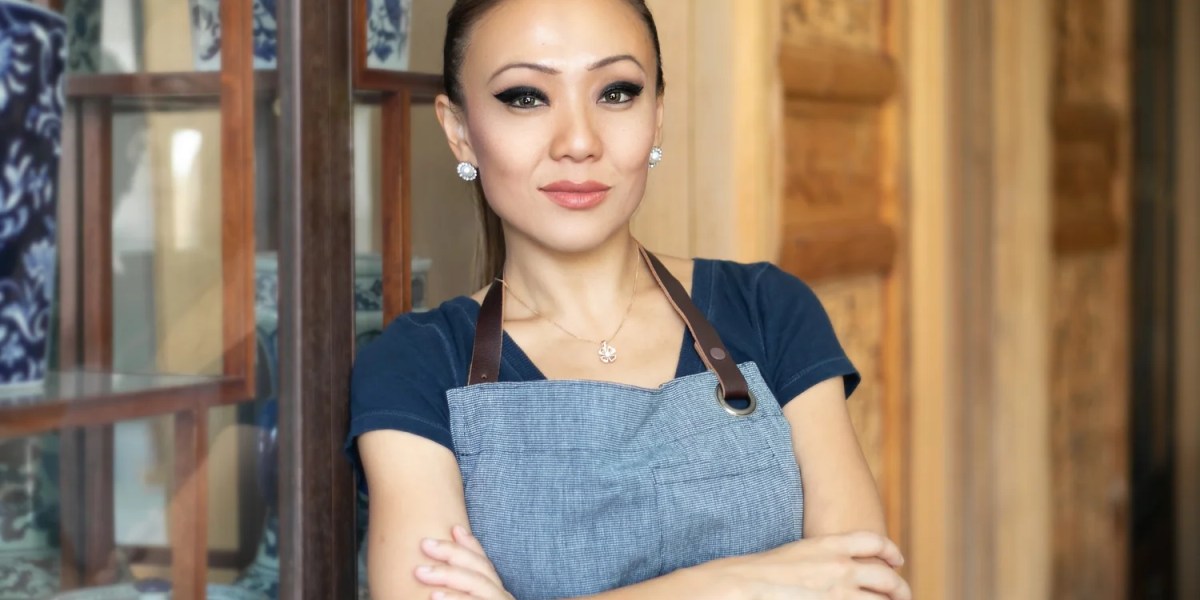
For decades, the crowds outside House of Nanking have been a fixture of San Francisco’s Chinatown, with lines frequently wrapping around the block to get a seat in the cramped, high-energy dining room, under the iconic, multicolored sign that crowns Kearny Street. But for Kathy Fang, the restaurant’s heir apparent, her presence in that kitchen represents a sharp deviation from the “American Dream” her parents envisioned for her—a deviation that initially caused them deep dismay.

Peter Fang, the restaurant’s legendary patriarch, and his wife did not build House of Nanking so their daughter could inherit it, Kathy Fang told Fortune in a recent interview. To them, cooking was a necessity born of survival, not a career choice for the educated. “For my parents being very traditional, they also didn’t want me to do it,” she explained. “In fact, we have a saying that, you know, if you don’t cut it in school, you can always go be a cook because it’s considered manual labor. You don’t need to have a proper education to go work in a kitchen.”

Her parents don’t know about “foodie” culture, she explained, and don’t even know how famous they’ve become. Speaking to Fortune as she releases the first-ever cookbook dedicated to her family’s restaurant, she said even that was a struggle.

“It took me decades,” she said about convincing her father to go along with it. “He thought that if he shared his recipes, people would just make it at home and not come to the restaurant anymore.” He didn’t understand his restaurant is a San Francisco institution, frequented by the likes of Francis Ford Coppola and Keanu Reeves, celebrities that her father wouldn’t—and didn’t—recognize anyway.

The House of Nanking on Kearny Street is a legendary eating institution that often has long lines of hungry diners hoping for a table. Renowned as much for it’s surly service as the food, it is worth the wait. Taken in San Francisco’s Chinatown.

Michael Robinson Chavez/Los Angeles Times via Getty Images

Fang, who recently turned 40, shared Reeves was her favorite actor since high school, and the first time he visited her family’s restaurant, she begged her father not to make him wait in the queue stretching around the block, as it does every night. His response was that “everybody waits in line,” until she promised to get straight A’s, and he relented. What happened next summed everything up.

“[My dad] walks up to him and says something to him. Then looks at me and goes, ‘Kathy, come over, take a picture with him. It’s Sean Connery.’ And I’m like, ‘Oh, my God. My dad doesn’t know anybody, but he’s heard of Sean Connery.” Reeves, who is famously polite and good-hearted, told the Fangs that he was “really flattered.”

“We took a picture that day and that picture sits on the wall at the restaurant,” Fang said, happily. “But the story is that nobody there knows any of the famous people who go in.” As a born and raised Californian, she would know all the celebrities, she added, but she’s always busy, running her own restaurant, Fang, in the SoMa business district, which is about a 20-minute walk away. Fang and Reeves recreated the photo 29 years later, as shown by the House of Nanking’s Instagram.

Kathy Fang is a busy businesswoman. Besides running her Fang restaurant and releasing a cookbook, she is a Food Network star as a two-time Chopped champion and a cast member of Chef Dynasty: House of Fang.” San Francisco Magazine even crowned her as a “culinary queen,” and she’s the mother of two children with her husband who, she notes, doesn’t even like Chinese food. She talked to Fortune about how she disappointed her parents by failing to become a doctor or lawyer—and finally found out how proud they were of her through her reality TV side hustle.

A calling to a crowded kitchen

Like many immigrants to the U.S. (the Fangs moved to San Francisco from the Shanghai area), the Fangs pushed Kathy toward a stable, prestigious future.

“They wanted me to be a doctor or a lawyer [or] go into the corporate world,” she said. She dutifully followed this path to the University of Southern California as a pre-med student, only to discover that, while she had no fear of cooking oil in a giant wok, she had no stomach for medicine.

“I realized I was terrified of needles, like irked by hospitals,” she said. “That would be a problem. Yeah, I still to this day cannot see a needle go into an arm.”

She subsequently landed in the corporate world, working at Fortune 100 company Johnson & Johnson and Wall Street stalwart Merrill Lynch. But the corporate environment left her feeling uninspired. When she finally called her father to announce she was quitting her job to return to the family restaurant, he was befuddled and upset. “He’s like, ‘Why, did you get fired or something?’” Kathy recalled, and she responded: “No, I just really don’t like what I’m doing and I love food, I love cooking and I like miss that kind of environment.”

The environment she missed is one of organized chaos and high-pressure efficiency. While she declined to disclose financials, and acknowledged Fang had struggled more during the pandemic (as many restaurants did), she acknowledged her family’s restaurant is a “cash cow” that has served an estimated 5 million to 6 million people over its 38 years in business, quite a feat considering the tiny footprint.

“That’s tough when you think about how big the restaurant was when they first got started,” she said, noting it could only seat 30 to 40 people for its first decade in business. “And the kitchen can only fit about two to three people.” It’s since doubled the size of its dining room, but “the kitchen hasn’t changed at all. It’s just kind of wild.”

A business career to be proud of

Kathy’s return marked a turning point for the brand. While Peter Fang had built the restaurant’s reputation through culinary ingenuity, the family was media-shy, unlike their telegenic, media-savvy daughter. She said she was approached to try food television, and she sees it as something that allowed her to share her family’s story.

“I felt like I was kind of helping build this brand that my parents already built,” she said. “Everybody knows House of Nanking, but they’d never done anything with it. They’d never done any marketing, never done any PR around it.”

Her involvement proved to her father the business could be multigenerational, easing his fears the restaurant would die when he could no longer work.

“My dad now knows that this is something that can continue down generations,” Kathy notes, adding he even looks at his 8-year-old granddaughter as a potential future successor.

Fang said strangers and customers at the restaurant have come up to her and said, “your dad’s so proud of you,” and about three years ago, she recalled, during filming for the Chef Dynasty show, her dad said during a green-room recap interview, “I’m just very proud.” But she’s never heard it directly from him. “My dad will never tell me, and that’s a very Chinese thing, they just, they’ll never compliment you to your face.”
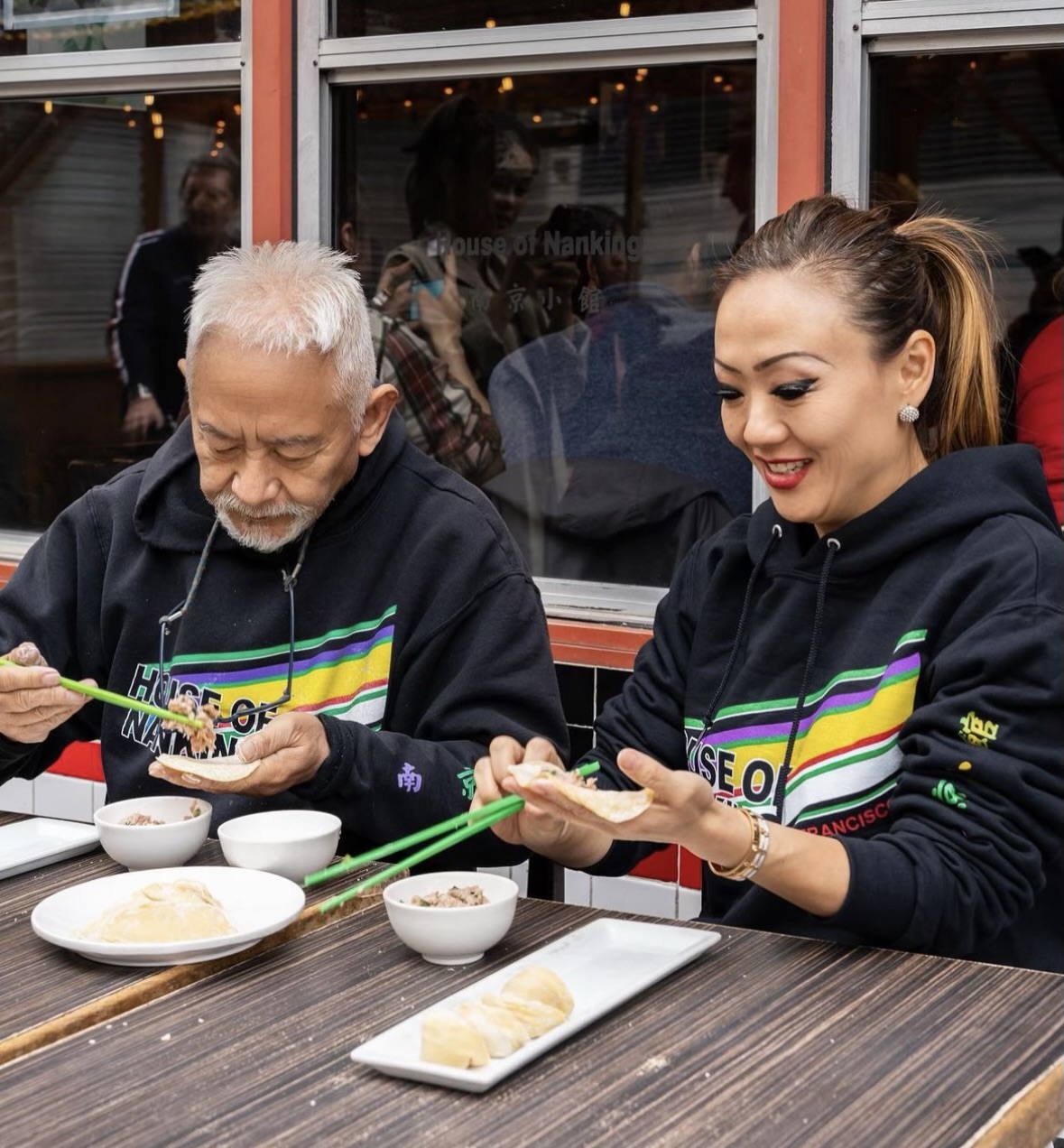
The restaurateur shared that one of her big jobs now is managing her parents’ workload. Now in their mid-70s, they still both work the lunch and dinner shifts every single day. The thing is, Fang noted, the 18-month hiatus during the pandemic revealed that retirement might not be an option; during the lockdown, Kathy’s mother, restaurant co-founder Lily, developed health issues from no longer being on her feet all day, and her father actually went totally silent.

“My dad lost his voice because he was using it every day that the vocal cords became weak,” Kathy said. “It’s like wild… As soon as he got back to work and started using his voice again, it came back.”

She said there’s no plan for them to slow down anytime soon. “They like the routine. Staying at home is not good for them. They also, because they work every day, have never developed any hobbies or made any friends,” she said with a laugh.

There aren’t plans to further expand, either. Kathy said she respects her father’s wish to keep the business small and Chinatown-bound, waving off talk of any kind of nationwide expansion.

“I’m not going to do it if my dad doesn’t want to,” she said. “It would kind of lose that essence and soul to it.”


Source link

Continue Reading

Business

Allegiant to acquire Sun Country in deal valued at $1.5 billion

Published

on


Allegiant Travel Co. will acquire Sun Country Airlines Holdings Inc. in a cash-and-stock deal valued at $1.5 billion including Sun Country’s debt, the two carriers said in a joint statement on Sunday. 

Sun Country’s shareholders will receive 0.1557 shares of Allegiant common stock and $4.10 in cash per Sun Country share, the companies said. The offer represents a premium of 19.8% over Sun Country’s closing share price on Friday, according to the statement.

The combined entity will provide more than 650 routes, including 18 international destinations in Mexico, Canada, the Caribbean and Central America, the companies said.  

“Together, our complementary networks will expand our reach to more vacation destinations including international locations,” said Allegiant Chief Executive Officer Gregory C. Anderson in a statement. 

Join us at the Fortune Workplace Innovation Summit May 19–20, 2026, in Atlanta. The next era of workplace innovation is here—and the old playbook is being rewritten. At this exclusive, high-energy event, the world’s most innovative leaders will convene to explore how AI, humanity, and strategy converge to redefine, again, the future of work. Register now.


Source link

Continue Reading

Business

Iran edges closer to a revolution that would reshape the world

Published

on


As protesters pour into the streets of Iran night after night, leaders across the region and around the world are grappling with the possibility that the Islamic Republic could be overthrown — a seminal event that would transform global geopolitics and energy markets.

The regime of Supreme Leader Ayatollah Ali Khamenei has weathered bouts of protests many times, but demonstrations that began two weeks ago are spreading — by some accounts, hundreds of thousands of people defied authorities’ threats and a brutal crackdown to take to the streets over the weekend, from the capital Tehran to dozens of other cities across the nation of 90 million. They are being cheered on by President Donald Trump, fresh off the capture of Venezuela’s Nicolas Maduro, and the US leader has in recent days repeatedly threatened to strike Iran, suggesting that America is back in the regime change business.

World leaders and investors are watching closely. US commanders have briefed Trump on options for military strikes, according to a White House official. Brent crude surged more than 5% on Thursday and Friday to over $63 a barrel as investors priced in the possibility of supply disruptions in OPEC’s fourth-biggest producer.

“This is the biggest moment in Iran since 1979,” said William Usher, a former senior Middle East analyst at the Central Intelligence Agency, referring to the revolution that birthed the Islamic Republic, upended the balance of power in the region and led to decades of rancor between Tehran and the US and its allies. “The regime is in a very tough spot right now and the primary driver is the economy. I think they have a narrowing window to reassert control and a diminished toolset to do it.”

More than 500 protesters have been killed in the past two weeks, according to the AP, citing the US-based Human Rights Activists News Agency, and more than 10,000 have been arrested in demonstrations triggered by a currency crisis and economic collapse, but now also focused on the regime.

Authorities have tried to block the internet and telephone networks since Thursday, as they seek to quell Iranians’ growing outrage over government corruption, economic mismanagement and repression. Foreign airlines have canceled flights to the country.

Trump’s repeated warnings to Iran that the US will strike if it kills peaceful protesters come as the president escalates his assault on the post-World War II global order in a stunning assertion of American power that’s included claiming Venezuela’s oil after seizing Maduro, and threatening to take over Greenland from NATO ally Denmark.

Israel, which battered Iran during a US-assisted 12-day air war in June, is liaising closely with European governments about the situation on the ground, according to a senior European official, who asked not to be named discussing private talks. 

If the regime does fall, it would be a blow to Russian President Vladimir Putin, who would lose another foreign ally after Maduro this month and the overthrow of Syria’s Bashar al-Assad just over a year ago, the official added.

The stakes for oil traders are significant. But it’s unclear if Khuzestan, the main oil-pumping province, has seen unrest and so far there are no signs of reduced crude exports. On Saturday, Reza Pahlavi, the son of the former shah who’s exiled in the US and positioning himself as an opposition leader, urged petroleum workers to strike. Oil strikes in 1978 were one of the death knells of his father’s monarchy because of how they immediately hit the economy.

The market’s “focus has now shifted to Iran,” said Arne Lohmann Rasmussen, chief analyst at A/S Global Risk Management, which helps clients manage volatility in energy markets. “There is also growing concern in the market that the US, with Trump at the helm, could exploit the chaos to attempt to overthrow the regime, as we have seen in Venezuela.”

The White House is on a high after the tactical success of the operation against Maduro, as well as Trump’s decision to bomb Iranian nuclear facilities at the end of the 12-day war. American officials are also increasing pressure on Denmark to cede control of Greenland, signaling the administration has the appetite for more forays abroad.

Read More: Trump’s Ousting of Maduro Shows His New World Order Is Here

Trump may well be tempted, for all the risks, to try to topple a government that’s been an archenemy to the US and Israel for over 45 years. 

“The balance of power would change dramatically,” Mark Mobius, the veteran emerging markets investor, said of the downfall of the Islamic Republic. “The best outcome would be a complete change in the government. The worst outcome would be continued internal conflict and a continuing rule by the current regime.”

Trump at times ran against American adventurism in the region, where the ousting of longtime US enemy Saddam Hussein in Iraq unleashed a generation of chaos and terrorism, costing hundreds of thousands of lives and trillions of dollars.

It’s just that kind of potential power vacuum that’s worrying Arab leaders in the Gulf Cooperation Council, according to regional officials. While the group — which includes Saudi Arabia, the United Arab Emirates and Qatar — has often viewed Iran as an adversary, its members have sought to improve ties in recent years to ensure Tehran doesn’t lash out against any Israeli or US military action by attacking them. The specter of the Arab Spring, where dictators fell across the region only for chaos to follow, looms large.

Iran has warned that if it’s attacked, American assets in the region — where it has deep commercial ties and tens of thousands of troops stationed — and Israel will be “legitimate targets for us.”

Read More: How Sanctions and a Currency Crash Fueled Iran Unrest

The Islamic Republic has been severely weakened in the past two years, thanks to its stagnating economy, rampant inflation and Israel striking both it and its proxies. But it retains a large and sophisticated arsenal of ballistic missiles able to hit targets across the Middle East, from military bases to oil installations, and the regime still has the backing of the country’s myriad security forces, including the all-important Islamic Revolutionary Guard Corps.

For the GCC and the likes of Turkey and Pakistan, the worst outcome would be chaos in Iran, said Ellie Geranmayeh, deputy program director for the Middle East and North Africa at the European Council on Foreign Relations. It’s an eventuality made more possible by the sheer diversity of Iranian protesters, who include everyone from urban, secular elites to religious conservatives and lack a unifying leader.

“With the GCC reconciliation of the past few years with Tehran, there’s a sense of better the devil you know rather than complete chaos or an unknown power structure that is alien to them,” said Geranmayeh.

US and Israeli strikes might even strengthen the government and reduce the appeal of the protest movement. In June, there was a surge in nationalism as the Jewish state and Washington rained down bombs.

The Islamic Republic probably won’t survive in its current form by the end of 2026, according to Dina Esfandiary, a Middle East analyst at Bloomberg Economics. The most likely scenario, she said, is a leadership reshuffle that largely preserves the system or a coup by the IRGC, which could mean greater social freedom — the organization is run by generals rather than clerics — but less political liberty and a more militaristic foreign policy.

The chances of a revolution are still fairly low, she said.

“A collapse appears unlikely for now,” she said. “Iranians are frightened of chaos, having seen it wreak havoc in neighboring Iraq and Syria. More importantly, the government is cracking down hard.”

On Sunday, President Masoud Pezeshkian, a former heart surgeon and a moderate relative to others at the top of the Iranian government, struck a conciliatory note, offering condolences to families affected by the “tragic consequences.”

“Let’s sit down together, hand in hand, and solve the problems,” he said on state TV.

It’s unlikely many protesters will believe him. The supreme leader, a much more powerful figure, as well as members of the security forces, are increasingly bellicose, floating the death penalty and making clear they’re prepared to respond as they always have — with brutal force.

“I don’t think a collapse of the regime would be pretty,” said Usher, the former CIA analyst. “Short-term, I could imagine some fracturing of the country as ethnic minority groups and some provinces pursue autonomy from Tehran. The IRGC will fight vigorously to save the regime so I think there’d be strong possibility for large-scale violence.”


Source link

Continue Reading

Business

Britain is in talks with NATO to boost Arctic security, agreeing with Trump on Russia and China

Published

on


Britain is discussing with NATO allies how it can help beef up security in the Arctic to counter threats from Russia and China, a government minister said Sunday.

Transport Secretary Heidi Alexander said the talks are “business as usual” rather than a response to recent threats by U.S. President Donald Trump to take over Greenland.

Trump said Friday that he would like to make a deal to acquire Greenland, a semiautonomous region of NATO ally Denmark, to prevent Russia or China from taking it over.

“We are going to do something on Greenland whether they like it or not,” Trump said Friday.

Greenland, with a population of around 57,000, is defended by Denmark, whose military is dwarfed by that of the U.S., which has a military base on the island. Denmark’s prime minister has warned that a takeover would threaten NATO.

The U.K. agrees with Trump that Russia and China are increasingly becoming more competitive in the Arctic Circle, Alexander said.

“Whilst we haven’t seen the appalling consequences in that part of the world that we’ve seen in Ukraine, it is really important that we do everything that we can with all of our NATO allies to ensure that we have an effective deterrent in that part of the globe against (Russian President Vladimir) Putin,” Alexander told the BBC.

Britain’s former ambassador to the U.S., Peter Mandelson, who was sacked last year because of his friendship with the disgraced financier Jeffrey Epstein, said he did not think Trump would take Greenland by force.

“He’s not a fool,” Mandelson said. “We are all going to have to wake up to the reality that the Arctic needs securing against China and Russia. And if you ask me who is going to lead in that effort to secure, we all know, don’t we, that it’s going to be the United States.”

Ed Davey, leader of the Liberal Democrat Party, suggested Britain offer to deploy troops to Greenland in a joint command with Denmark.

“If Trump is serious about security, he’d agree to participate and drop his outrageous threats,” Davey said. “Tearing the NATO alliance apart would only play into the hands of Putin.”

It’s unclear how remaining NATO members would respond if the U.S. decided to forcibly take control of the island or if they would come to Denmark’s aid.


Source link

Continue Reading

Trending

Copyright © Miami Select.