Connect with us

Business

Minneapolis is so unsafe in the ICE shooting aftermath that families can choose remote learning for their kids for the next month

Published

on


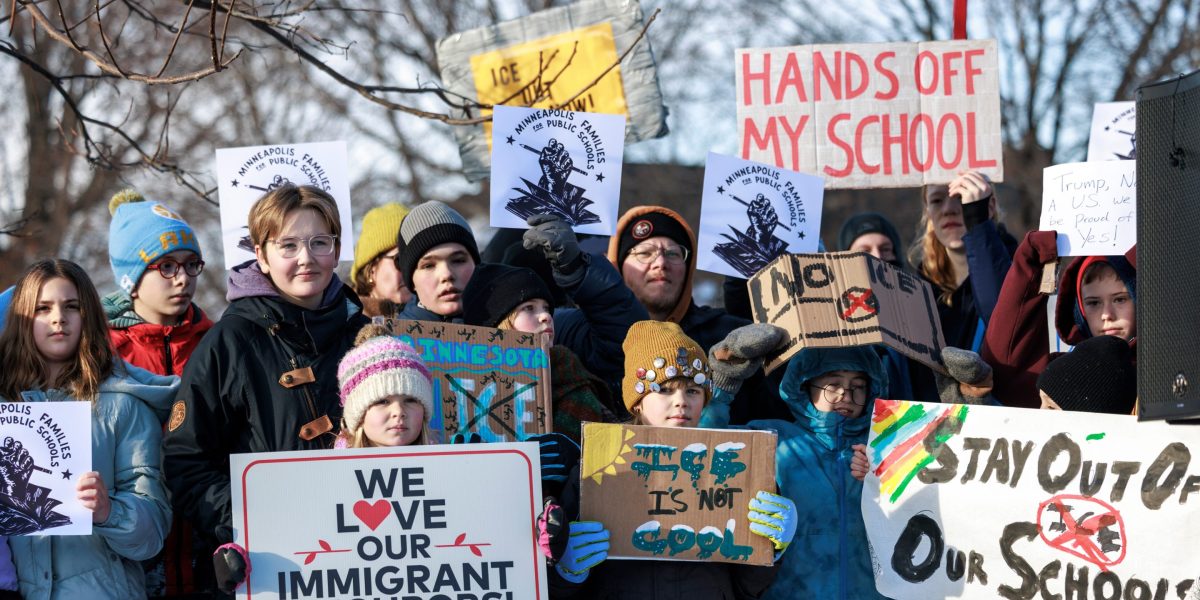
The Minneapolis school system will offer families the option of remote learning for a month, officials said Friday, responding to concerns that children might feel unsafe venturing out in a city where tensions are high over federal immigration enforcement.

Under the temporary plan, teachers will simultaneously deliver lessons from their classrooms to students in the classroom and at home, similar to the way many did during the COVID-19 pandemic.

Immigration enforcement in cities across the U.S. has led to dips in attendance, parents and educators say. Advocates in other cities facing federal interventions have sought remote learning options, particularly for immigrant families that might feel vulnerable, but Minneapolis appears to be one of the few districts to reintroduce the option of virtual learning.

“This meets a really important need for our students who are not able to come to school right now,” a Minneapolis school administrator wrote in an email to their staff late Thursday.

Administrators’ emails to staff indicate the decision to offer remote learning wasn’t a quick one. They refer to long meetings with input from school principals and the teachers union, acknowledging the planning and coordination required to deliver virtual school. In light of the devastating academic and emotional impact remote learning had during the pandemic, some also see it as a last resort.

A desire to keep students engaged in school appeared to prevail.

“This will keep them safe and help them keep up with their work,” the school administrator explained in one of the emails obtained by The Associated Press. “It will also allow them to be counted present, so we don’t have a ton of dropouts next week.”

Schools see remote learning as a way to help in stressful times

That Minneapolis, a district of nearly 30,000 students, would willingly offer remote learning again suggests a new level of fear after an onslaught of federal attention and conflict. There’s been President Donald Trump’s verbal attacks on the Somali community living there, a pledge to send 2,000 federal immigration agents and a federal agent’s deadly shooting of Renee Good, a mother of three and a U.S. citizen, on Wednesday.

On the same day as the shooting, immigration enforcement agents detained someone outside the city’s Roosevelt High School around dismissal time, which led to altercations with bystanders. The Minneapolis Federation of Educators said agents deployed tear gas and detained an educator before releasing them.

“We will not tolerate ICE inhibiting our city’s youth from their constitutional right to attend school safely or inhibiting educators from doing their job,” the union said.

Federal officials said agents had been pursuing a U.S. citizen who rammed a Border Patrol vehicle before a 5-mile (8-kilometer) chase that ended outside the school. Border Patrol Cmdr. Gregory Bovino, who has been in Minneapolis this week, said on social media that protesters assaulted agents and there were four total arrests.

It used to be that school campuses were no-go zones for immigration arrests, but Trump dismissed that guidance early in his second term.

“The way ICE has escalated in our community has made it so that there are people who feel unsafe coming to and from school,” said Natasha Dockter, first vice president of the local union representing Minneapolis public school teachers. “We’ve, you know, heard concerns from our members, from families, and wanted to advocate that there is an option for remote learning.”

Boisey Corvah, a 15-year-old sophomore at South High School, said students have been sharing videos from social media of the shooting and the episode at Roosevelt High. He said he worries especially about his friends who are Latino — because of possible encounters with immigration enforcement, and the crackdown’s effects for their mental health.

“They’re probably going to have to go straight home, you know. They won’t be able to hang out with their friends,” he said.

Other districts have considered offering virtual options

This fall, Chicago school board members called for a remote option during a federal intervention there, but Chicago Public Schools has resisted offering it. New York state last year allowed districts to offer virtual schooling to students afraid of Trump’s immigration crackdown, but it’s not clear how many districts took advantage of it.

One concern some school districts have raised is they are normally prohibited from asking families about their immigration status. If the school offers virtual learning for students worried about immigration enforcement, it could unintentionally identify that someone in their home is here illegally.

To get around this problem, advocates have urged districts to offer the option to everyone, not just students from immigrant homes.

“We are hoping and recommending for districts to have flexible options for all of their students. Learning doesn’t necessarily have to happen in the classroom,” said Viridiana Carrizales, chief executive officer of ImmSchools, a Texas-based group that consults with school districts on their policies for immigrant students.

Carrizales said she’s working with districts in New Jersey, New York and Texas on trying to help worried parents who are keeping children home from school and even withdrawing them.

The conversations have become more urgent in the past few weeks, she said, because school districts are losing students.

Some districts that already had ongoing virtual programs have seen an uptick in demand since Trump returned to office. In the Portland, Oregon, suburb of Hillsboro, the school district has opened enrollment slots at its online academy, district spokesperson Beth Graser said.

In a statement Thursday, the Minnesota Department of Education said districts and charter schools can provide remote options for enrolled students.

“Plans for online instruction need to consider how the needs of all students can be met, including students with disabilities and students learning English,” Commissioner Willie Jett said.

Minneapolis public schools were closed Thursday and Friday because of the tumult, but the district directed teachers to report to their school building to receive more details from administrators about the online instruction option. The virtual option will be available until Feb. 12, the district said.

___

Associated Press writer Claire Rush contributed to this report from Portland, Oregon. Vázquez Toness reported from Boston.


Source link

Continue Reading

Business

I run one of America’s most successful remote work programs and the critics are right. Their solutions are all wrong, though

Published

on


Justin Harlan is the managing director of Tulsa Remote, the largest relocation incentive program in the U.S., with over 3,500 members. Publications such as the Harvard Business Review and the Brookings Institute have looked to Tulsa Remote as a prominent example of how remote work attraction programs are reversing the brain drain in smaller U.S. cities and have confirmed the economic impact of the program.


Justin previously served as the Senior Executive Director for Reading Partners Tulsa. He launched his career with Teach For America-Oklahoma when it opened in Tulsa in 2009 and quickly rose through the organization as it expanded across the state. In various roles, Justin raised over $7.5 million for Teach For America and secured funding from the State of Oklahoma. He was a founding board member for Collegiate Hall College Prep Charter School in Tulsa.


Source link

Continue Reading

Business

Fortune Article | Fortune

Published

on


Greenland’s harsh environment, lack of key infrastructure and difficult geology have so far prevented anyone from building a mine to extract the sought-after rare earth elements that many high-tech products require. Even if President Donald Trump prevails in his effort to take control of the Arctic island, those challenges won’t go away.

Trump has prioritized breaking China’s stranglehold on the global supply of rare earths ever since the world’s number two economy sharply restricted who could buy them after the United States imposed widespread tariffs last spring. The Trump administration has invested hundreds of millions of dollars and even taken stakes in several companies. Now the president is again pitching the idea that wresting control of Greenland away from Denmark could solve the problem.

“We are going to do something on Greenland whether they like it or not,” Trump said Friday.

But Greenland may not be able to produce rare earths for years — if ever. Some companies are trying anyway, but their efforts to unearth some of the 1.5 million tons of rare earths encased in rock in Greenland generally haven’t advanced beyond the exploratory stage. Trump’s fascination with the island nation may be more about countering Russian and Chinese influence in the Arctic than securing any of the hard-to-pronounce elements like neodymium and terbium that are used to produce the high-powered magnets needed in electric vehicles, wind turbines, robots and fighter jets among other products.

“The fixation on Greenland has always been more about geopolitical posturing — a military-strategic interest and stock-promotion narrative — than a realistic supply solution for the tech sector,” said Tracy Hughes, founder and executive director of the Critical Minerals Institute. “The hype far outstrips the hard science and economics behind these critical minerals.”

Trump confirmed those geopolitical concerns at the White House Friday.

“We don’t want Russia or China going to Greenland, which if we don’t take Greenland, you can have Russia or China as your next door neighbor. That’s not going to happen,” Trump said

A difficult place to build a mine

The main challenge to mine in Greenland is, “of course, the remoteness. Even in the south where it’s populated, there are few roads and no railways, so any mining venture would have to create these accessibilities,” said Diogo Rosa, an economic geology researcher at the Geological Survey of Denmark and Greenland. Power would also have to be generated locally, and expert manpower would have to be brought in.

Another concern is the prospect of mining rare earths in the fragile Arctic environment just as Greenland tries to build a thriving tourism industry, said Patrick Schröder, a senior fellow in the Environment and Society program at the Chatham House think-tank in London.

“Toxic chemicals needed to separate the minerals out from the rock, so that can be highly polluting and further downstream as well, the processing,” Shröder said. Plus, rare earths are often found alongside radioactive uranium.

Besides the unforgiving climate that encases much of Greenland under layers of ice and freezes the northern fjords for much of the year, the rare earths found there tend to be encased in a complex type of rock called eudialyte, and no one has ever developed a profitable process to extract rare earths from that type of rock. Elsewhere, these elements are normally found in different rock formation called carbonatites, and there are proven methods to work with that.

“If we’re in a race for resources — for critical minerals — then we should be focusing on the resources that are most easily able to get to market,” said David Abraham, a rare earths expert who has followed the industry for decades and wrote the book “The Elements of Power.”

This week, Critical Metals’ stock price more than doubled after it said it plans to build a pilot plant in Greenland this year. But that company and more than a dozen others exploring deposits on the island remain far away from actually building a mine and would still need to raise at least hundreds of millions of dollars.

Producing rare earths is a tough business

Even the most promising projects can struggle to turn a profit, particularly when China resorts to dumping extra materials onto the market to depress prices and drive competitors out of business as it has done many times in the past. And currently most critical minerals have to be processed in China.

The U.S. is scrambling to expand the supply of rare earths outside of China during the one-year reprieve from even tougher restrictions that Trump said Xi Jinping agreed to in October. A number of companies around the world are already producing rare earths or magnets and can deliver more quickly than anything in Greenland, which Trump has threatened to seize with military power if Denmark doesn’t agree to sell it.

“Everybody’s just been running to get to this endpoint. And if you go to Greenland, it’s like you’re going back to the beginning,” said Ian Lange, an economics professor who focuses on rare earths at the Colorado School of Mines.

Focusing on more promising projects elsewhere

Many in the industry, too, think America should focus on helping proven companies instead of trying to build new rare earth mines in Greenland, UkraineAfrica or elsewhere. A number of other mining projects in the U.S. and friendly nations like Australia are farther along and in much more accessible locations.

The U.S. government has invested directly in the company that runs the only rare earths mine in the U.S., MP Materials, and a lithium miner and a company that recycles batteries and other products with rare earths.

Scott Dunn, CEO of Noveon Magnetics, said those investments should do more to reduce China’s leverage, but it’s hard to change the math quickly when more than 90% of the world’s rare earths come from China.

“There are very few folks that can rely on a track record for delivering anything in each of these instances, and that obviously should be where we start, and especially in my view if you’re the U.S. government,” said Dunn, whose company is already producing more than 2,000 metric tons of magnets each year at a plant in Texas from elements it gets outside of China.

___

Funk reported from Omaha, Nebraska, and Naishadham reported from Madrid.


Source link

Continue Reading

Business

A major factor in Gen Z and millennial divorce is ‘financial future faking’

Published

on


Many of us have experienced that gut-wrenching feeling when we realize the relationship we’re in and thought was “the one” turns out to be a total wash.

Sometimes the eventual severance comes down to a difference of morals or plain-old lost feelings. And sometimes it happens when dishonestly, like catfishing, is revealed.

But many people in the younger generations are navigating a new kind of deception: financial future faking. It’s when people make big promises to each other about sharing a home, lifestyle, or long-term financial security early in a relationship without any real intention or follow-through. This phenomenon is an offshoot of “future faking,” a psychological manipulation tactic recognized by major health care and psychological organizations. 

Financial future faking is becoming a major factor in Gen Z and millennial divorces—and perhaps a reason why these younger generations marry less often or much later in life.

“I often see a lack of financial intimacy, transparency, and alignment as central factors in divorce,” celebrity divorce attorney Jackie Combs told Fortune. “When money becomes a source of leverage, or when expectations are never clearly articulated, it fractures communication, creates misalignment, and erodes trust.”

Combs, who is a family and matrimonial law attorney and partner at Los Angeles-based firm BlankRome, has represented many Gen Z and millennial celebrities including Emily Ratajkowski, Chris Appleton, and Ines de Ramon. She also represents other high net-worth clients and has been recognized both as a top family lawyer as well as an “Entertainment Business Visionary” by the Los Angeles Times

The financial future faking trend is especially disheartening for Gen Z and millennials because they’re facing an inflationary period, soft job market, and a housing affordability crisis. So when those in relationships aren’t honest about money and shared goals, the entire lifestyle they’ve dreamed of could all come crashing down. 

“Gen Z and millennials are particularly vulnerable to future financial faking for several reasons,” Combs warned. “They are dating in an era of unprecedented financial instability, defined by student debt, housing unaffordability, and delayed economic security.”

Beware of the dream wedding

Combs says another reason younger generations are so susceptible to this is because they were raised in households where money was rarely openly discussed, leaving them ill-equipped to ask direct financial questions or understand whether they’re financially aligned with their partner early on. 

“This vulnerability is compounded by consumer culture and social media, which glamorizes aspirational lifestyles such as luxury weddings, ‘soft life’ aesthetics, and trad-wife narratives, without addressing the financial infrastructure required to support them,” she added. 

The illusion of a dream wedding can also be a culprit. The wedding services market alone was valued at about $218 billion in 2024, according to BRC Wedding Service Global Market Report 2025, and is expected to grow to a whopping $362 billion by 2029. This underscores “how fantasy often outpaces financial reality,” Combs said. 

To put it in perspective, the average cost of a wedding is an eye-popping $33,000, according to The Knot, or roughly half the average American salary. And that’s a relatively conservative average, considering weddings in certain markets—and for certain demographics and aesthetics—can cost hundreds of thousands of dollars. 

Still, it’s comforting and exciting to daydream about a luxurious wedding and lifestyle with your partner—although it can often lead to a trap.

“When someone offers hope through vague financial promises about the future, it can feel reassuring rather than deceptive, making financial future faking particularly effective,” Combs said.

How to spot financial future faking—and when to talk about money

Some of the common signs of financial future faking include making grand, but nonspecific financial promises, a lack of transparency about income, debt, or spending, and repeated delays in financial accountability or tangible process toward a financial goal, Combs said. 

“Future promises sound like commitment, but are never structured in reality or a future partnership” is what financial future faking sounds like, she added. 

But it’s difficult, and can sometimes feel confrontational, to question a partner—especially in a new relationship—about finances. 

“Sincerity is reflected in alignment between words and behavior,” Combs said. “Vague optimism without structure, or a willingness to learn, is a red flag.”

Combs said it’s important to have financial discussions early on before significant emotional or financial commitments are made. That entails having discussions about money before moving in together, signing a lease, or sharing expenses. 

Still, “that doesn’t mean sharing your 401k balance on the first date,” she explained. “It means asking thoughtful, value-based questions like, ‘if you won the [lottery] today, what would you do with the winnings?’ ‘What does financial security mean to you?’ or “What’s your biggest financial fear?’”

To get the most out of your conversation, Combs recommended “leading with curiosity and not judgment” because it can help show emotional vulnerability and build trust. And it’s also critical to have these conversations before any discussions about marriage or long-term commitment, because the former can often mean relinquishing financial autonomy.

Basically, if one person in a relationship doesn’t fully understand the financial or legal implications of marriage, they “give up control over their financial future,” Combs said.

“These conversations aren’t about forcing commitment,” she emphasized. “They’re about risk assessment and determining long-term compatibility.”


Source link

Continue Reading

Trending

Copyright © Miami Select.