Connect with us

Business

Down Arrow Button Icon

Published

on


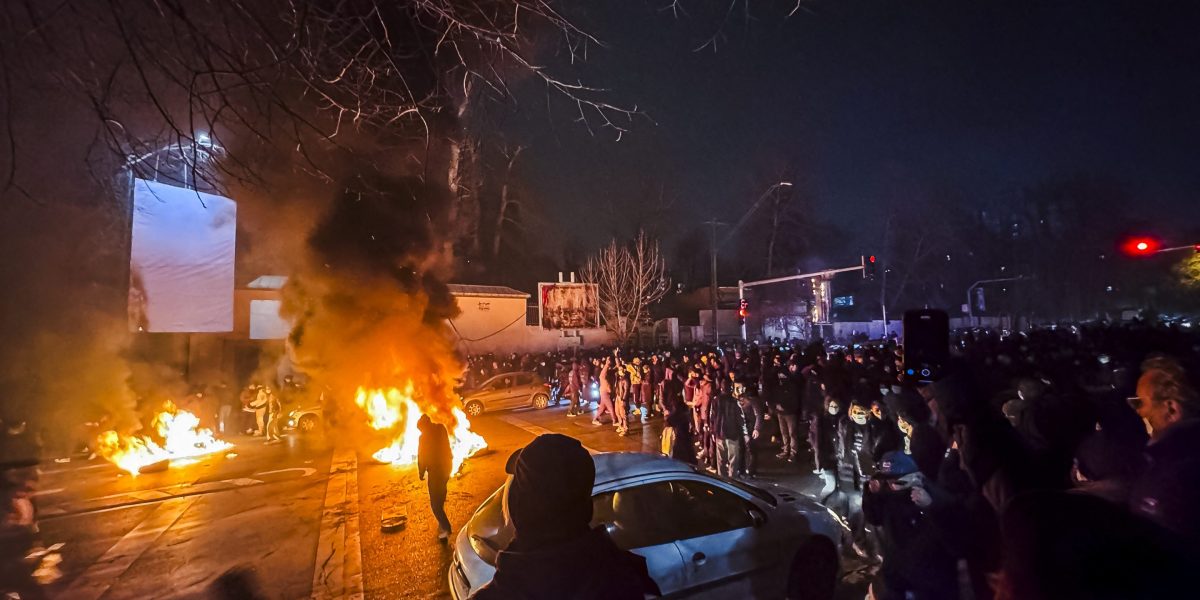
The largest anti-government demonstrations to rock Iran in recent years intensified Friday night, fueling fears of growing fatalities as authorities battle to suppress the protests.   

Social media footage trickling out of Iran amid a blanket shutdown of internet and telecommunications networks showed hundreds of thousands marching and chanting anti-regime slogans across the country, with graphic scenes of bodies lying in blood. Other clips showed that the elderly made up many of the protesters.

Separate mobile-camera footage from Fardis, a city about 50 kilometers (31 miles) west of Tehran, showed at least seven bodies covered in blood inside a building. In the videos, people are seen bandaging the head and patching an eye of another individual, while a voice says at least 10 people were killed by gunfire. None of the footage could be independently verified by Bloomberg.

Security forces have arrested nearly 200 “leaders of terrorist groups,” seizing ammunition, hand grenades and Molotov cocktails, Tasnim reported Saturday, citing an informed security official. Iran’s prosecutor general warned that all detainees would be charged as an “enemy of God” — a broadly defined offense punishable by death under Islamic law in the country.

Mohammad Movahedi Azad said all “rioters” would face the same charge, “whether an individual has assisted rioters and terrorists” or “whether they are mercenaries who have taken up arms.” He said trial proceedings will be carried out without any delay and “without leniency, compassion, or indulgence,” the state-run IRIB News reported. 

The US-based Human Rights Activists News Agency said Friday that at least 65 people have been killed and 2,311 arrested since protests began on Dec. 28, when traders in Tehran protested a currency crisis and worsening living conditions. The demonstrations have since spread nationwide.

Thirty-eight of the fatalities were identified in Chaharmahal and Bakhtiari, Ilam, Kermanshah, and Fars provinces in central and western Iran, according to the Human Rights Activists group. Time magazine reported Friday that at least 217 protesters have died in Tehran, mostly by live ammunition, citing a doctor in the capital.

Internet-monitoring group NetBlocks said in an X posting that a nationwide internet blackout remained in place in Iran as of Saturday. People inside the country appeared largely cut off from international online services afternoon local time, with many users worldwide reporting they had been unable to get in touch with loved ones at home for almost two days.

Read More: Iran’s Growing Unrest Risks Deepening Crisis for Islamic Regime

The protests over Thursday and Friday — Iran’s weekend — followed a call by Reza Pahlavi, the exiled son of the country’s former shah who’s positioning himself as an opposition leader. He urged demonstrators again to return to the streets after 6 p.m. local time on Saturday and Sunday. 

“Our goal is no longer merely to take to the streets,” the US-based, 65-year-old Pahlavi said in an X posting. “The goal is to prepare to seize city centers and hold them.” Pahlavi urged workers in oil, gas and transportation industries to begin a nationwide strike, and said he is “preparing to return to the homeland.”

Oman’s Foreign Minister Badr Albusaidi arrived in Tehran on Saturday, Iranian media reported. The visit comes amid rising tensions between the US and Iran over the Islamic Republic’s handling of protests, a day after Iranian Foreign Minister Abbas Araghchi said it was unclear whether Albusaidi was carrying “a message from anywhere.” Oman mediated five rounds of nuclear talks between Tehran and Washington last year, which stalled after US and Israeli attacks on Iran in June.

State TV played down the protests on Saturday, saying security forces had largely contained the demonstrations on Friday after what it described as unrest by “armed terrorists” in Tehran and other cities the night before.

Iran’s regular army signaled its loyalty to Supreme Leader Ayatollah Ali Khamenei, saying it will “monitor enemy movements in the region and firmly safeguard the nation’s interests, strategic infrastructure, and public property” under the 86-year-old leader, the semi-official Tasnim news agency reported.

Chanting Crowds

Iranian authorities have so far refrained from releasing an official tally of fatalities among protesters or security forces. State-affiliated media reported at least a dozen deaths among police and Basij volunteer militia forces since Thursday. Tasnim said “armed terrorists” killed several police personnel in gunfire on Thursday.

Violence also broke out in Zahedan, a Sunni-majority city in south-western Iran and a long-standing flashpoint for deadly security incidents. The Norwegian-registered Hengaw Organization for Human Rights said security forces opened fire on demonstrators after Friday prayers, leaving several wounded.

State media published images of several burned buildings in Tehran, while a social media video purportedly showed a municipality building in Karaj, west of the capital, engulfed in flames.

Chants recorded in footage included “Death to the dictator,” “No Gaza, no Lebanon, my life for Iran,” and “This is the year of blood; Seyyed Ali will be toppled,” referring to Khamenei, who on Friday repeated his pledge to quash protesters.

While the US has so far been reluctant to embrace Pahlavi as a potential replacement for the Iranian government, President Donald Trump has warned the regime repeatedly against killing protesters. 

On Friday, the leaders of France, the UK and Germany also called on the regime to “exercise restraint, to refrain from violence, and to uphold the fundamental rights of Iran’s citizens.”


Source link

Continue Reading

Business

I run one of America’s most successful remote work programs and the critics are right. Their solutions are all wrong, though

Published

on


Justin Harlan is the managing director of Tulsa Remote, the largest relocation incentive program in the U.S., with over 3,500 members. Publications such as the Harvard Business Review and the Brookings Institute have looked to Tulsa Remote as a prominent example of how remote work attraction programs are reversing the brain drain in smaller U.S. cities and have confirmed the economic impact of the program.


Justin previously served as the Senior Executive Director for Reading Partners Tulsa. He launched his career with Teach For America-Oklahoma when it opened in Tulsa in 2009 and quickly rose through the organization as it expanded across the state. In various roles, Justin raised over $7.5 million for Teach For America and secured funding from the State of Oklahoma. He was a founding board member for Collegiate Hall College Prep Charter School in Tulsa.


Source link

Continue Reading

Business

Fortune Article | Fortune

Published

on


Greenland’s harsh environment, lack of key infrastructure and difficult geology have so far prevented anyone from building a mine to extract the sought-after rare earth elements that many high-tech products require. Even if President Donald Trump prevails in his effort to take control of the Arctic island, those challenges won’t go away.

Trump has prioritized breaking China’s stranglehold on the global supply of rare earths ever since the world’s number two economy sharply restricted who could buy them after the United States imposed widespread tariffs last spring. The Trump administration has invested hundreds of millions of dollars and even taken stakes in several companies. Now the president is again pitching the idea that wresting control of Greenland away from Denmark could solve the problem.

“We are going to do something on Greenland whether they like it or not,” Trump said Friday.

But Greenland may not be able to produce rare earths for years — if ever. Some companies are trying anyway, but their efforts to unearth some of the 1.5 million tons of rare earths encased in rock in Greenland generally haven’t advanced beyond the exploratory stage. Trump’s fascination with the island nation may be more about countering Russian and Chinese influence in the Arctic than securing any of the hard-to-pronounce elements like neodymium and terbium that are used to produce the high-powered magnets needed in electric vehicles, wind turbines, robots and fighter jets among other products.

“The fixation on Greenland has always been more about geopolitical posturing — a military-strategic interest and stock-promotion narrative — than a realistic supply solution for the tech sector,” said Tracy Hughes, founder and executive director of the Critical Minerals Institute. “The hype far outstrips the hard science and economics behind these critical minerals.”

Trump confirmed those geopolitical concerns at the White House Friday.

“We don’t want Russia or China going to Greenland, which if we don’t take Greenland, you can have Russia or China as your next door neighbor. That’s not going to happen,” Trump said

A difficult place to build a mine

The main challenge to mine in Greenland is, “of course, the remoteness. Even in the south where it’s populated, there are few roads and no railways, so any mining venture would have to create these accessibilities,” said Diogo Rosa, an economic geology researcher at the Geological Survey of Denmark and Greenland. Power would also have to be generated locally, and expert manpower would have to be brought in.

Another concern is the prospect of mining rare earths in the fragile Arctic environment just as Greenland tries to build a thriving tourism industry, said Patrick Schröder, a senior fellow in the Environment and Society program at the Chatham House think-tank in London.

“Toxic chemicals needed to separate the minerals out from the rock, so that can be highly polluting and further downstream as well, the processing,” Shröder said. Plus, rare earths are often found alongside radioactive uranium.

Besides the unforgiving climate that encases much of Greenland under layers of ice and freezes the northern fjords for much of the year, the rare earths found there tend to be encased in a complex type of rock called eudialyte, and no one has ever developed a profitable process to extract rare earths from that type of rock. Elsewhere, these elements are normally found in different rock formation called carbonatites, and there are proven methods to work with that.

“If we’re in a race for resources — for critical minerals — then we should be focusing on the resources that are most easily able to get to market,” said David Abraham, a rare earths expert who has followed the industry for decades and wrote the book “The Elements of Power.”

This week, Critical Metals’ stock price more than doubled after it said it plans to build a pilot plant in Greenland this year. But that company and more than a dozen others exploring deposits on the island remain far away from actually building a mine and would still need to raise at least hundreds of millions of dollars.

Producing rare earths is a tough business

Even the most promising projects can struggle to turn a profit, particularly when China resorts to dumping extra materials onto the market to depress prices and drive competitors out of business as it has done many times in the past. And currently most critical minerals have to be processed in China.

The U.S. is scrambling to expand the supply of rare earths outside of China during the one-year reprieve from even tougher restrictions that Trump said Xi Jinping agreed to in October. A number of companies around the world are already producing rare earths or magnets and can deliver more quickly than anything in Greenland, which Trump has threatened to seize with military power if Denmark doesn’t agree to sell it.

“Everybody’s just been running to get to this endpoint. And if you go to Greenland, it’s like you’re going back to the beginning,” said Ian Lange, an economics professor who focuses on rare earths at the Colorado School of Mines.

Focusing on more promising projects elsewhere

Many in the industry, too, think America should focus on helping proven companies instead of trying to build new rare earth mines in Greenland, UkraineAfrica or elsewhere. A number of other mining projects in the U.S. and friendly nations like Australia are farther along and in much more accessible locations.

The U.S. government has invested directly in the company that runs the only rare earths mine in the U.S., MP Materials, and a lithium miner and a company that recycles batteries and other products with rare earths.

Scott Dunn, CEO of Noveon Magnetics, said those investments should do more to reduce China’s leverage, but it’s hard to change the math quickly when more than 90% of the world’s rare earths come from China.

“There are very few folks that can rely on a track record for delivering anything in each of these instances, and that obviously should be where we start, and especially in my view if you’re the U.S. government,” said Dunn, whose company is already producing more than 2,000 metric tons of magnets each year at a plant in Texas from elements it gets outside of China.

___

Funk reported from Omaha, Nebraska, and Naishadham reported from Madrid.


Source link

Continue Reading

Business

A major factor in Gen Z and millennial divorce is ‘financial future faking’

Published

on


Many of us have experienced that gut-wrenching feeling when we realize the relationship we’re in and thought was “the one” turns out to be a total wash.

Sometimes the eventual severance comes down to a difference of morals or plain-old lost feelings. And sometimes it happens when dishonestly, like catfishing, is revealed.

But many people in the younger generations are navigating a new kind of deception: financial future faking. It’s when people make big promises to each other about sharing a home, lifestyle, or long-term financial security early in a relationship without any real intention or follow-through. This phenomenon is an offshoot of “future faking,” a psychological manipulation tactic recognized by major health care and psychological organizations. 

Financial future faking is becoming a major factor in Gen Z and millennial divorces—and perhaps a reason why these younger generations marry less often or much later in life.

“I often see a lack of financial intimacy, transparency, and alignment as central factors in divorce,” celebrity divorce attorney Jackie Combs told Fortune. “When money becomes a source of leverage, or when expectations are never clearly articulated, it fractures communication, creates misalignment, and erodes trust.”

Combs, who is a family and matrimonial law attorney and partner at Los Angeles-based firm BlankRome, has represented many Gen Z and millennial celebrities including Emily Ratajkowski, Chris Appleton, and Ines de Ramon. She also represents other high net-worth clients and has been recognized both as a top family lawyer as well as an “Entertainment Business Visionary” by the Los Angeles Times

The financial future faking trend is especially disheartening for Gen Z and millennials because they’re facing an inflationary period, soft job market, and a housing affordability crisis. So when those in relationships aren’t honest about money and shared goals, the entire lifestyle they’ve dreamed of could all come crashing down. 

“Gen Z and millennials are particularly vulnerable to future financial faking for several reasons,” Combs warned. “They are dating in an era of unprecedented financial instability, defined by student debt, housing unaffordability, and delayed economic security.”

Beware of the dream wedding

Combs says another reason younger generations are so susceptible to this is because they were raised in households where money was rarely openly discussed, leaving them ill-equipped to ask direct financial questions or understand whether they’re financially aligned with their partner early on. 

“This vulnerability is compounded by consumer culture and social media, which glamorizes aspirational lifestyles such as luxury weddings, ‘soft life’ aesthetics, and trad-wife narratives, without addressing the financial infrastructure required to support them,” she added. 

The illusion of a dream wedding can also be a culprit. The wedding services market alone was valued at about $218 billion in 2024, according to BRC Wedding Service Global Market Report 2025, and is expected to grow to a whopping $362 billion by 2029. This underscores “how fantasy often outpaces financial reality,” Combs said. 

To put it in perspective, the average cost of a wedding is an eye-popping $33,000, according to The Knot, or roughly half the average American salary. And that’s a relatively conservative average, considering weddings in certain markets—and for certain demographics and aesthetics—can cost hundreds of thousands of dollars. 

Still, it’s comforting and exciting to daydream about a luxurious wedding and lifestyle with your partner—although it can often lead to a trap.

“When someone offers hope through vague financial promises about the future, it can feel reassuring rather than deceptive, making financial future faking particularly effective,” Combs said.

How to spot financial future faking—and when to talk about money

Some of the common signs of financial future faking include making grand, but nonspecific financial promises, a lack of transparency about income, debt, or spending, and repeated delays in financial accountability or tangible process toward a financial goal, Combs said. 

“Future promises sound like commitment, but are never structured in reality or a future partnership” is what financial future faking sounds like, she added. 

But it’s difficult, and can sometimes feel confrontational, to question a partner—especially in a new relationship—about finances. 

“Sincerity is reflected in alignment between words and behavior,” Combs said. “Vague optimism without structure, or a willingness to learn, is a red flag.”

Combs said it’s important to have financial discussions early on before significant emotional or financial commitments are made. That entails having discussions about money before moving in together, signing a lease, or sharing expenses. 

Still, “that doesn’t mean sharing your 401k balance on the first date,” she explained. “It means asking thoughtful, value-based questions like, ‘if you won the [lottery] today, what would you do with the winnings?’ ‘What does financial security mean to you?’ or “What’s your biggest financial fear?’”

To get the most out of your conversation, Combs recommended “leading with curiosity and not judgment” because it can help show emotional vulnerability and build trust. And it’s also critical to have these conversations before any discussions about marriage or long-term commitment, because the former can often mean relinquishing financial autonomy.

Basically, if one person in a relationship doesn’t fully understand the financial or legal implications of marriage, they “give up control over their financial future,” Combs said.

“These conversations aren’t about forcing commitment,” she emphasized. “They’re about risk assessment and determining long-term compatibility.”


Source link

Continue Reading

Trending

Copyright © Miami Select.