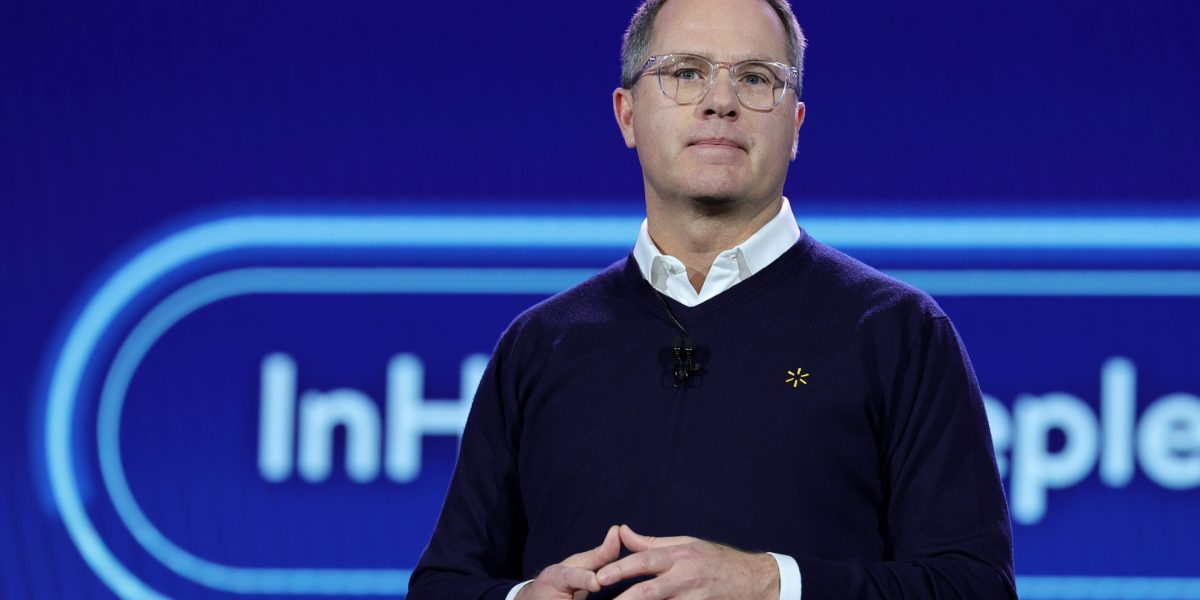
McMillon, who has been leading the $905 billion grocery chain giant since 2011, enjoys around $27.5 million in total compensation. He’s set to retire at the end of this month, and is bowing out on a monetary high; in his final year as CEO, McMillon took home a $1.5 million salary, while also receiving $20.4 million in stock awards and $4.4 million in non-equity incentive plan compensation.
It’s a far cry from the pay of his first Walmart job. The outgoing CEO started working in the business’ warehouses in the summer of 1984, unloading trailers for just $6.50 an hour. That’s 481 times lower than the average $3,127 he earns every hour of the day as CEO. Even within one minute he blows that figure out of the water, reeling in around $52 in 60 seconds.
Now, it takes less than 20 hours for the Walmart CEO to outearn the average U.S. worker who takes home about $62,088 a year, according to 2025 first quarter wage data from the BLS. And while it could take decades for Americans to pool up savings for a house, McMillon can afford it within one workweek. It only takes 5.85 days for the chief executive to reel in $439,000, the median price of a U.S. home, according to a CEO salary tool from Resume.ai. And over the span of U.S. workers’ dreaded 30-minute commute to the office, McMillon is already $1,563 richer. Every second, the chief executive can watch his bank account inch up nearly $1.
Fortune reached out to Walmart for comment.
While CEOs are reaping record-breaking salaries, Americans are bunkering down
McMillon is just one face in a crowd of CEOs making headlines for their eyebrow-raising salaries.
Late last year, the leader of Tesla and the world’s richest person, Elon Musk, secured a $1 trillion pay package at his EV company, spurring criticism of the growing wealth divide between the world’s wealthiest and poorest workers.
And Tim Cook, the CEO of $3.8 trillion tech giant Apple, reaped $74.6 million in 2024, up 18% from $63.2 million the year before. In only about seven hours, Cook has already outearned the typical American worker, and in 2.15 days, can afford the average U.S. home. But he’s not even the highest-paid CEO leading a large, billion-dollar public U.S. company. Rick Smith, the chief executive of $45.5 billion defense-tech company Axon, took home a whopping $164.5 million, according to an analysis from Equilar.
Meanwhile, America’s poorest aren’t enjoying the spoils of their employers’ success. The after-tax wages of U.S. workers in the lowest-income group grew just 1.3% year-over-year this July, down from 1.6% in the month before, according to the Bank of America Institute. In that same period, higher-income wages swelled to 3.2%—the third consecutive monthly increase. It marked the widest wealth divide between lower and upper-income households in four years.
“In some sense, we had an improvement in lower-income wage growth since the pandemic, and now that’s gone into reverse,” David Tinsley, senior economist for the Bank of America Institute, told Fortune this August. “There was a narrowing of wealth inequality, and now it’s widening.”
However, some companies are stepping up to ensure that their workers get a fair share of the success. Samsung rolled out a new three-year program last year, granting payouts to its employees based on the company’s stock price starting October 2025 to the same month in 2028, according to reporting from Bloomberg. The plan also gives workers the option to receive up to half of that payout in shares instead of cash. Prior to this monetary move, the only other instance Samsung workers were granted stock was when Samsung distributed 30 shares to staffers as part of a union deal.
And even billionaires are responding to the growing wealth divide between the haves and have-nots. In response to an Oxfam study’s findings that billionaire wealth increased by $33 trillion between 2015 and 2025, entrepreneur Mark Cuban pointed out that wealth has surged because “the stock market has gone straight up.” He called out that workers should get a slice of the pie.
“You know who is funding the increase, particularly lately? Retail investors. 401ks,” Cuban wrote on X last year. “The better question is, why are we not giving incentives to companies to require them to give shares in their companies to all employees, at the same percentage of cash earnings as the CEO?”






 Politics8 years ago