Connect with us

Business

Down Arrow Button Icon

Published

on


After dedicating decades of his life to philanthropic endeavors, and pledging virtually all his wealth to humanitarian aid around the world, Gates could only watch from the sidelines as the U.S. government cancelled foreign aid contracts under a second Trump administration.

The 70-year-old tech titan has been critical of these decisions, warning it could lead to the death of children. He has also sought to speak directly to President Trump about why the American government should continue funding life-saving programs around the world, and believes there is time yet to get the world “back on track.”

In his 2026 annual letter, Gates wrote that while he remains upbeat about the future, his optimism now comes with footnotes. He questioned whether generosity would grow in line with an increasingly wealthy global population, and whether innovation will be scaled in way which improves equality.

Indeed Gates, who has always been bullish on the transformative powers AI can have on healthcare and climate matters, also mused on how to minimize the negative disruption of the revolutionary technology as it continues to accelerate in capability.

Here’s Bill Gates’s 2026 annual letter, released today, in full:

The Year Ahead: Optimism with Footnotes

As we start 2026, I am thinking about how the year ahead will set us up for the decades to come.

By Bill Gates

I have always been an optimist. When I founded Microsoft, I believed a digital revolution powered by great software would make the world a better place. When I started the Gates Foundation, I saw an opportunity to save and improve millions of lives because critical areas like children’s health were getting so little money. 

In both cases, the results exceeded my expectations. We are far better off than when I was born 70 years ago. I believe the world will keep improving—but it is harder to see that today than it has been in a long time.

Friends and colleagues often ask me how I stay optimistic in an era with so many challenges and so much polarization. My answer is this: I am still an optimist because I see what innovation accelerated by artificial intelligence will bring. But these days, my optimism comes with footnotes.

The thing I am most upset about is the fact that the world went backwards last year on a key metric of progress: the number of deaths of children under 5 years old. Over the last 25 years, those deaths went down faster than at any other point in history. But in 2025, they went up for the first time this century, from 4.6 million in 2024 to 4.8 million in 2025—an increase driven by less support from rich countries to poor countries. This trend will continue unless we make progress in restoring aid budgets.

The next five years will be difficult as we try to get back on track and work to scale up new lifesaving tools. Yet I remain optimistic about the long-term future. As hard as last year was, I don’t believe we will slide back into the Dark Ages. I believe that, within the next decade, we will not only get the world back on track but enter a new era of unprecedented progress.

The key will be, as always, innovation. Consider this: An HIV diagnosis used to be a death sentence. Today, thanks to revolutionary treatments, a person with HIV can expect to live almost as long as someone without the virus. By the 2040s, new innovations could virtually eliminate deaths from HIV/AIDS.

Budget cuts limit how many people benefit from lifesaving tools, as we saw to devastating effect last year. But nothing can erase the fact that for decades we didn’t know how to save people from HIV, and now we do. Breakthroughs are a bell that cannot be unrung. They ensure that we will never go back to the world in 2000 where over 10 million children died from preventable causes every year—and they form the core of my optimism about where the world is headed. 

But as I mentioned, there are footnotes to my optimism. Although the innovation pipeline sets us up for long-term success, the trajectory of progress hinges on how the world addresses three key questions.

1. Will a world that is getting richer increase its generosity toward those in need?

The “golden rule” precept is more important now than ever with the record disparities in wealth. This idea of treating others as you wish to be treated does not just apply to rich countries giving aid. It must also include philanthropy from the wealthy to help those in need—both domestically and globally—which should grow rapidly in a world with a record number of billionaires and even centibillionaires. 

Through the Giving Pledge, I get to work with a number of incredible philanthropists who set a great example by giving away substantial portions of their wealth in smart ways. However, more needs to be done to encourage higher levels of generosity from the rich and to show how fulfilling and impactful it can be.

Turning to aid budgets for poor countries, I am worried about one number: If funding for health decreases by 20 percent, 12 million more children could die by 2045. I know cuts won’t be reversed overnight, even though aid represented less than 1 percent of GDP even in the most generous countries. But it is critical that we restore some of the funding. The foundation’s Goalkeepers report lays out what is at risk and how the world can best spend the aid it gives.

I will spend much of my year working with partners to advocate for increased funding for the health of the world’s children. I plan to engage with a number of communities, including health care workers, religious groups, and members of diaspora communities to help make this case.

2. Will the world prioritize scaling innovations that improve equality?

Some problems require doing far more than just letting market incentives take their course.

The first critical area is climate change. Without a large global carbon tax (which is, unfortunately, politically unachievable), market forces do not properly incentivize the creation of technologies to reduce climate-related emissions. 

Yet only by replacing all emitting activities with cheaper alternatives will we stop the temperature increase. This is why I started Breakthrough Energy 10 years ago and why I will continue to put billions into innovation. 

The world has made meaningful progress in the last decade, cutting projected emissions by more than 40 percent. But we still have a lot of innovation and scaling up to do in tough areas like industrial emissions and aviation. Government policies in rich countries are still critical because unless innovations reach scale, the costs won’t come down and we won’t achieve the impact we need.

If we don’t limit climate change, it will join poverty and infectious disease in causing enormous suffering, especially for the world’s poorest people. Since even in the best case the temperature will continue to go up, we also need to innovate to minimize the negative impacts. 

This is called climate adaptation, and a critical example is helping farmers in poor countries with better seeds and better advice so they can grow more even in the face of climate change. Using AI, we will soon be able to provide poor farmers with better advice about weather, prices, crop diseases, and soil than even the richest farmers get today. The foundation has committed $1.4 billion to supporting farmers on the frontlines of extreme weather.

I will be investing and giving more than ever to climate work in the years ahead while also continuing to give more to children’s health, the foundation’s top priority. The need to ensure money is spent on the most important priorities was the topic of a memo I wrote in the fall.

A second critical area where the world must focus on innovation-driven equality is health care. Concerns about healthcare costs and quality are higher than ever in all countries. 

In theory, people should feel optimistic about the state of health care with the incredible pipeline of innovations. For example, a recent breakthrough in diagnosing Alzheimer’s will revolutionize how we test for—and ultimately prevent—this disease, saving billions of dollars in costs. (Funding Alzheimer’s research is a particular focus for me.) There’s similar progress on obesity and cancer, as well as on problems in developing countries like malaria, TB, and malnutrition. 

Despite so much progress, however, the cost and complexity of the system means very few people are satisfied with their care. I believe we can improve health care dramatically in all countries by using AI not only to accelerate the development of innovations but directly in the delivery of health care. 

Like many of you, I already use AI to better understand my own health. Just imagine what will be possible as it improves and becomes available for every patient and provider. Always-available, high-quality medical advice will improve medicine by every measure. 

We aren’t quite there yet—developers still have work to do on reliability and how we connect the AI to doctors and nurses so they are empowered to check and override the system. But I’m optimistic we will soon begin to scale access globally. I am following this work so the Gates Foundation and partners can make sure this capability is available in the countries that need it most—where there aren’t enough medical personnel—at the same time it is available elsewhere. We are already working on pilots and making sure that even relatively uncommon African languages are fully supported.

Governments will have to play a central role in leading the implementation of AI into their health systems. This is another case where the market alone won’t and can’t provide the solution.

A third and final area I will mention briefly is education. AI gives us a chance for the kind of personalized learning to keep students motivated that we have dreamed of in the past. This is now a focus of the Gates Foundation’s spending on education, and I am hopeful it will be empowering to both teachers and students. I’ve seen this firsthand in New Jersey, and it will be game changing as we scale it for the world.

All three of these areas—climate, health, and education—can improve rapidly with the right government focus. This year I will spend a lot of time meeting with pioneers all over the world to see which countries are doing the best work so we can spread best practices.

3. Will we minimize negative disruptions caused by AI as it accelerates?

Of all the things humans have ever created, AI will change society the most. It will help solve many of our current problems while also bringing new challenges very different from past innovations. 

When people in the AI space predict that AGI or fully humanoid robots will come soon and then those deadlines are missed, it creates the impression that these things will never happen. However, there is no upper limit on how intelligent AIs will get or on how good robots will get, and I believe the advances will not plateau before exceeding human levels.

The two big challenges in the next decade are use of AI by bad actors and disruption to the job market.Both are real risks that we need to do a better job managing. We’ll need to be deliberate about how this technology is developed, governed, and deployed.

In 2015, I gave a TED talk warning that the world was not ready to handle a pandemic. If we had prepared properly for the Covid pandemic, the amount of human suffering would have been dramatically less. Today, an even greater risk than a naturally caused pandemic is that a non-government group will use open source AI tools to design a bioterrorism weapon.

The second challenge is job market disruption. AI capabilities will allow us to make far more goods and services with less labor. In a mathematical sense, we should be able to allocate these new capabilities in ways that benefit everyone. As AI delivers on its potential, we could reduce the work week or even decide there are some areas we don’t want to use AI in.

The effects of this disruption are hard to model. Sometimes, when a game-changing technology improves rapidly, it drives more demand at lower cost and, by making the world richer, increases demand in other areas. For example, AI makes software developers at least twice as efficient, which makes coding cheaper while also creating demand elasticity for code. (Computing is a good historical example where lower costs actually caused the overall market to grow.) 

Even with this complexity, the rate of improvement is already starting to be enough to disrupt job demand in areas like software development. Other areas like warehouse work or phone support are not quite there yet, but once the AIs become more capable, the job disruption will be more immediate.

We’re already starting to see the impact of AI on the job market, and I think this impact will grow over the next five years. Even if the transition takes longer than I expect, we should use 2026 to prepare ourselves for these changes—including which policies will best help spread the wealth and deal with the important role jobs play in our society. Different political parties will likely suggest different approaches.

By including these footnotes, particularly the last one, some readers may find my continued optimism even more surprising. But as we start 2026, I remain optimistic about the days ahead because of two core human capabilities. 

The first is our ability to anticipate problems and prepare for them, and therefore ensure that our new discoveries make all of us better off.  The second is our capacity to care about each other. Throughout history, you can always find stories of people tending not just to themselves or their clan or their country but to the greater good. 

Those two qualities—foresight and care—are what give me hope as the year begins. As long as we keep exercising those abilities, I believe the years ahead can be ones of real progress.




Source link

Continue Reading

Business

As U.S. debt soars past $38 trillion, corporate bond flood is a growing threat to Treasury supply

Published

on


As the Treasury Department looks to ensure investors continue absorbing the fresh supply of debt it must sell, growing competition from companies issuing their own bonds could send rates higher, according to Apollo Chief Economist Torsten Slok.

In a note on Saturday, he pointed out that Wall Street estimates for the volume of investment grade debt that’s on the way this year reach as high as $2.25 trillion.

That’s as the AI boom increasingly sends companies, including hyperscalers and adjacent firms, to the bond market to fund massive investments in data centers and other infrastructure.

“The significant increase in hyperscaler issuance raises questions about who will be the marginal buyer of IG paper,” Slok said. “Will it come from Treasury purchases and hence put upward pressure on the level of rates? Or might it come from mortgage purchases, putting upward pressure on mortgage spreads?”

With U.S. debt topping $38 trillion, the federal government has already borrowed $601 billion in the first three months of the 2026 fiscal year, which began in October 2025, according to the latest data from the Congressional Budget Office.

That’s $110 billion less than the deficit during the same period a year earlier as tariffs helped revenue outpace spending. But the Supreme Court could strike down President Donald Trump’s global tariffs soon, and this year’s tax season should see a surge of refunds to account for new tax cuts under the One Big Beautiful Bill Act.

Meanwhile, Trump has vowed to boost defense spending to $1.5 trillion a year from $1 trillion, threatening to further deepen federal budget deficits.

And despite the Federal Reserve’s series of rate cuts this past autumn, Treasury yields remain about where they were in early September, suggesting the government will not see much relief on debt-servicing costs that are also contributing to the overall tally of red ink.

“The bottom line is that the volume of fixed-income products coming to market this year is significant and is likely to put upward pressure on rates and credit spreads as we go through 2026,” Slok said.

Apollo

To make sure there’s sufficient demand among bond investors, Treasury yields must remain attractive relative to the competition. Failure to draw enough investors raises the risk of so-called fiscal dominance, or when a central bank must step into to finance widening deficits.

That’s what former Treasury Secretary Janet Yellen warned of last weekend, during a panel hosted by the American Economic Association.

“The preconditions for fiscal dominance are clearly strengthening,” she said, noting debt is on a steep upward trajectory toward 150% of GDP over the next three decades.

At the same time, he holders of U.S. debt have shifted drastically over the past decade, tilting more toward profit-driven private investors and away from foreign governments that are less sensitive to prices.

That threatens to turn the U.S. financial system more fragile in times of market stress, according to Geng Ngarmboonanant, a managing director at JPMorgan and former deputy chief of staff to Yellen during her tenure at Treasury.

Foreign governments accounted for more than 40% of Treasury bond holdings in the early 2010s, up from just over 10% in the mid-1990s, he wrote in a New York Times op-ed last month. This reliable bloc of investors allowed the U.S. to borrow vast sums at artificially low rates.

“Those easy times are over,” he warned. “Foreign governments now make up less than 15% of the overall Treasury market.”


Source link

Continue Reading

Business

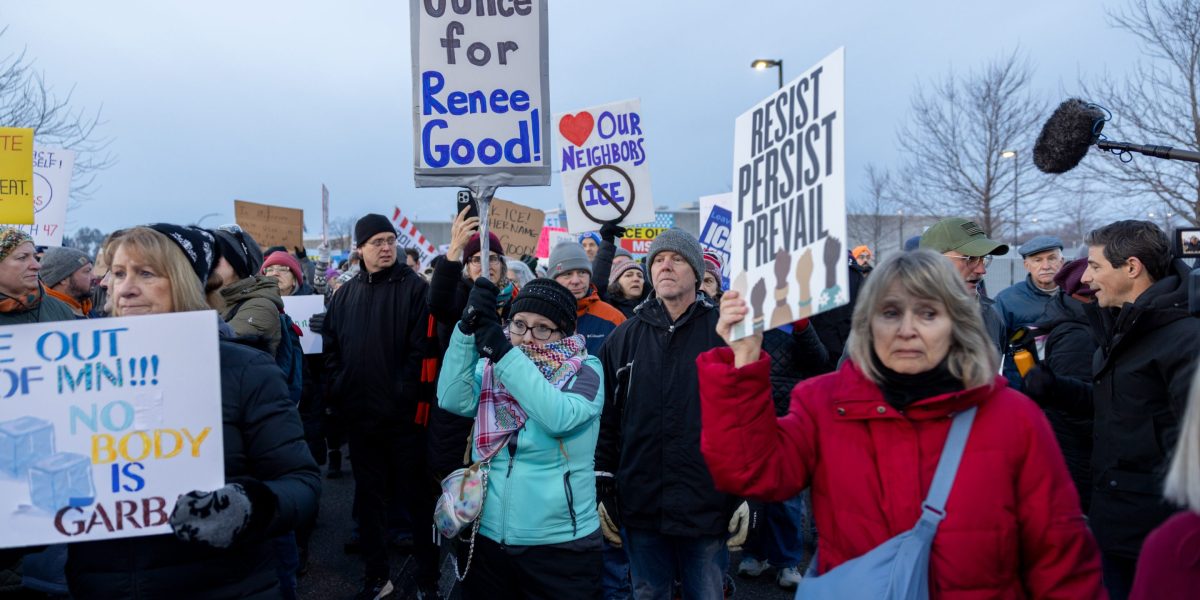
ICE shooting that killed Renee Good sets up budget standoff ahead of shutdown deadline

Published

on


The killing of Renee Good by an Immigration and Customs Enforcement agent in Minnesota has sparked a potential funding battle just as the federal government faces another shutdown deadline on Jan. 30.

Democrats in Congress are considering ways to rein in President Donald Trump’s immigration crackdown after the fatal shooting, and legislation to fund the Department of Homeland Security could be one vehicle for it.

Sen. Chris Murphy, the ranking Democrat on the subcommittee that oversees the DHS budget, plans to introduce legislation that would require agents to have warrants for arrests, ban them from wearing masks during enforcement operations, limit the use of guns by ICE during civil actions, and restrict the Border Patrol to the border.

He is trying to gather enough Democrats who will demand guardrails on DHS in exchange for their votes to pass a spending bill for the department, sources told Axios.

“Democrats cannot vote for a DHS budget that doesn’t restrain the growing lawlessness of this agency,” Murphy said in a post on X on Wednesday.

At least one Republican, Sen. Sen. Lisa Murkowski from Alaska, has called for policy changes, saying the shooting in Minnesota “was devastating, and cannot happen again.”

“The videos I’ve seen from Minneapolis yesterday are deeply disturbing,” she said in a statement. “As we mourn this loss of life, we need a thorough and objective investigation into how and why this happened.”

Some Democrats in the House, where Republicans hold a razor-thin majority that has gotten narrower, have also said legislation for DHS appropriations should be used as leverage.

And Rep. Adriano Espaillat, a member of the House Appropriations Committee, suggested at a news conference Friday that Democrats should take an even more aggressive stance.

“I was of the belief that perhaps we could reform ICE. Now I am of the belief that it has to be dismantled as an entity,” he said. “This unaccounted for violence is part of its culture. And so we must dismantle it and build it from the ground up again.”

But after the longest government shutdown ever last fall took a heavy toll on the economy and social services, top Democrats like Senate Minority Leader Chuck Schumer have signaled they want to avoid another one a few months later.

Still, House Speaker Mike Johnson admitted on Friday he’s concerned Democrats’ targeting of immigration enforcement funding could interfere with overall negotiations on government appropriations.

“We should not be limiting funding for Homeland Security at a dangerous time,” Johnson said, according to Politico. “We need officials to allow law enforcement to do their job. Immigration and Customs Enforcement is a critically important function of the government. It is a top concern for Americans, as demonstrated by the last election cycle.”


Source link

Continue Reading

Business

‘That’s fine, I’m not mad at you’: New video of Minnesota shooting shows crucial moments before incident

Published

on


A Minnesota prosecutor on Friday called on the public to share with investigators any recordings and evidence connected to the fatal shooting of Renee Good as a new video emerged showing the final moments of her encounter with an immigration officer.

The Minneapolis killing and a separate shooting in Portland, Oregon, a day later by the Border Patrol have set off protests in multiple cities and denunciations of immigration enforcement tactics by the U.S. government. The Trump administration has defended the officer who shot Good in her car, saying he was protecting himself and fellow agents.

The reaction to the shooting has largely been focused on witness cellphone video of the encounter. A new, 47-second video that was published online by a Minnesota-based conservative news site, Alpha News, and later reposted on social media by the Department of Homeland Security shows the shooting from the perspective of ICE officer Jonathan Ross, who fired the shots.

Sirens blaring in the background, he approaches and circles Good’s vehicle in the middle of the road while apparently filming on his cellphone. At the same time, Good’s wife also was recording the encounter and can be seen walking around the vehicle and approaching the officer. A series of exchanges occurred:

“That’s fine, I’m not mad at you,” Good says as the officer passes by her door. She has one hand on the steering wheel and the other outside the open driver side window.

“U.S. citizen, former f—ing veteran,” says her wife, standing outside the passenger side of the SUV holding up her phone. “You wanna come at us, you wanna come at us, I say go get yourself some lunch, big boy.”

Other officers are approaching the driver’s side of the car at about the same time and one says: “Get out of the car, get out of the f—ing car.” Ross is now at the front driver side of the vehicle. Good reverses briefly, then turns the steering wheel toward the passenger side as she drives ahead and Ross opens fire.

The camera becomes unsteady and points toward the sky and then returns to the street view showing Good’s SUV careening away.

“F—ing b—,” someone at the scene says.

A crashing sound is heard as Good’s vehicle smashes into others parked on the street.

Federal agencies have encouraged officers to document encounters in which people may attempt to interfere with enforcement actions, but policing experts have cautioned that recording on a handheld device can complicate already volatile situations by occupying an officer’s hands and narrowing focus at moments when rapid decision-making is required.

Under an ICE policy directive, officers and agents are expected to activate body-worn cameras at the start of enforcement activities and to record throughout interactions, and footage must be kept for review in serious incidents such as deaths or use-of-force cases. The Department of Homeland Security has not responded to questions about whether the officer who opened fire or any of the others who were on the scene were wearing body cameras.

Homeland Security says video shows self-defense

Vice President JD Vance and Homeland Security spokesperson Tricia McLaughlin said in posts on X that the new video backs their contention that the officer fired in self-defense.

“Many of you have been told this law enforcement officer wasn’t hit by a car, wasn’t being harassed, and murdered an innocent woman,” Vance said. “The reality is that his life was endangered and he fired in self defense.”

Minneapolis Mayor Jacob Frey has said any self-defense argument is “garbage.”

Policing experts said the video didn’t change their thoughts on the use-of-force but did raise additional questions about the officer’s training.

“Now that we can see he’s holding a gun in one hand and a cellphone in the other filming, I want to see the officer training that permits that,” said Geoff Alpert, a criminology professor at the University of South Carolina.

The video demonstrates that the officers didn’t perceive Good to be a threat, said John P. Gross, a professor at the University of Wisconsin Law School who has written extensively about officers shooting at moving vehicles.

“If you are an officer who views this woman as a threat, you don’t have one hand on a cellphone. You don’t walk around this supposed weapon, casually filming,” Gross said.

Ross, 43, is an Iraq War veteran who has served in the Border Patrol and ICE for nearly two decades. He was injured last year when he was dragged by a driver fleeing an immigration arrest.

Attempts to reach Ross at phone numbers and email addresses associated with him were not successful.

Prosecutor asks for video and evidence

Meanwhile, Hennepin County Attorney Mary Moriarty said that although her office has collaborated effectively with the FBI in past cases, she is concerned by the Trump administration’s decision to bar state and local agencies from playing any role in the investigation into Good’s killing.

She also said the officer who shot Good in the head does not have complete legal immunity, as Vance declared.

“We do have jurisdiction to make this decision with what happened in this case,” Moriarty said at a news conference. “It does not matter that it was a federal law enforcement agent.”

Moriarty said her office would post a link for the public to submit footage of the shooting, even though she acknowledged that she wasn’t sure what legal outcome submissions might produce.

Good’s wife, Becca Good, released a statement to Minnesota Public Radio on Friday saying, “kindness radiated out of her.”

“On Wednesday, January 7th, we stopped to support our neighbors. We had whistles. They had guns,” Becca Good said.

“I am now left to raise our son and to continue teaching him, as Renee believed, that there are people building a better world for him,” she wrote.

The reaction to Good’s shooting was immediate in the city where police killed George Floyd in 2020, with hundreds of protesters converging on the shooting scene and the school district canceling classes for the rest of the week as a precaution and offering an online option through Feb. 12.

On Friday, protesters were outside a federal facility serving as a hub for the immigration crackdown that began Tuesday in Minneapolis and St. Paul. That evening, hundreds protested and marched outside two hotels in downtown Minneapolis where immigration enforcement agents were supposed to be staying. Some people were seen breaking or spray painting windows and state law enforcement officers wearing helmets and holding batons ordered the remaining group of fewer than 100 people to leave late Friday.

Shooting in Portland

The Portland shooting happened outside a hospital Thursday. A federal border officer shot and wounded a man and woman in a vehicle, identified by the Department of Homeland Security as Venezuela nationals Luis David Nico Moncada and Yorlenys Betzabeth Zambrano-Contreras. Police said they were in stable condition Friday after surgery, with DHS saying Nico Moncada was taken into FBI custody

DHS defended the actions of its officers in Portland, saying the shooting occurred after the driver with alleged gang ties tried to “weaponize” his vehicle to hit them. It said no officers were injured.

Portland Police Chief Bob Day confirmed that the two people shot had “some nexus” to Tren de Aragua, a Venezuelan gang. Day said they came to the attention of police during an investigation of a July shooting believed to have been carried out by gang members, but they were not identified as suspects.

The chief said any gang affiliation did not necessarily justify the shooting by U.S. Border Patrol. The Oregon Department of Justice said it would investigate.

On Friday evening, hundreds of protesters marched to the ICE building in Portland.

The biggest crackdown yet

The Minneapolis shooting happened on the second day of the immigration crackdown in the Twin Cities, which Homeland Security said is the biggest immigration enforcement operation ever. More than 2,000 officers are taking part and Homeland Security Secretary Kristi Noem said they have made more than 1,500 arrests.

The government is also shifting immigration officers to Minneapolis from sweeps in Louisiana, according to documents obtained by The Associated Press. This represents a pivot, as the Louisiana crackdown that began in December had been expected to last into February.

Good’s death — at least the fifth tied to immigration sweeps since President Donald Trump took office — has resonated far beyond Minneapolis. More protests are planned for this weekend, according to Indivisible, a group formed to resist the Trump administration.

___

Associated Press reporters Steve Karnowski and Mark Vancleave in Minneapolis; Ed White in Detroit; Valerie Gonzalez in Brownsville, Texas; Graham Lee Brewer in Norman, Oklahoma; Michael Biesecker in Washington; Jim Mustian and Safiyah Riddle in New York; Ryan Foley in Iowa City, Iowa; and Hallie Golden in Seattle contributed.

This story was originally featured on Fortune.com


Source link

Continue Reading

Trending

Copyright © Miami Select.