Connect with us

Business

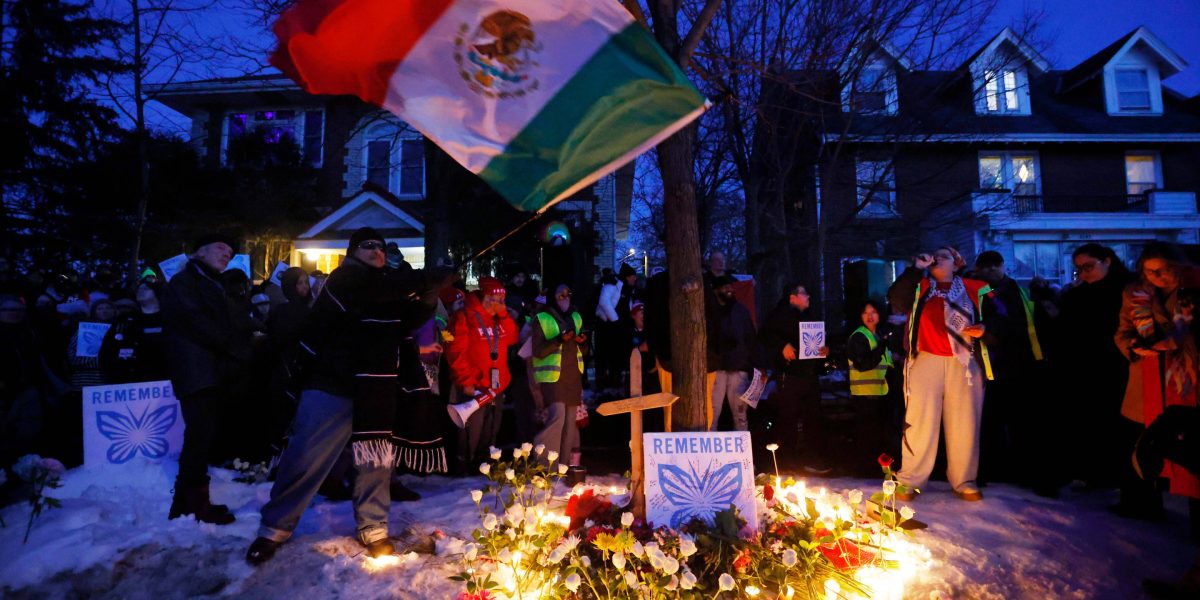
37-year-old mother of 3 shot and killed by ICE in Minneapolis was a U.S. citizen who had recently moved to the state

Published

on


The woman shot and killed by a U.S. Immigration and Customs Enforcement officer in Minneapolis on Wednesday was Renee Nicole Macklin Good, a 37-year-old mother of three who had recently moved to Minnesota.

She was a U.S. citizen born in Colorado and appears to never have been charged with anything involving law enforcement beyond a traffic ticket.

In social media accounts, Macklin Good described herself as a “poet and writer and wife and mom.” She said she was currently “experiencing Minneapolis,” displaying a pride flag emoji on her Instagram account. A profile picture posted to Pinterest shows her smiling and holding a young child against her cheek, along with posts about tattoos, hairstyles and home decorating.

Her ex-husband, who asked not to be named out of concern for the safety of their children, said Macklin Good had just dropped off her 6-year-old son at school Wednesday and was driving home with her current partner when they encountered a group of ICE agents on a snowy street in Minneapolis, where they had moved last year from Kansas City, Missouri.

Video taken by bystanders posted to social media shows an officer approaching her car, demanding she open the door and grabbing the handle. When she begins to pull forward, a different ICE officer standing in front of the vehicle pulls his weapon and immediately fires at least two shots into the vehicle at close range.

In another video taken after the shooting, a distraught woman is seen sitting near the vehicle, wailing, “That’s my wife, I don’t know what to do!”

Calls and messages to Macklin Good’s current partner received no response.

Trump administration officials painted Macklin Good as a domestic terrorist who had attempted to ram federal agents with her car. Her ex-husband said she was no activist and that he had never known her to participate in a protest of any kind.

He described her as a devoted Christian who took part in youth mission trips to Northern Ireland when she was younger. She loved to sing, participating in a chorus in high school and studying vocal performance in college.

She studied creative writing at Old Dominion University in Virginia and won a prize in 2020 for one of her works, according to a post on the school’s English department Facebook page. She also hosted a podcast with her second husband, who died in 2023.

Macklin Good had a daughter and her son from her first marriage, who are now ages 15 and 12. Her 6-year-old son was from her second marriage.

Her ex-husband said she had primarily been a stay-at-home mom in recent years but had previously worked as a dental assistant and at a credit union.

Donna Ganger, her mother, told the Minnesota Star Tribune the family was notified of the death late Wednesday morning.

“Renee was one of the kindest people I’ve ever known,” Ganger told the newspaper. “She was extremely compassionate. She’s taken care of people all her life. She was loving, forgiving and affectionate. She was an amazing human being.”

Ganger did not respond to calls or messages from the AP.

___

Mustian reported from New York.


Source link

Continue Reading

Business

Some Republicans push back against Trump on Greenland, Venezuela, and health care

Published

on


For House Republicans, the political year started with a pep rally of sorts as President Donald Trump gathered them at Washington’s Kennedy Center for a stemwinder of a speech. But by the time lawmakers had completed their first week of work this midterm election year, fractures in the party were already showing.

From pushback to Trump’s self-described “Donroe doctrine” of aggressionin the Western Hemisphere to breaks in party unity over health care, Republican lawmakers are displaying signs of independence from Trump after spending much of the last year acquiescing to his practically every demand. It showed a new dynamic in the GOP as Republicans embark on difficult campaign to keep control of both the House and Senate.

Senate Majority Leader John Thune, speaking at the U.S.-Mexico border Friday with a group of Republican Senate candidates, said that Republicans were “going to be focused like a laser” on issues of affordability and pointed to legislation in the works on housing and health care.

Thune’s border trip and talk of affordability were a nod back to some of the core themes of Trump’s presidential campaign. But the focus in Washington of late has instead been dominated by Trump’s military operation to capture Venezuelan leader Nicolás Maduro, his threats to use military force to take control of Greenland, the release of case files on Jeffrey Epstein and a debate over extending subsidies for insurance offered under the Affordable Care Act — an issue where Republicans have long struggled to find unity.

Recent shootings by Immigration and Customs Enforcement officers in several U.S. cities, including one that killed a woman in Minneapolis, have also raised new questions about Republicans’ hard-line immigration agenda and shifted attention away from Trump’s handling of the border, which they see as a political success.

Even so, Trump still has plenty of command over most of the party. That was demonstrated this week by a pair of unsuccessful House veto override votes in which most GOP members stuck with the president despite previously voting for the low-profile bills.

Rep. Thomas Massie, a Kentucky Republican who has been one of the few Republicans to consistently defy Trump, said that “there was some bully pulpit intimidation going on” from the president that caused the veto overrides to fail.

Still, Democrats are making the case that Trump is becoming distracted from the needs of Americans, especially after the attack on Venezuela.

“He’s lurching towards another endless, expensive war, all the while American families here are struggling with skyrocketing costs,” said Senate Democratic Leader Chuck Schumer.

Venezuela war powers vote draws GOP support

To prove their point, Democrats are forcing votes on war powers resolutions that would stop Trump from attacking Venezuela without congressional approval. Such measures are rarely successful, but a procedural vote on the legislation drew support from five Republicans Thursday, setting up a final vote next week. House Democrats are also pushing forward a similar resolution.

The GOP senators who voted for the legislation tried to defuse the conflict with Trump by arguing their positions were in line with his own campaign promises to scale back U.S. commitments overseas.

“A drawn-out campaign in Venezuela involving the American military, even if unintended, would be the opposite of President Trump’s goal of ending foreign entanglements,” Sen. Todd Young, an Indiana Republican who voted for the war powers resolution, said in a lengthy statement explaining his vote.

Trump reacted with fury. The president promptly called for the five Republicans, which included Maine Sen. Susan Collins, who is up for reelection this year, to “never be elected to office again.”

Republicans are already dealing with retirements from several lawmakers who had uneasy relationships with Trump, and there was worry that such clashes could complicate their campaign picture even more.

“If Susan isn’t the senator from Maine, we’re going to end up with a Democrat,” said Sen. Bernie Moreno, an Ohio Republican. “That would be 10 times worse. But I do appreciate that President Trump is absolutely pissed off.”

GOP pushes back on Trump’s Greenland plans

Trump’s desire to possess Greenland and his administration’s decision not to rule out military force also met significant resistance from GOP lawmakers this week.

Sen. Thom Tillis, a North Carolina Republican who is retiring after crossing Trump last summer, took to the Senate floor to proclaim that he was “sick of stupid.” He specifically criticized White House deputy chief of policy Stephen Miller, who made comments that Greenland should be part of the U.S.

“I want good advice for this president, because I want this president to have a good legacy,” Tillis added. “And this nonsense on what’s going on with Greenland is a distraction from the good work he’s doing, and the amateurs who said it was a good idea should lose their jobs.”

Other Republicans, including Thune and Senate Armed Services Committee chair Sen. Roger Wicker, also gently pushed back on military threats against Denmark, which is a NATO ally of the U.S.

After meeting with the Danish ambassador, Wicker said it was Denmark’s right not to sell Greenland.

“I’m troubled by Greenland. I’m troubled by some of the things he does. I don’t get it,” said Nebraska Rep. Don Bacon, another retiring Republican. “I do feel like Congress should be more independent and should provide checks and balances here.”

Bacon added that Trump still had the ability to “bully” his Republican colleagues, but that Trump’s threats had “stiffened my spine.”

Health care votes expose divisions

During Trump’s speech at the Kennedy Center on Tuesday, he urged Republicans to own the issue of health care. Yet when the House voted Thursday on a Democratic proposal to extend expired health care subsidies for Affordable Care Act health plans, 17 Republicans broke with party leadership to help pass the bill.

“People recognize the challenge here, which is to address health care affordability,” said Rep. Mike Lawler, a New York Republican who voted for the proposal.

He still criticized the Affordable Care Act, a hallmark piece of legislation for Democrats, yet the health care debate unfolding in Congress is one that Democrats feel confident making a central campaign issue.

“In this first, full week of the new year, House Democrats — every single one of us joined by 17 Republicans — have partnered in a bipartisan way to protect the health care of the American people,” said House Democratic leader Hakeem Jeffries following the vote.

Jan. 6 plaque coming out of storage

On the fifth anniversary of the attack on the Capitol, Trump told House Republicans that he had told his supporters to go “peacefully and patriotically” to confront Congress from certifying the 2020 presidential election. The White House also unveiled a website that portrayed the Jan. 6 attack as a “witch hunt” against him by Democrats and some Republicans in Congress.

But the Senate, which Republicans control, this week agreed to display a plaque honoring the police who defended the Capitol — a cause that has become a point of contention with Trump as president. The plaque had been kept in storage rather than being displayed because House Speaker Mike Johnson had said the memorial did not comply with the law.

It was Tillis again who pushed the issue on the Republican side. He said it was important to honor the police and staff who risked their own lives and safety that day.

Democrats who joined in the effort said they were alarmed by the White House’s attempt to recast the narrative.

“It’s so important we be honest with the American people about what happened,” said Sen. Jeff Merkley, an Oregon Democrat.


Source link

Continue Reading

Business

Facing 682% inflation, Venezuelans work three or more jobs and still can barely afford any food

Published

on


At the White House, President Donald Trump vows American intervention in Venezuela will pour billions of dollars into the country’s infrastructure, revive its once-thriving oil industry and eventually deliver a new age of prosperity to the Latin American nation.

Here at a sprawling street market in the capital, though, utility worker Ana Calderón simply wishes she could afford the ingredients to make a pot of soup.

“Food is incredibly expensive,” says Calderón, noting rapidly rising prices that have celery selling for twice as much as just a few weeks ago and a kilogram (2 pounds) of meat going for more than $10, or 25 times the country’s monthly minimum wage. “Everything is so expensive.”

Venezuelans digesting news of the United States’ brazen capture of former President Nicolás Maduro are hearing grandiose promises of future economic prowess even as they live through the crippling economic realities of today.

“They know that the outlook has significantly changed but they don’t see it yet on the ground. What they’re seeing is repression. They’re seeing a lot of confusion,” says Luisa Palacios, a Venezuelan-born economist and former oil executive who is a research scholar at the Center on Global Energy Policy at Columbia University. “People are hopeful and expecting that things are going to change but that doesn’t mean that things are going to change right now.”

Whatever hope exists over the possibility of U.S. involvement improving Venezuela’s economy is paired with the crushing daily truths most here live. People typically work two, three or more jobs just to survive, and still cupboards and refrigerators are nearly bare. Children go to bed early to avoid the pang of hunger; parents choose between filling a prescription and buying groceries. An estimated eight in 10 people live in poverty.

It has led millions to flee the country for elsewhere.

Those who remain are concentrated in Venezuela’s cities, including its capital, Caracas, where the street market in the Catia neighborhood once was so busy that shoppers bumped into one another and dodged oncoming traffic. But as prices have climbed in recent days, locals have increasingly stayed away from the market stalls, reducing the chaos to a relative hush.

Neila Roa, carrying her 5-month-old baby, sells packs of cigarettes to passersby, having to monitor daily fluctuations in currency to adjust the price.

“Inflation and more inflation and devaluation,” Roa says. “It’s out of control.”

Roa could not believe the news of Maduro’s capture. Now, she wonders what will come of it. She thinks it would take “a miracle” to fix Venezuela’s economy.

“What we don’t know is whether the change is for better or for worse,” she says. “We’re in a state of uncertainty. We have to see how good it can be, and how much it can contribute to our lives.”

Trump has said the U.S. will distribute some of the proceeds from the sale of Venezuelan oil back to its population. But that commitment so far largely appears to be focused on America’s interests in extracting more oil from Venezuela, selling more U.S.-made goods to the country and repairing the electricity grid.

The White House is hosting a meeting Friday with U.S. oil company executives to discuss Venezuela, which the Trump administration has been pressuring to open its vast-but-struggling oil industry more widely to American investment and know-how. In an interview with The New York Times, Trump acknowledged that reviving the country’s oil industry would take years.

“The oil will take a while,” he said.

Venezuela has the world’s largest proven oil reserves. The country’s economy depends on them.

Maduro’s predecessor, the fiery Hugo Chávez, elected in 1998, expanded social services, including housing and education, thanks to the country’s oil bonanza, which generated revenues estimated at some $981 billion between 1999 and 2011 as crude prices soared. But corruption, a decline in oil production and economic policies led to a crisis that became evident in 2012.

Chávez appointed Maduro as his successor before dying of cancer in 2013. The country’s political, social and economic crisis, entangled with plummeting oil production and prices, marked the entirety of Maduro’s presidency. Millions were pushed into poverty. The middle class virtually disappeared. And more than 7.7 million people left their homeland.

Albert Williams, an economist at Nova Southeastern University, says returning the energy sector to its heyday would have a dramatic spillover effect in a country in which oil is the dominant industry, sparking the opening of restaurants, stores and other businesses. What’s unknown, he says, is whether such a revitalization happens, how long it would take and how a government built by Maduro will adjust to the change in power.

“That’s the billion-dollar question,” Williams says. “But if you improve the oil industry, you improve the country.”

The International Monetary Fund estimates Venezuela’s inflation rate is a staggering 682%, the highest of any country for which it has data. That has sent the cost of food beyond what many can afford.

Many public sector workers survive on roughly $160 per month, while the average private sector employee earned about $237 last year. Venezuela’s monthly minimum wage of 130 bolivars, or $0.40, has not increased since 2022, putting it well below the United Nations’ measure of extreme poverty of $2.15 a day.

The currency crisis led Maduro to declare an “economic emergency” in April.

Usha Haley, a Wichita State University economist who studies emerging markets, says for those hurting the most, there is no immediate sign of change.

“Short-term, most Venezuelans will probably not feel any economic relief,” she says. “A single oil sale will not fix the country’s rampant inflation and currency collapse. Jobs, prices, and exchange rates will probably not shift quickly.”

In a country that has seen as much strife as Venezuela has in recent years, locals are accustomed to doing what they have to in order to get through the day, so much so that many utter the same expression

“Resolver,” they say in Spanish, or “figure it out,” shorthand for the jury-rigged nature of life here, in which every transaction, from boarding a bus to buying a child’s medicine, involves a delicate calculation.

Here at the market, the smell of fish, fresh onions and car exhaust combine. Calderon, making her way through, faces freshly skyrocketing prices, saying “the difference is huge,” as the country’s official currency has rapidly declined against its unofficial one, the U.S. dollar.

Unable to afford all the ingredients for her soup, she left with a bunch of celery but no meat.


Source link

Continue Reading

Business

Minneapolis shooter revealed as Jonathan Ross, Iraq War veteran with nearly two decades of Border Patrol, Immigration experience

Published

on


The federal agent who shot and killed a driver in Minneapolis is an Iraq War veteran who has served for nearly two decades in the Border Patrol and U.S. Immigration and Customs Enforcement, according to records obtained Thursday by The Associated Press.

Jonathan Ross, who shot Renee Good on Wednesday, has served as a deportation officer with ICE since 2015, records show. He was seriously injured last summer when he was dragged by the vehicle of a fleeing suspect whom he shot with a stun gun.

Federal officials have not named the officer who shot Good, a 37-year-old mother who was shot as she tried to drive away from federal agents. But Homeland Security Secretary Kristi Noem said the agent who shot Good had been dragged by a vehicle last June, and a department spokesperson confirmed Noem was referring to the Bloomington, Minnesota, case in which documents identified the injured officer as Ross.

Noem and other Trump administration officials have defended the agent as an experienced law enforcement professional who followed his training and shot Good after he believed she was trying to run him or other agents over with her vehicle. Video has raised questions about whether the shooting was in self-defense, and the FBI is investigating the deadly use of force. Some protesters are demanding that Ross face criminal charges, and Minnesota authorities also want to investigate.

Attempts to reach Ross, 43, at phone numbers and email addresses associated with him were not immediately successful.

Here are some things to know about him:

Experienced military and law enforcement officer

In courtroom testimony last month, Ross said he deployed to Iraq from 2004 to 2005 with the Indiana National Guard. Ross said he served as a machine-gunner on a gun truck as part of a combat patrol team.

He said he returned from Iraq in 2005, went to college and joined the Border Patrol in 2007 near El Paso, Texas. He worked there until 2015, serving as a field intelligence agent gathering and analyzing information on cartels and drug and human smuggling.

Ross said he has served as a deportation officer based in Minnesota since he joined ICE in 2015. He is assigned to fugitive operations, seeking to arrest “higher value targets” in the ICE region that includes Minneapolis, he testified last month. He said that he was also a team leader with the FBI’s Joint Terrorism Task Force.

“So I develop the targets, create a target package, surveillance, and then develop a plan to execute the arrest warrant,” he said.

Ross said that he was also a firearms instructor, an active shooter instructor, a field intelligence officer and member of the SWAT team. He said that he attended the Border Patrol’s academy in New Mexico, where he learned to speak Spanish.

Seriously injured last June

Ross was a leader of a team of agents who went to arrest a man who was in the U.S. illegally in the Minneapolis suburb of Bloomington on June 17. Agents had gathered outside the home of the man, Roberto Munoz-Guatemala, who left in his car, according to court records.

FBI agents activated emergency sirens and lights instructing him to pull over but he did not. Ross pulled his vehicle diagonally in front of Munoz-Guatemala to force him to stop.

Ross and an FBI agent identified themselves as police and pointed guns at Munoz-Guatemala, who raised his hands. Ross then approached Munoz-Guatemala’s vehicle and ordered him to put it in park.

Ross told the driver to lower his window all the way down and warned that he would break it if he did not. Ross used a device known as a “spring-loaded window punch” to break the rear driver’s side window and reached inside the car to unlock the driver’s door.

Munoz-Guatemala drove off while Ross’ arm was caught in the vehicle and accelerated, dragging Ross down the street. Ross fired his Taser, striking Munoz-Guatemala with prongs in the head, face and shoulder.

Munoz-Guatemala was not incapacitated by the Taser, prosecutors said, and kept driving, taking Ross the length of a football field in 12 seconds. Ross was knocked free from the vehicle by force after Munoz-Guatemala drove onto a curb for a second time and back to the street.

Ross’ right arm was bleeding, and an FBI agent applied a tourniquet. Eventually, he received dozens of stitches at a hospital. Prosecutors said he had “suffered multiple large cuts, and abrasions to his knee, elbow, and face.”

“It was pretty excruciating pain,” Ross testified.

Munoz-Guatemala was bleeding from his injuries and had a woman call 911, saying that he was assaulted and didn’t know whether the person trying to stop him was an officer. He was arrested and charged with assault on a federal officer with a dangerous or deadly weapon.

A jury found Munoz-Guatemala guilty at a trial last month, finding he “should reasonably have known that Jonathan Ross was a law enforcement officer and not a private citizen attempting to assault him.”

Federal officials defend the agent without identifying him

Vice President JD Vance praised the agent’s service to the country Thursday without naming him, saying the ICE officer “deserves a debt of gratitude.”

“This is a guy who’s actually done a very, very important job for the United States of America,” Vance said. “He’s been assaulted. He’s been attacked. He’s been injured because of it.”

DHS assistant Tricia McLaughlin declined to confirm the agent’s identity Thursday, saying doing so would be dangerous for the safety of him and his family. But she noted that he had been selected for ICE’s special response team, which includes a 30-hour tryout and additional training on specialized skills such as breaching techniques, perimeter control, hostage rescue and firearms.

“He acted according to his training,” she said. “This officer is a longtime ICE officer who has been serving his country his entire life.”

___

AP reporters Michael Biesecker and Jonathan J. Cooper contributed to this report.


Source link

Continue Reading

Trending

Copyright © Miami Select.