Connect with us

Business

Down Arrow Button Icon

Published

on


The U.S. Supreme Court could rule as soon as Friday on whether President Trump’s tariff regime is unconstitutional. If the court strikes down his trade policies, it could jeopardize up to one-third of Trump’s newly proposed military budget, according to a post by the president on social media.

Trump said Wednesday on Truth Social that he wanted to increase U.S. military spending from $1 trillion to $1.5 trillion. “I would stay at the $1 Trillion number but, because of Tariffs, and the tremendous Income that they bring, amounts being generated, … we are able to easily hit the $1.5 Trillion Dollar number.”

Most observers, however, are expecting the court to strike down his tariff regime or at least curtail it. At oral arguments, the justices expressed scepticism that the White House has the power to impose taxes on trade without the permission of Congress under the International Emergency Economic Powers Act (IEEPA).

“The betting markets think there’s a high chance the White House loses its appeal and that could see a raft of tariffs—including so-called ‘reciprocal’ levies on the E.U., China and the rest of the world—struck down,” ING told its clients in an email seen by Fortune. Bettors on Kalshi give only a 29% chance of Trump’s tariffs surviving; it’s just 25% on Polymarket

About 1,000 companies are petitioning the court to scrap the tariffs. If they are successful, the White House would have to figure out a mechanism to pay them all back. That would be a non-trival undertaking. According to data from Bloomberg provided to Fortune via Pantheon Macroeconomics, tariff revenue is being generated at a current rate of $30.4 billion per month, for an annualized rate of $364.5 billion. (Notably, that number is below the extra $500 billion Trump wants to spend on the military.)
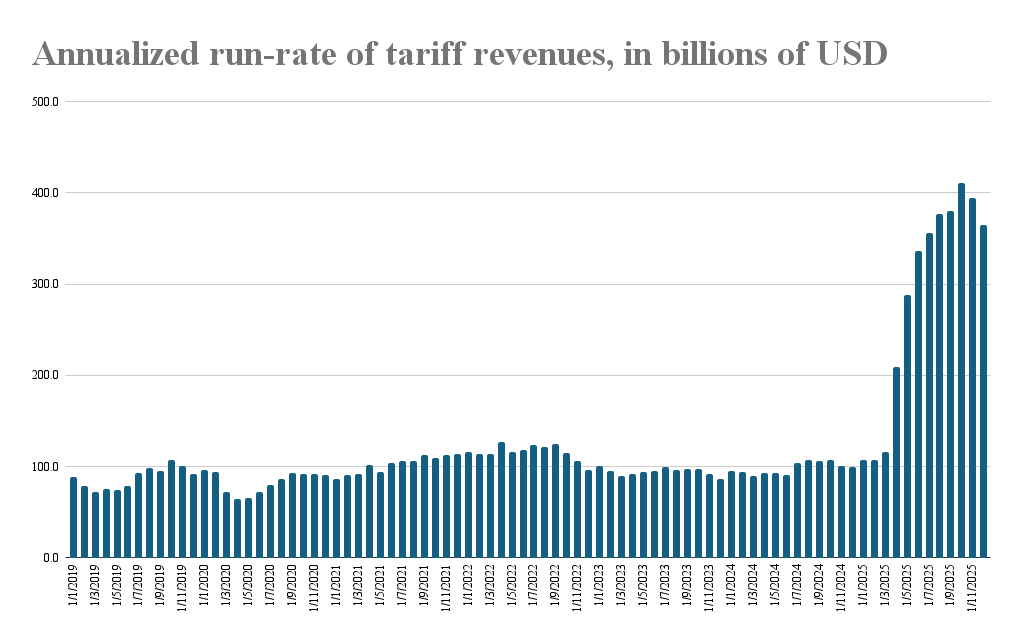
Trump has previously warned that it “would be a National Security catastrophe” if he was forced to refund the tariffs.

Defense stocks are all over the place

U.S. defense company stocks sold off sharply yesterday for a separate but related reason: Trump signed an executive order that potentially bans military supply chain companies from making stock buybacks or setting senior executive compensation higher than $5 million if the White House thinks they aren’t working fast enough or producing high-quality equipment.

“If Raytheon wants further business with the United States Government, under no circumstances will they be allowed to do any additional Stock Buybacks, where they have spent Tens of Billions of Dollars, until they are able to get their act together. Our Country comes FIRST, and they’re going to have to learn that, the hard way!” Trump said on social media.

S&P 500 futures were down this morning after the index fell yesterday. Markets were broadly down in Asia and Europe. Defence stocks are seeing a high level of volatility in reaction to Trump’s various statements.

“President Trump’s social media posts dragged on shares of homebuilders and defence companies,” Jim Reid and his colleagues at Deutsche Bank told clients this morning. 

“Defence contractors including Northrop Grumman (-5.50%), Lockheed Martin (-4.82%) and RTX (-2.45%) slid on the news. However, there were potentially better news for defence firms after the close, with Trump demanding a boost in the 2027 US defence budget from $1trn to $1.5trn. It is $901bn in the current 2026 fiscal year. The renewed policy risks left the S&P 500 -0.34% lower by the close,” they said.

In overnight trading, those stocks popped upward again following Trump’s $1.5 trillion budget proposal. Northrop Grumman rose 7.28%, Lockheed Martin rose 6.71%, and RTX (owner of Raytheon) rose 5%.

If the court rules against Trump, expect those stocks to take another battering, given that the end of the tariffs threatens such a large proposed chunk of Department of War spending.

Also on the radar:

JPMorgan noted that retail stock buyers started the year bullish. They net bought $10.1 billion in stocks in the first week of the year, above the weekly average of $6.5 billion, according to Arun Jain and his team. Most of that ($7.2 billion) went into ETFs.

More cracks in the private credit market, according to S&P Global’s With Intelligence unit. Selective defaults were up as was the use of “Payment-in-Kind” provisions—extra payments that companies promise their lenders if they cannot meet the initial terms of their debt. PIKs are generally associated with lower quality debt.

2026 Bitcoin forecasts are all over the place. CNBC did a roundup of experts’ forecasts for the cryptocurrency’s performance this year and found a wild spread of predictions—perhaps unsurprising given that there is no way to calculate the fundamental value of a piece of code that has no underlying asset behind it.

Here’s a snapshot of the markets ahead of the opening bell in New York this morning:

  • S&P 500 futures were down 0.25% this morning. The last session closed down 0.34% at 6,944.82, a record high.
  • STOXX Europe 600 was down 0.38% in early trading. 
  • The U.K.’s FTSE 100 was down 0.29% in early trading. 
  • Japan’s Nikkei 225 was down 1.63%.
  • China’s CSI 300 was down 0.82%. 
  • The South Korea KOSPI was flat.
  • India’s NIFTY 50 was down 1.01% 
  • Bitcoin sank to $90.1K.
Join us at the Fortune Workplace Innovation Summit May 19–20, 2026, in Atlanta. The next era of workplace innovation is here—and the old playbook is being rewritten. At this exclusive, high-energy event, the world’s most innovative leaders will convene to explore how AI, humanity, and strategy converge to redefine, again, the future of work. Register now.


Source link

Continue Reading

Business

Minneapolis shooter revealed as Jonathan Ross, Iraq War veteran with nearly two decades of Border Patrol, Immigration experience

Published

on


The federal agent who shot and killed a driver in Minneapolis is an Iraq War veteran who has served for nearly two decades in the Border Patrol and U.S. Immigration and Customs Enforcement, according to records obtained Thursday by The Associated Press.

Jonathan Ross, who shot Renee Good on Wednesday, has served as a deportation officer with ICE since 2015, records show. He was seriously injured last summer when he was dragged by the vehicle of a fleeing suspect whom he shot with a stun gun.

Federal officials have not named the officer who shot Good, a 37-year-old mother who was shot as she tried to drive away from federal agents. But Homeland Security Secretary Kristi Noem said the agent who shot Good had been dragged by a vehicle last June, and a department spokesperson confirmed Noem was referring to the Bloomington, Minnesota, case in which documents identified the injured officer as Ross.

Noem and other Trump administration officials have defended the agent as an experienced law enforcement professional who followed his training and shot Good after he believed she was trying to run him or other agents over with her vehicle. Video has raised questions about whether the shooting was in self-defense, and the FBI is investigating the deadly use of force. Some protesters are demanding that Ross face criminal charges, and Minnesota authorities also want to investigate.

Attempts to reach Ross, 43, at phone numbers and email addresses associated with him were not immediately successful.

Here are some things to know about him:

Experienced military and law enforcement officer

In courtroom testimony last month, Ross said he deployed to Iraq from 2004 to 2005 with the Indiana National Guard. Ross said he served as a machine-gunner on a gun truck as part of a combat patrol team.

He said he returned from Iraq in 2005, went to college and joined the Border Patrol in 2007 near El Paso, Texas. He worked there until 2015, serving as a field intelligence agent gathering and analyzing information on cartels and drug and human smuggling.

Ross said he has served as a deportation officer based in Minnesota since he joined ICE in 2015. He is assigned to fugitive operations, seeking to arrest “higher value targets” in the ICE region that includes Minneapolis, he testified last month. He said that he was also a team leader with the FBI’s Joint Terrorism Task Force.

“So I develop the targets, create a target package, surveillance, and then develop a plan to execute the arrest warrant,” he said.

Ross said that he was also a firearms instructor, an active shooter instructor, a field intelligence officer and member of the SWAT team. He said that he attended the Border Patrol’s academy in New Mexico, where he learned to speak Spanish.

Seriously injured last June

Ross was a leader of a team of agents who went to arrest a man who was in the U.S. illegally in the Minneapolis suburb of Bloomington on June 17. Agents had gathered outside the home of the man, Roberto Munoz-Guatemala, who left in his car, according to court records.

FBI agents activated emergency sirens and lights instructing him to pull over but he did not. Ross pulled his vehicle diagonally in front of Munoz-Guatemala to force him to stop.

Ross and an FBI agent identified themselves as police and pointed guns at Munoz-Guatemala, who raised his hands. Ross then approached Munoz-Guatemala’s vehicle and ordered him to put it in park.

Ross told the driver to lower his window all the way down and warned that he would break it if he did not. Ross used a device known as a “spring-loaded window punch” to break the rear driver’s side window and reached inside the car to unlock the driver’s door.

Munoz-Guatemala drove off while Ross’ arm was caught in the vehicle and accelerated, dragging Ross down the street. Ross fired his Taser, striking Munoz-Guatemala with prongs in the head, face and shoulder.

Munoz-Guatemala was not incapacitated by the Taser, prosecutors said, and kept driving, taking Ross the length of a football field in 12 seconds. Ross was knocked free from the vehicle by force after Munoz-Guatemala drove onto a curb for a second time and back to the street.

Ross’ right arm was bleeding, and an FBI agent applied a tourniquet. Eventually, he received dozens of stitches at a hospital. Prosecutors said he had “suffered multiple large cuts, and abrasions to his knee, elbow, and face.”

“It was pretty excruciating pain,” Ross testified.

Munoz-Guatemala was bleeding from his injuries and had a woman call 911, saying that he was assaulted and didn’t know whether the person trying to stop him was an officer. He was arrested and charged with assault on a federal officer with a dangerous or deadly weapon.

A jury found Munoz-Guatemala guilty at a trial last month, finding he “should reasonably have known that Jonathan Ross was a law enforcement officer and not a private citizen attempting to assault him.”

Federal officials defend the agent without identifying him

Vice President JD Vance praised the agent’s service to the country Thursday without naming him, saying the ICE officer “deserves a debt of gratitude.”

“This is a guy who’s actually done a very, very important job for the United States of America,” Vance said. “He’s been assaulted. He’s been attacked. He’s been injured because of it.”

DHS assistant Tricia McLaughlin declined to confirm the agent’s identity Thursday, saying doing so would be dangerous for the safety of him and his family. But she noted that he had been selected for ICE’s special response team, which includes a 30-hour tryout and additional training on specialized skills such as breaching techniques, perimeter control, hostage rescue and firearms.

“He acted according to his training,” she said. “This officer is a longtime ICE officer who has been serving his country his entire life.”

___

AP reporters Michael Biesecker and Jonathan J. Cooper contributed to this report.


Source link

Continue Reading

Business

Wife of Renee Good on fatal shooting: ‘we had whistles. They had guns’

Published

on


The wife of Renee Good, the woman shot and killed in her car by a federal immigration agent in Minneapolis, says the couple had stopped to support their neighbors on the day of the shooting and described the mother of three as leaving a legacy of kindness.

“We had whistles. They had guns,” Becca Good said in a written statement Friday that was provided to Minnesota Public Radio.

The statement was her first public comment about the death of Renee Good, 37, who was killed Wednesday after three Immigration and Customs Enforcement officers surrounded her Honda Pilot SUV on a snowy street a few blocks from the couple’s home. Video taken by bystanders show an officer approaching the SUV stopped across the middle of the road, demanding the driver open the door and grabbing the handle.

The vehicle begins to pull forward and a different ICE officer standing in front of it pulls his weapon and immediately fires at least two shots at close range, jumping back as the vehicle moves toward him.

Trump administration officials have painted Renee Good as a domestic terrorist who tried to run over an officer with her vehicle. State and local officials in Minneapolis, as well as protesters, have rejected that characterization.

Becca Good has not responded to calls and messages from The Associated Press. Her statement provided no further detail about the day of the shooting and instead focused on memorializing her wife.

The couple had only recently moved to Minneapolis and were raising Renee Good’s 6-year-old son from a previous marriage.

Becca said Renee was a Christian who “knew that all religions teach the same essential truth: we are here to love each other, care for each other, and keep each other safe and whole.”

She thanked the people all across America and the world who had reached out in support of their family.

“Renee sparkled. She literally sparkled,” Becca Good wrote. “I mean, she didn’t wear glitter but I swear she had sparkles coming out of her pores. All the time. You might think it was just my love talking but her family said the same thing. Renee was made of sunshine.”

Far from the worst-of-the-worst criminals President Donald Trump said his immigration crackdown would target, Good was a U.S. citizen born in Colorado who apparently was never charged with anything beyond a single traffic ticket.

In social media accounts, she described herself as a “poet and writer and wife and mom.” She said she was currently “experiencing Minneapolis,” displaying a pride emoji on her Instagram account. A profile picture posted to Pinterest shows her smiling and holding a young child against her cheek, along with posts about tattoos, hairstyles and home decorating.

Her ex-husband, who asked not to be named out of concern for the safety of the two now-teenage children he had with Renee Good while they were married, told the AP on Wednesday that he had never known her to participate in a protest of any kind.

Becca Good said the couple, who had previously lived in Kansas City, Missouri, had settled in Minneapolis after an “extended road trip.” She said people they encountered in the Twin Cities had provided a strong sense that “they were looking out for each other.”

“We were raising our son to believe that no matter where you come from or what you look like, all of us deserve compassion and kindness,” Becca wrote. “I am now left to raise our son and to continue teaching him, as Renee believed, that there are people building a better world for him. That the people who did this had fear and anger in their hearts, and we need to show them a better way.”


Source link

Continue Reading

Business

Gen Z are arriving to college unable to even read a sentence—professors warn it could lead to a generation of anxious and lonely graduates

Published

on


As Gen Z ditch books at record levels, students are arriving to classrooms unable to complete assigned reading on par with previous expectations. It’s leaving colleges no choice but to lower their expectations. 

One shocked professor has described young adults showing up to class, unable to read a single sentence. 

“It’s not even an inability to critically think,” Jessica Hooten Wilson, a professor of great books and humanities at Pepperdine University told Fortune. “It’s an inability to read sentences.”

Her observation reflects a broader trend: nearly half of all Americans did not read a single book in 2025, with the habit plunging some 40% over the last decade. And even with young people embracing BookTok, a TikTok subcommunity dedicated to books and literature, Gen Z’s reading habits still lag behind all other generations. Americans aged 18 to 29 read on average just 5.8 books in 2025, according to YouGov.

“I feel like I am tap dancing and having to read things aloud because there’s no way that anyone read it the night before,” Wilson admitted. “Even when you read it in class with them, there’s so much they can’t process about the very words that are on the page.”

Students are struggling to read long passages

With students struggling, academics have been forced to adapt—a move critics describe as “coddling.”

For her part, Wilson has turned to reading passages aloud together, discussing them line by line, or repeatedly returning to a single poem or text over the course of a semester—in part so students can begin to develop the skills to read critically on their own and be prepared for their post-graduate career.

“I’m not trying to lower my standards,” Wilson said. “I just have to have different pedagogical approaches to accomplish the same goal.”

For Timothy O’Malley, a theology professor at the University of Notre Dame, adapting to changes in student behavior hasn’t been especially difficult. It’s always his job to tailor classes to students needs, he argued. What’s more, he said students showing up to class unprepared is nothing new.

Early in his career, O’Malley typically assigned 25 to 40 pages of reading per class —and students would either do it or admit they struggled.

“Today, if you assign that amount of reading, they often don’t know what to do,” O’Malley said—noting that many students instead just lean on AI summaries and miss the point of assigned reading.

He traces part of the problem to earlier stages of education, where reading has been framed as a means to an end rather than a pleasure or habit. Years of standardized testing, he argued, have also trained students to scan for information rather than sit with complex texts.

“They’ve been formed in a kind of scanning approach to reading,” he said—useful for navigating news articles online, but far less effective for engaging with dense novels or philosophical works.

Reading is on the decline—and it could have wide-ranging impacts

One major issue among college students isn’t hostility toward reading so much as a lack of confidence and stamina. 

When professors reduce anxiety around grades, students are often willing to give the reading list a go, according to Brad East, a theology professor at Abilene Christian University. 

In his course, he hasn’t changed reading length or difficulty but rather adjusted assignments in light of generative AI to stimulate real critical thinking.

“It isn’t important to me to have stress-filled cumulative exams, nor do I particularly care about grade inflation,” East told Fortune. “I want them to learn.”

The confidence issue is something that Brooke Vuckovic, a professor at Northwestern’s Kellogg School of Management, has seen among business school students. Each term, about 40-50% of her students describe themselves as novice or reluctant readers, but once they are encouraged to begin reading, she said, the shift can be immediate.

And despite Gen Z’s shift away from reading, the habit remains popular among the ultra-wealthy. A JPMorgan survey of more than 100 billionaires released last month found that reading ranks as the top habit that elite achievers have in common.

The consequences of declining literacy extend far beyond grades, classroom performance, or even future careers. Reading, Wilson said, is a way of seeing ideas from other people’s eyes—leading to increased empathy and feeling of community.

“I think losing that polarization, anxiety, loneliness, a lack of friendship, all of these things happen when you don’t have a society that reads together.”


Source link

Continue Reading

Trending

Copyright © Miami Select.