Connect with us

Business

Netflix co-CEO says he doesn’t read business books—instead, he reads one 1902 novella about a ship and its captain ‘over and over again’

Published

on


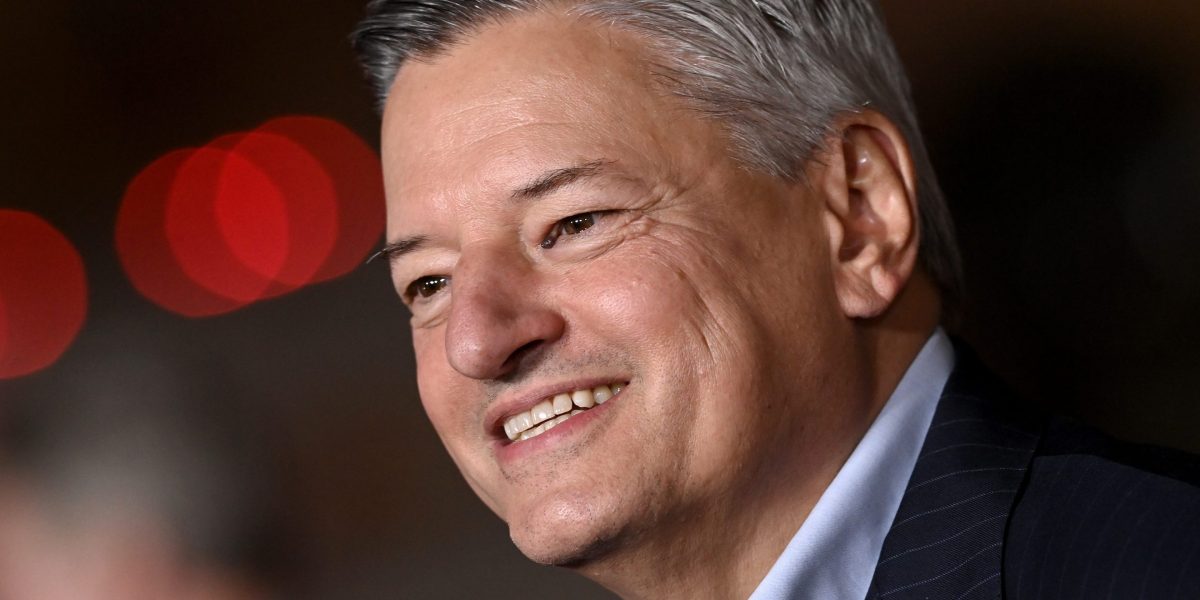
Netflix is in the midst of a high-stakes battle to acquire Warner Bros., a deal that could dramatically reshape Hollywood’s power structure. But amidst the uncertainty, co-CEO Ted Sarandos isn’t looking toward traditional management books for leadership advice.

In fact, the 61-year-old executive doesn’t like to read business books—at all. He instead often returns to his favorite work of fiction: Typhoon, a 1902 Joseph Conrad novella about a steamship captain and crew navigating a severe storm while at sea.

“It doesn’t sound like a management story on the surface, but I think it’s the most powerful leadership story I’ve ever read,” Sarandos recently told CNBC. “I read it over and over again because I find … I get something different in the book every time I read it.”

Typhoon follows a captain forced to make difficult decisions with limited information as the ship faces extreme conditions. Goodreads describes the book as an exploration of leadership, tolerance, and the consequences of making decisions under pressure.

When Sarandos first read the novella some two decades ago, he admitted he thought the captain was a reckless “hot dog” who was endangering his crew. Over time, his interpretation shifted.

“Now, what I see is that when you go through life and you go through business, you make a lot of decisions that don’t turn out the way you thought they would,” Sarandos added to CNBC. “The real leadership test is: How do you manage through that?”

Fortune reached out to Netflix for further comment.

Even business leaders like Bill Gates and Elon Musk take time to turn off the screen and escape inside a good book

Sarandos’s preference for fiction over traditional management books—or even reading at all—may surprise some, especially considering reading is on the decline. Less than half of all Americans did not read a single book in 2025, and daily reading for pleasure has plummeted 40% over the past two decades. 

However, reading is an activity shared by many of the world’s most influential business leaders. A recent JPMorgan survey of more than 100 billionaires found that reading is the most commonly cited habit tied to the success of some of the world’s wealthiest families.

Microsoft cofounder Bill Gates regularly reads more than 50 books a year. And while many of them end up being works of nonfiction, when he does pick up a work of fiction, he makes sure to “read about interesting characters who help me see the world in a new way.” In a November blog post, Gates recommended Remarkably Bright Creatures by Shelby Van Pelt, a novel about finding meaning in life, especially as you get older.

Apple’s CEO Tim Cook has spoken about books that shaped him, citing Phil Knight’s memoir, Malala Yousafzai’s autobiography, and Harper Lee’s To Kill a Mockingbird during a 2023 appearance on Dua Lipa’s podcast.

And Elon Musk, the world’s richest man, has also long credited reading with helping him build foundational knowledge. As a child, he said he spent hours immersed in science fiction and encyclopedias. More recently, he encouraged people to read Isaac Asimov’s Foundation series and called The Hitcherhiker’s Guide to the Galaxy author Douglas Adams his “favorite philosopher.”

“I’d encourage people to read a lot of books,” Musk said on Lex Fridman’s podcast. “Basically try to ingest as much information as you can and try to develop a good general knowledge.”


Source link

Continue Reading

Business

Down Arrow Button Icon

Published

on


If the current frenzy over artificial intelligence feels familiar to Peter Cappelli, the George W. Taylor professor of management at the Wharton School, it’s because he’s seen this movie before. He points to the period between 2015 and 2017, when major consultancies and the World Economic Forum confidently predicted that driverless trucks would eliminate truck drivers within a few years.

“You didn’t have to think very long to realize that just wasn’t going to make sense in practice,” Cappelli told Fortune on Zoom from his home in Philadelphia.

“You didn’t have to think very long about driverless trucks to think about, okay, what happens when they need gas? You know? Or what happens if they have to stop and make a delivery? And if they have to have an employee sitting with them, of course it defeats the purpose, right?”

Cappelli, who recently partnered with Accenture on a series of podcasts to get to the bottom of what AI is actually doing to jobs, warned against listening too closely to the companies that are talking their book, or trying to sell you on their new products.

“If you’re listening to the people who make the technology, they’re telling you what’s possible, and they’re not thinking about what is practical.”

Over the course of a wide-ranging conversation with Fortune, Cappelli tackled what AI is really doing to work, much like he talked to Fortune previously about how remote work is, actually, quite bad for most organizations.

“I mean, people say I’m a contrarian,” Cappelli said, “but I don’t think so, so much as I just am skeptical about stuff, you know?”

When pointed out this was an inherently contrarian position, Cappelli laughed, before returning to the main point. “I just get nervous with hype.”

He talked to Fortune about how his research fits into the wider picture that defined the back half of 2025, after the influential MIT study that caught the eye on 95% of generative AI pilots failing to generate any meaningful return. His favorite example was a particular case study on a company that actually made AI work, both cutting headcount and boosting productivity. It still didn’t fit neatly with predictions (say, from Elon Musk or Anthropic’s Dario Amodei, that work will soon be optional, or even a hobby). “It’s hugely expensive to do this,” Cappelli said about his findings. “And this was a success.”

Three times the cost

Cappelli detailed the findings of a case study that he participated in, published in the Harvard Business Review, on Ricoh, an insurance claims processor: the exact type of low-level administrative work that AI is supposed to automate easily. The reality of adoption, however, was a financial shock. While the company eventually achieved three times the performance, the transition was anything but cheap. The firm spent a year with a team of six, three of whom were expensive outside consultants, just to get the system running.

“The first thing they discovered,” Capelli said, “is large language models could do this pretty well — at three times the cost of their employees doing it [manually]. Okay, so that’s not going to work.” Cappelli pointed out that the costs included Ricoh paying roughly $500,000 in fees to outside consultants.

Even after optimizing the process, Ricoh was still spending about $200,000 a month on AI fees—more than their total payroll for the task had been. They were able to cut their headcount from 44 to 39, he added, showing just how far from being a massive job killer AI is in practice. His explanation recalls his self-driving truck example.

“The reason they still need employees is that lots of problems have to be chased down, and they’re harder to chase down if they come off of AI,” he said. The good news, he added, is that this Ricoh division will ultimately be three times as productive.

“So that’s the payoff, but it’s not cheap [and] it took a hell of a long time to do.”

Ashok Shenoy, VP of Ricoh USA, told Fortune that, after starting to use AI for “very routine, repetitive, high-volume tasks,” work for humans didn’t disappear, but “shifted toward areas where human judgment and experience add the most value.” In the year or so since the case study was conducted, he noted that Ricoh has successfully applied AI to mid-level, repetitive, time-consuming tasks at scale, and expects to use AI agents to achieve partial or full workflow automation within the next six to 12 months, “with a human-in-the-loop to resolve missing or unclear information and ensure quality.”

While acknowledging the big-ticket costs highlighted by Cappelli, Shenoy noted that this project reached break-even in less than a year, and it’s $200,000 monthly costs are less expensive than the previous operating model. “The shift to AI delivered an estimated 15% total cost reduction, even though it did not rely on significant labor cuts.” Regarding headcount, he said “this exercise was not driven by cost or headcount reduction,” and AI implementation requires creating new roles, redesigning existing ones, and repurposing team members toward higher-value work. He said there haven’t been further job cuts, either, with staffing levels largely stabilizing as productivity increased and volumes grew. “The bigger change was in how people spent their time. They are doing less repetitive work and are more focused on resolving exceptions, maintaining quality and serving customers.”

Performative AI shame in the boardroom

Cappelli said he found similar dynamics in his partnership with Accenture, which looked at Mastercard, Royal Bank of Scotland, and Jabil. “These are all success stories,” he said, and in the long run, they will see productivity will go up. Companies will be able to do more with fewer people but “it’ll take a long while to get there.” He argued that something crucial is being underestimated. “The key thing, though, is just how much work is involved in doing it.”

Also, regarding headcount reductions, Cappelli said that at least in the areas that he researched, which were specific units within each company, he didn’t see any job cuts whatsoever. When contacted for comment by Fortune, Accenture said it largely agrees with Cappelli’s conclusions, and referred back to CEO Julie Sweet’s recent interview with Fortune Editor-in-Chief Alyson Shontell.

According to Cappelli, so much of the noise around AI—and the distance between what’s possible and what’s practical—is driven by what other commentators have called “AI shame.”

Cappelli wasn’t familiar with the “AI shame” phrase, but told Fortune it was “absolutely right” in describing what he’s seen. “They’re pretending so they can say they’re doing something, right?” he said. “So the pressure is just enormous on them to try to make this stuff work, because the investors love the idea.”

The professor cited the Harris Poll’s finding in early 2025 that 74% of CEOs globally felt they’d lose their job in two years if they couldn’t demonstrate AI success, and roughly a third said they were performatively adopting AI without really understanding what it would entail. As The Harris Poll put it: “CEOs estimate that over a third (35%) of their AI initiatives amount to mere ‘AI washing’ for optics and reputation, but offering little to no real business value at all.”

Cappelli described how markets typically celebrate news of layoffs, and even cited research that “phantom layoffs” get announced by companies that never actually occur, because companies are arbitraging the positive stock-market reaction to the news of a potential layoff.

Cappelli predicted a “slow learning curve” will take place, in which CFOs will start realizing “this is super-expensive stuff to put in place.” The problem, according to Cappelli, is that U.S. management has become “spoiled” and increasingly averse to the hard work of organizational change.

“[Employers] think it should be free. It should be cheap. You should just be able to hang a shingle out, and the right people will just show up,” he says. Real AI success, in his opinion, will require “old-fashioned human resources” work: mapping workflows, breaking down jobs into tasks, and having employees work alongside AI “agents” to refine prompts.

“You can’t do it over the top of employees, because the employees really do know how their job is done,” Cappelli said. The professor was withering about what he sees happening in most C-suites, saying they are largely “ducking” the problem of really grappling with this technology.

“They’re not seeing it as an organization change problem and a big one,” he said. “They’re just stressing everybody out and, you know, hoping that it somehow works itself out.”


Source link

Continue Reading

Business

Netflix’s $82.7 billion rags-to-riches story: How the a DVD-by-mail company swallowed Hollywood

Published

on


It’s a story so good  it could have been a screenplay. In 2000, Reed Hastings and Marc Randolph sat down across from John Antioco, then CEO of video rental giant Blockbuster, and pitched him on acquiring their still unprofitable DVD-by-mail startup, Netflix, which at the time had around 300,000 subscribers. But when they told him their price—$50 million and the chance to develop and run Blockbuster’s online rental business—Antioco balked. It was a famously shortsighted business decision: By 2010, Blockbuster had filed for bankruptcy, and Netflix had stormed Hollywood with its entertainment streaming service

Now Netflix—a behemoth that has moved far beyond streaming others’ films and shows, with an estimated $18 billion content spend for 2025—is writing the sequel, following the same underdog-towinner trope. It announced in early December an $82.7 billion deal to become the new owner of the storied Warner Bros. film and television studios, plus cable crown jewel HBO and streamer HBO Max. The deal comes some 15 years after an executive who previously oversaw those very assets dismissed the notion of Netflix being a threat to Hollywood’s power structures: Jeff Bewkes, then CEO of Warner Bros. parent Time Warner, described that scenario in 2010 as “a little bit like, is the Albanian army going to take over the world?” 

To be sure, Netflix has never before attempted a deal of this size. And with rival Paramount making a play for the entire Warner Bros. Discovery business through a hostile bid, a Netflix–Warner Bros. tie-up is still far from a sure thing. But even if the deal never actually materializes, Netflix has demonstrated how to not just disrupt an industry but swallow it. 

It’s a trajectory that’s all the more impressive given the company’s scrappy, dotcom-era start. “Netflix should have never existed,” says Peter Supino, who analyzes the media and entertainment industries as managing director at Wolfe Research. “Their path relied on a bunch of strategic decisions that were risky and uncertain at times and the body of which proved out to be smashingly correct.” 

To dominate streaming today, of course, is to dominate all of entertainment. And Netflix now has a market cap—almost $400 billion currently— that exceeds the combined value of legacy competitors Disney, Warner Bros. Discovery, Fox Corp., Paramount, and Lionsgate. 

So just how did Netflix do it? The company has built a culture that fosters flexibility and daring, and has repeatedly shown its adeptness at taking calculated risks—including a series of strategic U-turns. Netflix was never going to make original television shows and movies—until it ponied up an unprecedented $100 million for two seasons of House of Cards from executive producer David Fincher in 2011, sight-unseen without a pilot. Netflix didn’t care about password sharing—until it began vigorously enforcing a “one household” rule in 2023. Netflix was never going to introduce livestreaming or advertising—until it added both within a few months in 2022 and 2023, then struck its first major sports rights deal, another one-time no-go, in 2024.

“When one of your people does something dumb, don’t blame them. Instead ask yourself what context you failed to set. Are you articulate and inspiring enough in expressing your goals and strategy? Have you clearly explained all the assumptions and risks that will help your team to make good decisions?”


Reed Hastings on leading with “context, not control.”
From No Rules Rules: Netflix and the Culture of Reinvention, by Reed Hastings and Erin Meyer

And Netflix was never going to go all in on theatrical releases—until it decided to buy Warner Bros. and pledged to distribute its films to movie theaters. “We’ve built a great business, and to do that, we’ve had to be bold and continue to evolve,” co-CEO Ted Sarandos told investors on the call announcing the deal. “We can’t stand still. We need to keep innovating and investing in stories that matter most to audiences.”

Call it “innovating,” or call it misleading the competition, most people agree that Netflix has offered a master class in audacious strategy. In his business tome, No Rules Rules: Netflix and the Culture of Reinvention, Hastings offers guidelines for strategic pivots, pointing out: “The vast majority of firms fail when their industry shifts.” The former CEO, who kicked himself upstairs to chairman in 2023, attributes the company’s success to a culture that prioritizes innovation, motivates top performers, and has few controls, allowing Netflix “to continually grow and change as the world, and our members’ needs, have likewise morphed around us.” 

This is antithetical to how business is usually done in Hollywood, where studio executives would rather bet on proven IP with sequels, spinoffs, reboots, and copycats than stick their neck out for new, untested ideas. 

Netflix cofounder and ex-CEO Reed Hastings (left) with his successor, co-CEO Ted Sarandos.

Kevin Dietsch—Getty Images

A bolder approach has given Netflix the upper hand. “We were willing to take the risk that these other companies weren’t willing to take because they were so stuck on what made them successful in the first place,” says Jessica Neal, former chief talent officer at Netflix. This approach means also accepting what Neal calls “the tax” of sometimes disappointing customers in the short term, in service of a bigger goal. Case in point: Netflix’s short-lived plan to split its DVD-by-mail operations into a separate unit called Qwikster in 2011, while arguably necessary to maintain the focus on streaming growth, annoyed customers, and its execution was seen as a rare blunder for the company

“Companies do [themselves] a massive disservice because they look at mistakes as failures, and we looked at mistakes as learning,” says Neal, who worked almost 12 years in talent-focused roles during two stints at Netflix. “But you have to teach people how to do it, and we did. And you also have to hire people that have the appetite to do it.” 

That once-scrappy DVD-by-mail company now employs around 14,000 people worldwide. And after nearly 30 years of strategic pivots, little of Netflix’s original business model remains in place. Yet remarkably, the company’s internal corporate culture remains relatively unchanged. It’s that work
environment—and what Supino calls an “unsentimental culture”—that just might be its secret weapon. 

Thousand-fold growth

Blockbuster turned down the opportunity to buy Netflix in 2000.

~300,000


Approximate number of subscribers to Netflix’s DCD-by-mail service in 2000

>300 million

Netflix’s 2025 streaming subscribers, in over 190 countries
Sources: Netflix, Media Reports

In 2009, Netflix published a 125-slide culture deck on how it has become such a high-functioning workplace. The memo has been updated several times, but it continues to emphasize a handful of unique concepts, including freedom over processes, leading with “context, not control,” and a commitment to candor, even (or especially) when it’s uncomfortable. 

As Hastings’s book acknowledges, Netflix’s culture is weird. The company doesn’t keep track of vacation or expenses. It champions internal transparency around performance data and executive salaries. And to ensure it’s only employing people at the top of their game, the company famously applies a “keeper test”—essentially an employee review where bosses ask themselves, “If X wanted to leave, would I fight to keep them?”—to decide who is delivering real results and who should be let go. Some very senior executives have exited the company in accordance with these principles, including Patty McCord, the company’s original chief talent officer and one of the architects of its corporate culture. 

“We were very focused on feedback and having tough conversations that people don’t want to have,” says Neal. “And we believed that telling the truth to somebody was actually caring, and it was uncaring to do the opposite.” This helps teams communicate during rough patches, she says: “We actually were able to navigate those things much more effectively because we were able to talk about the tough stuff.”

Take the moment, all those years ago, when Time Warner’s CEO shrugged Netflix off as the “Albanian army.” In what could be a scene straight out of the official Netflix movie, a comment intended as an insult instead galvanized the troops. Hastings reportedly gifted top executives camouflage berets featuring the double-headed eagle from the flag of Albania, and Neal remembers staff wearing Albanian army dog tags “with pride.” 

Even back then, they knew they’d eventually get their Hollywood ending.

This article appears in the February/March issue of Fortune with the headline “How Netflix swallowed Hollywood.”


Source link

Continue Reading

Business

Gen Z is rebelling against the economy with ‘disillusionomics,’ tackling near 6-figure debt by turning life into a giant list of income streams

Published

on


What happens when a generation is raised on economic promises that never materialize? Gen Z may want to ask their older siblings, the millennials, how that turned out, as the Great Recession of 2008—and the ensuing “jobless recovery”—left millions of altered lives, if not dashed dreams, in its wake. 

But as the oldest Gen Zers approach the 30-year-old benchmark, the economic habits of a generation who was born during a financial regime change are looking increasingly different from those of the generation that lived through it. 

The zoomers double as the so-called “doom spenders,” dishing out hundreds of dollars on concert tickets or international travel, entrenching the “YOLO economy” that emerged in 2021 amid the meme-stock craze. Gen Zers average $94,101 in personal debt, the highest of any generation and far more than millennials ($59,181) and Gen X ($53,255). 

This could be easily written off as the financial mismanagement of youth, but taken as a whole, Gen Z’s outlook on the economy is at once a rejection of conventional wisdom and a deep, almost subconscious absorption of the commodification of everything. Economist and author Alice Lassman, a (British) Gen Zer herself, has written for Business Insider about her personal disillusionment after her stint at Columbia led to a verbal, later rescinded offer to be an economist at USAID. She calls Gen Z’s approach to economic life “disillusionomics,” or a way to cope with an uncertain and mystifying financial future. 

Lassman wrote about her theory for the Guardian in October 2025, and told Fortune that she came up with the term herself. “I actually was sitting for a while with trying to understand this broad trend, or this broad glue that was connecting together a lot of the disparate Gen Z trends that we were seeing.” She said she thinks much of the way people relate to her generation has to do with this underlying economic phenomenon.

Gen Z’s rejection of traditional financial prudence is deeper than coming of age during an economic crisis, like their millennial counterparts, she told Fortune in an interview. With some members still in middle school, they are much younger than millennials were in 2008 and are more skeptical about their financial futures, according to the Institute of Politics at Harvard Kennedy School. 

“The economic system their parents are talking to them about isn’t really going to work out for them in the same way,” Lassman explained. Her first taste of economics was the 2008 financial crisis, which hit when she was in what the British call primary school. “Since then it’s been kind of a perpetual crisis,” she said. Gen Z has internalized a mismatch between what they were told about how the economy works and what they’ve experienced much more deeply than is often appreciated, she argued. 

“I think there’s this general sense of kids at school and … the content that they’re being exposed to, that things aren’t fitting, that like the economic system they think their parents are talking to them about isn’t really going to work out for them in the same way,” Lassman said. 

Lack of faith in the future promised to them

Familiar markers of stability, such as homeownership, family and retirement feel unattainable. The unemployment rate for 16-to-24-year-olds reached 10.8% last year compared to 4.3% overall. One-third of Gen Z says they believe they’ll never own a home, and many are planning to forgo having children. Disillusionment, to Lassman, explains why Gen Z is no longer playing by the rules as they grow in their distrust of institutions like government, media, and business.

While alluding to “economic nihilism,” the term coined by entrepreneur Demetri Kofinas and made famous by the influential Substacker Kyla Scanlon, Lassman said her theory of disillusionomics has to do with the “late-stage commodification of anything.” Riffing off how Airbnb pushed a model of turning a spare room into more income, she said “Gen Z has taken that logic to the max” with their habit of “house hacking,” or renting an apartment larger than they need, chopping it up, and renting out rooms. She sees a generation constantly looking to diversify their sources of income, and seeing content creation as a kind of passive income. 

“When every conventional path narrows, people start to look for alternatives. And in practice, that has meant turning toward the few places where a real upside still appears possible, even if the risks are high.” Scanlon recently wrote in the Wall Street Journal. “When people start treating the economy like a game, it’s a sign that the traditional ways of winning no longer feel real.”

Lassman noted that Gen Z is more likely to use buy-now-pay-later services than traditional credit cards, affording them flexibility as they commodify their lives. Despite their affinity towards BNPL, Gen Z seems to be, in line with Lassman’s theory, spending less in general and spending differently than older generations. 

“You know, Gen Z’s so interesting,” PwC’s global retail leader Kelly Pedersen told Fortune, expressing surprise at how little they’re spending as they age. He estimated that Gen Z spent 10% to 12% in the recent holiday season than the previous year. “For their spend to decrease as much as they say it was going to decrease is pretty significant,” she said. 

“That generation should be increasing spending more than anybody,” Pedersen said, “because they have the highest income growth out of any generation,” but it’s just not happening. He added that while it was “pretty surprising” to see this, any close watcher of Gen Z would expect it as this approach to spending is “pretty pervasive in terms of that generation and some of their habits … what we found overall is that the generation is very, very value-conscious.”

Pederson alluded to “dupe culture,” or Gen Z’s love of cheaper alternatives to luxury goods. “We find that if that generation doesn’t see the value there very quickly, they will very quickly trade down into a dupe, right, or into something that is like what they want, but maybe isn’t as expensive. So it’s all about value, value, value to that generation.” Gen Z disillusionomics, in other words, means they quite literally see past the illusion of luxury fashion into the value they can get from an object. Sustainability and longevity also play a big role in how Gen Z spends their money, he added.

Trouble in paradise

Gen Z also displays some “hostile” attitudes, Lassman said, being increasingly prone to shoplift in person or online because they feel like it is justified to steal from corporations that can absorb the loss. Others fall into zero-sum thinking about resources and an increasingly competitive labor market.   

They are also more likely to experience age and money dysmorphia, Lassman said, a need to feel like they are always catching up. Short-lived financial trends and coping mechanisms such as treat culture and fast-yield dividend investments are material and psychological “survival strategies” to manage life in an affordability crisis. 

“People are thinking that they’ve lost time, so we’re all kind of panicked about where things are going, also living in a very, very volatile world, politically, socially, economically,” she said. 

Economic nihilism has been another strong reaction to an economy some say does not reward long-term planning. By gamifying their finances with prediction markets, sports betting and cryptocurrency, Gen Z is creating new opportunities to build lives for themselves in the system they don’t believe serves them.

Lassman told Fortune that she doesn’t think Gen Z is even really aware of how it’s acting, economically, but they are shaping the 21st century as they grow up. “A lot of it is just kind of reactive,” she said. “And so they’re kind of defining their own income streams.”


Source link

Continue Reading

Trending

Copyright © Miami Select.