Connect with us

Politics

Lori Berman blasts Gov. DeSantis’ redistricting push as ‘clearly illegal,’ citing 2010 amendment
Published

on


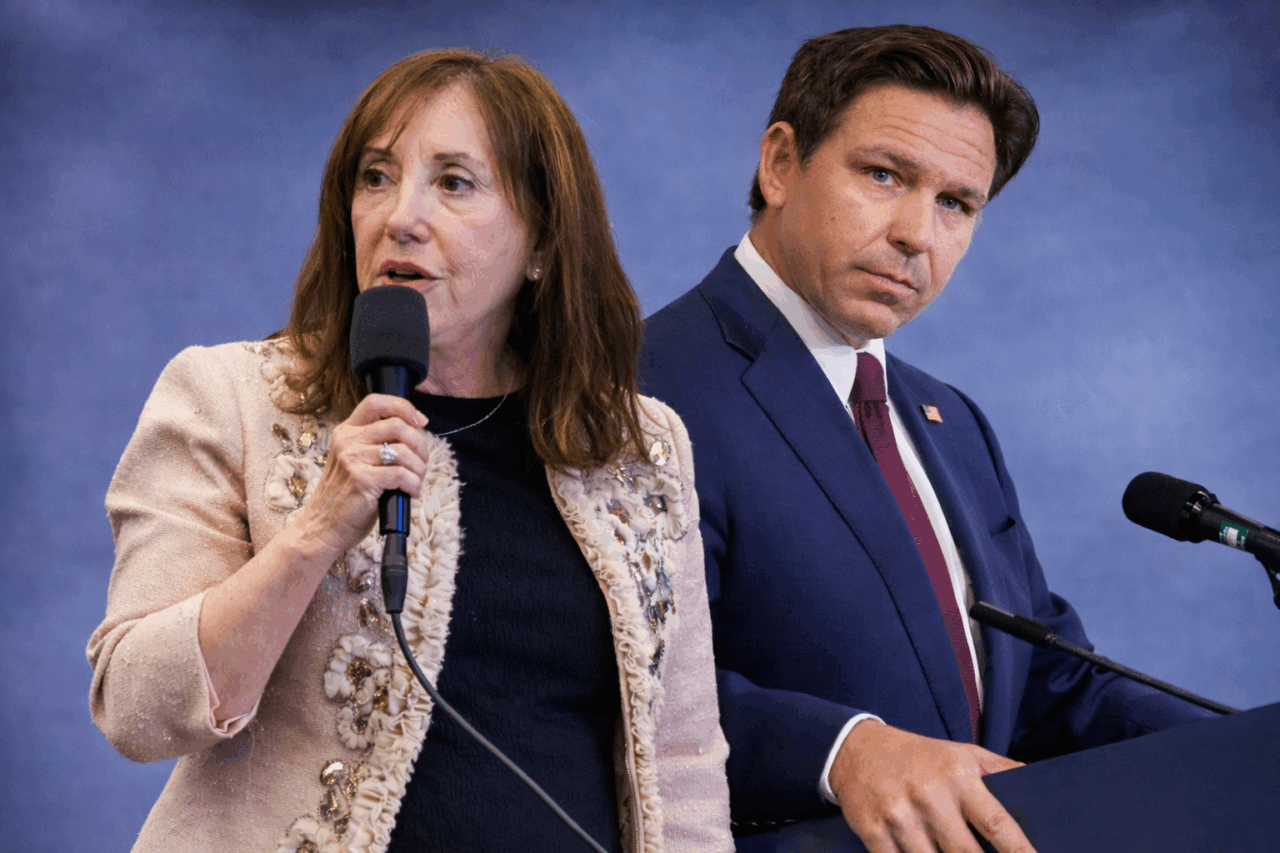
Gov. Ron DeSantis’ just-announced confirmation that he will pursue mid-decade redistricting through a Special Session drew a swift rebuke from Senate Democratic Leader Lori Berman, who argued such a move would violate the Florida Constitution.

Berman, a Boca Raton lawyer, pointed to the Fair Districts Amendment, which 63% of voters approved in 2010 to ban partisan or discriminatory gerrymandering. The amendment requires fair, compact, voter-respecting legislative districts. That’s the antithesis of what DeSantis and other GOP policymakers are proposing, Berman said.

“No matter what pretext the Governor offers for mid-decade redistricting — and he has offered nearly half a dozen in an attempt to find one that sticks — what he wants the Legislature to do is clearly illegal,” Berman said in a statement Tuesday, shortly after DeSantis said he’ll reconvene lawmakers on the matter in April.

“Florida’s Fair Districts Amendment strictly prohibits any maps from being drawn for partisan reasons, and regardless of any bluster from the Governor’s office, the only reason we’re having this unprecedented conversation about drawing new maps is because Donald Trump demanded it.”

Trump’s administration began calling for redistricting in mid-2025 to give Republicans a better chance to flip Democrat-held seats by the 2026 Midterms. Efforts to follow through on the President’s demands are now playing out in one form or another across 15 states, including Missouri, Ohio and Texas, while Democrat-led states like California and New York are weighing retaliatory or defensive redistricting moves.

Florida already has a 20-8 Republican advantage in its congressional delegation through maps the Governor’s Office drew based on 2020 Census data, which DeSantis called “flawed” in October. That same month, he said his proposed “political gerrymandering” is “likely” to survive court challenges, since the U.S. Constitution “says nothing” about it.

But the Florida Constitution does. The Fair Districts Amendment, added to Section 20, Article III, states: “No apportionment plan or individual district shall be drawn with the intent to favor or disfavor a political party or an incumbent; and districts shall not be drawn with the intent or result of denying or abridging the equal opportunity of racial or language minorities to participate in the political process or to diminish their ability to elect representatives of their choice; and districts shall consist of contiguous territory.”

DeSantis said Florida is awaiting a U.S. Supreme Court ruling on a case concerning Section 2 of the Voting Rights Act, which has been used to draw majority-minority congressional districts almost exclusively led by Democrats.

The Court’s 2019 ruling on Rucho v. Common Cause provided that while partisan gerrymandering may be “incompatible with democratic principles,” there is no clear, manageable legal standard for federal courts to determine when partisan line-drawing goes too far.

However, the court did leave the door open for challenges under state constitutions and state courts, noting that states are free to adopt anti-gerrymandering rules — such as Florida’s Fair Districts Amendment — and enforce them independently of federal courts.

A majority of Florida’s electorate opposes mid-decade redistricting, according to polling Common Cause commissioned late last year, which found 55% of voters are against political parties changing district boundaries mid-decade. That included 62% of Democrats, 60% of third- and no-party voters, and a plurality (45%) of Republicans.

“An overwhelming majority of Floridians voted in favor of the Fair Districts Amendment and their voices must be respected,” Berman said. “The redistricting process is meant to serve the people, not the politicians.”

The Florida Democratic Party and League of Women Voters of Florida expressed similar disdain for the redistricting push, calling it “a desperate attempt to rig the system” and “an affront to Florida voters,” respectively.


Source link

Continue Reading

Politics

Massive immigration package targets employers hiring undocumented immigrants

Published

on


Florida businesses that purposely ignore whether employees are legally in the United States could face hefty fines or even criminal charges if they hire more than 50 undocumented immigrants, according to a sweeping new immigration package.

Filed Wednesday by Republican Sen. Jonathan Martin, the 34-page bill would presume certain noncitizens are at fault in car accidents, severely restrict their employment, and prevent state banks from loaning them money.

It’s the most wide-ranging immigration bundle proposed so far ahead of the 2026 Session, and would extend a 2025 crackdown that removed in-state tuition for undocumented students, impose state-level penalties for illegally entering Florida, and require all counties to partner with Immigration and Customs Enforcement (ICE).

The nationwide push to quash all avenues for undocumented immigration has been exemplified in Florida, the first state to create a state-run migrant detention center. Since President Donald Trump’s inauguration last January, Sunshine State officials have mirrored his anti-illegal immigration agenda.

This includes deputizing hundreds of state and local officials to act as immigration officers; Florida is the only state to have all of its (67) counties entering into 287(g) agreements, which are partnerships with ICE.

Martin didn’t immediately respond to a request for comment.

E-Verify penalties

SB 1380 would create civil penalties for employers who fail to properly use E-Verify, a federal database that checks whether new hires are legally authorized to work in the country. This builds off of another Martin bill, which would require all businesses to use E-Verify.

Employers who fail to check workers’ immigration status through E-Verify before submitting workers’ compensation claims would be personally liable for any costs, expenses or benefits for undocumented employees.

Purposely not checking their status, however, would result in suspension of business licenses for one year and fines up to $10,000. Doing it again would result in a five-year license suspension alongside a $100,000 fine, and a third violation would mean permanent license revocation and a $250,000 fine.

If the employer purposely flouts this section and the undocumented worker then ends up injuring another person, the employer’s license would be suspended for five years with a $100,000 fine. If the worker kills another person, the licenses would be permanently revoked with a $500,000 fine.

In a similar vein, the bill would impose a third-degree felony charge for an employer who knowingly hires more than 50 undocumented workers. The business would permanently lose its license. The bill would create a cause of action against the employer for any person injured or the next of kin of a person killed by the actions of an undocumented worker.

These provisions evoke a recently closed, two-year federal investigation into Archer Western, a road-building company hired by the state that employed undocumented immigrants for years, as the Tampa Bay Times has reported.

Officials opened the investigation after an undocumented Archer Western employee driving heavy machinery in 2022 hit and killed a Pinellas County deputy. At least 18 of his coworkers on that state-funded construction site were also undocumented.

Car accidents, foreign remittances, and licensing

SB 1380 would create a rebuttable presumption of fault in car accidents involving undocumented immigrants from other states. This means if an out-of-state driver who is undocumented is involved in a car accident in Florida, authorities could presume he or she was at fault — as long as the other motorist wasn’t driving recklessly, under the influence, or clearly at fault.

Insurers could not pay benefits or settle claims with an unauthorized out-of-state driver, the bill says.

Additionally, the bill requires law enforcement officers investigating car accidents to verify whether the parties are legally in the country.

Other provisions would ban the state Division of Risk Management from approving a claim submitted by an adult undocumented immigrant. Unauthorized immigrants would be barred from sending money to other countries and state banks could not accept IDs traditionally used by undocumented immigrants or those illegally in the state with down payments or loans.

All licensing procedures, relicensing instruction and licensing testing must be conducted in English, the bill says. Interpreters, translators or alternate language accommodations would be banned.

The 2026 Session begins on Jan. 13.

___

Reporting by Liv Caputo. Florida Phoenix is part of States Newsroom, a nonprofit news network supported by grants and a coalition of donors as a 501c(3) public charity. Florida Phoenix maintains editorial independence. Contact Editor Michael Moline for questions: [email protected].


Source link

Continue Reading

Politics

Gov. DeSantis appoints business, education leaders to the St. Petersburg College Board

Published

on


The Trustees will help oversee governance, budgeting and strategic direction for St. Petersburg College.

Gov. Ron DeSantis has appointed two new members and reappointed three incumbents to the St. Petersburg College District Board of Trustees.

DeSantis announced the appointment of Richard Franz III and Danielle Marolf, along with the reappointment of Jason Butts, Katherine Cole and Thomas Kidwell.

Franz serves as Chief Operating Officer and Southeast regional managing partner at Sorren Inc. He is a member of both the American and Florida Institutes of Certified Public Accountants and previously worked as a CPA at PricewaterhouseCoopers. He earned a bachelor’s degree in accounting from the University of Florida.

Marolf is President, founder and head of school for Wellmont Academy. She also serves as Vice Chair and Treasurer of the Florida Coalition of Christian Private Schools Accreditation. Marolf holds bachelor’s degrees in psychology and music from Houghton College.

Butts is President of SimplyIOA, a division of the Insurance Office of America. He’s a member of the Citizens Property Insurance Corporation Board of Governors and the Florida Association of Insurance Agents, and earned a bachelor’s degree in telecommunications from the University of Florida.

Cole is a lawyer and shareholder at Hill Ward Henderson. She is Chair-elect of the Clearwater Regional Chamber of Commerce, serves on the Morton Plant Mease Hospital Board of Directors, and has previously served on both the Pinellas County and City of Clearwater charter review committees. Cole earned her undergraduate degree from the University of Tennessee and her law degree from Stetson University.

Kidwell is Vice President of Wealth Management at Cyndeo Wealth Partners. His background includes time as an account Vice President at UBS and time as a minor league baseball player and coach within the St. Louis Cardinals organization. He earned a bachelor’s degree in American Studies from Yale University.

All five appointments are subject to confirmation by the Senate. If confirmed, the Trustees will help oversee governance, budgeting and strategic direction for St. Petersburg College.


Source link

Continue Reading

Politics

State leaders take action against toxic baby formula

Published

on


If you’re tired of questionable additives in your baby’s bottle, good news: Gov. Ron DeSantis and other state leaders are as well.

During a press conference in Bartow, DeSantis and other state leaders condemned toxic filler in formula, introducing members of the Florida MAHA Commission and lauding their efforts to test “staples” like infant formula.

“What we just want is, basically, transparency and the truth, and we want people to be able to make the best decision for them — not necessarily what would be in the best decision of some, you know, manufacturer or something like that,” DeSantis said.

First Lady Casey DeSantis, a survivor of breast cancer and a mother of three, said “small, repeated toxins” can add up to consequences, particularly in what’s being fed to babies.

Baby formula contamination “affects the most vulnerable among us,” she said, noting that Friday’s action is just the first of many “major announcements” regarding toxic additives to food in the coming days and weeks.

Florida’s Department of Health tested 24 formulas for contaminants, with 16 of them having at least one heavy metal that exceeded federal standards, the First Lady said, evidencing “systemic problems” and showing the need for manufacturers to test for “harmful chemicals.”

“Of the 24 infant formulas tested, 16 of those formulas contained at least one, if not more, heavy metals that exceeded federal standards. Mercury was the most common detected above federal benchmarks in 16 formulas. Arsenic exceeded benchmarks in five formulas; cadmium, three; and lead, two.”

The First Lady said this initiative showed Florida’s willingness to help out the U.S. Department of Health and Human Services’ Stork Speed operation, and called on other states to join the effort and be a “force multiplier.”

She also said that families in the Women, Infants, and Children (WIC) program will now have more formula options covered by financial assistance, in the event people want to change, and urged them to check out ExposingFoodToxins.com to find out specifics about given products on the market.

Surgeon General Joseph Ladapo, a father of three himself, noted that many families supplement with, or exclusively use, baby formula for nursing infants, and said neurological development could be harmed by the heavy metals found in formula.

“I wish I could say this was an isolated finding,” Ladapo said.

Lt. Gov. Jay Collins said a “medically-complex child” of his could only take formula, and noted that one of those identified in the state testing was one that his kid used.


Source link

Continue Reading

Trending

Copyright © Miami Select.