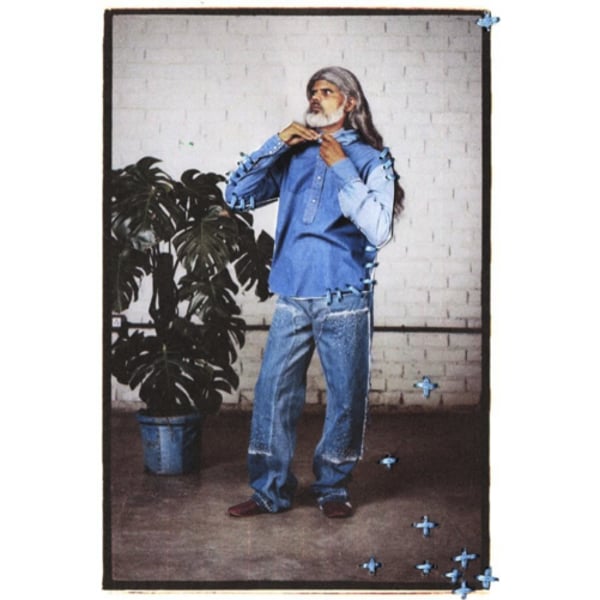
This season, the Fédération de la Haute Couture et de la Mode (FHCM)’s Sphere showroom welcomes two emerging labels for the first time. Gardouch and Rkivecity join five labels already well established in the French capital: C.R.É.O.L.E, Cachí, La Cage, Ouest Paris, and Lazoschmidl.
Rémy Guerra explores memories and nostalgia linked to childhood – Gardouch
Hosted at the Palais de Tokyo during Paris Fashion Week Homme from January 21 to 25, the two brands were selected for their distinctive visions. Gardouch is a French label named after a village in south-west France. Founded in 2024 by Rémy Guerra, a graduate of Amsterdam’s Gerrit Rietveld Academie, Gardouch is guided by a central idea: memory fades if we cease to hold on to it.
Two labels exploring time
With collections entitled “Le loup au fond du couloir” and “Jouer à faire semblant,” multidisciplinary artist Rémy Guerra draws directly on his childhood memories, reframing them through themes that continue to resonate with adults. His colourful, eclectic hats, tops, dungarees, and tutus evoke a birthday-party wardrobe, poised between naïve craftsmanship, anachronisms, and deadstock materials. With his “Les ombres” line, the designer strips the pieces of colour, rendering them entirely black and leaving only their essence.
Born in New Delhi, Rkivecity draws its strength from the history of objects and materials – Rkivecity
Alongside Gardouch, Sphere welcomes Rkivecity. The label crafts a wardrobe inspired by a host of elements gleaned from the everyday by its designer, Ritwirk Khanna. A graduate of New York’s Fashion Institute of Technology, where he immersed himself in material histories, vintage, and archives, he came to believe that garments bear the imprint of time. On his return to India, he worked in Gujarat’s Special Economic Zones on textile waste management projects, an experience that revealed the scale of overconsumption and marked a turning point in his career.
In the early 2020s, the designer founded Rkivecity, a brand conceived as a research and design laboratory dedicated to circularity. Drawing on traditional techniques such as boro and raffoo, the brand develops zero-waste remanufacturing systems. Each piece is repaired, reconstructed and reinterpreted to give it new life, in a process that saw Ritwirk Khanna take the top prize at the R|Elan Circular Design Challenge, a United Nations-supported award centred on circularity.
This article is an automatic translation. Click here to read the original article.
For nearly two decades, sports brands benefited as people swapped out dress shoes for sneakers when heading everywhere from the airport to fancy restaurants and even the office.
Nike
That’s been a boon for Adidas AG, Nike Inc. and Puma SE, which capitalized on consumers’ changing tastes by serving up snazzy, comfy kicks that people wanted to wear on and off the playing field. The rising demand for sports shoes also underpinned the rapid growth of challengers like Hoka and On Holding AG, which emerged in the wake of the financial crisis and quickly became popular brands.
Now the future of that longstanding sneaker boom is being called into question, most notably by Bank of America analysts led by Thierry Cota. They rocked the footwear world last week with a 61-page analysis concluding that the growth prospects for these sports brands are rapidly dimming.
They argue that the sporting goods sector had enjoyed a 20-year “upcycle” that lifted sneakers from less than a quarter of world footwear sales to at least a half — a trend that culminated during the Covid pandemic, when millions of people were suddenly working from home. “With this structural shift largely complete, prospects for future revenue growth are now significantly reduced,” the analysts said.
They accompanied that view with a rare “double downgrade” of Adidas, abandoning their “buy” rating and declaring the stock one of the least attractive in the industry.
Their contention that the sneaker boom has passed its peak prompted a backlash from skeptics who say the casual footwear trend has room to run. Longtime industry analyst Matt Powell, an adviser at consulting firm Spurwink River, conveyed that sentiment on LinkedIn, where he posted a Barron’s article about the research and commented: “C’mon, man! No evidence of this.”
Adidas shares plunged as much as 7.6% in response to the downgrade on Tuesday, before recovering part of those losses by the end of the week.
Sneakers now make up about 60% of footwear sales in the US, according to Beth Goldstein, an analyst at Circana in New York. Sport shoes have won over the population as part of a wider societal push toward comfort, health and wellness, priorities that probably aren’t going to disappear anytime soon, she said. The US sneaker category grew 4% last year through November, while the fashion category dropped 3%, she added.
“The sneaker business is larger than ever,” she said. “I wouldn’t even call casualization a trend — it’s just a key consumer preference.”
Yet the sneaker makers have run into headwinds since the pandemic as they sometimes failed to keep up with shoppers’ fickle tastes, saw sales cool particularly in China, and faced the threat of US tariffs. Shares of Adidas are down by almost a third in the past year, and even On Holding’s stock is down by more than 10% in the period, despite strong revenue growth.
“We don’t believe the casualization trend is over — rather, it has stabilized, with wardrobes now more balanced,” said Poonam Goyal, an analyst at Bloomberg Intelligence.
“The category has moved beyond the pandemic-driven demand spike and is now operating in a more normalized environment.”
There are signs that sneakers are bleeding into the dress shoe category. In 2025, the top-traded loafer on Stockx, an online resale platform, was the New Balance 1906L, which looks like the offspring of a preppy boat shoe and a marathon trainer. It’s also common these days to see movie stars and fashion influencers donning spiffed-up, expensive versions of trainers, often in collaboration with luxury brands like Gucci and Moncler.
The analysts at Bank of America didn’t suggest that people are going to ditch their sneakers for patent leather oxfords anytime soon. Rather, they indicated that sporting goods — after booming during the pandemic — have since mid-2023 been growing at a slower-than-average pace compared with the past couple of decades.
While that typically could mean the industry is poised to take off again, no big rebound is apparent, the analysts argued. They cited data ranging from recent credit card purchases to sluggish sales figures from Asian footwear and apparel suppliers to less-than-bullish commentary from industry leaders regarding the outlook for 2026.
If the sporting goods industry grew by an average of about 9% a year since 2007, as millions of people traded in dress shoes for sneakers, the future annual expansion may only be about 4% or 5%, they suggested.
Their optimistic take is that the industry is in a prolonged slump because of consumers fearing economic conditions and recent stumbles at Nike. That could mean that the sneaker boom still has legs and will resurge as early as 2027.
“The alternative is much worse and more likely, in our view,” the Bank of America analysts added. “The emergence of a new, less favorable long-term industry paradigm.”
Long defined by rarity, artisanal excellence, and desirability, the luxury sector now faces an unprecedented equation: how can it continue to create value without further increasing pressure on natural and social resources? This is the question addressed by the report “Business models for sustainable luxury,” published by the consultancy Square Management, which offers an in-depth analysis of the transformation of luxury business models through the lens of planetary boundaries.
Repair is one of the pillars of sustainable fashion – Shutterstock
The study’s first finding is that luxury occupies a strategic position in the ecological transition. With global sales of 364 billion euros in 2024 and considerable symbolic weight, it wields significant influence across the creative industries as a whole. Yet this influence plays out against a backdrop of multiple pressures: the growing scarcity of raw materials (gold, leather, cashmere); tighter regulation (the CSRD directive, the AGEC law, the Green Deal); the increasing integration of ESG criteria into financial valuation; evolving consumer expectations; and shifting cultural norms around consumption.
A strategy to be implemented globally
In the face of these shifts, the study shows that marginal adjustments are no longer enough and urges the luxury sector to undertake a profound transformation of its business models. To frame this reconfiguration, the report draws on the circular economy’s “9Rs” framework, which ranks sustainability strategies from the least to the most transformative, from recycling to calling into question overproduction.
The study highlights a wide variety of models already in play. The least ambitious strategies focus on waste-to-energy (Recover) or the recycling of raw materials (Recycle), with examples including Guerlain‘s refillable bottles and Prada‘s Re-Nylon line. More structurally significant are upcycling approaches (Repurpose, Remanufacture, Refurbish), which turn unsold items and dormant stock into creations with high symbolic value: Balenciaga, Jean Paul Gaultier, Coach, and Jeanne Friot exemplify this blend of circularity, creativity, and storytelling.
Reducing production and buying less: two key ideas for sustainability
Repair is a crucial lever. By extending product lifespans, it avoids the most emissions-intensive stages of the life cycle. Maisons such as Hermès, Chanel, and Cartier have made it a pillar of their client relationships, while platforms such as Tilli are helping to structure this practice at scale. Re-use and rental are also fast-growing markets, driven by younger generations: 65% of luxury consumers say they are interested in buying second-hand, according to the “True-Luxury Global Consumer Insights” report (BCG-Altagamma, 2023), a figure that is rising steadily.
When it comes to sustainability, the luxury industry must embrace its leadership role by fundamentally transforming the way it operates. – Shutterstock
The most transformative models are those aimed at reducing production itself, namely Reduce, Refuse (superfluous purchases), and Rethink. On-demand manufacturing, pre-orders or limited production, as practised by Gabriela Hearst or MaisonCléo, help limit unsold stock while reinforcing exclusivity. Some houses go further still, committing to regenerative models: Kering invests in regenerative agriculture, while Chloé embeds social and environmental impact at the heart of every product as a mission-driven company. However, the report emphasises that these transformations face major obstacles.
The limits of the “do less harm” philosophy
Internally, many obstacles are cited to the introduction of circular models: complex logistics, high costs, cognitive resistance, and a cultural attachment to ownership. To overcome these, the study’s authors identify several key factors, including enhanced traceability (notably via blockchain), co-opetition between players to pool costs and, above all, the ability to reframe sustainable luxury symbolically, not as a renunciation, but as a new form of prestige.
The study also highlights a strategic shift: luxury can no longer settle for “doing less harm.” It is now expected to create positive, measurable, and shared value that is compatible with planetary boundaries. A transformation that profoundly redefines the very notion of desirability.
This article is an automatic translation. Click here to read the original article.
Canadian fashion retailer Aritzia announced on Thursday a 42.8% increase in net revenue for the third quarter ended November 30, driven by strong demand across all channels and all geographies.
Aritzia surpasses $1 billion in Q3 revenue as brand demand surges. – Aritzia
Aritzia posted net revenue of $1.04 billion, marking the highest quarterly revenue in the company’s history. Comparable sales increased 34.3 percent, with double-digit growth across retail and e-commerce and in both Canada and the United States.
By region, in the United States, net revenue increased 53.8% to $621.1 million, compared to $403.7 million in Q3 2025. Net revenue in Canada increased 29.0% to $419.2 million, compared to $325.0 million in Q3 2025.
Retail revenue rose 35.1 percent to $657.3 million, while e-commerce revenue surged 58.2 percent to $383.0 million. Over the past 12 months, Aritzia opened 13 new boutiques and repositioned four, bringing its total global store count to 139.
Net income rose 87.5 percent to $138.9 million, while adjusted net income per diluted share climbed 54.9 percent to $1.10.
“Our performance was fueled by unparalleled demand for our everyday luxury offering. This was driven by our digital initiatives, which included the launch of our app, our new boutique openings and our strategic marketing investments. Our impressive growth in the United States continued as net revenue increased 54%, highlighting our expanding awareness and the tremendous momentum of the Aritzia brand,” said Jennifer Wong, chief executive officer.
Momentum has continued into the fourth quarter, according to Wong, who cited strong holiday demand for the Winter assortment and effective execution across Aritzia’s three growth pillars: geographic expansion, digital growth and increased brand awareness.
Looking ahead, Aritzia expects fourth-quarter net revenue between $1.10 billion and $1.125 billion, representing growth of 23 to 26 percent. For the full fiscal year, the company forecasts net revenue of $3.615 billion to $3.64 billion, up approximately 33 percent from fiscal 2025.