Connect with us

Business

Venezuela’s new president steered $500,000 to Trump’s inauguration—in 2017

Published

on


In 2017, as political outsider Donald Trump headed to Washington, Delcy Rodríguez spotted an opening.

Then Venezuela’s foreign minister, Rodríguez directed Citgo — a subsidiary of the state oil company — to make a $500,000 donation to the president’s inauguration. With the socialist administration of Nicolas Maduro struggling to feed Venezuela, Rodríguez gambled on a deal that would have opened the door to American investment. Around the same time, she saw that Trump’s ex-campaign manager was hired as a lobbyist for Citgo, courted Republicans in Congress and tried to secure a meeting with the head of Exxon.

The charm offensive flopped. Within weeks of taking office, Trump, urged by then-Sen. Marco Rubio, made restoring Venezuela’s democracy his driving focus in response to Maduro’s crackdown on opponents. But the outreach did bear fruit for Rodríguez, making her a prominent face in U.S. business and political circles and paving the way for her own rise.

“She’s an ideologue, but a practical one,” said Lee McClenny, a retired foreign service officer who was the top U.S. diplomat in Caracas during the period of Rodríguez’s outreach. “She knew that Venezuela needed to find a way to resuscitate a moribund oil economy and seemed willing to work with the Trump administration to do that.”

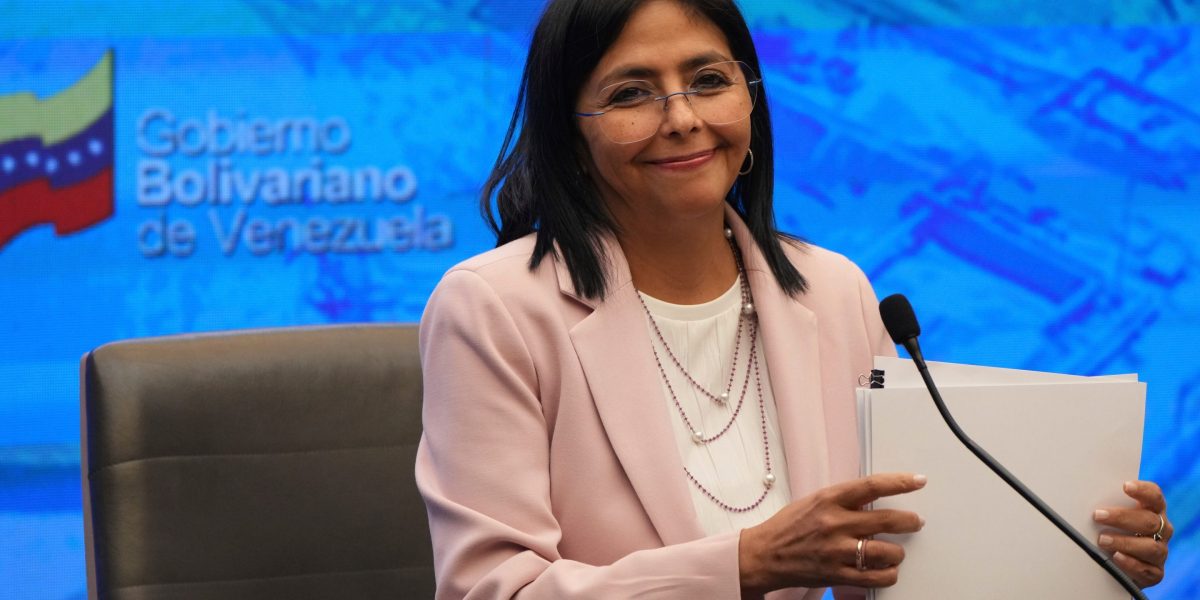
Nearly a decade later, as Venezuela’s interim president, Rodríguez’s message — that Venezuela is open for business — seems to have persuaded Trump. In the days since Maduro’s stunning capture Saturday, he’s alternately praised Rodríguez as a “gracious” American partner while threatening a similar fate as her former boss if she doesn’t keep the ruling party in check and provide the U.S. with “total access” to the country’s vast oil reserves. One thing neither has mentioned is elections, something the constitution mandates must take place within 30 days of the presidency being permanently vacated.

This account of Rodríguez’s political rise is drawn from interviews with 10 former U.S. and Venezuelan officials as well as businessmen from both countries who’ve had extensive dealings with Rodríguez and in some cases have known her since childhood. Most spoke on the condition of anonymity for fear of retaliation from someone who they almost universally described as bookishly smart, sometimes charming but above all a cutthroat operator who doesn’t tolerate dissent. Rodríguez didn’t respond to AP requests for an interview.

Father’s murder hardens leftist outlook

Rodríguez entered the leftist movement started by Hugo Chávez late — and on the coattails of her older brother, Jorge Rodríguez, who as head of the National Assembly swore her in as interim president Monday.

Tragedy during their childhood fed a hardened leftist outlook that would stick with the siblings throughout their lives. In 1976 — when, amid the Cold War, U.S. oil companies, American political spin doctors and Pentagon advisers exerted great influence in Venezuela — a little-known urban guerrilla group kidnapped a Midwestern businessman. Rodriguez’s father, a socialist leader, was picked up for questioning and died in custody.

McClenny remembers Rodríguez bringing up the murder in their meetings and bitterly blaming the U.S. for being left fatherless at the age of 7. The crime would radicalize another leftist of the era: Maduro.

Years later, while Jorge Rodríguez was a top electoral official under Chávez, he secured for his sister a position in the president’s office.

But she advanced slowly at first and clashed with colleagues who viewed her as a haughty know-it-all.

In 2006, on a whirlwind international tour, Chávez booted her from the presidential plane and ordered her to fly home from Moscow on her own, according to two former officials who were on the trip. Chávez was upset because the delegation’s schedule of meetings had fallen apart and that triggered a feud with Rodriguez, who was responsible for the agenda.

“It was painful to watch how Chávez talked about her,” said one of the former officials. “He would never say a bad thing about women but the whole flight home he kept saying she was conceited, arrogant, incompetent.”

Days later, she was fired and never occupied another high-profile role with Chávez.

Political revival and soaring power under Maduro

Years later, in 2013, Maduro revived Rodríguez’s career after Chávez died of cancer and he took over.

A lawyer educated in Britain and France, Rodríguez speaks English and spent large amounts of time in the United States. That gave her an edge in the internal power struggles among Chavismo — the movement started by Chávez, whose many factions include democratic socialists, military hardliners who Chávez led in a 1992 coup attempt and corrupt actors, some with ties to drug trafficking.

Her more worldly outlook, and refined tastes, also made Rodríguez a favorite of the so-called “boligarchs” — a new elite that made fortunes during Chávez’s Bolivarian revolution. One of those insiders, media tycoon Raul Gorrín, worked hand-in-glove with Rodríguez’s back-channel efforts to mend relations with the first Trump administration and helped organize a secret visit by Rep. Pete Sessions, a Texas Republican, to Caracas in April 2018 for a meeting with Maduro. A few months later, U.S. federal prosecutors unsealed the first of two money laundering indictments against Gorrin.

After Maduro promoted Rodríguez to vice president in 2018, she gained control over large swaths of Venezuela’s oil economy. To help manage the petro-state, she brought in foreign advisers with experience in global markets. Among them were two former finance ministers in Ecuador who helped run a dollarized, export-driven economy under fellow leftist Rafael Correa. Another key associate is French lawyer David Syed, who for years has been trying to renegotiate Venezuela’s foreign debt in the face of crippling U.S. sanctions that make it impossible for Wall Street investors to get repaid.

“She sacrificed her personal life for her political career,” said one former friend.

As she amassed more power, she crushed internal rivals. Among them: once powerful Oil Minister Tareck El Aissami, who was jailed in 2024 as part of an anti-corruption crackdown spearheaded by Rodríguez.

In her de-facto role as Venezuela’s chief operating officer, Rodríguez proved a more flexible, trustworthy partner than Maduro. Some have likened her to a sort of Venezuelan Deng Xiaoping — the architect of modern China.

Hans Humes, chief executive of Greylock Capital Management, said that experience will serve her well as she tries to jump-start the economy, unite Chavismo and shield Venezuela from stricter terms dictated by Trump. Imposing an opposition-led government right now, he said, could trigger bloodshed of the sort that ripped apart Iraq after U.S. forces toppled Saddam Hussein and formed a provisional government including many leaders who had been exiled for years.

“We’ve seen how expats who have been outside of the country for too long think things should be the way it was before they left,” said Humes, who has met with Maduro as well as Rodríguez on several occasions. “You need people who know how to work with how things are not how they were.”

Democracy deferred?

Where Rodríguez’s more pragmatic leadership style leaves Venezuela’s democracy is uncertain.

Trump, in remarks after Maduro’s capture, said Nobel Peace Prize winner Maria Corina Machado lacks the “respect” to govern Venezuela despite her handpicked candidate winning what the U.S. and other governments consider a landslide victory in 2024 presidential elections stolen by Maduro.

Elliott Abrams, who served as special envoy to Venezuela during the first Trump administration, said it is impossible for the president to fulfill his goal of banishing criminal gangs, drug traffickers and Middle Eastern terrorists from the Western Hemisphere with the various factions of Chavismo sharing power.

“Nothing that Trump has said suggests his administration is contemplating a quick transition away from Delcy. No one is talking about elections,” said Abrams. “If they think Delcy is running things, they are completely wrong.”


Source link

Continue Reading

Business

Tim Walz insists Minnesota has a role to play in investigating fatal shooting of a U.S. citizen by ICE

Published

on


Minnesota must play a role in investigating the fatal shooting of a Minneapolis woman by an Immigration and Customs Enforcement officer, Gov. Tim Walz insisted Thursday, pushing back against the Trump administration’s decision to keep the investigation solely in federal hands.

A day after the ICE officer shot Renee Good in the head as she tried to drive away on a snowy Minneapolis street, tensions remained high, with dozens of protesters venting their outrage outside of a federal facility that’s serving as a hub for the administration’s latest immigration crackdown on a major city.

“We should be horrified,” protester Shanta Hejmadi said as demonstrators shouted “No More ICE,” “Go Home Nazis,” and other slogans at a line of Border Patrol officers, who responded with tear gas and pepper spray. “We should be saddened that our government is waging war on our citizens. We should get out and say no. What else can we do?”

Homeland Security Secretary Kristi Noem, President Donald Trump and others in his administration characterized the shooting as an act of self-defense and cast Good as a villain, suggesting she used her vehicle as a weapon to attack the officer who shot her.

Vice President JD Vance weighed in Thursday, saying the shooting was justified and that Good, a 37-year-old mother of three, was a “victim of left-wing ideology.”

“I can believe that her death is a tragedy while also recognizing that it is a tragedy of her own making,” Vance said, noting that the officer who killed her was injured while making an arrest last June.

But state and local officials and protesters rejected that characterization, with Minneapolis Mayor Jacob Frey saying video of the shooting shows the self-defense argument to be “garbage.”

An immigration crackdown quickly turns deadly

The shooting happened on the second day of the Trump administration’s immigration crackdown on the Twin Cities of Minneapolis and St. Paul, which the Department of Homeland Security said is the biggest immigration enforcement operation ever. More than 2,000 officers are taking part, and Noem said they have already made more than 1,500 arrests.

It provoked an immediate response in the city where police killed George Floyd in 2020, with hundreds of people turning up to the scene to vent their outrage at the ICE officers and the school district later canceling classes for the rest of the week as a precaution.

Good’s death — at least the fifth tied to an immigration crackdown under Trump — has resonated far beyond Minneapolis, as anti-immigration enforcement protests took place or were expected Thursday in New York City, Seattle, Detroit, Washington, D.C., Los Angeles, Philadelphia, San Antonio, New Orleans and Chicago. Protests were also scheduled for later this week in Arizona, North Carolina, and New Hampshire.

Who will investigate?

On Thursday, the Minnesota agency that investigates officer-involved shootings said it was informed that the FBI and U.S. Justice Department would not work with the department, effectively ending any role for the state to determine if crimes were committed. Noem said the state has no jurisdiction.

“Without complete access to the evidence, witnesses and information collected, we cannot meet the investigative standards that Minnesota law and the public demands,” Drew Evans, the Minnesota Bureau of Criminal Apprehension’s superintendent, said in a statement.

Walz publicly demanded that the state be allowed to take part, repeatedly emphasizing that it would be “very, very difficult for Minnesotans” to accept that an investigation that excludes the state could be fair.

Noem, he said, was “judge, jury and basically executioner” during her public comments defending the officer’s actions.

“People in positions of power have already passed judgment, from the president to the vice president to Kristi Noem — have stood and told you things that are verifiably false, verifiably inaccurate,” said the governor, who repeated his calls for protesters to remain calm.

Mary Moriarty, the prosecutor in Hennepin County, which includes Minneapolis, said her office is exploring whether a state investigation can proceed.

“We want to make sure that there is a check on this administration to ensure that this investigation is done for justice, not for the sake of a cover-up,” Frey, the mayor, told The Associated Press.

Deadly encounter seen from multiple angles

Several bystanders captured footage of Good’s killing, which happened in a residential neighborhood south of downtown.

The videos show an officer approaching an SUV stopped across the middle of the road, demanding the driver open the door and grabbing the handle. The Honda Pilot begins to pull forward, and a different ICE officer standing in front of it pulls his weapon and immediately fires at least two shots at close range, jumping back as the vehicle moves toward him.

It isn’t clear from the videos if the vehicle makes contact with the officer, and there is no indication of whether the woman had interactions with ICE agents earlier. After the shooting the SUV speeds into two cars parked on a curb before crashing to a stop.

In another recording made afterward, an unidentified woman who identifies Good as her spouse is seen crying near the vehicle. She says she and Good recently arrived in Minnesota and that they had a child.

The mayor said he’s working with community leaders to try to keep Minneapolis calm and ensure that residents keep their protests peaceful.

“The top thing that this Trump administration is looking for is an excuse to come in with militarized force, to further occupy our streets, to cause more chaos, to have this kind of civil war on the streets of America in a Democratically run city,” Frey told the AP. “We cannot give them what they want.”

Officer identified in court documents

Noem hasn’t publicly named the officer who shot Good. But a Homeland Security spokesperson said her description of his injuries last summer refers to an incident in Bloomington, Minnesota, in which court documents identify him as Jonathan Ross.

Ross got his arm stuck in the window of a vehicle of a driver who was fleeing arrest on an immigration violation, and was dragged roughly 100 yards (91 meters) before he was knocked free, records show.

He fired his Taser, but the prongs didn’t incapacitate the driver, according to prosecutors. Ross was transported to a hospital, where he received more than 50 stitches.

The driver claimed he didn’t know that Ross was a federal agent. A jury, however, found him guilty of assaulting a federal officer with a dangerous or deadly weapon.

DHS assistant secretary Tricia McLaughlin said the officer involved in the shooting had worked more than 10 years as a deportation officer and had been selected for ICE’s special response team, which includes a 30-hour tryout and additional training. She said those skills include breaching techniques, perimeter control, advanced firearms training and hostage rescue.

McLaughlin declined to confirm the identity of the officer as Ross. The AP wasn’t immediately able to locate a phone number or address for Ross, and ICE no longer has a union that might comment on his behalf.

___

Associated Press reporters Steve Karnowski, Giovanna Dell’Orto and Mark Vancleave in Minneapolis, Ed White in Detroit, Valerie Gonzalez in Brownsville, Texas, Graham Lee Brewer in Norman, Oklahoma, Michael Biesecker In Washington, Jim Mustian in New York and Ryan Foley in Iowa City, Iowa contributed.

This story was originally featured on Fortune.com


Source link

Continue Reading

Business

Vance on woman shot and killed by ICE: ‘a tragedy of her own making’

Published

on


Vice President JD Vance on Thursday blamed a federal immigration officer’s fatal shooting of a Minneapolis woman on “a left-wing network,” Democrats, the news media and the woman who was killed as protests related to her death expanded to cities across the country.

The vice president, who made his critiques in a rare appearance in the White House briefing room and on social media, was the most prominent example yet of the Trump administration quickly assigning culpability for the death of 37-year-old Renee Good while the investigation is still underway. Good was shot and killed by an ICE officer while she tried to drive away on a snowy residential street as officers were carrying out an operation related to the administration’s immigration crackdown.

Vance said at the White House that he wasn’t worried about prejudging the investigation into Good’s killing, saying of the videos he’d seen of the Wednesday incident, “What you see is what you get in this case.”

Vance said he was certain that Good accelerated her car into the officer and hit him. It isn’t clear from the videos if the vehicle makes contact with the officer. Minneapolis Mayor Jacob Frey said Wednesday that video of the shooting shows arguments that the officer was acting in self-defense were “garbage.”

The vice president also said part of him felt “very, very sad” for Good. He called her “brainwashed” and “a victim of left-wing ideology.”

“I can believe that her death is a tragedy, while also recognizing that it’s a tragedy of her own making and a tragedy of the far left who has marshaled an entire movement — a lunatic fringe — against our law enforcement officers,” Vance said.

His defense of the officer, at times fiery, came as Homeland Security Secretary Kristi Noem and President Donald Trump likewise said the officer’s actions were a justified act of self-defense. Trump said Good “viciously ran over” the ICE officer, though video footage of the event contradicts that claim.

Trump has made a wide-ranging crackdown on crime and immigration in Democratic cities a centerpiece of his second term in office. He has deployed federal law enforcement officials and National Guard troops to support the operations and has floated the idea of invoking the Insurrection Act to try to stop his opponents from blocking his plans through the courts.

Trump officials made it clear that they were rejecting claims by Democrats and officials in Minnesota that the president’s move to deploy immigration officers in American cities had been inflammatory and needed to end.

“The Trump administration will redouble our efforts to get the worst of the worst criminal, illegal alien killers, rapists and pedophiles off of American streets,” White House press secretary Karoline Leavitt said Thursday before Vance spoke.

She called Good’s killing “a result of a large, sinister left-wing movement.”

Vance was selected as Trump’s running mate last year partly for his ability to verbally spar, especially with the media. He opened his remarks by condemning headlines he saw about the shooting, at times raising his voice and decrying the “corporate media.”

“This was an attack on law and order. This was an attack on the American people,” Vance said.

He accused journalists of falsely portraying Good as “innocent” and said: “You should be ashamed of yourselves. Every single one of you.”

“The way that the media, by and large, has reported this story has been an absolute disgrace,” he added. “And it puts our law enforcement officers at risk every single day.”

When asked what responsibility he and Trump bore to defuse tension in the country over the incident, Vance said their responsibility was to “protect the people who are enforcing law and protect the country writ large.”

“The best way to turn down the temperature is to tell people to take their concerns about immigration policy to the ballot box,” he said.

Vance also announced that the administration was deputizing a new assistant attorney general to prosecute the abuse of government assistance programs in response to growing attention to fraud in childcare programs in Minnesota.

He said the prosecutor will focus primarily on Minnesota, and will be nominated in coming days. Vance added that Senate Majority Leader John Thune told him he’d seek a prompt confirmation.

___

Associated Press writers Konstantin Toropin, Will Weissert and Jonathan J. Cooper contributed to this report.


Source link

Continue Reading

Business

Nicolas Maduro and Luigi Mangione joined at Brooklyn lock-up by Tekashi 6ix9ine

Published

on


Rapper Tekashi 6ix9ine is joining Venezuela’s president and the man charged with gunning down United Healthcare’s CEO in a notorious federal lockup in New York City.

The embattled 29-year-old artist, whose real name is Daniel Hernandez, reported to the Metropolitan Detention Center in his native Brooklyn on Tuesday to serve out his latest stint behind bars.

He drove up to the gates of the jail in a luxury van with internet personality Adin Ross and a camera crew streaming live as he turned himself in.

The facility is the only federal jail in New York City but is so troubled that some judges have refused to send people there and others have described it as “ hell on earth ” for its poor conditions and constant violence.

It currently houses Venezuelan President Nicolás Maduro and his wife, Cilia Flores, as well as Luigi Mangione, who is accused of killing Brian Thompson, the leader of the country’s biggest health insurer.

Over the years, MDC Brooklyn has housed a constellation of other infamous inmates, including music stars R. Kelly and Sean “Diddy” Combs and longtime Jeffrey Epstein associate Ghislaine Maxwell.

Hernandez’s lawyers didn’t immediately respond to emails seeking comment Tuesday, but have said previously that the rapper looked forward to serving out his sentence so he could resume his music career.

Hernandez admitted last year to assaulting a man and possessing drugs, in violation of the terms of his supervised release in a gang-related case.

He was sentenced in December to serve three more months in federal custody. He was previously slapped with a 45-day sentence in 2024 for breaking the terms of his supervised release.

Hernandez shot to fame with the 2017 release of his song “Gummo,” but the following year he pleaded guilty to his involvement with a violent New York-based gang, the Nine Trey Gangsta Bloods.

He was sentenced to two years in prison in 2019, followed by five years of supervised release for his cooperation in the racketeering case against other gang members.

He was released from federal prison several months early during the height of COVID-19 pandemic in 2020.

Hernandez’s latest sentence is related to small amounts of cocaine and ecstasy found at his Miami home during a police raid. Prosecutors say he also punched a man who taunted him at a Florida mall over his cooperation against gang members.


Source link

Continue Reading

Trending

Copyright © Miami Select.