Connect with us

Business

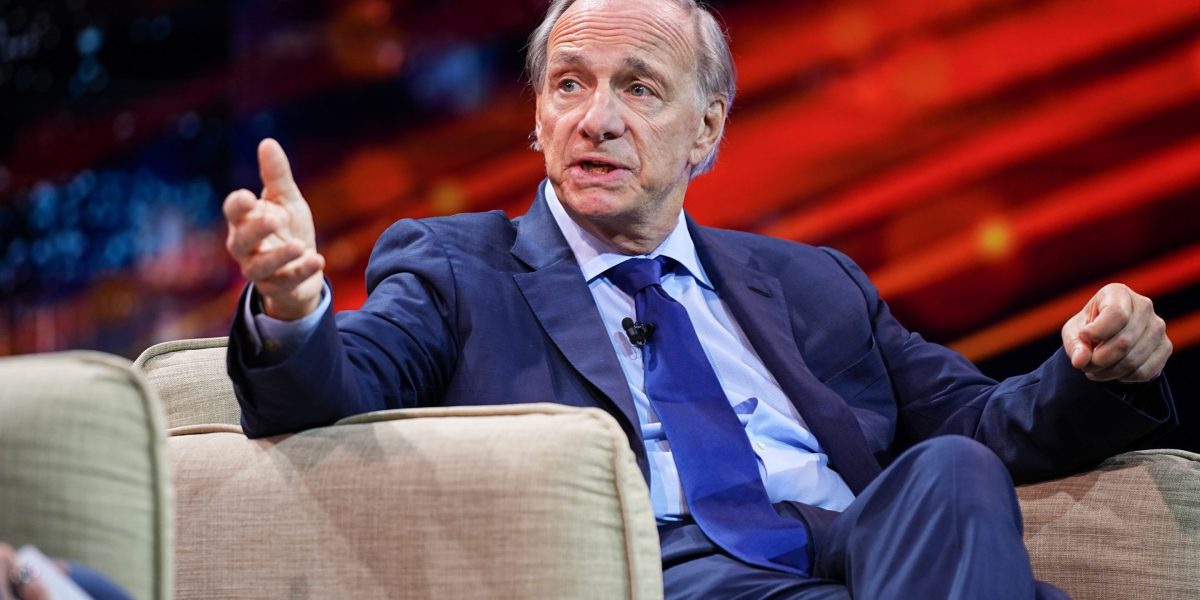
Ray Dalio warns AI is in the early stages of a bubble

Published

on


The artificial intelligence boom is no longer just a growth story, as one of Wall Street’s most prolific investors is sounding the alarm about how the tune could shift in 2026.

U.S. stocks surged last year, with the S&P 500 rising 16%, the third consecutive year of significant gains. Soaring technology stocks fueled much of that rise, powered by ongoing optimism about the future of AI. But this year, investors should brace for the possibility outperforming shares will collide with reality, billionaire hedge fund manager Ray Dalio warned on Monday.

“Obviously the AI boom that is now in the early stages of a bubble had a big effect on everything,” Dalio, founder of Bridgewater Associates, wrote in a 2025 retrospective on X.

While markets eventually posted a strong year, 2025 was not consistently a smooth ride for investors. In addition to market dips generated by the Trump administration’s tariff rollout, stocks were particularly sensitive to any warning signs from the AI camp. In August, the tech-heavy Nasdaq index fell 1.4% in a single morning after OpenAI CEO Sam Altman himself admitted an AI bubble was a possibility, and that investors as a whole might be “overexcited about AI.”

Much of the concern about an AI bubble has been focused on the technology’s rate of adoption, with one MIT study last year finding 95% of generative AI pilots at companies had so far failed to turn a profit. In a November interview with CNBC, Dalio did not deny the potentially transformative effects of AI, but maintained the currently soaring valuations of tech darlings could face a correction before companies figure out how to fully integrate AI. 

In that interview, Dalio claimed he viewed the AI bubble as being at “about 80%” of the euphoria leading up to the 1929 stock market crash or the 2000 dot-com bubble.

In his X post on Monday, Dalio pointed to ongoing questions about the Federal Reserve’s monetary policy stance as big unknowns in 2026. With Fed chair Jerome Powell’s term expiring in May, President Donald Trump has stated his pick for Powell’s successor will be “someone who believes in lower interest rates, by a lot.” Dalio wrote the central bank’s “most likely” dovish stance in 2026 could continue propping up share prices and further inflate the AI bubble.

In his guidance for 2026, Dalio emphasized diversity as key, pointing out how gold ended 2025 as the “best performing major market.” The commodity, widely seen as a safe-haven asset for investors ahead of possible market corrections, posted stellar returns last year, breaking records alongside other precious metals including silver and platinum. Dalio noted how gold outperformed the S&P index by 47% last year, undercutting some of the perceived gains of the U.S. stock market.

Another factor Dalio emphasized was a weakened dollar in 2025. In one of its worst performances in years, the U.S. dollar declined 10% on the back of interest-rate cuts and uncertainty over trade policy. Dalio wrote an underperforming dollar could obscure some underlying weaknesses in markets.

“When one’s own currency goes down, it makes it look like the things measured in it went up. In other words, looking at the investment returns through the lens of a weak currency makes them look stronger than they really are,” he wrote.

Dalio pointed to various overseas stock markets that outperformed the U.S. through this lens, including Europe, China, the U.K. and Japan. Emerging markets posted the strongest returns last year, with the MSCI benchmark index rising 33%, double the S&P 500’s return. This is part of a larger trend of a shifting outlook in global capital, Dalio continued, which is no longer gravitationally bound to the U.S.

“There were big shifts in flows, values, and, in turn, wealth away from the U.S., and what is happening will probably lead to more rebalancing and diversifying,” he wrote.


Source link

Continue Reading

Business

As U.S. debt soars past $38 trillion, corporate bond flood is a growing threat to Treasury supply

Published

on


As the Treasury Department looks to ensure investors continue absorbing the fresh supply of debt it must sell, growing competition from companies issuing their own bonds could send rates higher, according to Apollo Chief Economist Torsten Slok.

In a note on Saturday, he pointed out that Wall Street estimates for the volume of investment grade debt that’s on the way this year reach as high as $2.25 trillion.

That’s as the AI boom increasingly sends companies, including hyperscalers and adjacent firms, to the bond market to fund massive investments in data centers and other infrastructure.

“The significant increase in hyperscaler issuance raises questions about who will be the marginal buyer of IG paper,” Slok said. “Will it come from Treasury purchases and hence put upward pressure on the level of rates? Or might it come from mortgage purchases, putting upward pressure on mortgage spreads?”

With U.S. debt topping $38 trillion, the federal government has already borrowed $601 billion in the first three months of the 2026 fiscal year, which began in October 2025, according to the latest data from the Congressional Budget Office.

That’s $110 billion less than the deficit during the same period a year earlier as tariffs helped revenue outpace spending. But the Supreme Court could strike down President Donald Trump’s global tariffs soon, and this year’s tax season should see a surge of refunds to account for new tax cuts under the One Big Beautiful Bill Act.

Meanwhile, Trump has vowed to boost defense spending to $1.5 trillion a year from $1 trillion, threatening to further deepen federal budget deficits.

And despite the Federal Reserve’s series of rate cuts this past autumn, Treasury yields remain about where they were in early September, suggesting the government will not see much relief on debt-servicing costs that are also contributing to the overall tally of red ink.

“The bottom line is that the volume of fixed-income products coming to market this year is significant and is likely to put upward pressure on rates and credit spreads as we go through 2026,” Slok said.

Apollo

To make sure there’s sufficient demand among bond investors, Treasury yields must remain attractive relative to the competition. Failure to draw enough investors raises the risk of so-called fiscal dominance, or when a central bank must step into to finance widening deficits.

That’s what former Treasury Secretary Janet Yellen warned of last weekend, during a panel hosted by the American Economic Association.

“The preconditions for fiscal dominance are clearly strengthening,” she said, noting debt is on a steep upward trajectory toward 150% of GDP over the next three decades.

At the same time, he holders of U.S. debt have shifted drastically over the past decade, tilting more toward profit-driven private investors and away from foreign governments that are less sensitive to prices.

That threatens to turn the U.S. financial system more fragile in times of market stress, according to Geng Ngarmboonanant, a managing director at JPMorgan and former deputy chief of staff to Yellen during her tenure at Treasury.

Foreign governments accounted for more than 40% of Treasury bond holdings in the early 2010s, up from just over 10% in the mid-1990s, he wrote in a New York Times op-ed last month. This reliable bloc of investors allowed the U.S. to borrow vast sums at artificially low rates.

“Those easy times are over,” he warned. “Foreign governments now make up less than 15% of the overall Treasury market.”


Source link

Continue Reading

Business

ICE shooting that killed Renee Good sets up budget standoff ahead of shutdown deadline

Published

on


The killing of Renee Good by an Immigration and Customs Enforcement agent in Minnesota has sparked a potential funding battle just as the federal government faces another shutdown deadline on Jan. 30.

Democrats in Congress are considering ways to rein in President Donald Trump’s immigration crackdown after the fatal shooting, and legislation to fund the Department of Homeland Security could be one vehicle for it.

Sen. Chris Murphy, the ranking Democrat on the subcommittee that oversees the DHS budget, plans to introduce legislation that would require agents to have warrants for arrests, ban them from wearing masks during enforcement operations, limit the use of guns by ICE during civil actions, and restrict the Border Patrol to the border.

He is trying to gather enough Democrats who will demand guardrails on DHS in exchange for their votes to pass a spending bill for the department, sources told Axios.

“Democrats cannot vote for a DHS budget that doesn’t restrain the growing lawlessness of this agency,” Murphy said in a post on X on Wednesday.

At least one Republican, Sen. Sen. Lisa Murkowski from Alaska, has called for policy changes, saying the shooting in Minnesota “was devastating, and cannot happen again.”

“The videos I’ve seen from Minneapolis yesterday are deeply disturbing,” she said in a statement. “As we mourn this loss of life, we need a thorough and objective investigation into how and why this happened.”

Some Democrats in the House, where Republicans hold a razor-thin majority that has gotten narrower, have also said legislation for DHS appropriations should be used as leverage.

And Rep. Adriano Espaillat, a member of the House Appropriations Committee, suggested at a news conference Friday that Democrats should take an even more aggressive stance.

“I was of the belief that perhaps we could reform ICE. Now I am of the belief that it has to be dismantled as an entity,” he said. “This unaccounted for violence is part of its culture. And so we must dismantle it and build it from the ground up again.”

But after the longest government shutdown ever last fall took a heavy toll on the economy and social services, top Democrats like Senate Minority Leader Chuck Schumer have signaled they want to avoid another one a few months later.

Still, House Speaker Mike Johnson admitted on Friday he’s concerned Democrats’ targeting of immigration enforcement funding could interfere with overall negotiations on government appropriations.

“We should not be limiting funding for Homeland Security at a dangerous time,” Johnson said, according to Politico. “We need officials to allow law enforcement to do their job. Immigration and Customs Enforcement is a critically important function of the government. It is a top concern for Americans, as demonstrated by the last election cycle.”


Source link

Continue Reading

Business

‘That’s fine, I’m not mad at you’: New video of Minnesota shooting shows crucial moments before incident

Published

on


A Minnesota prosecutor on Friday called on the public to share with investigators any recordings and evidence connected to the fatal shooting of Renee Good as a new video emerged showing the final moments of her encounter with an immigration officer.

The Minneapolis killing and a separate shooting in Portland, Oregon, a day later by the Border Patrol have set off protests in multiple cities and denunciations of immigration enforcement tactics by the U.S. government. The Trump administration has defended the officer who shot Good in her car, saying he was protecting himself and fellow agents.

The reaction to the shooting has largely been focused on witness cellphone video of the encounter. A new, 47-second video that was published online by a Minnesota-based conservative news site, Alpha News, and later reposted on social media by the Department of Homeland Security shows the shooting from the perspective of ICE officer Jonathan Ross, who fired the shots.

Sirens blaring in the background, he approaches and circles Good’s vehicle in the middle of the road while apparently filming on his cellphone. At the same time, Good’s wife also was recording the encounter and can be seen walking around the vehicle and approaching the officer. A series of exchanges occurred:

“That’s fine, I’m not mad at you,” Good says as the officer passes by her door. She has one hand on the steering wheel and the other outside the open driver side window.

“U.S. citizen, former f—ing veteran,” says her wife, standing outside the passenger side of the SUV holding up her phone. “You wanna come at us, you wanna come at us, I say go get yourself some lunch, big boy.”

Other officers are approaching the driver’s side of the car at about the same time and one says: “Get out of the car, get out of the f—ing car.” Ross is now at the front driver side of the vehicle. Good reverses briefly, then turns the steering wheel toward the passenger side as she drives ahead and Ross opens fire.

The camera becomes unsteady and points toward the sky and then returns to the street view showing Good’s SUV careening away.

“F—ing b—,” someone at the scene says.

A crashing sound is heard as Good’s vehicle smashes into others parked on the street.

Federal agencies have encouraged officers to document encounters in which people may attempt to interfere with enforcement actions, but policing experts have cautioned that recording on a handheld device can complicate already volatile situations by occupying an officer’s hands and narrowing focus at moments when rapid decision-making is required.

Under an ICE policy directive, officers and agents are expected to activate body-worn cameras at the start of enforcement activities and to record throughout interactions, and footage must be kept for review in serious incidents such as deaths or use-of-force cases. The Department of Homeland Security has not responded to questions about whether the officer who opened fire or any of the others who were on the scene were wearing body cameras.

Homeland Security says video shows self-defense

Vice President JD Vance and Homeland Security spokesperson Tricia McLaughlin said in posts on X that the new video backs their contention that the officer fired in self-defense.

“Many of you have been told this law enforcement officer wasn’t hit by a car, wasn’t being harassed, and murdered an innocent woman,” Vance said. “The reality is that his life was endangered and he fired in self defense.”

Minneapolis Mayor Jacob Frey has said any self-defense argument is “garbage.”

Policing experts said the video didn’t change their thoughts on the use-of-force but did raise additional questions about the officer’s training.

“Now that we can see he’s holding a gun in one hand and a cellphone in the other filming, I want to see the officer training that permits that,” said Geoff Alpert, a criminology professor at the University of South Carolina.

The video demonstrates that the officers didn’t perceive Good to be a threat, said John P. Gross, a professor at the University of Wisconsin Law School who has written extensively about officers shooting at moving vehicles.

“If you are an officer who views this woman as a threat, you don’t have one hand on a cellphone. You don’t walk around this supposed weapon, casually filming,” Gross said.

Ross, 43, is an Iraq War veteran who has served in the Border Patrol and ICE for nearly two decades. He was injured last year when he was dragged by a driver fleeing an immigration arrest.

Attempts to reach Ross at phone numbers and email addresses associated with him were not successful.

Prosecutor asks for video and evidence

Meanwhile, Hennepin County Attorney Mary Moriarty said that although her office has collaborated effectively with the FBI in past cases, she is concerned by the Trump administration’s decision to bar state and local agencies from playing any role in the investigation into Good’s killing.

She also said the officer who shot Good in the head does not have complete legal immunity, as Vance declared.

“We do have jurisdiction to make this decision with what happened in this case,” Moriarty said at a news conference. “It does not matter that it was a federal law enforcement agent.”

Moriarty said her office would post a link for the public to submit footage of the shooting, even though she acknowledged that she wasn’t sure what legal outcome submissions might produce.

Good’s wife, Becca Good, released a statement to Minnesota Public Radio on Friday saying, “kindness radiated out of her.”

“On Wednesday, January 7th, we stopped to support our neighbors. We had whistles. They had guns,” Becca Good said.

“I am now left to raise our son and to continue teaching him, as Renee believed, that there are people building a better world for him,” she wrote.

The reaction to Good’s shooting was immediate in the city where police killed George Floyd in 2020, with hundreds of protesters converging on the shooting scene and the school district canceling classes for the rest of the week as a precaution and offering an online option through Feb. 12.

On Friday, protesters were outside a federal facility serving as a hub for the immigration crackdown that began Tuesday in Minneapolis and St. Paul. That evening, hundreds protested and marched outside two hotels in downtown Minneapolis where immigration enforcement agents were supposed to be staying. Some people were seen breaking or spray painting windows and state law enforcement officers wearing helmets and holding batons ordered the remaining group of fewer than 100 people to leave late Friday.

Shooting in Portland

The Portland shooting happened outside a hospital Thursday. A federal border officer shot and wounded a man and woman in a vehicle, identified by the Department of Homeland Security as Venezuela nationals Luis David Nico Moncada and Yorlenys Betzabeth Zambrano-Contreras. Police said they were in stable condition Friday after surgery, with DHS saying Nico Moncada was taken into FBI custody

DHS defended the actions of its officers in Portland, saying the shooting occurred after the driver with alleged gang ties tried to “weaponize” his vehicle to hit them. It said no officers were injured.

Portland Police Chief Bob Day confirmed that the two people shot had “some nexus” to Tren de Aragua, a Venezuelan gang. Day said they came to the attention of police during an investigation of a July shooting believed to have been carried out by gang members, but they were not identified as suspects.

The chief said any gang affiliation did not necessarily justify the shooting by U.S. Border Patrol. The Oregon Department of Justice said it would investigate.

On Friday evening, hundreds of protesters marched to the ICE building in Portland.

The biggest crackdown yet

The Minneapolis shooting happened on the second day of the immigration crackdown in the Twin Cities, which Homeland Security said is the biggest immigration enforcement operation ever. More than 2,000 officers are taking part and Homeland Security Secretary Kristi Noem said they have made more than 1,500 arrests.

The government is also shifting immigration officers to Minneapolis from sweeps in Louisiana, according to documents obtained by The Associated Press. This represents a pivot, as the Louisiana crackdown that began in December had been expected to last into February.

Good’s death — at least the fifth tied to immigration sweeps since President Donald Trump took office — has resonated far beyond Minneapolis. More protests are planned for this weekend, according to Indivisible, a group formed to resist the Trump administration.

___

Associated Press reporters Steve Karnowski and Mark Vancleave in Minneapolis; Ed White in Detroit; Valerie Gonzalez in Brownsville, Texas; Graham Lee Brewer in Norman, Oklahoma; Michael Biesecker in Washington; Jim Mustian and Safiyah Riddle in New York; Ryan Foley in Iowa City, Iowa; and Hallie Golden in Seattle contributed.

This story was originally featured on Fortune.com


Source link

Continue Reading

Trending

Copyright © Miami Select.