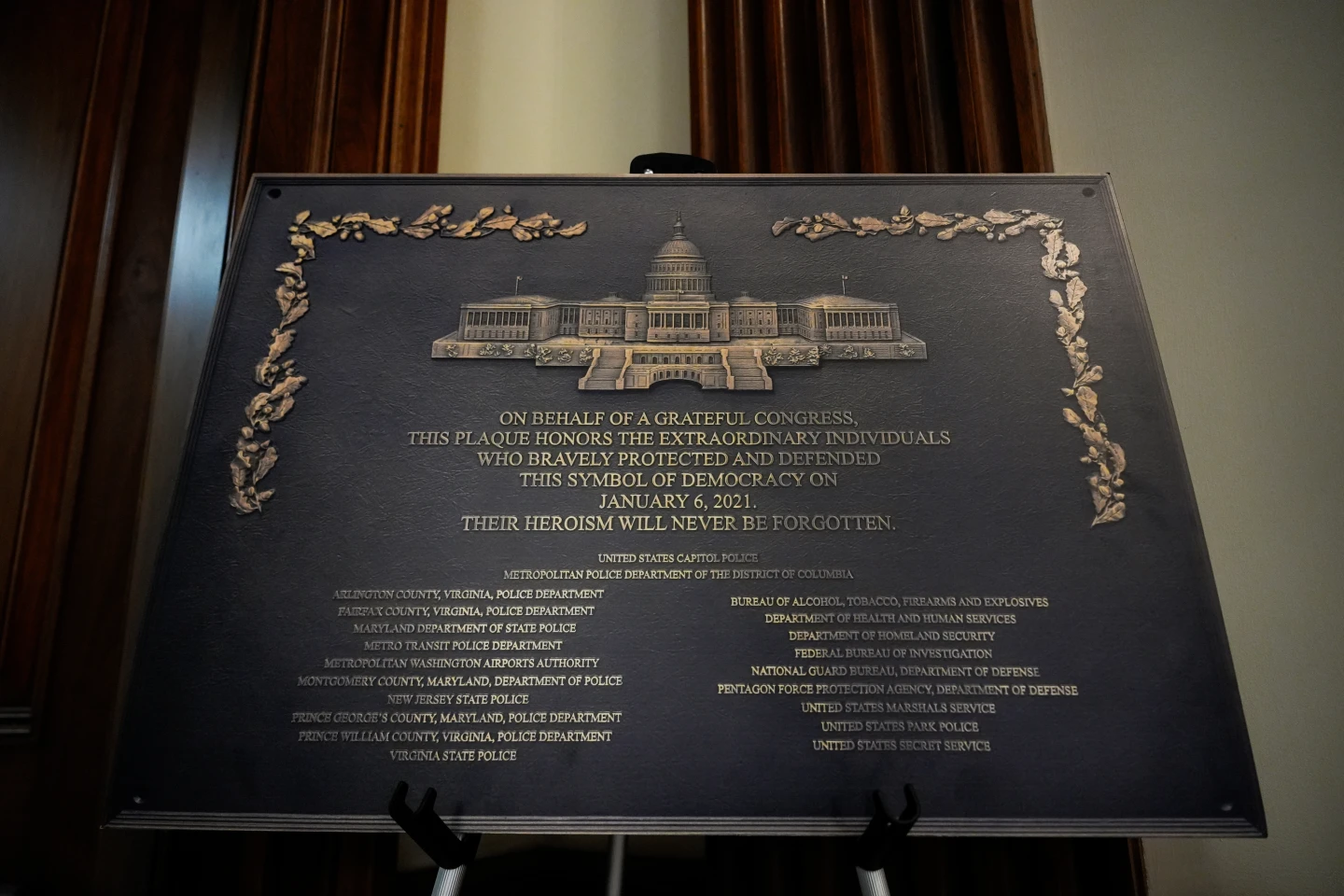
It’s not on display at the Capitol, as is required by law. Its whereabouts aren’t publicly known, though it’s believed to be in storage.
House Speaker Mike Johnson, a Louisiana Republican, has yet to formally unveil the plaque. And the Trump administration’s Department of Justice is seeking to dismiss a police officers’ lawsuit asking that it be displayed as intended. The Architect of the Capitol, which was responsible for obtaining and displaying the plaque, said in light of the federal litigation, it cannot comment.
A replica plaque commemorating the Jan. 6, 2021 Capitol riot hangs outside the office of Speaker Emerita Nancy Pelosi, D-Calif., Tuesday, Dec. 30, 2025, at the Longworth House Office Building on Capitol Hill in Washington. (AP Photo/Julia Demaree Nikhinson)
Determined to preserve the nation’s history, some 100 members of Congress, mostly Democrats, have taken it upon themselves to memorialize the moment. For months, they’ve mounted poster board-style replicas of the Jan. 6 plaque outside their office doors, resulting in a Capitol complex awash with makeshift remembrances.
“On behalf of a grateful Congress, this plaque honors the extraordinary individuals who bravely protected and defended this symbol of democracy on Jan. 6, 2021,” reads the faux bronze stand-in for the real thing. “Their heroism will never be forgotten.”

Jan. 6 void in the Capitol
In Washington, a capital city lined with monuments to the nation’s history, the plaque was intended to become a simple but permanent marker, situated near the Capitol’s west front, where some of the most violent fighting took place as rioters breached the building.
But in its absence, the missing plaque makes way for something else entirely — a culture of forgetting.
Visitors can pass through the Capitol without any formal reminder of what happened that day, when a mob of President Donald Trump’s supporters stormed the building trying to overturn the Republican’s 2020 reelection defeat to Democrat Joe Biden. With memory left unchecked, it allows new narratives to swirl and revised histories to take hold.
Five years ago, the jarring scene watched the world over was declared an “insurrection” by the then-GOP leader of the Senate, while the House GOP leader at the time called it his “saddest day” in Congress. But those condemnations have faded.

A replica plaque commemorating the Jan. 6, 2021 Capitol riot hangs outside the office of Rep. Jamie Raskin, D-Md., Tuesday, Dec. 30, 2025, at the Rayburn House Office Building on Capitol Hill in Washington. (AP Photo/Julia Demaree Nikhinson)
Trump calls ita “day of love.” And Johnson, who was among those lawmakers challenging the 2020 election results, is now the House Speaker.
“The question of January 6 remains – democracy was on the guillotine — how important is that event in the overall sweep of 21st century U.S. history,” said Douglas Brinkley, a professor of history at Rice University and noted scholar.
“Will January 6 be seen as the seminal moment when democracy was in peril?” he asked. Or will it be remembered as “kind of a weird one-off?”
“There’s not as much consensus on that as one would have thought on the fifth anniversary,” he said.
Memories shift but violent legacy lingers
At least five people died in the riot and its aftermath, including Trump supporter Ashli Babbitt, who was fatally shot by police while trying to climb through a window toward the House chamber. More than 140 law enforcement officers were wounded, some gravely, and several died later, some by suicide.
All told, some 1,500 people were charged in the Capitol attack, among the largest federal prosecutions in the nation’s history. When Trump returned to power in January 2025, he pardoned all of them within hours of taking office.
Unlike the twin light beams that commemorated the Sept. 11, 2001, attack or the stand-alone chairs at the Oklahoma City bombing site memorial, the failure to recognize Jan. 6 has left a gap not only in memory but in helping to stitch the country back together.
“That’s why you put up a plaque,” said Rep. Mary Gay Scanlon, a Pennsylvania Democrat. “You respect the memory and the service of the people involved.”
Police sued, DOJ seeks to dismiss
The Speaker’s office said in a statement late Monday the statute authorizing the plaque is “not implementable” and proposed alternatives also “do not comply.” Johnson’s spokesman said if Democrats are serious about commemorating the police, they’re free to work with the appropriate committees to develop a framework for proper vetting and consideration.
Lawmakers approved the plaque in March 2022 as part of a broader government funding package. The resolution said the U.S. “owes its deepest gratitude to those officers,” and it set out instructions for an honorific plaque listing the names of officers “who responded to the violence that occurred.” It gave a one-year deadline for installation at the Capitol.
This summer, two officers who fought the mob that day sued over the delay.
“By refusing to follow the law and honor officers as it is required to do, Congress encourages this rewriting of history,” saidthe claim by officers Harry Dunn and Daniel Hodges. “It suggests that the officers are not worthy of being recognized, because Congress refuses to recognize them.”
The Justice Department is seeking to have the case dismissed. U.S. Attorney Jeanine Pirro and others argued Congress “already has publicly recognized the service of law enforcement personnel” by approving the plaque and displaying it wouldn’t alleviate the problems they claim to face from their work.
“It is implausible,” the Justice Department attorneys wrote, to suggest installation of the plaque “would stop the alleged death threats they claim to have been receiving.”
The department also said the plaque is required to include the names of “all law enforcement officers” involved in the response that day — some 3,600 people.
Makeshift memorials emerge
Lawmakers who’ve installed replicas of the plaque outside their offices said it’s important for the public to know what happened.
“There are new generations of people who are just growing up now who don’t understand how close we came to losing our democracy on Jan 6, 2021,” said Rep. Jamie Raskin, a Maryland Democrat, a member of the Jan. 6 committee, which was opposed by GOP leadership but nevertheless issued a nearly 1,000-page report investigating the run-up to the attack and the attempt to overturn the 2020 election.
A replica plaque commemorating the Jan. 6, 2021 Capitol riot stands outside the office of House Minority Leader Hakeem Jeffries, D-N.Y, Tuesday, Dec. 30, 2025, at the U.S. Capitol in Washington. (AP Photo/Julia Demaree Nikhinson)
Raskin envisions the Capitol one day holding tours around what happened. “People need to study that as an essential part of American history,” he said.
“Think about the dates in American history that we know only by the dates: There’s the 4th of July. There’s December 7th. There’s 9/11. And there’s January 6th,” said Rep. Zoe Lofgren, a California Democrat, who also served on the committee and has a plaque outside her office.
“They really saved my life, and they saved the democracy and they deserve to be thanked for it,” she said.
But as time passes, there are no longer bipartisan memorial services for Jan. 6. On Tuesday, the Democrats will reconvene members from the Jan. 6 committee for a hearing to “examine ongoing threats to free and fair elections,” House Democratic Leader Hakeem Jeffries of New York announced. It’s unlikely Republicans will participate.
The Republicans under Johnson have tapped Rep. Barry Loudermilk of Georgia to stand up their own special committee to uncover what the speaker calls the “full truth” of what happened. They’re planning a hearing this month.
“We should stop this silliness of trying to whitewash history — it’s not going to happen,” said Rep. Joe Morelle, a New York Democrat, who helped lead the effort to display the replica plaques.
“I was here that day so I’ll never forget,” he said. “I think that Americans will not forget what happened.”
The number of makeshift plaques that fill the halls is a testimony to that remembrance, he said.
Instead of one plaque, he said, they’ve “now got 100.”
___
Republished with permission of The Associated Press.
Franz serves as Chief Operating Officer and Southeast regional managing partner at Sorren Inc. He is a member of both the American and Florida Institutes of Certified Public Accountants and previously worked as a CPA at PricewaterhouseCoopers. He earned a bachelor’s degree in accounting from the University of Florida.
Marolf is President, founder and head of school for Wellmont Academy. She also serves as Vice Chair and Treasurer of the Florida Coalition of Christian Private Schools Accreditation. Marolf holds bachelor’s degrees in psychology and music from Houghton College.
Butts is President of SimplyIOA, a division of the Insurance Office of America. He’s a member of the Citizens Property Insurance Corporation Board of Governors and the Florida Association of Insurance Agents, and earned a bachelor’s degree in telecommunications from the University of Florida.
Cole is a lawyer and shareholder at Hill Ward Henderson. She is Chair-elect of the Clearwater Regional Chamber of Commerce, serves on the Morton Plant Mease Hospital Board of Directors, and has previously served on both the Pinellas County and City of Clearwater charter review committees. Cole earned her undergraduate degree from the University of Tennessee and her law degree from Stetson University.
Kidwell is Vice President of Wealth Management at Cyndeo Wealth Partners. His background includes time as an account Vice President at UBS and time as a minor league baseball player and coach within the St. Louis Cardinals organization. He earned a bachelor’s degree in American Studies from Yale University.
All five appointments are subject to confirmation by the Senate. If confirmed, the Trustees will help oversee governance, budgeting and strategic direction for St. Petersburg College.
If you’re tired of questionable additives in your baby’s bottle, good news: Gov. Ron DeSantis and other state leaders are as well.
During a press conference in Bartow, DeSantis and other state leaders condemned toxic filler in formula, introducing members of the Florida MAHA Commission and lauding their efforts to test “staples” like infant formula.
“What we just want is, basically, transparency and the truth, and we want people to be able to make the best decision for them — not necessarily what would be in the best decision of some, you know, manufacturer or something like that,” DeSantis said.
First Lady Casey DeSantis, a survivor of breast cancer and a mother of three, said “small, repeated toxins” can add up to consequences, particularly in what’s being fed to babies.
Baby formula contamination “affects the most vulnerable among us,” she said, noting that Friday’s action is just the first of many “major announcements” regarding toxic additives to food in the coming days and weeks.
Florida’s Department of Health tested 24 formulas for contaminants, with 16 of them having at least one heavy metal that exceeded federal standards, the First Lady said, evidencing “systemic problems” and showing the need for manufacturers to test for “harmful chemicals.”
“Of the 24 infant formulas tested, 16 of those formulas contained at least one, if not more, heavy metals that exceeded federal standards. Mercury was the most common detected above federal benchmarks in 16 formulas. Arsenic exceeded benchmarks in five formulas; cadmium, three; and lead, two.”
The First Lady said this initiative showed Florida’s willingness to help out the U.S. Department of Health and Human Services’ Stork Speed operation, and called on other states to join the effort and be a “force multiplier.”
She also said that families in the Women, Infants, and Children (WIC) program will now have more formula options covered by financial assistance, in the event people want to change, and urged them to check out ExposingFoodToxins.com to find out specifics about given products on the market.
Surgeon General Joseph Ladapo, a father of three himself, noted that many families supplement with, or exclusively use, baby formula for nursing infants, and said neurological development could be harmed by the heavy metals found in formula.
“I wish I could say this was an isolated finding,” Ladapo said.
Lt. Gov. Jay Collins said a “medically-complex child” of his could only take formula, and noted that one of those identified in the state testing was one that his kid used.
Christina Lambert’s bid to become West Palm Beach’s next Mayor has crossed the seven-figure mark, a fundraising pace her campaign says is unmatched in city election history.
The campaign announced it has raised more than $1.02 million in the 12 months since filing last January, combining receipts from Lambert’s official campaign account and the Friends of Christina Lambert political committee. The total makes Lambert the fastest mayoral candidate in West Palm Beach to hit the $1 million milestone, according to her campaign.
Lambert’s campaign account has brought in more than $172,000, fueled by 382 donations from 342 unique contributors. The average contribution was just under $456, with donations ranging from $1 to the $1,000 legal maximum. Campaign officials said 128 donors maxed out, underscoring strong financial backing.
The bulk of her fundraising flowed through the Friends of Christina Lambert political committee, which raised more than $854,000 from 46 donations made by 36 unique donors. Those contributions included support from business leaders, unions, community figures and companies that have recently relocated or expanded in West Palm Beach.
Among the most significant contributions were $50,000 from philanthropists Howard and Wendy Cox of Palm Beach and $25,000 from Rob Posner and his investment services firm, which recently moved operations to the city.
“This campaign is about neighborhoods and the people who call West Palm Beach home,” Lambert said. “Reaching this milestone so early shows that people value local experience and a reflection of the broad coalition we’re building: residents, workers, business owners, faith leaders, and community advocates who believe in a city that works for everyone.
“I’m deeply grateful for the trust people have placed in me, and I’m excited to keep listening, leading, and fighting for every neighborhood in West Palm Beach. Our residents and leaders understand how important West Palm Beach has become to the county and region and want to see strong and steady leadership that is ready to tackle future challenges, while continuing to build on the successes we have accomplished.”
The fundraising haul comes as Lambert continues an early, active campaign for a race that won’t be decided until March 2027. The election will be open because the current Mayor, Keith James, is term-limited.
Since launching her campaign, Lambert has emphasized neighborhood-level engagement, including targeted direct mail, text outreach and community events tied to public safety, growth and quality-of-life issues. She has held listening sessions and conducted citywide community surveys, hosting five meetings across all districts during a Spring and Summer listening tour.
Beyond fundraising, Lambert has also rolled out a long list of early endorsements, including the outgoing Mayor, the local Fraternal Order of Police, the West Palm Beach Firefighters Association, the Service Employees International Union, the Chamber of Commerce of the Palm Beaches and the Democratic Black Caucus, along with more than 500 residents.
She has also assembled several campaign coalitions, including a Women’s Leadership Council comprising 100 local executives and community leaders.
Lambert last won election to the West Palm Beach City Commission in March 2024, securing 72% of the vote in District 5.
So far, the only other candidate to file for Mayor is Palm Beach County Commissioner Gregg Weiss. He first joined the Palm Beach County Commission in 2018 and has a term ending this year.