Connect with us

Business

Down Arrow Button Icon

Published

on


On Jan. 1, Vitalik Buterin announced a New Year’s resolution for the blockchain he devised way back in 2013. It’s time, he declared, for Ethereum to step up and deliver on its original mission: “To build the world computer that serves as a central infrastructure piece of a more free and open internet.” 

Buterin’s message is a timely one. For more than a decade now, Ethereum has offered the tantalizing promise of a global computer, available to anyone, that can be used to create decentralized alternatives to Big Tech’s data-gobbling monopolies. The blockchain popularized smart contracts, and has been a springboard for thousands of projects backed by billions of dollars. It has also spawned legions of mostly fly-by-night imitators.

Despite all of this, the promise of Ethereum always seems just over the horizon. In recent years, the blockchain has come to resemble that can’t-miss sports prospect who can’t quite hack it in the big leagues. Instead of evolving into a popular global computer, Ethereum still feels like a sub-culture where cliques of insiders build esoteric applications for each other. In response, many in the crypto world started betting on other horses like Solana that promised to deliver practical results.

Ethereum’s problem, ironically, has been its idealism. The blockchain has a core community that believes passionately in decentralization, and is mistrustful of anything resembling formal authority. That includes Buterin, who stepped back from his creation several years ago, preferring to let Ethereum find its own path forward.

All of this is admirable, especially in contrast to many recent arrivals on the crypto scene, whose first and only concern is to make a buck. Unfortunately, it has also led Ethereum developers to dither in the face of obvious problems, including congestion and high gas fees. To be fair, the blockchain has made some important fixes—but only after allowing piggy-back chains, known as layer 2s, to siphon off large amounts of revenue and make the crypto landscape painfully complicated.

Now, though, change could be in the air. In the last two years, both BlackRock and JPMorgan Chase have launched tokenized assets that settle directly to the main Ethereum blockchain. This is a testament to how Ethereum remains the gold standard for security and points to a future where it will be the backbone of global finance. The tokenized transactions also legitimize Ethereum’s claim to be a universal computer, and could spur the mainstream adoption of other decentralized applications for social media, identity, and more.

For this to happen, though, the Ethereum community will require Buterin’s ongoing leadership. That’s why his New Year’s Day post is a welcome development. The piece reinforced the primacy of decentralization as Ethereum’s paramount value: “We’re building decentralized applications. Applications that run without fraud, censorship or third-party interference. Applications that pass the walkaway test: they keep running even if the original developers disappear.”

But it also delivered a pragmatic piece of advice to the community seeking to build this decentralized future: Get on with it, already.

Jeff John Roberts
jeff.roberts@fortune.com
@jeffjohnroberts

DECENTRALIZED NEWS

Trump airdrop coming: Yet another Trump token is on the way as Truth Social announced an upcoming drop to its shareholders via Crypto.com. The company added the token will not be transferable and “cannot be exchanged for cash” but could become redeemable for Trump Media discounts. (FT)

Memecoin misery: In a year that saw silver outperform every other asset, Bitcoin notched a 5% decrease in 2025. But the biggest losers of 2026 were memecoins with Dogwifhat down 91%, $TRUMP down 93% and Milei’s $LIBRA down 99%. (WSJ)

Better late than never: The U.S. head of PWC, echoing earlier statements from its Big 4 peers, says the consulting firm decided to “lean in” to crypto in light of the new regulatory environment. The firm is actively providing audits and advice to clients. (FT)

Bitcoin bounces back: The crypto market is off to a strong start in 2026 as Bitcoin climbed over $93,000 and altcoins posted gains even as the economic impact of events in Venezuela remain uncertain. (Bloomberg)

Counting coins: In a key development in corporate accounting, the standard setting body FASB will formally explore whether firms can treat stablecoins as cash equivalents. (WSJ)

MAIN CHARACTER OF THE WEEK

Bitfinex hacker Ilya Lichtenstein is back online.

@cipherstein

Ilya Lichtenstein, the mastermind behind the multi-billion dollar Bitfinex hack, is the latest crypto criminal to walk free. He now faces a fate many would regard as worse than prison—resuming domestic life with his rapper wife Razzlekhan.

MEME O’ THE MOMENT
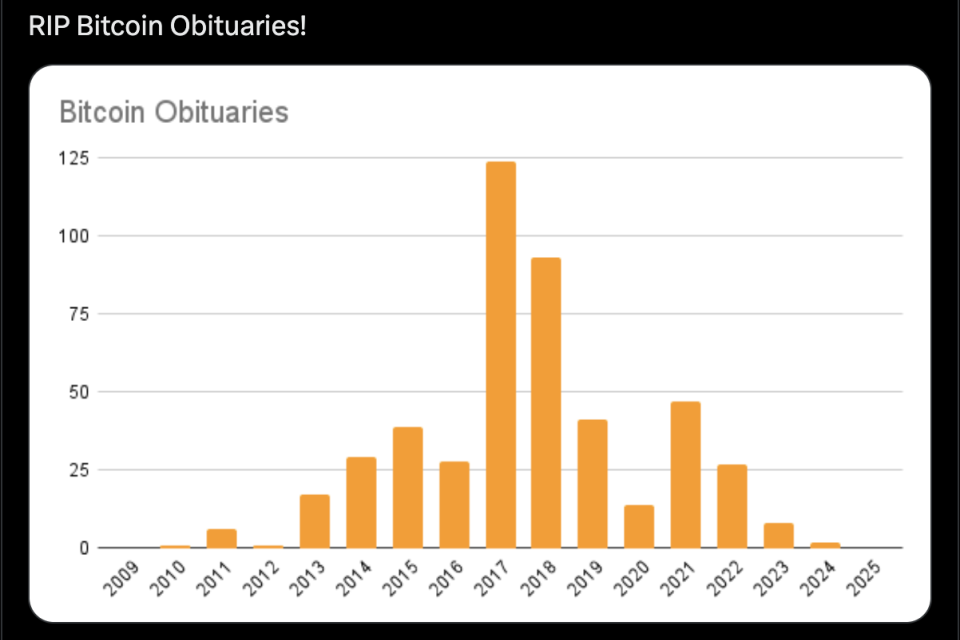
Longtime Bitcoiner Jameson Lopp counted zero “Bitcoin obituaries” for 2025.

@lopp

It was once fashionable for journalists to seize on price slumps in order to write sneering columns predicting Bitcoin’s demise. These “Bitcoin obituaries” persisted well after the currency’s viability became clear, but now appear to have finally faded altogether.


Source link

Continue Reading

Business

Harvard economist Ricardo Hausmann warns against Trump’s profit motive in rebuilding Venezuelan

Published

on


President Donald Trump has assured the people of Venezuela that his undertaking to restore the country’s oil infrastructure will be mutually beneficial to both them and the U.S. 

Ricardo Hausmann, professor of the practice of international political economy at the Harvard Kennedy School, isn’t convinced. 

“There’s a reason why there’s no profit motive in government,” Hausmann told Fortune, referring to the U.S. controlling the Venezuelan oil market. “Profit motive in government is what we call corruption.” 

Trump has unveiled lofty plans to revive Venezuela’s troubled oil industry, just days after U.S. forces captured Venezuelan leader Nicolas Maduro over the weekend. The White House explicitly said Maduro’s arrest—and the U.S.’s subsequent takeover of some of the country’s affairs—was an effort to dominate the Western Hemisphere, invoking the 19th century Monroe Doctrine to justify intervention in Venezuela. Venezuela is home to the world’s largest proven crude oil reserves.

“This is one of the countless good energy deals President Trump has brokered to restore American energy dominance that will benefit the American people, American energy companies, and the Venezuelan people,” White House spokesperson Taylor Rogers told Fortune in a statement.

The president said he will control the country and its oil market for years, reportedly meeting with U.S. oil company executives to discuss Venezuela’ s oil industry. On Tuesday, he announced Venezuela’s interim leadership would provide the U.S. with 30 million to 50 million barrels of oil, the proceeds from which would be sold at market rates, not discounted rates, and distributed to both the U.S. and Venezuela. The proceeds will go into U.S.-controlled bank accounts overseen by Trump, according to the White House.

“We will rebuild it in a very profitable way,” Trump said in an interview with the New York Times on Thursday. “We’re going to be using oil, and we’re going to be taking oil. We’re getting oil prices down, and we’re going to be giving money to Venezuela, which they desperately need.”

Trump’s government capitalism

Trump’s industry interventions and turn to state capitalism have become the hallmark of his second term: In August 2025, the U.S. government secured a 10% stake in Intel, becoming the largest shareholder of the struggling chipmaker. Earlier that month, Nvidia and AMD made a deal with the U.S. government to share 15% of revenue from chip sales to China.

These kinds of large-scale agreements are not only rare, but in the case of Nvidia and AMD, unprecedented and potentially unconstitutional according to some legal experts, as the U.S. Constitution prohibits duties on exports.

Hausmann, who served as the Venezuelan minister of planning from 1992 to 1993, argued Trump’s heavy hand in market affairs is counter to the purpose of government, which is not supposed to make money, but rather provide stability and policy that allow businesses to thrive.

In the case of Venezuela, Hausmann said, Trump’s prioritization of extracting oil for a short-term profit is not just a philosophical misalignment with his vision of government; it’s plain a bad idea.

“Having a policy because you want to make money, you’re going to be dramatically disappointed in any scenario you want to imagine,” Hausmann said. “If you want Venezuela to recover, money is going to go into Venezuela, not out of Venezuela. Venezuela is going to need to attract resources. It’s not [that] resources are going to go away.”

Trump told Fox News’ Sean Hannity this week that oil companies would need to spend at least $100 billion to revive Venezuela’s oil industry.

The state of Venezuelan oil

Hausmann noted that Trump’s strategy of leveraging oil to return Venezuela to economic prosperity is futile without restoring democratic leadership to the country, which can implement credible policy to stabilize the oil industry. 

When Maduro took power in Venezuela in 2013, Venezuelans were about four times wealthier than today; Venezuela was the richest country in South America in 2001. These periods of wealth aligned with higher oil production, which has since atrophied. When Hugo Chavez became president in 1999, Venezuela was producing around 3.5 million barrels of oil daily. Today, that total is around 1 million barrels per day.

Economists and public policy thinkers attribute this precipitous drop to the breakdown of the country’s oil infrastructure following decades of mismanagement, corruption, and U.S. sanctions. Chavez, for example, fired about 10,000 employees of state-owned oil giant Petróleos de Venezuela S.A. (PDVSA) in 2003 for participating in a two-month strike. PDVSA’s revenue would collapse about a decade later.

Analysts said Trump’s proposed solution of giving U.S. oil companies access to Venezuela to repair the infrastructure (and granting the U.S. access to 30% of the world’s oil reserves) is an expensive endeavor costing at least $10 billion annually for several years. Beyond repairing infrastructure, those companies will need to commit to the more-expensive extraction of heavy crude oil that makes up the vast majority of what is found in Venezuela’s Orinoco Belt.

The steep costs of rebuilding the oil industry means U.S. companies are going to need assurance that their investments will be worth it, Miguel Tinker Salas, a professor emeritus of history at Pamona College and author of The Enduring Legacy: Oil, Culture, and Society in Venezuela, told Fortune.

“I don’t think any large U.S. major company is going to want to invest without a series of guarantees, because you’re talking about billions of dollars of investment,” Tinker Salas said. “This is an investment for the long term, not for the short term.”

Hausmann suggested that one way for private oil companies to be lured to Venezuela—particularly when they have easier access to large oil reserves in Guyana and Namibia—is to address why the infrastructure of the industry decayed in the first place.

“These are self-inflicted wounds. If you want to recover oil, you need to go back to rule of law,” he said. “Let’s be very mechanical: You need to change the hydrocarbons law. And to change the hydrocarbons law, you need a congress that people think is legitimate.”

Hausmann’s vision for a Venezuelan future

The hydrocarbon laws to which Hausmann is referring originated in 1943, outlining that foreign oil companies must pay Venezuela 50% of their oil profits, a price companies were willing to pay to have access to the country’s massive reserves.

After PDVSA was established in 1976, foreign oil companies were able to partner with the state-owned giant, but at a steep cost: a 60% equity stake in their joint ventures. Chavez delivered a death knell to the industry decades later, according to Hausmann, seizing and nationalizing the assets of U.S. oil companies like ConocoPhillips and Exxon Mobil, which then left the country. Today, only Chevron, under a special U.S. license, continues to do business in Venezuela.

Venezuelan opposition leader María Corina Machado previously expressed intent to reform these hydrocarbon laws to increase foreign investment by getting rid of ownership restrictions. But Trump seems unlikely to give power to Venezuela’s popular political figures. He said Machado lacked the support necessary to lead the country, despite evidence of widespread backing for her and Edmundo González, who ran against Maduro in the 2024 election. Maduro’s vice president, Delcy Rodríguez, is Venezuela’s interim leader.

Hausmann said U.S. oil companies are aware of the political instabilities within Venezuela, another factor that may inform their decision to not immediately invest in the country. However, the economist also indicated that while Venezuela’s 303 billion barrels of oil in reserves make oil an obvious industry to expand, it’s not all the country has to offer. He suggests that if a democratic leader can come into power, Venezuela can invest more heavily in its other industries, such as tourism and its Caroni River, from which it derives 64% of its hydroelectric capacity.

“Venezuela has become much, much bigger than its oil, and Venezuela has an enormous potential in many other things,” Hausmann said. “You might say that the easiest thing would be oil, but even oil is not that simple.”


Source link

Continue Reading

Business

The 6-7 craze offered a brief window into the hidden world of children. Even more, it showed how much of social life happens online

Published

on


In case you managed to miss it, 6-7 is a slang term – spoken aloud as “six seven” – accompanied by an arm gesture that mimics someone weighing something in their hands.

For the most part, adults responded with mild annoyance and confusion.

But as media scholars who study children’s culture, we didn’t view the meme with bewilderment or exasperation. Instead, we thought back to our own childhoods on three different continents – and all the secret languages we spoke.

There was Pig Latin. The cool “S” doodled on countless worksheets and bathroom stalls. Forming an L-shape with our thumb and index finger to insult someone. Remixing the words of hand-clapping games from previous generations.

6-7 is only the latest example of these long-standing practices – and though the gesture might not mean much to adults, it says a lot about children’s play, their social lives and their desire for power.

You can see this longing for power in classic play like spying on adults and in games like “king of the hill.”

Kids spend much of their days watched and controlled – and will jump at the chance to turn the tables. H. Armstrong Roberts/ClassicStock via Getty Images

A typical school day involves a tight schedule of adult-directed activities; kids have little time or space for agency.

But during those in-between times when children are able to stealthily evade adult surveillance – on playgrounds, on the internet and even when stuck at home during the pandemic – children’s culture can thrive. In these spaces, they can make the rules. They set the terms. And if it confuses adults, all the better.

As 6-7 went viral, teachers complained that random outbursts by their students were interrupting their lessons. Some started avoiding asking any kind of question that might result in an answer of 67. The trend migrated from schools to sports arenas and restaurants: In-N-Out Burger ended up banning the number 67 from their ticket ordering system.

The meaninglessness of 6-7 made it easy to create a sense of inclusion and exclusion – and to annoy adults, who strained to decipher hidden meanings. In the U.S., siblings and friends dressed as the numbers 6-7 for Halloween. And in Australia, it was rumored that houses with 6-7 in their address were going for astronomical prices.

Remixing games and rhymes

Since before World War I, historians have documented children’s use of secret languages like “back slang,” which happens when words are phonetically spoken backwards. And nonsense words and phrases have long proliferated in children’s culture: Recent examples include “booyah,” “skibidi” and “talk to the hand.”

6-7 also coincides with a long history of children revising, adapting and remixing games and rhymes.

For example, in our three countries – the U.S., Australia and South Korea – we’ve encountered endless variations of the game of “tag.” Sometimes the chasers pretend to be the dementors from Harry Potter. Other times the chasers have pretended to be the COVID-19 virus. Or we’ll see them incorporate their immediate surroundings, like designating playground equipment as “home” or “safe.”

Similar games can spread among children around the world. In South Korea, “Mugunghwa kkochi pieotseumnida” – which roughly translates to “The rose of Sharon has bloomed,” a reference to South Korea’s national flower – is similar to the game “Red Light, Green Light” in English-speaking countries. In the game “Hwang-ma!,” South Korean children in the early aughts shouted the word and playfully struck a peer upon seeing a rare, gold-colored car, a game similar to “Punch Buggy” and “Slug Bug” in the U.S. and Australia.

A group of young children play a game in a field on an autumn day.

Variations of ‘Red Light, Green Light’ exist around the world. Jarek Tuszyński/Wikimedia Commons, CC BY-SA

Historically, children have reworked rhymes and clapping games to draw on popular culture of the day. “Georgie Best, Superstar,” sung to the tune of “Jesus Christ Superstar,” was a popular chant on U.K. playgrounds in the 1970s that celebrated the legendary soccer player George Best. And a variation of the clapping game “I went to a Chinese Restaurant” included the lyrics “My name is, Elvis Presley, girls are sexy, Sitting on the back seat, drinking Pepsi.”

Making space for children’s culture

One reason 6-7 became so popular is the low barrier to entry: Saying “6-7” and doing the accompanying hand movement is easy to pick up and translate into different cultural contexts. The simplicity of the meme allowed young Korean children to repeat the phrase in English. And deaf children have participated by signing the meme.

Because the social worlds of children now exist across a range of online spaces, 6-7 has been able to seamlessly spread and evolve. On the gaming platform Roblox, for example, children can create avatars that resemble 6-7 and play games that feature the numbers.

The strange words, nonsensical games and creative play of your childhood might seem ridiculous today. But there’s real value in these hidden worlds.

With or without access to the internet, children will continue to transform language and games to suit their needs – which, yes, includes getting under the skin of adults.

A great deal of attention is given to the omnipresence of digital technologies in children’s lives, but we think it’s worth taking a moment to appreciate the way children are using these technologies to innovate and connect in ways both creative and mundane.

Rebekah Willett, Professor in the Information School, University of Wisconsin-Madison; Amanda Levido, Lecturer, Southern Cross University, and Hyeon-Seon Jeong, Professor of Digital Media Education, Gyeongin National University of Education

This article is republished from The Conversation under a Creative Commons license. Read the original article.

The Conversation


Source link

Continue Reading

Business

How the new protein and dairy diet flies in the face of modernist, according to a nutritionist who served on the advisory board until 2024

Published

on


Every five years, the U.S. government releases an updated set of recommendations on healthy eating. This document, called the Dietary Guidelines for Americans, has served as the cornerstone of nutrition policy for almost half a century.

On Jan. 7, 2026, the Department of Health and Human Services and the Department of Agriculture released the 2025-2030 edition of the guidelines. The updated guidelines recommend that people consume more protein and fat, and less ultraprocessed foods.

These guidelines are the foundation for governmental nutritional programs – for example, they are used to determine which foods are covered by the Supplemental Nutrition Assistance Program, or SNAP, as well as how school lunches are prepared. Eldercare centers and child care centers use them when providing meals, as do clinical nutritionists working with patients to help them achieve a healthy diet. And because the guidelines are so scientifically rigorous, many countries around the world base their own nutritional guidelines on them.

I’m a nutrition scientist specializing in developing interventions for preventing obesity. Between 2022 and 2024 I served on the scientific advisory committee tasked with assessing the best available evidence on a wide range of topics in nutrition in order to inform federal officials in updating the guidelines.

But most of the committee’s recommendations were ignored in developing the latest dietary guidelines.

On the surface, these guidelines share a lot of similarities with the previous version, published in 2020, but they also have a few important differences. In my view, the process followed was different from the norm.

How are the Dietary Guidelines for Americans developed?

For each update, HHS and USDA establish a scientific advisory committee like the one I served on. Members with expertise in different aspects of nutrition are carefully selected and vetted. They then spend two years reviewing the latest scientific studies to assess evidence about specific nutrition-related questions – such as the relationship between saturated fats in foods and cardiovascular disease and what strategies are most effective for weight management.

For each question, the committee first prepares a protocol to answer it, identifies the most rigorous studies and synthesizes its findings, discussing the evidence extensively. It then produces specific recommendations about the topic for the HHS and USDA. At each step, the public and the scientific community are invited to provide comments, which the committee considers.

All this scientific information is put together in a massive report, which the federal agencies then use to create the updated guidelines, translating the expert recommendations for the public and health professionals.

A departure from the norm

The advisory committee I served on functioned as usual – our report was published in December 2024.

But the dietary guidelines released on Jan. 7 were mainly not based on that report. Instead, they were based on a different scientific report that was also published on Jan. 7. That report drew some material from ours but went through a completely different process.

It was created by a group of people who were not vetted in the usual way, and although they repeated some of the same questions we did, they also explored other topics that were chosen with no input from the wider community of nutrition researchers or from the public. It was not based on a publicly available protocol, with no input from the scientific community, and it’s unclear how and to what degree it was peer-reviewed.

The updated dietary guidelines were developed through a different process compared with the established methodology that’s been used to assess nutrition science behind the guidelines for many years.

What’s new in the 2025-2030 guidelines

Many of the recommendations in the 2020 guidelines and the ones released on Jan. 7 are broadly the same: that Americans should consume three servings of vegetables, two servings of fruits and three servings of dairy products per day, as well as replacing refined grains with whole grains, and limiting intake of sugar and sodium.

The main differences relate to recommendations about protein and dairy products.

The 2020 guidelines recommended that Americans focus on protein such as poultry and other lean meats, seafood, eggs, legumes, nuts and seeds. The updated version instead emphasizes eating protein at every meal from different protein sources – not specifically lean ones.

The most recent guidelines also recommend a higher amount of protein – specifically 1.2 to 1.6 grams of protein per kilogram of body weight per day, up from 0.8 grams per kilogram of body weight recommended in the Dietary Reference Intakes for the U.S, the official guidelines for nutrient recommendations. Recommending a higher protein intake goes beyond the mission of the dietary guidelines.

Also, the updated dietary guidelines now recommend full-fat dairy products, rather than low-fat ones as they did previously. But in my view, this recommendation isn’t practical, because it doesn’t raise the level of recommended saturated fat, which remains at 10%. To understand how this would work in practice, I roughly translated these recommendations into a typical menu based on my weight and calorie requirements. These changes would raise my saturated fat consumption well above this limit, so the messages are inconsistent. https://www.youtube.com/embed/zo-f0j1E_jY?wmode=transparent&start=0 The 2025-2030 Dietary Guidelines for Americans recommend more protein and suggest consuming full-fat rather than low-fat dairy – a departure from previous versions.

Naming ultraprocessed foods

Another difference is that the new recommendations specifically call out avoiding ultraprocessed foods. The previous guidelines did not explicitly name ultraprocessed foods but instead recommended consuming nutrient-dense foods, which means foods that have a lot of nutrients while also having relatively few calories. That is, in essence, less processed or whole foods.

Food scientists still lack a solid definition of ultraprocessed foods. Our committee actually spent a long time discussing this, and the Food and Drug Administration is currently working on creating a clear definition of the term that can guide research and policy.

Also, solid research on ultraprocessed foods has been limited. Most studies available for our review took a snapshot of people’s eating habits but didn’t track their effects over a long time or compare groups in randomized controlled trials, the gold-standard research method.

That’s changing, however. The committee did its assessment two years ago, but evidence linking ultraprocessed foods to chronic diseases is getting stronger.

Can Americans trust the science behind the 2025-2030 guidelines?

In my view, some of the changes in the 2025-2030 guidelines, such as limiting ultraprocessed foods, are beneficial. But the problem is that it’s not possible to determine whether the necessary scientific rigor was applied in developing them.

Much of the research on saturated fat consumption is still unsettled and controversial. That’s why it’s important to have a systematic and transparent process for evaluating the research, with input from experts with multiple perspectives who review the entire body of research published about a particular topic.

If you don’t do it properly, you can select the evidence that you prefer. That makes it easy for bias to creep in.

Cristina Palacios, Professor and Chair of Dietetics and Nutrition, Florida International University

This article is republished from The Conversation under a Creative Commons license. Read the original article.


Source link

Continue Reading

Trending

Copyright © Miami Select.